1.1 Introducing Calculus: Can Change Occur at An Instant?

♾️AP Calculus AB/BC Unit 1 Review
1.1 Introducing Calculus: Can Change Occur at An Instant?
♾️ AP Calculus AB/BC
1.1
Introducing Calculus: Can Change Occur at An Instant?
1.2
Defining Limits and Using Limit Notation
1.3
Estimating Limit Values from Graphs
1.4
Estimating Limit Values from Tables
1.5
Determining Limits Using Algebraic Properties of Limits
1.6
Determining Limits Using Algebraic Manipulation
1.7
Selecting Procedures for Determining Limits
1.8
Determining Limits Using the Squeeze Theorem
1.9
Connecting Multiple Representations of Limits
1.10
Exploring Types of Discontinuities
1.11
Defining Continuity at a Point
1.12
Confirming Continuity over an Interval
1.13
Removing Discontinuities
1.14
Connecting Infinite Limits and Vertical Asymptotes
1.15
Connecting Limits at Infinity and Horizontal Asymptotes
1.16
Working with the Intermediate Value Theorem (IVT Calc)
TLDR
Yes, change can happen at an instant. In AP Calculus, you find the rate of change at a single point (the instantaneous rate of change) by looking at average rates of change over smaller and smaller intervals around that point. Limits are the tool that lets you connect those average rates to one exact instant.
Why This Matters for the AP Calculus Exam
This topic sets up how you think about rates of change for the rest of the course. The idea that an instantaneous rate of change comes from average rates of change over shrinking intervals leads directly to the derivative in later units, and it shows up when you interpret motion, growth, and other real-world rates. On the AP Calculus exam, you will see rate-of-change ideas in both multiple-choice questions and free-response questions, often presented as graphs, tables, equations, or word descriptions. Getting comfortable now with the difference between an average rate and an instantaneous rate makes the harder topics later feel natural.
Key Takeaways
- An average rate of change measures change over an interval using , which is the slope of a secant line.
- An instantaneous rate of change measures change at a single point, like the slope of a tangent line at that point.
- You cannot just plug in a single point into the average rate formula, because the change in the input would be zero and division by zero is undefined.
- Limits let you define the instantaneous rate of change by looking at average rates over intervals that shrink toward the point.
- Calculus uses limits to model dynamic change, which is change that does not stay constant across an interval.
Finding the Average Rate of Change
In earlier math classes, slope measured a constant rate of change. In AP Calculus, you start with the same idea but apply it to functions whose rate of change can vary across an interval.
The slope between two points is the change in over the change in :
This gives you the slope of the secant line, which is the average rate of change between two points on the function. If you pick different pairs of points, you get different secant lines with different slopes, because the function changes differently over different intervals.
Each secant line above has its own slope, set by the two endpoints you choose. That is exactly why an average rate of change describes an interval, not a single instant.
From Average Rate to Instantaneous Rate
So how do you find the rate of change at one exact point? You cannot just plug a single point into the average rate formula. If both points are the same, the change in is zero, and dividing by zero is undefined.
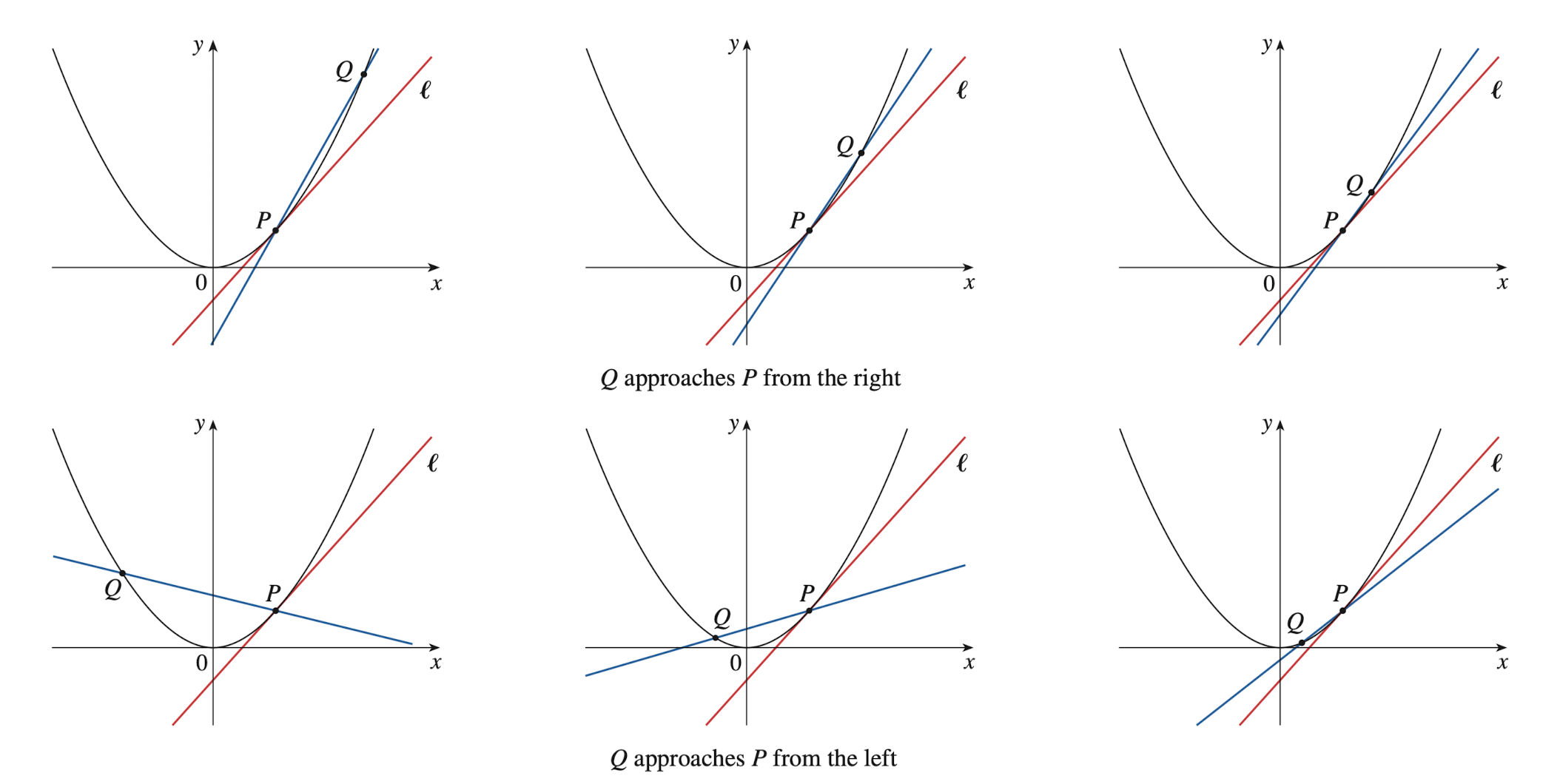
The fix is to keep the point you care about and slide the second point closer and closer to it. As the interval shrinks, the secant line slope gets closer to the slope at that single point, which is the slope of the tangent line. The value that those average rates approach is the instantaneous rate of change.
The tool that makes this precise is the limit. A limit lets you describe the value something approaches as the interval shrinks toward zero, without ever dividing by zero. In notation, a limit looks like this:
This is the central idea of Unit 1: limits connect average rates of change over intervals to a rate of change at one instant. In later units, this same limit idea is used to define the derivative, which is the slope of the tangent line at a point.
So to answer the question "can change occur at an instant?": yes, it can, and limits are how you measure it.
How to Use This on the AP Calculus Exam
MCQ
- Read carefully whether a question asks for an average rate of change (an interval) or an instantaneous rate of change (a single point). They are not the same.
- For an average rate of change, use with the two given endpoints.
- When a question gives a table, you can estimate an instantaneous rate at a point by using a small interval around that point.
Free Response
- Show the setup, not just the answer. Write the rate-of-change expression you are using before you simplify.
- Keep your variables and meaning clear. If a problem is about velocity, label your rate as a velocity with the right units.
- When you interpret a rate in context, say what is changing and how fast, including units, so your meaning is clear.
Common Trap
- Do not confuse the slope of a secant line (average rate over an interval) with the slope of a tangent line (instantaneous rate at a point).
Common Misconceptions
- Misconception: Change cannot happen at a single instant.Actually: It can. The instantaneous rate of change is well defined as the value that average rates approach as the interval shrinks.
- Misconception: Average rate and instantaneous rate are the same thing.Actually: Average rate uses an interval between two points. Instantaneous rate is at one point. They match only in special cases, like a straight line.
- Misconception: You can find an instantaneous rate by plugging one point into .Actually: You cannot, because the change in the input would be zero, making the expression undefined. That is why limits are needed.
- Misconception: A secant line and a tangent line are the same line.Actually: A secant line crosses the curve at two points and gives an average rate. A tangent line touches at one point and gives the instantaneous rate.
- Misconception: Limits are only an abstract idea.Actually: Limits are the practical tool that lets you define and calculate instantaneous rates of change throughout the course.
Related AP Calculus Guides
Practice Questions for 1.1
1 of 10
The graph of the function is shown above.
Which of the following expressions represents the instantaneous rate of change of at its smaller -intercept?
A.
B.
C.
D.
Vocabulary
The following words are mentioned explicitly in the AP® course framework for this topic.Term | Definition |
|---|---|
average rate of change | The change in the value of a function divided by the change in the input over an interval [a, b], calculated as (f(b) - f(a))/(b - a). |
dynamic change | Change that occurs over time or as variables vary, which calculus uses limits to understand and model. |
instantaneous rate of change | The rate at which a function is changing at a specific point, represented by the derivative at that point. |
limit | The value that a function approaches as the input approaches some value, which may or may not equal the function's value at that point. |
rate of change at an instant | The instantaneous rate of change of a function at a specific point, interpreted through the limiting behavior of average rates of change over intervals containing that point. |
Frequently Asked Questions
Can change occur at an instant in AP Calculus?
Yes. AP Calculus defines instantaneous rate of change using limits of average rates of change over intervals that shrink toward a single point.
What is an average rate of change?
Average rate of change measures how much a function changes over an interval. It is calculated with (f(b)-f(a))/(b-a) and represented by the slope of a secant line.
What is an instantaneous rate of change?
Instantaneous rate of change measures how fast a function is changing at one point. It is represented by the slope of the tangent line at that point.
Why do limits matter for instantaneous change?
You cannot use the average rate formula with one point because the denominator would be zero. Limits let you describe what the average rates approach as the interval shrinks.
What is the difference between a secant line and a tangent line?
A secant line uses two points and represents average rate of change over an interval. A tangent line touches at one point and represents instantaneous rate of change.
How is AP Calculus 1.1 tested on the exam?
You may interpret rates from graphs, tables, equations, or word problems. Watch whether the question asks for an average rate over an interval or an instantaneous rate at a point.
See Fiveable more often in Google
Mark Fiveable as a preferred source and Google is more likely to show you our guides in Top Stories, with a "preferred" badge in AI Mode and AI Overviews.