8.10 Volume with Disc Method: Revolving Around Other Axes

♾️AP Calculus AB/BC Unit 8 Review
8.10 Volume with Disc Method: Revolving Around Other Axes
♾️ AP Calculus AB/BC
8.1
Finding the Average Value of a Function on an Interval
8.2
Connecting Position, Velocity, and Acceleration of Functions Using Integrals
8.3
Using Accumulation Functions and Definite Integrals in Applied Contexts
8.4
Finding the Area Between Curves Expressed as Functions of x
8.5
Finding the Area Between Curves Expressed as Functions of y
8.6
Finding the Area Between Curves That Intersect at More Than Two Points
8.7
Volumes with Cross Sections: Squares and Rectangles
8.8
Volumes with Cross Sections: Triangles and Semicircles
8.9
Volume with Disc Method: Revolving Around the x- or y-Axis
8.10
Volume with Disc Method: Revolving Around Other Axes
8.11
Volume with Washer Method: Revolving Around the x- or y-Axis
8.12
Volume with Washer Method: Revolving Around Other Axes
8.13
The Arc Length of a Smooth, Planar Curve and Distance Traveled
The disc method still works when you revolve a region around a line other than the x- or y-axis, like or . The radius becomes the distance from the function to that shifted axis, such as for a horizontal line or for a vertical line . For AP Calculus, define the radius as a distance before squaring it in the volume integral.
Why This Matters for the AP Calculus Exam
Volumes of solids of revolution are a regular part of AP Calculus, and shifting the axis of rotation is a common twist on the standard disc problem. On free-response questions, you are expected to write a correct integral with proper notation before you compute, so being able to set up an expression like matters for clear exam work. These problems test whether you can read a region from a graph, pick the right variable to integrate with respect to, and adjust the radius for an axis that is not at the origin.
Key Takeaways
- The radius is the perpendicular distance from the curve to the axis of rotation, not just the function value.
- For a horizontal axis , integrate with respect to : .
- For a vertical axis , integrate with respect to : .
- Use absolute value when needed so the radius stays positive, and remember the square keeps it positive anyway.
- Find your limits of integration from given values or from where curves intersect each other or the axis.
- Always draw the region and the axis first so you can see the radius clearly.
Revolving Around Other Axes
"Revolving around other axes" means a region spins around a horizontal line like or a vertical line like instead of the x- or y-axis. AP Calculus sticks to horizontal and vertical lines, so you will not see rotation around slanted lines.
If you want a refresher on the standard disc method first, check the 8.9 guide.
The Core Idea
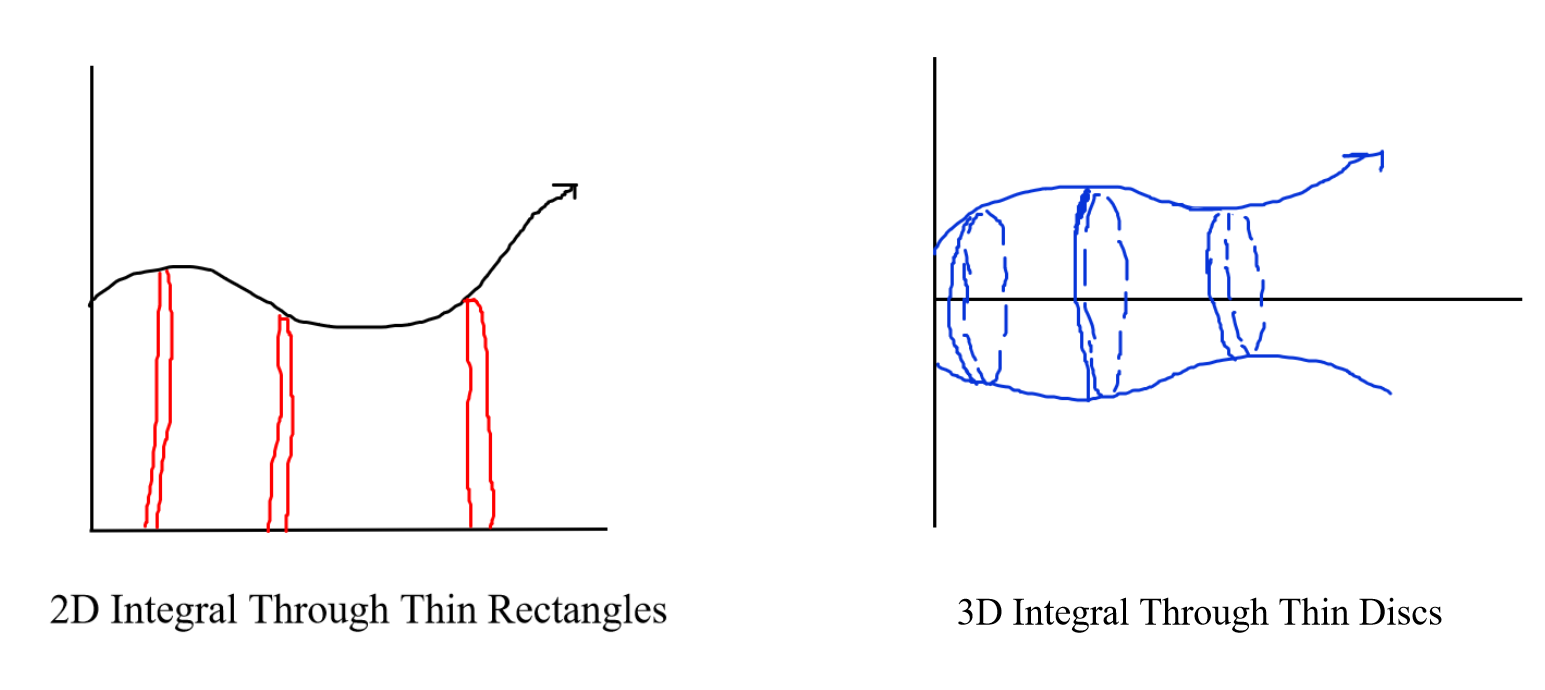
Volume comes from stacking up many thin circular cross sections (discs). Each disc has area , so the volume is the integral of that area over the region:
The only thing that changes when the axis moves is how you find .
Step 1: Pick Your Variable
- Rotate around a horizontal line (like or the x-axis): integrate with respect to .
- Rotate around a vertical line (like or the y-axis): integrate with respect to .
Quick memory hook: horizontal rotation goes with , vertical rotation goes with .
Step 2: Find the Radius
The radius is the distance between the curve and the axis of rotation, not the height of the function by itself. That is the part that changes for a shifted axis.
- Axis (horizontal):
- Axis (vertical):
For example, if you revolve around the line , the radius is . If the curve sits below the axis, subtracting still works as long as you square the result, which keeps the area positive.
Step 3: Set Up the Integral
Combine the radius with :
Use the first form for a horizontal axis and the second for a vertical axis .
Finding the Limits
The bounds and are either given directly in the problem or come from intersection points. To find them algebraically, set , or set , or set the function equal to whatever line the problem names. Graphing the region makes these limits easy to see.
How to Use This on the AP Calculus Exam
Free Response
Write the integral with correct notation before evaluating. A clean setup like
shows your reasoning and is important for clear exam work. Make sure the square is outside the parentheses and that you used the distance to the shifted axis, not just .
Problem Solving
- Sketch the region and the axis of rotation.
- Decide horizontal (use ) or vertical (use ).
- Write the radius as the distance from the curve to the axis.
- Find the limits from given values or intersections.
- Integrate and, if needed, evaluate with a calculator.
Common Trap
Subtracting a negative constant flips to addition. If the axis is and the curve is , then . Forgetting this sign change is one of the most common setup errors.
Practice Problem
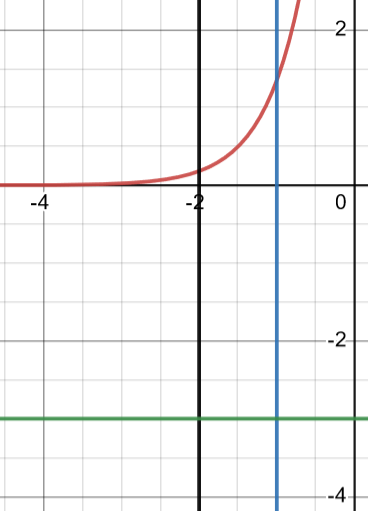
Rotate the region bounded by between and about the line .
Try it, then check the solution below.
Solution
The general form is or . Since we revolve around a horizontal line, use the first form with .
The bounds are given directly: and . Here and the axis is , so . Because we subtract a negative, the radius becomes .
For a refresher on evaluating integrals, see the integration and accumulation guide.
Pull out the constant using :
Expand the square:
Integrate term by term:
If you want to check, take the derivative of the antiderivative and confirm it matches the integrand.
Plug in and and subtract:
which simplifies to
This is about . Don't forget the factor of at the end.
Common Misconceptions
- Misconception: When the axis is shifted, the radius is .Actually: The radius is always the distance from the curve to the axis, so subtract the axis line. For , use , not just .
- Misconception: Horizontal axes pair with and vertical axes pair with .Actually: Horizontal axes pair with and vertical axes pair with . Choosing the wrong one usually means you cannot even set up the integral correctly.
- Misconception: Revolving around gives a radius of .Actually: Subtracting a negative number adds. Revolving around gives a radius of , not .
- Misconception: Only is squared.Actually: The area of a disc is , so the entire expression gets squared, not just .
- Misconception: If the axis passes through the region or the region has a gap from the axis, use solid discs.Actually: If the axis passes through the region or the region has a gap from the axis, you get a hole and need washers instead of solid discs.
- Misconception: Disc areas do not include a factor of .Actually: Every disc area carries a factor of , so keep it through the whole calculation.
Related AP Calculus Guides
- Unit 8 Overview: Applications of Integration
- 8.1 Finding the Average Value of a Function on an Interval
- 8.7 Volumes with Cross Sections: Squares and Rectangles
- 8.2 Connecting Position, Velocity, and Acceleration of Functions Using Integrals
- 8.4 Finding the Area Between Curves Expressed as Functions of x
- 8.3 Using Accumulation Functions and Definite Integrals in Applied Contexts
Practice Questions for 8.10
1 of 10
The graph of is shown above. Let be the region bounded by the graph, the vertical line , and the x-axis.
Which of the following describes a solid whose volume is given by the exact same integral structure as revolving region around the vertical line ?
A.
Revolving the region bounded by , the line , and around the y-axis.
B.
Revolving the region bounded by , the x-axis, the y-axis, and around the x-axis.
C.
Revolving the region bounded by , the x-axis, the y-axis, and around the line .
D.
Revolving the region bounded by , the line , and the y-axis around the y-axis.
Vocabulary
The following words are mentioned explicitly in the AP® course framework for this topic.Term | Definition |
|---|---|
definite integral | The integral of a function over a specific interval [a, b], representing the net signed area between the curve and the x-axis. |
disc method | A technique for finding the volume of a solid of revolution by integrating the cross-sectional areas of circular discs perpendicular to the axis of rotation. |
solids of revolution | Three-dimensional solids formed by rotating a two-dimensional region around an axis. |
Frequently Asked Questions
How do you use the disc method around an axis that is not the x-axis or y-axis?
Use the same disc method, but make the radius the distance from the curve to the shifted axis. For a horizontal axis y = k, the radius is the vertical distance from the curve to y = k. For a vertical axis x = h, the radius is the horizontal distance from the curve to x = h.
What is the disc method formula around y = k?
For a region revolved around a horizontal line y = k, use vertical slices and integrate with respect to x. The setup is volume equals pi times the integral of the radius squared, where the radius is the distance between the function and y = k.
When do I integrate with respect to y for the disc method?
Integrate with respect to y when the axis of rotation is vertical, such as x = 3 or x = -1. Your slices should be perpendicular to the axis, so vertical axes use horizontal slices.
How do I find the radius when revolving around y = -3?
The radius is the distance from the curve to y = -3. If the curve is y = f(x), that distance is f(x) minus negative 3, which becomes f(x) + 3 before you square it in the volume integral.
What is the difference between disc method and washer method?
Use the disc method when the cross section is solid with no hole. Use the washer method when the region leaves a gap around the axis, creating an outer radius and an inner radius. Around shifted axes, the key is still measuring each radius from the axis of rotation.
What is the most common AP Calculus 8.10 mistake?
The most common mistake is using the function value as the radius instead of the distance to the shifted axis. Always draw the axis and measure the perpendicular distance from the axis to the curve or boundary.
See Fiveable more often in Google
Mark Fiveable as a preferred source and Google is more likely to show you our guides in Top Stories, with a "preferred" badge in AI Mode and AI Overviews.