1.12 Confirming Continuity over an Interval

♾️AP Calculus AB/BC Unit 1 Review
1.12 Confirming Continuity over an Interval
♾️ AP Calculus AB/BC
1.1
Introducing Calculus: Can Change Occur at An Instant?
1.2
Defining Limits and Using Limit Notation
1.3
Estimating Limit Values from Graphs
1.4
Estimating Limit Values from Tables
1.5
Determining Limits Using Algebraic Properties of Limits
1.6
Determining Limits Using Algebraic Manipulation
1.7
Selecting Procedures for Determining Limits
1.8
Determining Limits Using the Squeeze Theorem
1.9
Connecting Multiple Representations of Limits
1.10
Exploring Types of Discontinuities
1.11
Defining Continuity at a Point
1.12
Confirming Continuity over an Interval
1.13
Removing Discontinuities
1.14
Connecting Infinite Limits and Vertical Asymptotes
1.15
Connecting Limits at Infinity and Horizontal Asymptotes
1.16
Working with the Intermediate Value Theorem (IVT Calc)
A function is continuous over an interval when it stays continuous at every point inside that interval, with no holes, jumps, or vertical asymptotes. Polynomial, rational, power, exponential, logarithmic, and trigonometric functions are continuous everywhere in their domains, so confirming continuity often comes down to checking domain restrictions and any point where a piecewise function switches rules. For AP Calculus, justify interval continuity by checking the relevant domain and boundary points.
Why This Matters for the AP Calculus Exam
Continuity over an interval ties together limits, function values, and domain analysis, which are all skills you keep using throughout AP Calculus. You need continuity before you can apply major theorems later, including the Intermediate Value Theorem in this unit and ideas about differentiability in Unit 2.
On the exam, you may see continuity questions in both multiple-choice and free-response form. These often ask you to determine where a function is continuous, justify continuity using the definition, or solve for a parameter that makes a piecewise function continuous. Showing each condition clearly is important for clear exam work, since graders want to see that you verified the conditions before stating a conclusion.
Key Takeaways
- A function is continuous on an interval if it is continuous at every point in that interval.
- Polynomial, rational, power, exponential, logarithmic, and trigonometric functions are continuous at all points in their domains.
- Domain restrictions matter most: watch denominators that cannot equal zero and square roots that require nonnegative inputs.
- For piecewise functions, confirm continuity at each boundary where the function changes expressions.
- At a boundary point , you need .
- A vertical asymptote means the function is not continuous on any interval that includes that x-value.
Continuity on an Interval
A function is continuous on an interval if it is continuous at each point in that interval. In practice, this means there are no holes, jumps, or vertical asymptotes anywhere inside the interval. If you can trace the graph across the interval without lifting your pencil, the function is continuous there.
A useful shortcut: polynomial, rational, power, exponential, logarithmic, and trigonometric functions are continuous at all points in their domains. So once you know the domain, you know where the function is continuous. For example, a log function such as is continuous at every point in its domain, which is .
Because these standard functions are continuous wherever they are defined, confirming continuity usually means finding the spots where the function is not defined and checking whether those spots fall inside your interval.
Checking Domain Restrictions
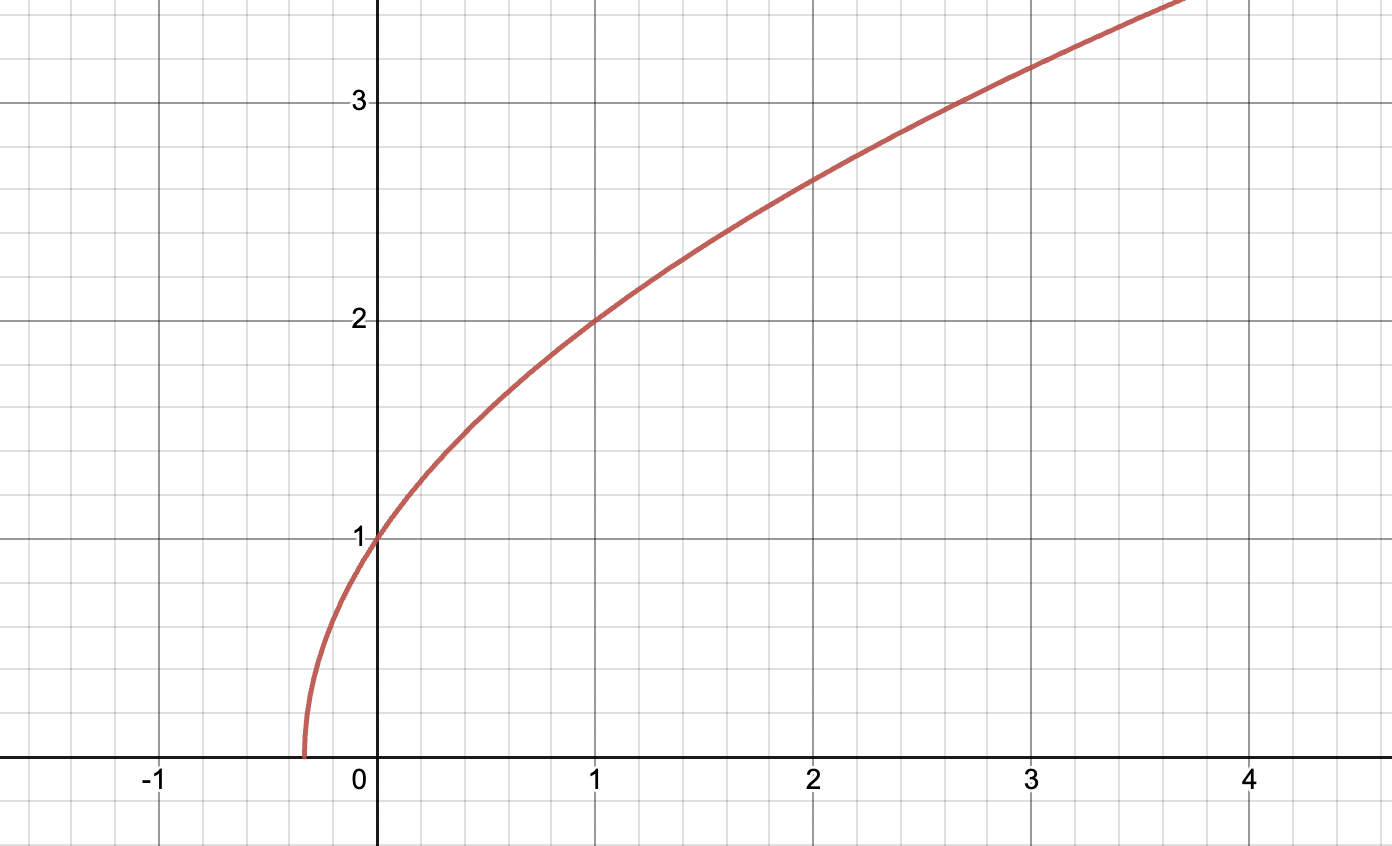
Two common domain restrictions to check are square roots and denominators of rational functions.
For square roots, requires , since you cannot take the square root of a negative number and get a real value.
For example, requires the expression under the radical to be nonnegative, so . The graph has a domain of .
For rational functions, requires , because you cannot divide by zero.
For example, has a denominator that cannot equal zero, so . The domain is , and there is a vertical asymptote at .
Continuity for Piecewise Functions
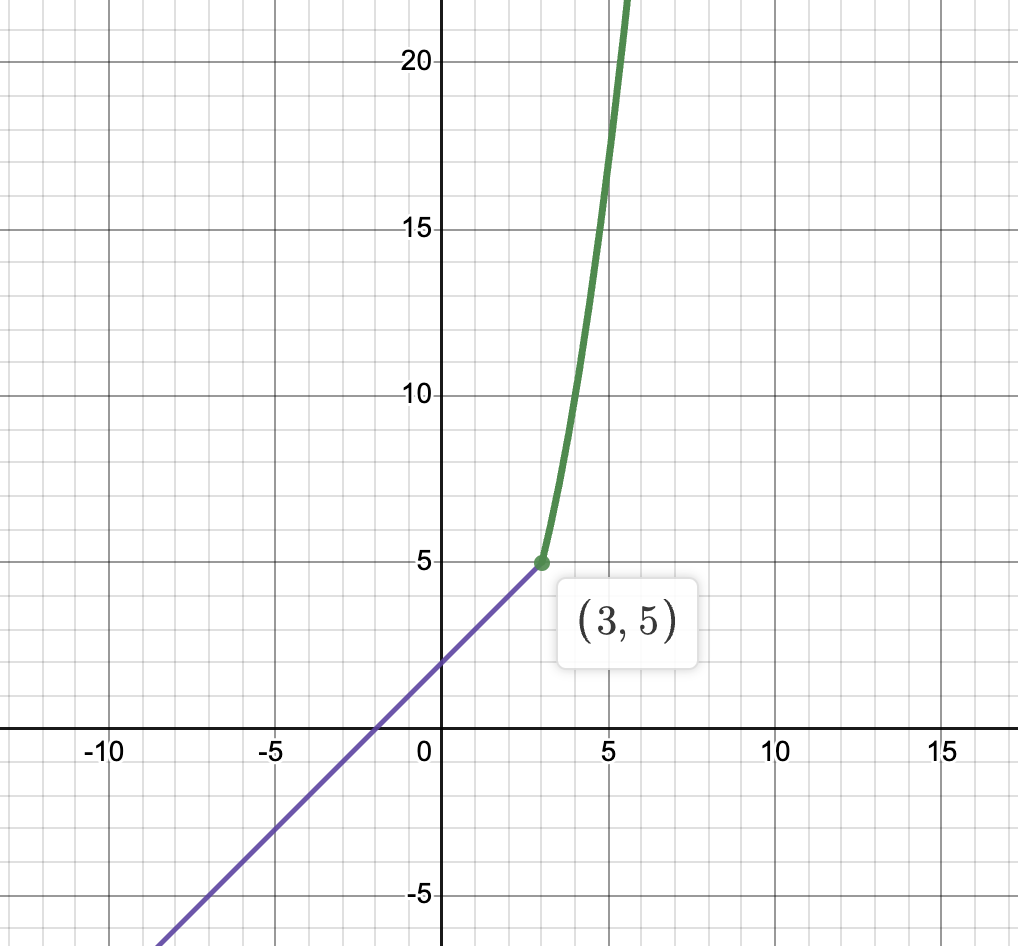
Continuity over an interval is especially important for piecewise functions. A piecewise function uses different equations to define its behavior on different parts of the domain instead of a single equation everywhere.
To confirm continuity, check the domain of each piece, then carefully check the boundary point where the function switches from one expression to another.
To confirm continuity at a boundary point, the left-hand limit, the right-hand limit, and the function value all have to agree:
This is the same point-continuity idea from confirming continuity at a single point, just applied at the spot where the function changes rules.
How to Use This on the AP Calculus Exam
Problem Solving
Work through the same kinds of problems you will see on the exam.
1) Continuity of a Piecewise Function
Determine if the function is continuous on the interval .
Step 1: Check for discontinuities in the domains.
Both expressions are polynomials, so each is continuous throughout its own domain.
Step 2: Check continuity at the boundary point.
The function changes expressions at .
The left-hand limit is .
The right-hand limit is .
The function value is .
Since all three agree, is continuous at .
Step 3: State the conclusion.
Because the pieces are continuous and the boundary checks out, is continuous on the interval .
2) Continuity of a Rational Function
Determine if the function is continuous on the interval .
First, check the domain. This is a rational function, so the denominator cannot equal zero. The domain is , since makes the denominator zero and creates a vertical asymptote.
Because lies inside and is not in the domain, the function is not continuous on .
Common Trap
When you justify continuity, state the conditions before the conclusion. On a piecewise problem, show the left-hand limit, the right-hand limit, and the function value, then conclude. Writing only "it is continuous" without verifying the conditions leaves out the reasoning graders look for.
Common Misconceptions
- Misconception: A function must be defined by one equation to be continuous.Actually: A function does not have to be defined by one equation to be continuous. Piecewise functions can be perfectly continuous as long as the pieces match up at every boundary.
- Misconception: Matching left and right limits is enough on its own for continuity.Actually: Matching left and right limits is not enough on its own. The function value at the point must also equal that shared limit for continuity.
- Misconception: A function that is continuous on its domain is continuous on any chosen interval.Actually: A function can be continuous on its domain and still not be continuous on a chosen interval if that interval includes a point where the function is undefined, such as a vertical asymptote.
- Misconception: A vertical asymptote can be fixed by redefining a single point.Actually: A vertical asymptote is not a removable break. You cannot redefine a single point to fix it, so any interval containing it is not an interval of continuity.
- Misconception: Continuous everywhere in its domain means continuous everywhere.Actually: "Continuous everywhere in its domain" does not mean "continuous everywhere." A rational function skips the x-values where its denominator is zero.
Related AP Calculus Guides
- 1.2 Defining Limits and Using Limit Notation
- 1.1 Introducing Calculus: Can Change Occur at An Instant?
- 1.6 Determining Limits Using Algebraic Manipulation
- 1.3 Estimating Limit Values from Graphs
- 1.5 Determining Limits Using Algebraic Properties of Limits
- 1.8 Determining Limits Using the Squeeze Theorem
Practice Questions for 1.12
1 of 10
The graph of the function , which models the displacement of an oscillating spring, is shown above.
Which of the following scenarios is modeled by a function that shares the same underlying continuity structure as on the interval ?
A.
The total cost of a parking garage that charges $5 for each hour or fraction of an hour.
B.
The temperature of a liquid that cools smoothly over time.
C.
The velocity of a car that instantly crashes into a wall and stops.
D.
The electric field strength of a point charge as the distance from the charge approaches zero.
Vocabulary
The following words are mentioned explicitly in the AP® course framework for this topic.Term | Definition |
|---|---|
continuous | A function that has no breaks, jumps, or holes in its graph over a given interval. |
domain | The set of all input values (x-values) for which a function is defined. |
exponential function | A function of the form f(x) = a^x, where a is a positive constant not equal to 1. |
interval | A connected set of real numbers, typically expressed as a range between two endpoints. |
logarithmic function | A function of the form f(x) = log_a(x), the inverse of an exponential function. |
polynomial function | A function composed of terms with non-negative integer exponents and real coefficients. |
power function | A function of the form f(x) = x^n, where n is a real constant. |
rational function | A function expressed as the ratio of two polynomial functions. |
trigonometric function | Functions such as sine, cosine, and tangent that relate angles to ratios of sides in a right triangle. |
Frequently Asked Questions
What does continuity over an interval mean?
A function is continuous over an interval if it is continuous at every point in that interval. There cannot be holes, jumps, or vertical asymptotes inside the interval.
How do you confirm a function is continuous on an interval?
Check that the function is continuous at every point in the interval. For common function types, this usually means finding the domain and making sure the interval does not include excluded values.
Which functions are continuous on their domains?
Polynomial, rational, power, exponential, logarithmic, and trigonometric functions are continuous at all points in their domains.
How do you check continuity for a piecewise function?
Check each piece on its own domain, then check each boundary point. At a boundary x = a, the left-hand limit, right-hand limit, and f(a) must all be equal.
Can a rational function be continuous on its domain but not on an interval?
Yes. A rational function is continuous on its domain, but if the interval includes a value where the denominator is zero, it is not continuous on that interval.
Why does continuity matter in AP Calculus?
Continuity is needed for major theorems such as the Intermediate Value Theorem and supports later ideas about differentiability. AP questions often ask you to justify continuity before using a theorem.
See Fiveable more often in Google
Mark Fiveable as a preferred source and Google is more likely to show you our guides in Top Stories, with a "preferred" badge in AI Mode and AI Overviews.