Big Idea 3 (SPS) - Spatial Process and Societal Change

🚜AP Human Geography Review
Big Idea 3 (SPS) - Spatial Process and Societal Change
🚜 AP Human Geography
Overview
Big Idea 3 in AP Human Geography is Spatial Process and Societal Change, abbreviated SPS. The official definition: a spatial perspective allows for a focus on the ways phenomena are related to one another in particular places, which in turn allows for the examination of human organization and its environmental consequences. In plain terms, SPS is the "change over time and space" thread of the course. While Big Idea 1 (PSO) asks where things are and Big Idea 2 (IMP) asks how things affect each other, SPS asks how places and societies transform as processes like diffusion, devolution, and agricultural revolution unfold. SPS appears in every one of the seven course units, which is why it shows up constantly on cumulative exam questions.
What This Big Idea Means
SPS is about processes, the verbs of geography. A pattern is a snapshot. A process is the movie that explains how the snapshot got that way and what the next frame will look like. Every SPS topic in the course answers some version of three core questions:
- How does a process unfold across space? Think of a religion diffusing outward from its hearth, or crops spreading through the Columbian Exchange.
- How does that process change society in particular places? Diffusion doesn't just move things around. It produces lingua francas, aging populations, devolved states, and Green Revolution farm economies.
- How does the answer change with scale? SPS is the home of scales of analysis (global, regional, national, and local). Patterns and processes at different scales reveal variations in, and different interpretations of, the same data.
That third question is the secret weapon. SPS trains you to say "at the national scale this looks like X, but at the local scale it looks like Y," which is exactly the kind of reasoning AP graders reward.
Each unit has its own SPS strand. SPS-1 establishes that geographers analyze complex issues with a distinctively spatial perspective. SPS-2 says changes in population have long- and short-term effects on a place's economy, culture, and politics. SPS-3 says cultural ideas, practices, and innovations change or disappear over time. SPS-4 says political, economic, cultural, or technological changes can challenge state sovereignty. SPS-5 says agriculture has changed over time because of cultural diffusion and advances in technology. Notice the shared DNA: change, over time, with spatial consequences.
SPS Across AP Human Geography
SPS spirals through all seven units, getting more complex each time. Here's the thread, unit by unit.
| Unit | How SPS Appears |
|---|---|
| 1: Thinking Geographically | Scales of analysis (1.6) and regional analysis (1.7). Regions as tools for tracking change |
| 2: Population and Migration | Population policies (2.7), women and demographic change (2.8), aging populations (2.9) |
| 3: Cultural Patterns and Processes | Historical causes of diffusion (3.5), contemporary causes (3.6), effects of diffusion (3.8) |
| 4: Political Patterns and Processes | Devolutionary factors (4.8), challenges to sovereignty (4.9), centrifugal and centripetal forces (4.10) |
| 5: Agriculture and Rural Land Use | Agricultural hearths and diffusion (5.3), Second Agricultural Revolution (5.4), Green Revolution (5.5) |
| 6: Cities and Urban Land Use | Challenges of urban changes (6.10) and how growth reshapes city life |
| 7: Industrial and Economic Development | The Industrial Revolution (7.1) and changes resulting from the world economy (7.7) |
Unit 1: The toolkit for analyzing change
Topic 1.6 introduces the four scales of analysis: global, regional, national, and local. Topic 1.7 adds regional analysis, where regions are defined by one or more unifying characteristics or by patterns of activity. The three region types are formal, functional, and perceptual/vernacular, and regional boundaries are transitional, often contested, and overlapping. That last point is pure SPS thinking. Regions aren't fixed containers; they shift as the processes inside them shift. Everything else in the course builds on this toolkit.
Unit 2: Population change rewrites societies
SPS-2 states that changes in population have long- and short-term effects on a place's economy, culture, and politics. Three topics carry the thread. Population policies (2.7) include pronatalist policies that encourage births, antinatalist policies that discourage them, and immigration policies. Women and demographic change (2.8) explains that changing social values and access to education, employment, health care, and contraception have reduced fertility rates in most parts of the world, and that changing roles for women influence fertility, mortality, and migration, as illustrated by Ravenstein's laws of migration. Aging populations (2.9) shows that population aging, determined by birth rates, death rates, and life expectancy, carries political, social, and economic consequences, including a rising dependency ratio. A country with a graying population is living through a spatial process with very real societal change attached.
Unit 3: Culture diffuses, and societies transform
SPS-3 is the clearest statement of the Big Idea: cultural ideas, practices, and innovations change or disappear over time. Historical processes like colonialism, imperialism, and trade shaped today's cultural patterns and produced new forms of cultural expression such as creolization and lingua francas. Contemporary forces work faster. Communication technologies like the internet drive time-space convergence, reshaping and accelerating interactions among people, expanding the use of English, contributing to the loss of indigenous languages, and creating both cultural convergence and divergence. When diffusion lands in a place, the effects include acculturation, assimilation, syncretism, and multiculturalism. If an FRQ asks how diffusion changes the cultural landscape, those four terms are your answer bank.
Unit 4: Change challenges sovereignty
SPS-4 says political, economic, cultural, or technological changes can challenge state sovereignty. Devolution is the headline process. Factors that lead to it include division of groups by physical geography, ethnic separatism, ethnic cleansing, terrorism, economic and social problems, and irredentism. Devolution shows up as autonomous regions and subnational political-territorial units within states like Spain, Belgium, Canada, and Nigeria, or as outright disintegration, as in Sudan and the former Soviet Union. Pressure also comes from above: supranational organizations including the UN, NATO, the EU, ASEAN, the Arctic Council, and the African Union can challenge sovereignty by limiting the economic or political actions of member states. Advances in communication technology have facilitated devolution, supranationalism, and democratization all at once. The consequences sort into centrifugal forces (failed states, uneven development, stateless nations, ethnic nationalist movements) and centripetal forces (more equitable infrastructure development and increased cultural cohesion).
Unit 5: Agricultural revolutions remake the world
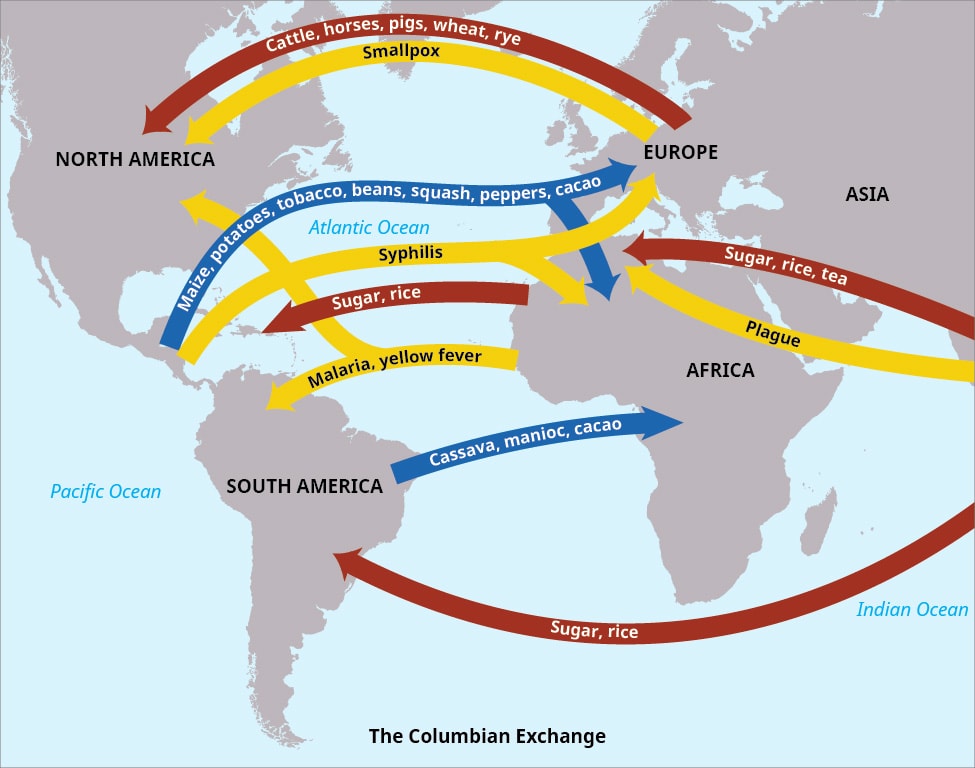
SPS-5 says agriculture has changed over time because of cultural diffusion and advances in technology. The story starts at the hearths: early domestication of plants and animals arose in the Fertile Crescent, the Indus River Valley, Southeast Asia, and Central America. Diffusion patterns like the Columbian Exchange spread plants and animals globally. Then come the revolutions. The Second Agricultural Revolution's new technology and increased food production led to better diets, longer life expectancies, and more people available for factory work, which connects directly to Unit 7's Industrial Revolution. The Green Revolution brought high-yield seeds, increased chemical use, and mechanized farming, with both positive and negative consequences for human populations and the environment. "Positive and negative consequences" is a phrase to memorize, because FRQs love asking for both sides of the Green Revolution.
Unit 6: Cities change, and change creates challenges
In Unit 6, the SPS thread runs through Topic 6.10, Challenges of Urban Changes. Cities are where every earlier SPS process piles up: migration streams from Unit 2, cultural diffusion from Unit 3, and economic shifts from Unit 7 all reshape urban neighborhoods over time. Growth and decline both create problems, and analyzing how a city's landscape reflects those changes is a classic SPS task.
Unit 7: Economic development as societal change
Unit 7 closes the loop. The Industrial Revolution (7.1) is the ultimate example of a spatial process driving societal change, pulling the workers freed up by the Second Agricultural Revolution into factories and cities. The unit then traces how trade and the world economy (7.6) and the changes that result from it (7.7) continue transforming places at different rates, ending with sustainable development (7.8) as a response to those changes.
Key Concepts and Vocabulary
These SPS terms appear across multiple units. For full definitions and more, check the AP Human Geography key terms glossary.
| Term | What It Means |
|---|---|
| Scales of analysis | Global, regional, national, and local levels at which data can be examined; patterns differ by scale |
| Formal region | Region defined by one or more shared characteristics |
| Functional region | Region organized around a node or pattern of activity |
| Perceptual/vernacular region | Region defined by people's perceptions, like "the South" |
| Pronatalist policy | Government policy encouraging population growth |
| Antinatalist policy | Government policy discouraging births |
| Dependency ratio | Measure of the non-working population relative to the working-age population |
| Ravenstein's laws of migration | Generalizations about who migrates, how far, and why |
| Creolization | Blending of cultures into a new cultural form |
| Lingua franca | Common language used between speakers of different native languages |
| Time-space convergence | Communication technology shrinking the "distance" between places |
| Acculturation | Adopting traits of another culture while keeping much of your own |
| Assimilation | Fully adopting a new culture, losing original traits |
| Syncretism | Fusion of cultural or religious practices into something new |
| Devolution | Transfer of power from a central government to subnational regions |
| Irredentism | Movement to reclaim territory based on ethnic or historical ties |
| Supranationalism | States joining organizations (UN, EU, NATO, ASEAN) that limit some sovereignty |
| Centrifugal/centripetal forces | Forces that divide a state versus forces that unify it |
| Columbian Exchange | Global transfer of plants, animals, and diseases after 1492 |
| Green Revolution | High-yield seeds, chemicals, and mechanized farming spreading to developing regions |
How This Big Idea Shows Up on the Exam
SPS questions are process questions. Pattern questions ask "what does this map show?" SPS questions ask "what process produced this, and what changes will follow?" Three reliable moves:
First, watch for scale. SPS-1 is tied directly to the skill of identifying scales of analysis in maps, data, images, and landscapes. When a question shows national-level data, ask yourself whether the local-scale story might differ, because patterns and processes at different scales reveal different interpretations of data. Saying so explicitly is often how you earn points on scale-based FRQ parts.
Second, lead with the process, then name the consequence. A strong SPS answer follows the formula "process X caused change Y in place Z." For example: the Green Revolution (process) increased crop yields but also increased chemical use (consequences) in countries that adopted high-yield seeds (place). Vague answers that name a pattern without explaining how it came about tend to miss explanation points.
Third, expect SPS to bridge units. Because the Big Idea spirals through all seven units, cumulative questions love connections like "Second Agricultural Revolution frees workers, who fuel the Industrial Revolution, which drives urbanization." If you can narrate that chain, you're thinking the way the exam wants. The other two threads work the same way, so reviewing PSO and IMP alongside SPS gives you all three lenses for any prompt.
Practice and Next Steps
Test the thread with questions that force you to explain processes across units. Work through guided multiple-choice practice and flag every question that mentions diffusion, devolution, a revolution, or a policy. Those are SPS questions in disguise. Then write a few responses in FRQ practice with instant scoring and check whether your answers name a process, a place, and a consequence. Browse the FRQ question bank for prompts on the Green Revolution, devolution, and aging populations, since those SPS topics recur often. When you're ready to see how all three Big Ideas mix together, take a full-length practice exam and review every miss by asking which Big Idea the question was really testing.
Frequently Asked Questions
What is Big Idea 3 (SPS) in AP Human Geography?
SPS stands for Spatial Process and Societal Change. The official definition says a spatial perspective focuses on how phenomena are related in particular places, allowing examination of human organization and its environmental consequences. In practice, it's the thread covering how processes like diffusion, devolution, and agricultural revolutions transform societies over time, and it appears in all seven course units.
What's the difference between SPS, PSO, and IMP in AP Human Geography?
PSO (Patterns and Spatial Organization) asks where things are and why they're arranged that way. IMP (Impacts and Interactions) covers cause-and-effect relationships among people and environments. SPS (Spatial Process and Societal Change) focuses on how processes unfold over time and space to change societies. All three spiral through every unit; see Big Idea 1 (PSO) for the pattern-focused thread.
What are the four scales of analysis in AP Human Geography?
The four scales of analysis are global, regional, national, and local. They're introduced in Topic 1.6 and belong to the SPS thread. The key idea: the same data can tell different stories at different scales, so a national average can hide big local variations. Pointing this out explicitly is a common way to earn points on scale-based FRQ parts.
What are examples of SPS topics on the AP Human Geography exam?
SPS covers population policies and aging populations (Unit 2), causes and effects of cultural diffusion like creolization and assimilation (Unit 3), devolution and supranationalism (Unit 4), and the Second Agricultural Revolution and Green Revolution (Unit 5). Exam questions on these topics usually ask you to explain a process and its consequences, so practice that structure with FRQ practice.
What is devolution in AP Human Geography?
Devolution is the transfer of power from a central government to subnational regions, and it's a core SPS-4 concept. It happens when states fragment into autonomous regions, as in Spain, Belgium, Canada, and Nigeria, or disintegrate entirely, as in Sudan and the former Soviet Union. Causes include ethnic separatism, irredentism, physical geography dividing groups, terrorism, and economic and social problems.
See Fiveable more often in Google
Mark Fiveable as a preferred source and Google is more likely to show you our guides in Top Stories, with a "preferred" badge in AI Mode and AI Overviews.