Big Idea 1 (PSO) - Patterns and Spatial Organization

🚜AP Human Geography Review
Big Idea 1 (PSO) - Patterns and Spatial Organization
🚜 AP Human Geography
Overview
Big Idea 1 in AP Human Geography is Patterns and Spatial Organization (PSO), the thread that explains how the spatial patterns and organization of human society are arranged according to political, historical, cultural, and economic factors. In plain terms, PSO is the "why of where." Why do people cluster in some places and spread out in others? Why do farms, cities, languages, and borders sit where they sit? PSO shows up in every single unit of the course, Units 1 through 7, which makes it one of the highest-leverage ideas you can build fluency with before the AP exam. If you can describe a spatial pattern and then explain the factors that created it, you are doing PSO, and you are doing exactly what the exam asks of you over and over.
What This Big Idea Means
PSO says that nothing in human geography is randomly placed. The locations of people, farms, factories, cities, religions, and political boundaries all follow patterns, and those patterns exist because of identifiable political, historical, cultural, and economic forces.
That breaks down into a few core questions that the whole course keeps circling back to:
- Where are things located, and in what arrangement? Geographers describe patterns using concepts like clustering, dispersal, density, and distribution. A map of world population is not a random scatter; it is a pattern you can describe.
- Why are they located there? This is the explanation step. Population clusters near rivers and coasts for physical reasons (climate, landforms, water) and human reasons (culture, economics, history, politics). Borders sit where colonialism, war, and independence movements put them.
- How is space organized? Humans actively arrange space. Cities zone land into rings and sectors, farmers arrange crops by distance from market, and states divide territory into provinces and voting districts. Spatial organization is the structure humans impose on space.
- How does the pattern change with scale? A pattern that looks one way globally (population concentrated in South and East Asia) looks completely different locally (population concentrated in one river valley within a country). The factors that explain a distribution vary according to the scale of analysis.
One more thing to keep straight: PSO is one of three Big Ideas in AP Human Geography. PSO focuses on describing and explaining patterns. Big Idea 2 (IMP), Impacts and Interactions, focuses on cause-and-effect relationships between people and environments. Big Idea 3 (SPS), Spatial Process and Societal Change, focuses on using a spatial perspective to analyze how phenomena relate to each other in particular places. They overlap constantly, but PSO is the "describe the pattern, explain the arrangement" thread.
PSO Across AP Human Geography
PSO spirals through all seven units. Each unit hands you a new category of human activity (population, culture, politics, agriculture, cities, economies) and asks the same PSO questions: what is the pattern, and what political, historical, cultural, and economic factors organized it that way?
| Unit | How PSO Appears |
|---|---|
| 1: Thinking Geographically | The spatial concepts toolkit: location, place, flows, distance decay, time-space compression, pattern (Topic 1.4) |
| 2: Population and Migration | Where and how people live shapes global cultural, political, and economic patterns (distribution, density, composition) |
| 3: Cultural Patterns and Processes | Cultural practices vary across locations because of physical geography and available resources (landscapes, regions) |
| 4: Political Patterns and Processes | The political organization of space results from historical and current processes, events, and ideas (states, boundaries, territoriality) |
| 5: Agriculture and Rural Land Use | Resource availability and cultural practices shape agricultural land-use patterns (von Thünen, settlement patterns, survey methods) |
| 6: Cities and Urban Land Use | The size, distribution, and internal structure of cities follow describable spatial patterns and models |
| 7: Industrial and Economic Development | Economic sectors, industry, and development are unevenly distributed across the world in patterns you can map and explain |
Unit 1: The PSO Toolkit
Unit 1 gives you the vocabulary you will use to describe patterns for the rest of the course. Topic 1.4 (Spatial Concepts) is the PSO core here: absolute and relative location, space, place, flows, distance decay, time-space compression, and pattern. You also learn that maps themselves reveal patterns like clustering, dispersal, and elevation, and that every map projection distorts shape, area, distance, or direction in some way. Topic 1.5 adds the nature-society concepts (sustainability, natural resources, land use) and the shift in geographic thinking from environmental determinism to possibilism. Everything after Unit 1 is just applying this toolkit to new content.
Unit 2: Population Patterns
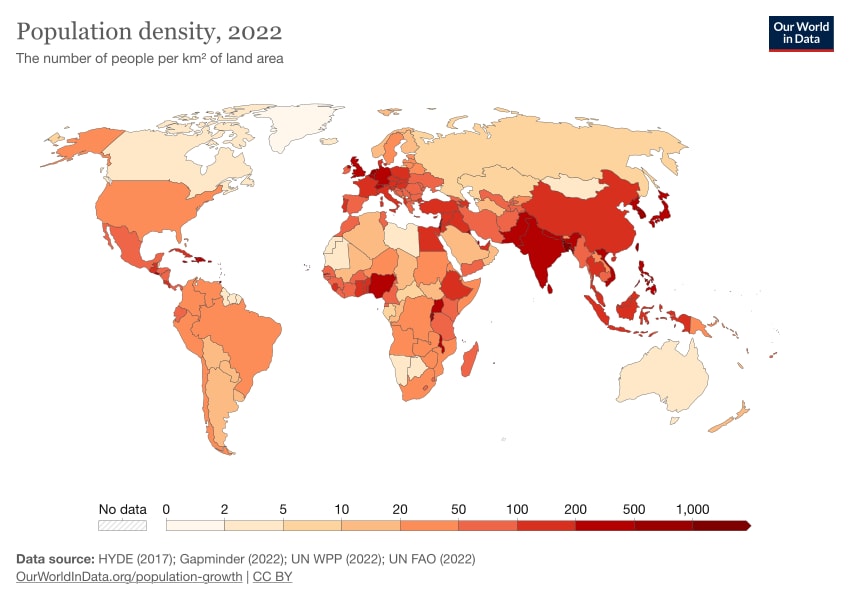
Unit 2 is PSO applied to people. Understanding where and how people live is essential to understanding global cultural, political, and economic patterns. Physical factors (climate, landforms, water bodies) and human factors (culture, economics, history, politics) influence population distribution, and the factors that explain a distribution change with the scale of analysis. The three density measures, arithmetic, physiological, and agricultural, each reveal something different about the pressure a population puts on the land. Population composition is spatial too: age structure and sex ratio patterns vary across regions and can be mapped at different scales, and population pyramids let geographers assess growth or decline and predict markets for goods and services. Distribution and density then affect political, economic, and social processes, including how services like medical care get provided, and they affect the environment through carrying capacity.
Unit 3: Cultural Patterns
Unit 3 asks why cultural practices vary across geographical locations, and the answer runs through physical geography and available resources. The cultural landscape is the visible PSO evidence: physical features, agricultural and industrial practices, religious and linguistic characteristics, sequent occupancy, traditional and postmodern architecture, and land-use patterns all written onto the land. Regional patterns of language, religion, and ethnicity contribute to a sense of place, enhance placemaking, and shape the global cultural landscape. Attitudes toward ethnicity and gender, ethnic neighborhoods, and indigenous communities all help shape how a society uses space. And language, ethnicity, and religion can act as centripetal forces (uniting) or centrifugal forces (dividing), a concept that sets up Unit 4.
Unit 4: Political Patterns
Unit 4 is PSO applied to power. The political organization of space results from historical and current processes, events, and ideas. Independent states are the primary building blocks of the world political map, but the full pattern includes nations, nation-states, stateless nations, multinational states, multistate nations, and autonomous and semiautonomous regions such as American Indian reservations. History organized this map: colonialism, imperialism, independence movements, and devolution along national lines shaped contemporary boundaries. Political power is expressed geographically as control over people, land, and resources, illustrated by neocolonialism, shatterbelts, and choke points. Territoriality, the connection of people, their culture, and their economic systems to the land, is the PSO concept that explains why borders carry such emotional and political weight. Devolutionary movements in places like Scotland, Northern Ireland, and Spain show the political map actively reorganizing.
Unit 5: Agricultural Patterns
Unit 5 might be the most PSO-heavy unit in the course. Availability of resources and cultural practices influence agricultural practices and land-use patterns. Climate sorts farming into regions: Mediterranean and tropical climates support different practices, intensive farming includes market gardening, plantation agriculture, and mixed crop/livestock systems, while extensive farming includes shifting cultivation, nomadic herding, and ranching. Rural settlement patterns are classified as clustered, dispersed, or linear, and survey methods (metes and bounds, township and range, long lot) literally draw spatial organization onto the landscape. The von Thünen model is the unit's signature PSO tool: it explains rural land use through transportation costs and distance from the market, producing concentric rings of land use, even though specialty farming regions do not always conform to the rings. Bid-rent theory explains why land costs help determine whether farming is intensive or extensive, and complex commodity chains now link production and consumption in a global system of agriculture.
Unit 6: Urban Patterns
Unit 6 applies PSO at two scales. At the global and national scale, you study the size and distribution of cities (Topic 6.4), including where cities form and how urban systems are organized. At the local scale, you study the internal structure of cities (Topic 6.5) plus density and land use (Topic 6.6), which means urban models that explain why downtowns, residential zones, and industrial areas arrange themselves in predictable patterns. The unit's title says it directly: Cities and Urban Land-Use Patterns and Processes.
Unit 7: Economic Patterns
Unit 7 closes the course with the spatial patterns of industry and development. Topics like Economic Sectors and Patterns (7.2), Measures of Development (7.3), and Theories of Development (7.5) all ask you to map and explain why manufacturing, services, wealth, and development are distributed unevenly across the world, and how trade and the world economy reorganize those patterns over time.
Key Concepts and Vocabulary
These are the PSO terms you should be able to define and apply. For the full course glossary, check the AP Human Geography key terms list.
| Term | What It Means |
|---|---|
| Pattern | The arrangement of phenomena across space (clustered, dispersed, linear, random) |
| Absolute vs. relative location | Exact coordinates vs. location described in relation to other places |
| Space and place | Space is the physical gap between things; place is a location with meaning |
| Flows | Movement of people, goods, ideas, and information between places |
| Distance decay | Interaction between places decreases as distance increases |
| Time-space compression | Technology shrinks the "felt" distance between places |
| Clustering and dispersal | Phenomena packed together vs. spread out |
| Arithmetic, physiological, agricultural density | Three density measures; each reveals different pressure on the land |
| Carrying capacity | How population distribution and density strain the environment and resources |
| Population pyramid | Age-sex graph used to assess growth or decline and predict markets |
| Cultural landscape | The visible imprint of culture on the land, including sequent occupancy |
| Sense of place / placemaking | How regional patterns of language, religion, and ethnicity make places distinct |
| Centripetal and centrifugal forces | Forces that unify or divide a state or society |
| Territoriality | The connection of people, culture, and economic systems to land |
| Sovereignty and nation-state | Self-rule over territory; a state whose borders match a nation |
| Shatterbelt and choke point | Geographic expressions of political power over land and resources |
| Settlement patterns | Clustered, dispersed, or linear rural arrangements |
| Survey methods | Metes and bounds, township and range, long lot |
| Von Thünen model | Concentric rings of rural land use based on transportation cost to market |
| Bid-rent theory | Land cost falls with distance from the center, shaping land-use intensity |
How This Big Idea Shows Up on the Exam
PSO is the Big Idea behind every "describe the spatial pattern" and "explain why it's located there" question, and those are everywhere on the AP Human Geography exam. Because PSO spirals through all seven units, it appears across both multiple-choice and free-response questions, usually attached to a stimulus like a map, chart, satellite image, or photograph.
Here is the move the exam wants, broken into two steps:
- Describe the pattern. Use precise spatial vocabulary. "Population is clustered along the coast" beats "people live near the water." Words like clustered, dispersed, linear, dense, sparse, and concentrated are doing real work in a rubric.
- Explain the pattern with factors. Then connect the pattern to political, historical, cultural, or economic causes. Why is population clustered there? Climate, landforms, water access, colonial history, economic opportunity. The explanation is where points live.
A few PSO-specific strategies:
- Always check the scale. The factors that explain a pattern vary with the scale of analysis, and patterns at different scales reveal different interpretations of data. If an FRQ shifts from a global map to a national one, your explanation should shift too. Saying "at the local scale" or "at the global scale" explicitly is a habit worth building.
- Know the models as pattern-explainers. Von Thünen, bid-rent, the demographic transition model, and the urban structure models are all tools for explaining spatial relationships in a specified context or region. The exam loves asking you to apply a model to a new place, and also to explain a model's limits (specialty farming regions don't always fit von Thünen's rings, for example).
- Use map skills deliberately. Identifying types of data on maps and describing the spatial patterns they show are tested skills. Remember that all maps are selective and every projection distorts shape, area, distance, or direction somewhere.
- Cross-unit connections earn synthesis. PSO links units naturally: population distribution (Unit 2) explains where cultural regions form (Unit 3), which explains where centrifugal forces threaten states (Unit 4). FRQs that pull from multiple units reward you for seeing these threads.
You can drill exactly these skills with stimulus-based practice questions and get instant scoring feedback on written responses with FRQ practice.
Practice and Next Steps
Start by quizzing yourself on the table above: for each unit, name one spatial pattern and the factors that organized it. If you can do that from memory, PSO is in good shape.
Then put the skill under exam conditions:
- Work through AP Human Geography guided practice and pay attention to every question with a map or data stimulus. Those are PSO questions in disguise.
- Write a full response in the FRQ practice tool and check whether you actually described the pattern before explaining it. Skipping the description step is the most common PSO point lost.
- Browse released FRQs and highlight every prompt verb like "describe the spatial pattern" or "explain the degree to which." Practice answering just the first sentence of each.
- When you are ready for the cumulative test, take a full-length practice exam and review the other two Big Ideas, IMP and SPS, so you can tell the three threads apart on sight.
Frequently Asked Questions
What is Big Idea 1 (PSO) in AP Human Geography?
PSO stands for Patterns and Spatial Organization, the idea that the spatial patterns and organization of human society are arranged according to political, historical, cultural, and economic factors. It's the 'why of where': describing where things are located and explaining the forces that put them there. PSO appears in every unit of the course, from population distribution to political boundaries to von Thünen's agricultural rings.
What are the three Big Ideas in AP Human Geography?
The three Big Ideas are PSO (Patterns and Spatial Organization), IMP (Impacts and Interactions), and SPS (Spatial Process and Societal Change). All three spiral through every one of the seven course units. PSO covers describing and explaining spatial patterns, IMP covers cause-and-effect relationships between people and environments, and SPS covers using a spatial perspective to analyze relationships among phenomena in particular places.
What is the difference between PSO and SPS in AP Human Geography?
PSO (Patterns and Spatial Organization) is about describing spatial patterns and explaining the political, historical, cultural, and economic factors that arrange them, like why population clusters where it does. SPS (Spatial Process and Societal Change) is about applying a spatial perspective to examine how phenomena relate to one another in particular places and how human organization changes over time. They overlap a lot; a quick test is that PSO asks 'what's the arrangement and why,' while SPS focuses on processes and change.
How does PSO show up on the AP Human Geography exam?
PSO drives every question that asks you to describe a spatial pattern from a map or data source and then explain why it exists, which shows up across both multiple-choice and FRQs. The winning two-step is to describe the pattern with precise terms (clustered, dispersed, linear) and then explain it using political, historical, cultural, or economic factors, noting the scale of analysis. You can practice this skill with Fiveable's FRQ practice tool and get instant scoring feedback.
Which units in AP Human Geography cover Patterns and Spatial Organization?
All seven units cover PSO; the College Board intentionally spirals it through the entire course. It anchors spatial concepts in Unit 1, population distribution in Unit 2, cultural landscapes in Unit 3, political boundaries and territoriality in Unit 4, agricultural land use and von Thünen in Unit 5, city size and internal structure in Unit 6, and economic development patterns in Unit 7.
See Fiveable more often in Google
Mark Fiveable as a preferred source and Google is more likely to show you our guides in Top Stories, with a "preferred" badge in AI Mode and AI Overviews.