7.8 Sustainable Development

🚜AP Human Geography Unit 7 Review
7.8 Sustainable Development
🚜 AP Human Geography
TLDR
Sustainable development means meeting today's needs without using up resources that future generations will need. In AP Human Geography, this topic focuses on how policies, ecotourism, and the UN's Sustainable Development Goals try to fix environmental problems caused by industrialization while still supporting economic growth.
Sustainable Development Summary
Sustainable development is development that balances economic growth, environmental protection, and social well-being over time. For AP Human Geography, the key idea is that industrialization creates problems like resource depletion, pollution, mass consumption, and climate change, and sustainable development strategies try to reduce those problems without stopping development altogether.
The most testable examples are ecotourism and the UN Sustainable Development Goals. Strong exam answers explain what each strategy is supposed to do, then evaluate its limits at local, regional, or global scales.
Why This Matters for the AP Human Geography Exam
This is the final topic of the course, and it pulls together ideas from population, agriculture, cities, and economic development. You should be ready to explain how sustainable development strategies respond to problems like resource depletion, pollution, and climate change at different scales.
A common skill here is evaluating how well a concept or strategy actually works across local, regional, and global scales. So you might be asked to explain the strengths and limits of approaches like ecotourism or the Sustainable Development Goals, not just define them. Multiple-choice questions may use maps, charts, or data on energy use or development indicators, and free-response prompts may ask you to connect sustainability to industrialization and uneven development.
Key Takeaways
- Sustainable development tries to meet present needs without limiting future generations, balancing economic, social, and environmental concerns.
- Sustainable development policies target natural-resource depletion, mass consumption, pollution, and climate change.
- Ecotourism is nature-based tourism that can protect threatened environments while creating jobs for local communities, but only if it is carefully managed.
- The UN's Sustainable Development Goals provide a framework for measuring progress, including small-scale finance and public transportation projects.
- Be ready to evaluate how effective these strategies are across local, regional, and global scales, not just describe them.
Sustainable Development Basics
Sustainable development is the use of natural resources in a way that meets the needs of the present without compromising the ability of future generations to meet their own needs. It balances three pillars: economic, social, and environmental concerns.
Sustainable development policies try to remedy problems that come from industrialization, including:
- Natural-resource depletion
- Mass consumption
- The effects of pollution
- The impact of climate change
Several ideas often guide these policies. You do not need to memorize them as a required AP list, but they help you explain how sustainability works as an approach:
- Intergenerational equity: the needs of future generations should count when we make decisions about resources today.
- The precautionary principle: when there is a risk of serious or irreversible harm, a lack of full scientific certainty should not delay action to prevent that harm.
- The polluter pays principle: those who create pollution should cover the costs of cleaning it up or preventing it.
- Common but differentiated responsibilities: countries at different levels of development carry different responsibilities for global environmental problems.
Common strategies include using resources more efficiently, shifting toward renewable energy, promoting sustainable agriculture, protecting biodiversity and habitats, and improving access to basic services.
Renewable Energy
Renewable energy comes from sources that nature replaces on a human timescale, such as sunlight, wind, water, and geothermal heat. Unlike fossil fuels, these sources are not used up when you tap them.
Common types of renewable energy include:
- Solar: generated from sunlight using photovoltaic cells or concentrated solar power.
- Wind: generated when turbines convert moving air into electricity.
- Hydroelectric: generated when moving water turns turbines.
- Geothermal: generated using heat from inside the Earth.
- Biomass: generated from organic matter such as wood, crops, and animal waste.
Renewable energy connects to sustainability because it reduces greenhouse gas emissions and pollution, and it can lower a country's dependence on imported fossil fuels. The cost of some technologies, especially solar and wind, has dropped a lot in recent years, making them more competitive. Renewable energy use is also one of the development measures used to compare countries, so it links back to earlier topics in this unit.
Ecotourism
Ecotourism is tourism based in natural environments, often ones threatened by industrialization or development. When it is managed well, it helps protect the environment while providing jobs for local people. That mix of conservation and local income is exactly why it shows up as a sustainable development strategy.
Ecotourism is built on conservation, education, and sustainability. Activities often include wildlife watching, birdwatching, hiking, and visits that support local cultures. It can take place in national parks, protected areas, coastal and marine zones, and rural or Indigenous communities.
Possible benefits of ecotourism:
- Environmental: encourages conservation and protects biodiversity and habitats.
- Economic: creates jobs and income for local communities.
- Cultural: supports cultural exchange and helps preserve local traditions.
- Educational: builds awareness of environments and cultures.
The catch is management. To stay sustainable, ecotourism may need limits on visitor numbers, low-impact transportation, and support for local conservation projects. Without those limits, too many visitors can damage the same environment the tourism was supposed to protect. This is a good example of why evaluating effectiveness matters: ecotourism can help, but its success depends on how it is run.
Examples of ecotourism settings include national parks like Serengeti National Park in Tanzania or Galapagos National Park in Ecuador, marine areas like the Great Barrier Reef in Australia, and rural or Indigenous communities near the Amazon rainforest. Treat these as examples that illustrate the concept, not required AP content.
Sustainable Development Goals
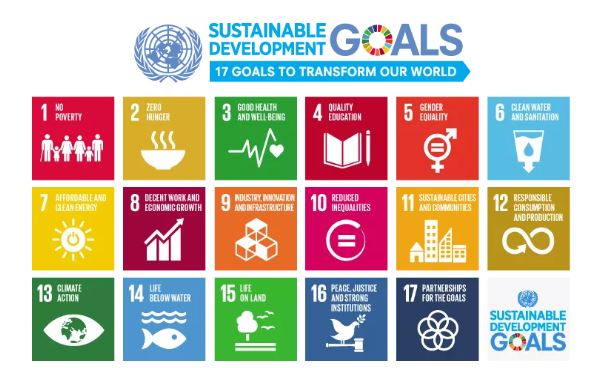
The Sustainable Development Goals (SDGs) are a set of 17 goals adopted by the United Nations in 2015 to reduce poverty, protect the planet, and support peace and prosperity. They help measure progress in development, including through small-scale finance and public transportation projects.
The 17 SDGs are:
- No poverty
- Zero hunger
- Good health and well-being
- Quality education
- Gender equality
- Clean water and sanitation
- Affordable and clean energy
- Decent work and economic growth
- Industry, innovation, and infrastructure
- Reduced inequalities
- Sustainable cities and communities
- Responsible consumption and production
- Climate action
- Life below water
- Life on land
- Peace, justice, and strong institutions
- Partnerships for the goals
Each goal has specific targets and indicators to track progress. The goals are meant to be connected, so progress on one often supports others. For AP, the most testable points are that the SDGs give a shared framework for measuring development and that examples like small-scale finance and public transportation projects show how the goals turn into action.
How to Use This on the AP Human Geography Exam
MCQ
Expect questions that give you a map, chart, or data set about energy use, development indicators, or sustainability projects. Read what the data actually shows before choosing an answer. Watch for choices that confuse renewable energy with fossil fuels, or that treat ecotourism as automatically harmless.
Free Response
Free-response prompts may ask you to explain how sustainable development strategies respond to problems from industrialization, or to evaluate how well a strategy works at different scales.
- Use the task verb. "Explain" means give reasoning and a cause-and-effect link, not just a definition.
- When a prompt asks how effective something is, give both a strength and a limit. For example, ecotourism can fund conservation and create jobs, but it can also strain the environment if visitor numbers are not controlled.
- Connect sustainability back to uneven development when you can, since that is the big idea running through this unit.
Common Trap
Do not write that sustainable development means stopping growth. It is about balancing economic, social, and environmental needs, not ending development. Also avoid claiming a strategy "solves" a problem completely. Strong answers show both what a strategy can do and where it falls short.
Common Misconceptions
- Misconception: Sustainable development is anti-growth.Actually: Sustainable development is not anti-growth. It tries to balance economic, social, and environmental goals over the long term.
- Misconception: Ecotourism is automatically good for the environment.Actually: Ecotourism is not automatically good for the environment. It only protects nature when it is carefully managed and limited.
- Misconception: Renewable energy is the same as nuclear energy.Actually: Renewable energy is not the same as nuclear energy. Renewables like solar and wind are naturally replenished, while nuclear relies on a finite fuel source.
- Misconception: The Sustainable Development Goals are a binding law that forces countries to act.Actually: The Sustainable Development Goals are a measuring and planning framework, not a binding law that forces countries to act.
- Misconception: More tourists or more projects always means more sustainability.Actually: More tourists or more projects does not always mean more sustainability. Effectiveness depends on management, scale, and follow-through.
Related AP Human Geography Guides
Practice Questions for 7.8
1 of 10
A geographer compares two land-use maps of a Central American coastal region from 1995 and 2025. The 1995 map shows expanding logging roads and clear-cutting for cattle ranching. The 2025 map shows the logging roads replaced by protected forest reserves, with new small-scale lodging and guided trail networks concentrated strictly along the reserve borders. Which conclusion about sustainable spatial development is best supported by this visual comparison?
A.
Manufacturing policies halted extractive industrial expansion while concentrating alternative economic development in limited zones.
B.
Ecotourism policies halted extractive industrial expansion while concentrating alternative economic development in limited zones.
C.
Ecotourism policies halted extractive industrial expansion but failed to generate alternative economic development in the region.
D.
Ecotourism policies expanded extractive agricultural production while concentrating alternative economic development in limited zones.
E.
Mass tourism policies halted extractive industrial expansion while concentrating large-scale resort development in limited zones.
Vocabulary
The following words are mentioned explicitly in the AP® course framework for this topic.Term | Definition |
|---|---|
climate change | Long-term shifts in global temperatures and weather patterns, primarily caused by human activities such as greenhouse gas emissions. |
ecotourism | Tourism based in natural environments that aims to protect the environment while providing economic benefits and employment to local populations. |
industrialization | The development of industries in a country or region on a large scale, involving the transformation of economies from agricultural to manufacturing-based. |
mass consumption | The widespread purchasing and use of goods and services by large populations, often leading to increased resource use and waste. |
natural-resource depletion | The reduction or exhaustion of natural resources such as forests, minerals, and water due to overuse or extraction. |
pollution | The introduction of harmful substances or contaminants into the environment that damage ecosystems and human health. |
public transportation | Systems of buses, trains, and other vehicles available to the general public for moving people within and between urban areas. |
small-scale finance | Financial services and lending programs designed to support small businesses and local economic development in communities. |
spatial development | The geographic patterns and processes of how land, resources, and infrastructure are organized and developed across space. |
sustainability principles | Guidelines and practices designed to meet present needs without compromising the ability of future generations to meet their own needs. |
Sustainable Development Goals | A set of United Nations objectives designed to measure progress in development across economic, social, and environmental dimensions. |
sustainable development policies | Government and organizational strategies designed to balance economic growth, environmental protection, and social well-being. |
Frequently Asked Questions
What is sustainable development in AP Human Geography?
Sustainable development is development that meets present needs without limiting the ability of future generations to meet their needs. It balances economic, social, and environmental goals.
How does sustainable development relate to industrialization?
Industrialization can cause resource depletion, mass consumption, pollution, and climate change. Sustainable development policies try to reduce those problems while still supporting spatial and economic development.
What is ecotourism?
Ecotourism is tourism based in natural environments, often places threatened by industrialization or development. When managed well, it can protect the environment and provide jobs for local people.
What are the UN Sustainable Development Goals?
The UN Sustainable Development Goals are 17 goals used to measure development progress, reduce poverty, protect the planet, and improve quality of life. AP examples include small-scale finance and public transportation projects.
Why is ecotourism not automatically sustainable?
Ecotourism can damage environments if visitor numbers, transportation, or infrastructure are poorly managed. Strong AP answers explain both its benefits and its limits.
What is a common mistake with sustainable development?
A common mistake is saying sustainable development means stopping growth. It actually means balancing development with long-term environmental and social needs.
See Fiveable more often in Google
Mark Fiveable as a preferred source and Google is more likely to show you our guides in Top Stories, with a "preferred" badge in AI Mode and AI Overviews.