

A function is increasing where its first derivative is positive and decreasing where the first derivative is negative. To find these intervals, locate the critical points (where or is undefined) plus any points where the function itself is undefined, split the domain at those points, then test the sign of in each piece. For AP Calculus, justify each interval with the sign of .
Why This Matters for the AP Calculus Exam
This topic is the backbone of analyzing function behavior with derivatives, which shows up across Unit 5. On the AP Calculus exam you will use sign analysis of to justify where a function increases or decreases, and that same skill leads directly into finding relative extrema, locating absolute extrema, and sketching graphs of from information about .
These questions appear in both multiple-choice and free-response settings. Strong justifications matter here: when you claim a function is increasing, you need to point to the sign of the derivative, not just say "the graph goes up." Refer to , , and by name so your reasoning is clear.

Key Takeaways
- means is increasing; means is decreasing.
- A function can only switch between increasing and decreasing at critical points (where or is undefined) or where itself is undefined.
- Split the domain at those points, then test the sign of at one sample point inside each interval.
- Report your answer in interval notation using open intervals.
- Justify with the sign of , not vague phrases like "it's going up."
- Always name , , or so the reader knows which function you mean.
When Does a Function Increase or Decrease?
The derivative of a function gives its rate of change at a point, so the sign of the derivative tells you which direction the function is heading.
- If is positive at a point, is increasing there.
- If is negative at a point, is decreasing there.
The graph below shows this pattern. The gray line is the function , and the black line is its derivative .
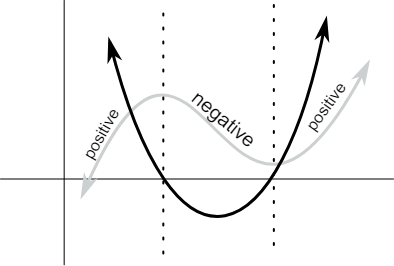
A function can only change direction (from increasing to decreasing or the reverse) at its critical points, where the derivative equals or is undefined, and at points where the function itself is undefined.
So for each interval between those points, pick one sample -value, plug it into , and check the sign. Positive means increasing on that interval; negative means decreasing. The sign stays the same across an interval because the function cannot switch direction without passing through a critical point.
Worked Example
Let be a function defined for all real numbers except , with derivative . On which intervals is increasing?
Find where can change direction. Set :
This gives at , so that is a critical point. The function is also undefined at , as stated. These two points split the number line into three intervals:
Test a sample -value in each interval. Here we use , , and .
| Interval | Verdict | ||
|---|---|---|---|
| is decreasing | |||
| is increasing | |||
| is increasing |
So is increasing on and .
Steps to Determine Function Behavior
- Find the critical points, where equals zero or is undefined.
- Split the domain into intervals at those critical points (and any points where is undefined).
- Choose a test point inside each interval.
- Evaluate at each test point.
- Read the sign: positive means is increasing on that interval, negative means is decreasing.
How to Use This on the AP Calculus Exam
Problem Solving
Use the sign chart of as your main tool. Find critical points, split the domain, test each interval, and translate the sign of into increasing or decreasing behavior of .
Free Response
When a question says "Justify your answer," anchor your justification to the sign of the derivative. Write something like " is increasing on because on that interval." Naming and specifically keeps your reasoning clear and easy to follow, which is important for clean exam work.
Common Trap
If you are given the graph of instead of an equation, read where the graph is above the -axis (positive, so is increasing) and below it (negative, so is decreasing). Do not treat the height of the graph as the height of .
Practice Problems
Question 1
Let . On which interval(s) is decreasing?
Question 2
Let . On which interval(s) is increasing?
Answers and Solutions
Question 1
The answer is .
Look for where is negative. The derivative is , which equals at and , so these are the only points where can change direction. They split the number line into three intervals: .
| Interval | Verdict | ||
|---|---|---|---|
| is increasing | |||
| is decreasing | |||
| is increasing |
So is decreasing on .
Question 2
The answer is and .
Look for where is positive. The derivative is , which factors as . It equals at , , and , so these are the only points where can change direction. They split the number line into four intervals: .
| Interval | Verdict | ||
|---|---|---|---|
| is decreasing | |||
| is increasing | |||
| is decreasing | |||
| is increasing |
So is increasing on and .
Common Misconceptions
- Reading the graph as if it were . A high point on the graph of does not mean is large; it means is increasing quickly. Use the sign of , not its height.
- Justifying with "it's going up." On free-response questions you need to cite the sign of the derivative, such as " on this interval," not a casual description.
- Forgetting points where is undefined. The function can only change direction at critical points and at points outside its domain, so include both when you split the number line.
- Saying always means a max or min. A zero of marks a possible change in direction, but might keep increasing or decreasing through it if the sign does not switch.
- Using closed intervals carelessly. Report intervals of increase and decrease as open intervals between the critical points.
- Writing "it" instead of naming the function. Always refer to , , and by name so your reasoning is unambiguous.
Related AP Calculus Guides
- Unit 5 Overview: Analytical Applications of Differentiation
- 5.1 Using the Mean Value Theorem
- 5.2 Extreme Value Theorem, Global vs Local Extrema, and Critical Points
- 5.4 Using the First Derivative Test to Determine Relative (Local) Extrema
- 5.11 Solving Optimization Problems
- 5.10 Introduction to Optimization Problems
Vocabulary
The following words are mentioned explicitly in the College Board Course and Exam Description for this topic.Term | Definition |
|---|---|
decreasing | An interval on which a function's output values are getting smaller as the input values increase, corresponding to where the first derivative is negative. |
first derivative | The derivative of a function, denoted f', which describes the rate of change and indicates where a function is increasing or decreasing. |
increasing | An interval on which a function's output values are getting larger as the input values increase, corresponding to where the first derivative is positive. |
Frequently Asked Questions
How do you find increasing and decreasing intervals in AP Calculus?
Find where f'(x)=0, where f' is undefined, and where f is undefined. Use those points to split the domain, test the sign of f' on each interval, then report where f'(x)>0 as increasing and where f'(x)<0 as decreasing.
What does f'(x) > 0 mean?
If f'(x)>0 on an interval, then f is increasing on that interval. On the AP exam, justify the claim by naming the derivative and the interval, not just by saying the graph goes up.
What points split the sign chart for increasing and decreasing intervals?
Use critical points where f'(x)=0 or f' is undefined, plus any points where f itself is undefined. Those values divide the domain into intervals where you can test the sign of the derivative.
Why do you use open intervals for increasing and decreasing?
Increasing and decreasing behavior is described on intervals between critical points or domain breaks. The endpoints are usually excluded because they are where the derivative is zero, undefined, or where the function is not defined.
How do you use the graph of f' to find where f is increasing?
Look for where the graph of f' is above the x-axis. That means f'(x)>0, so f is increasing. Where the graph of f' is below the x-axis, f'(x)<0 and f is decreasing.
What is a common AP Calc 5.3 mistake?
A common mistake is mixing up f and f'. If the question gives a graph of f', points above the x-axis show where f is increasing; they do not show the height of f itself.