5.4 Using the First Derivative Test to Determine Relative (Local) Extrema

♾️AP Calculus AB/BC Unit 5 Review
5.4 Using the First Derivative Test to Determine Relative (Local) Extrema
♾️ AP Calculus AB/BC
5.1
Using the Mean Value Theorem
5.2
Extreme Value Theorem, Global vs Local Extrema, and Critical Points
5.3
Determining Intervals on Which a Function is Increasing or Decreasing
5.4
Using the First Derivative Test to Determine Relative (Local) Extrema
5.5
Using the Candidates Test to Determine Absolute (Global) Extrema
5.6
Determining Concavity
5.7
Using the Second Derivative Test to Determine Extrema
5.8
Sketching Graphs of Functions and Their Derivatives
5.9
Connecting a Function, Its First Derivative, and its Second Derivative
5.10
Introduction to Optimization Problems
5.11
Solving Optimization Problems
5.12
Exploring Behaviors of Implicit Relations
The First Derivative Test finds local, or relative, maximums and minimums by checking how the sign of changes at each critical point. If goes from positive to negative, has a local max; if goes from negative to positive, has a local min; if the sign stays the same, there is no extremum there. For AP Calculus, justify extrema with the sign change of .
Why This Matters for the AP Calculus Exam
This topic is part of Unit 5, which carries a large share of the AP Calculus AB exam and a smaller but real share on BC. The First Derivative Test shows up when you need to locate and justify relative extrema, which is a common task on both multiple-choice and free-response questions.
A big part of the skill here is justification. Many free-response questions ask you to find an extremum and explain why it is a max or min using the sign behavior of . Writing a clean reason like " has a relative maximum at because changes from positive to negative there" is exactly the kind of calculus-based reasoning the exam rewards. Sloppy phrasing like "it goes up" does not count as a justification.
Key Takeaways
- A critical point is where or does not exist. All local extrema happen at critical points, but not every critical point is an extremum.
- Local max: changes from positive to negative (function goes from increasing to decreasing).
- Local min: changes from negative to positive (function goes from decreasing to increasing).
- No extremum: keeps the same sign on both sides of the critical point.
- Use test points or a sign chart for to check the sign on each side of every critical point.
- Always justify with the sign change of , and refer to , , and by name, not "it."
First Derivative Test
The First Derivative Test uses the sign of to find the relative (local) extrema of a function. If changes from positive to negative at a point (so changes from increasing to decreasing), then has a relative maximum there. If changes from negative to positive (so changes from decreasing to increasing), then has a relative minimum there.
The process is close to finding intervals where a function increases or decreases.
First, find the critical points of the function. A critical point is where the derivative equals or is not defined. Once you have those points, check the sign of on either side of each one.
- If is positive on the left and negative on the right, the point is a local maximum. ⬆️
- If is negative on the left and positive on the right, the point is a local minimum. ⬇️
- If has the same sign on both sides, the function is either increasing or decreasing through that point, and there is no relative extremum.
First Derivative Test Walkthrough
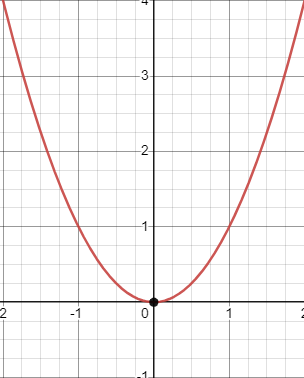
Consider the function . The derivative is by the power rule. At , the derivative equals , so this is a critical point. Now evaluate on either side.
Left side (for ): Substitute a value less than into . Using :
So is negative for .
Right side (for ): Substitute a value greater than . Using :
So is positive for .
Conclusion: is negative on the left and positive on the right, so has a relative minimum at . ⬇️
How to Use This on the AP Calculus Exam
Problem Solving
- Find and set it equal to . Also note any points where does not exist. These are your critical points.
- Build a sign chart for . Pick test points between and around the critical points.
- Plug each test point into and record whether the result is positive or negative.
- Read the sign changes: positive to negative is a local max, negative to positive is a local min, no change means no extremum.
Free Response
When a question says "Justify your answer," your work needs a clear reason tied to . A strong answer names the function and the sign change, like: " has a relative maximum at because changes from positive to negative at ." Start your sentence using the language from the question to keep your answer focused.
Practice Problems
Question 1: Let be a polynomial function with derivative . Where are 's relative minima?
Question 2: Let . Where are 's relative maxima?
Solutions
Question 1:
Find the critical points by setting equal to :
The critical points are , , and . The function can have minima only at these points. Now check the sign of on each side of each point.
| x | Left | Right | Verdict |
|---|---|---|---|
| -4 | + | - | Relative maximum |
| 0 | - | - | Not an extremum |
| 3 | - | + | Relative minimum |
So has one relative minimum at . Notice that is a critical point but not an extremum, because has the same sign on both sides (the factor does not change sign).
Question 2:
Find the critical points. Since , set it equal to to get and . The function can have maxima only at these points. Now check the sign of on each side.
| x | Left | Right | Verdict |
|---|---|---|---|
| -2 | + | - | Relative maximum |
| 2 | - | + | Relative minimum |
So has one relative maximum at .
Common Misconceptions
- Misconception: Every critical point is an extremum.Actually: Not true. If keeps the same sign on both sides (like the factor in Question 1), there is no max or min there.
- Misconception: The graph of is the graph of .Actually: A point where is increasing tells you about concavity of , not about where has a max or min. For extrema, you care about where changes sign, not where increases.
- Misconception: Saying "it goes up" is a sufficient justification.Actually: That is too vague. Tie your reason to the sign of and name the function, such as " is increasing because is positive."
- Misconception: Places where does not exist are not critical points.Actually: Critical points also include places where the derivative is undefined, like cusps or corners. A sign change there can still create an extremum.
- Misconception: Positive to negative is a min, and negative to positive is a max.Actually: Positive to negative is a max (the function peaks); negative to positive is a min (the function bottoms out). Sketching a quick sign chart helps you keep them straight.
Related AP Calculus Guides
- Unit 5 Overview: Analytical Applications of Differentiation
- 5.1 Using the Mean Value Theorem
- 5.2 Extreme Value Theorem, Global vs Local Extrema, and Critical Points
- 5.3 Determining Intervals on Which a Function is Increasing or Decreasing
- 5.11 Solving Optimization Problems
- 5.10 Introduction to Optimization Problems
Practice Questions for 5.4
1 of 10
The graph of , the derivative of a function , is shown above for .
How many relative minima does have on the open interval ?
A.
One
B.
Two
C.
Three
D.
Zero
Vocabulary
The following words are mentioned explicitly in the AP® course framework for this topic.Term | Definition |
|---|---|
first derivative | The derivative of a function, denoted f', which describes the rate of change and indicates where a function is increasing or decreasing. |
relative extrema | Maximum or minimum values of a function at a point relative to nearby points. |
Frequently Asked Questions
What is AP Calculus 5.4 about?
AP Calculus 5.4 is about using the First Derivative Test to determine relative, or local, extrema. You justify conclusions about a function by analyzing how the sign of its derivative changes around critical points.
How does the First Derivative Test work?
Find critical points where $f'(x)=0$ or $f'$ does not exist, then check the sign of $f'$ on each side. If $f'$ changes from positive to negative, $f$ has a local maximum. If $f'$ changes from negative to positive, $f$ has a local minimum.
What is a critical point in AP Calculus?
A critical point occurs at an interior point of the domain where $f'(x)=0$ or where $f'$ does not exist. Critical points are candidates for local extrema, but not every critical point is a maximum or minimum.
How do I tell whether a critical point is a max or min?
Use a sign chart for $f'$. Positive to negative means local maximum, negative to positive means local minimum, and no sign change means no local extremum at that point.
What is the difference between local extrema and absolute extrema?
Local extrema describe behavior near a point: the function is higher or lower than nearby values. Absolute extrema describe the highest or lowest value on an entire interval or domain. The First Derivative Test is mainly used for local extrema.
How should I justify a First Derivative Test answer on the AP exam?
Name the function and the derivative sign change. For example, write that $f$ has a relative maximum at $x=c$ because $f'$ changes from positive to negative at $x=c$. Avoid vague wording that does not mention $f'$ or the sign change.
See Fiveable more often in Google
Mark Fiveable as a preferred source and Google is more likely to show you our guides in Top Stories, with a "preferred" badge in AI Mode and AI Overviews.