2.9 Cell Compartmentalization

🧬AP Biology Unit 2 Review
2.9 Cell Compartmentalization
🧬 AP Biology
Cell compartmentalization is how eukaryotic cells use membranes and membrane-bound organelles to separate specific metabolic processes and enzymatic reactions. These internal membranes keep competing reactions apart and increase the surface area available for reactions, which makes the cell more efficient and lets each organelle hold the right conditions for its job. For AP Biology, connect each compartment's structure to the process it supports.
Why This Matters for the AP Biology Exam
This topic is part of Unit 2, which carries a noticeable share of the exam. You will be expected to explain how the structure of membrane-bound organelles connects to their function, not just name them. On multiple-choice questions, you might match an organelle to a process or predict what happens when a compartment is missing or disrupted. On free-response questions, you may need to explain in your own words how internal membranes make a cell more efficient by separating reactions and adding surface area. Diagrams of cells and organelles show up often, so being able to read and reason about them matters.
A common scoring problem is naming an organelle correctly but failing to describe its function accurately. Focus on linking each structure to what it actually does.
Key Takeaways
- Membranes and membrane-bound organelles separate intracellular metabolic processes and specific enzymatic reactions in eukaryotic cells.
- Internal membranes help cells work efficiently by minimizing competing interactions and by increasing the surface area where reactions occur.
- Each organelle maintains its own conditions, such as pH or ion concentration, so enzymes can work where they function best.
- Folded membranes like mitochondrial cristae and chloroplast thylakoids pack more reaction surface into a small space.
- Prokaryotes generally lack membrane-bound organelles, so processes like transcription and translation can occur in the same space.
- For the exam, always connect an organelle's structure to its specific function.
Eukaryotic Organization: Separate Compartments for Separate Jobs
One major difference between eukaryotes and prokaryotes is that eukaryotes separate their internal processes inside membrane-bound organelles. Each compartment holds the specific conditions and tools needed for a particular job.
In eukaryotic cells, membrane-bound organelles create separate internal compartments. These compartments isolate specific metabolic processes and enzymatic reactions, so different parts of the cell can carry out distinct functions under the conditions those reactions require. Here are the key membrane-bound organelles and their functions.
Nucleus: The Control Center
- Houses DNA and controls cell activities
- Surrounded by a double membrane with nuclear pores for transport
- Creates a protected environment for DNA storage and RNA production
- Separates transcription (making RNA from DNA) from translation (making proteins from RNA)
Endoplasmic Reticulum (ER)
- Rough ER: studded with ribosomes that make proteins
- Creates a specialized zone for protein folding and quality control
- Connects directly to the nuclear membrane for efficient RNA transport
- Smooth ER: no ribosomes; specializes in lipid production and detoxification
- Provides a separate environment for lipid synthesis enzymes
- Stores calcium ions in a controlled space away from other processes
Golgi Apparatus: Packaging and Shipping
- Receives proteins from the ER and modifies them
- Sorts and packages proteins into vesicles for delivery
- Works as a sequential processing line with different enzymes in different cisternae (flattened membrane sacs)
- Different cisternae maintain unique conditions for different processing steps
Lysosomes: Recycling and Waste Management
- Contain hydrolytic (digestive) enzymes that work best in acidic conditions (about pH 4.5)
- Break down cellular waste, old organelles, and foreign material
- Keep destructive enzymes safely contained so they do not damage the rest of the cell
Mitochondria: ATP Production
- Generate ATP through aerobic cellular respiration
- Have a double membrane structure:
- Outer membrane: smooth protective barrier
- Inner membrane: folded into cristae that increase surface area
- The folded cristae provide more space for ATP-producing reactions, which makes energy production more efficient
- Contain their own DNA and ribosomes, which is evidence of their evolutionary origin from once free-living prokaryotes
Peroxisomes: Breaking Down Toxic Molecules
- Break down fatty acids and certain toxic substances
- Contain enzymes (such as catalase) that produce and then break down hydrogen peroxide
- Provide a safe, contained place for these potentially dangerous reactions
Vacuoles: Storage
- Store nutrients, waste products, and water
- Help maintain turgor pressure in plant cells through a large central vacuole
- Create isolated environments for materials that might disrupt other cellular activities
Why Compartmentalization Improves Efficiency
Internal membranes in eukaryotic cells help cellular processes by minimizing competing interactions and by increasing the surface area where reactions can occur. Because membrane-bound organelles create separate compartments, different functions can happen efficiently without disrupting one another.
Creating Specialized Environments
- Different organelles maintain different pH levels and ion concentrations
- Lysosomes keep an acidic environment ideal for breaking down materials, while the surrounding cytoplasm stays closer to neutral
- This lets enzymes work in their best conditions without interfering with each other
Increasing Surface Area
- Internal membranes, like those in mitochondria and chloroplasts, increase the cell's total membrane surface area
- The folded inner membrane of mitochondria (cristae) provides more space for the reactions involved in ATP production
- More surface area means more room for reactions, which means more efficient processes
Separating Competing Reactions
- Some processes would interfere with each other if they happened in the same place
- DNA replication and transcription occur in the nucleus, while protein synthesis happens on ribosomes in the cytoplasm or rough ER
- This separation minimizes competing interactions so each process can run under the proper conditions
Placing Proteins Where They Are Needed
- Different membranes hold different proteins based on the function they serve
- Transport proteins, enzymes, and receptors are positioned exactly where they are needed
- For example, ATP synthase is located in the mitochondrial inner membrane rather than scattered throughout the cell
The Prokaryote Comparison
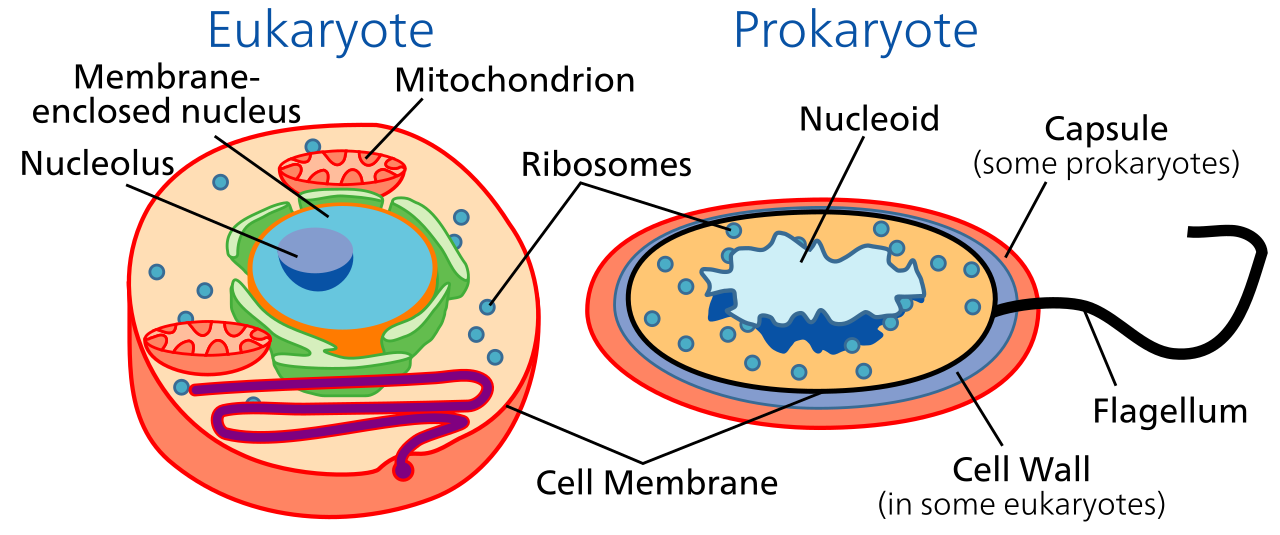
In prokaryotes, transcription and translation can occur in the same region because they lack a nucleus and other membrane-bound organelles. Without compartmentalization, prokaryotic processes share the same space, which limits how complex these cells can become.
How to Use This on the AP Biology Exam
Multiple Choice
Expect questions that ask you to match an organelle to a process or to predict the result of losing or disrupting a compartment. If lysosomes could not maintain an acidic interior, for example, you should be able to reason that their digestive enzymes would not work well. Watch for answer choices that describe the right organelle but the wrong function.
Written Responses
When a prompt asks you to explain how compartmentalization helps a cell, do not just list organelles. Connect structure to function: internal membranes separate competing reactions and increase surface area so reactions run efficiently and under the right conditions. A strong response names a specific example, such as cristae increasing surface area for ATP production, and explains why that structure matters.
Data and Diagrams
You may be given a cell diagram or data about organelle activity. Practice identifying organelles by structure (double membrane, folded inner membrane, ribosome-studded surface) and explaining what that structure allows the organelle to do.
Common Trap
Avoid leaning on the "cell city" or "rooms in a house" analogy in your written answers. On the exam, students who write about the analogy often forget to use real biology terms and lose points. Use the analogy to understand the idea, then write your answer using accurate terminology.
Common Misconceptions
- Misconception: Naming an organelle is enough.Actually: You also need to describe its function accurately. Correctly labeling the Golgi but not explaining that it modifies and packages proteins will not support a stronger score.
- Misconception: Compartmentalization is only about storage.Actually: Its main advantages are separating competing reactions and increasing reaction surface area, not just holding materials.
- Misconception: Prokaryotes have no organization.Actually: Prokaryotes lack membrane-bound organelles, but they still have internal regions with specialized structures and functions.
- Misconception: More surface area is just extra space.Actually: The folding of cristae and thylakoid membranes directly increases the room available for reactions, which raises efficiency.
- Misconception: All enzymes work in the same conditions.Actually: Different compartments maintain different pH and ion conditions so each set of enzymes can work where it functions best, like the acidic interior of lysosomes.
Related AP Biology Guides
Practice Questions for 2.9
1 of 10
A cell diagram shows arrows from ribosome-studded membrane sacs to a stack of flattened sacs, then to vesicles fusing with the cell boundary.
Which sequence of structures is shown by the arrows?
A.
Smooth endoplasmic reticulum nucleus cell exterior
B.
Rough endoplasmic reticulum Golgi apparatus plasma membrane
C.
Plasma membrane Golgi apparatus rough endoplasmic reticulum
D.
Golgi apparatus rough endoplasmic reticulum cytosol
Vocabulary
The following words are mentioned explicitly in the AP® course framework for this topic.Term | Definition |
|---|---|
compartmentalization | The division of the eukaryotic cell into distinct membrane-bound regions that separate different metabolic processes and enzymatic reactions. |
enzymatic reaction | Chemical reactions catalyzed by enzymes that occur within specific cellular compartments to facilitate metabolic processes. |
eukaryotic cell | Cells that contain a membrane-bound nucleus and internal membrane-bound organelles, found in animals, plants, fungi, and protists. |
internal membrane | Membranes within eukaryotic cells that divide the cell into compartments with specialized functions. |
intracellular metabolic process | Chemical reactions and pathways that occur within the cell to build up or break down molecules for energy and biosynthesis. |
membrane-bound organelle | Specialized structures within eukaryotic cells enclosed by a membrane that perform specific cellular functions. |
membrane-bound structure | Organelles and compartments in eukaryotic cells that are enclosed by a lipid bilayer membrane, separating their contents from the cytoplasm. |
organelle | Membrane-bound or non-membrane-bound structures within eukaryotic cells that perform specific cellular functions. |
surface area | The total area of a membrane available for chemical reactions and cellular processes to occur. |
Frequently Asked Questions
What is cell compartmentalization in AP Biology?
Cell compartmentalization is the use of membranes and membrane-bound organelles to separate metabolic processes and enzymatic reactions inside eukaryotic cells. This lets different processes happen in specialized spaces with the right conditions.
Why do eukaryotic cells use membrane-bound organelles?
Eukaryotic cells use membrane-bound organelles to organize cellular work. Organelles separate reactions, maintain specific pH or ion conditions, and place enzymes where they can function efficiently.
How do internal membranes make cells more efficient?
Internal membranes increase surface area for reactions and minimize competing interactions. Folded membranes, such as mitochondrial cristae and chloroplast thylakoids, create more space for reaction proteins in a small volume.
What is an example of compartmentalization in cells?
A lysosome is a clear example because it keeps digestive enzymes inside an acidic compartment, away from the neutral cytoplasm. Mitochondria are another example because cristae organize ATP-producing reactions.
How is compartmentalization tested on the AP Biology exam?
AP Biology questions often ask you to connect organelle structure to function. A strong answer explains how internal membranes separate reactions, increase reaction surface area, or maintain conditions that help enzymes work.
Do prokaryotes have cell compartmentalization?
Prokaryotes generally lack membrane-bound organelles, so they do not compartmentalize processes the same way eukaryotes do. They still have organization, but processes such as transcription and translation can occur in the same general space.
See Fiveable more often in Google
Mark Fiveable as a preferred source and Google is more likely to show you our guides in Top Stories, with a "preferred" badge in AI Mode and AI Overviews.