6.7 Mutations

🧬AP Biology Unit 6 Review
6.7 Mutations
🧬 AP Biology
A mutation is any change in a DNA sequence, and it can be beneficial, harmful, or neutral depending on whether it alters the protein produced and how that protein affects the organism in its environment. For AP Biology, know the main mutation types, how errors in mitosis or meiosis can change chromosome number or structure, and how mutations create genetic variation for natural selection to act on.
Types of Mutations in AP Bio
In AP Biology, a mutation is an alteration in a DNA sequence that can change the type or amount of protein produced. The main mutation types to know are point mutations, frameshift mutations, nonsense mutations, and silent mutations.
The exam usually asks you to reason through the effect, not just name the mutation. Track the chain from DNA sequence to codon, amino acid, protein structure or amount, phenotype, and possible selection in a specific environment.
Why This Matters for the AP Biology Exam
Mutations connect molecular changes to phenotype and to evolution, so this topic shows up across multiple-choice questions and free-response prompts. A common exam skill is linking a specific DNA change to its effect on a protein and then to the organism's phenotype, and explaining why that outcome depends on environmental context.
To do well, practice reasoning through cause and effect: a change at the nucleotide level leads to a change (or no change) in the protein, which leads to a change (or no change) in phenotype. Questions also ask you to explain how mutations and other variation-increasing processes feed natural selection, so be ready to connect this topic to evolution ideas in Unit 7.
Key Takeaways
- A mutation is a change in DNA sequence; it can be beneficial, detrimental, or neutral depending on its effect on the protein and the environment.
- Point mutations change one nucleotide; insertions or deletions can cause frameshifts that shift the whole reading frame.
- Nonsense mutations create a premature stop codon, and silent mutations cause no change in the amino acid sequence because of the redundancy of the genetic code.
- Errors in mitosis or meiosis, such as nondisjunction, can change chromosome number (aneuploidy) or structure and alter phenotype.
- Mutations are a source of genetic variation, the raw material for natural selection.
- Horizontal gene transfer in prokaryotes (transformation, transduction, conjugation, transposition) and viral recombination increase genetic variation.
Genotype and Phenotype
A genotype is the genetic makeup of an organism, and a phenotype is the observable traits, such as physical appearance, behavior, and biochemistry. Changes in genotype can lead to changes in phenotype, but not always.
One way genotype affects phenotype is through the type and amount of gene products, which include proteins and RNA molecules that carry out specific functions. When a mutation disrupts a gene that encodes one of these products, the result can be a new phenotype.
Example: Cystic Fibrosis

Mutations in the CFTR gene disrupt ion transport across cell membranes. The result is a buildup of thick, sticky mucus in the lungs and other organs, leading to symptoms like chronic lung infections and digestive problems. This is an example of how a single gene mutation changes phenotype.
Example: Adaptive Melanism in Pocket Mice
A mutation in the MC1R gene, which codes for a protein involved in pigmentation, can switch fur color from light to dark. In dark environments, dark fur provides camouflage from predators, so this mutation is beneficial in that context. This example shows that whether a mutation helps depends on the environment.
Types of Mutations
A mutation is any alteration in a DNA sequence. The type of mutation and its location can affect the structure and function of the resulting protein, which in turn can change phenotype.
Point Mutations
A point mutation is the substitution of one nucleotide for a different nucleotide. Because the genetic code is read in codons, a point mutation can change a single codon and therefore may change one amino acid in a protein. Whether this matters depends on where the change is and what amino acid swap (if any) it causes.
Insertions, Deletions, and Frameshifts
An insertion adds a nucleotide and a deletion removes one. If the number of nucleotides added or removed is not a multiple of three, the reading frame shifts. This frameshift mutation changes every codon downstream of the change, usually producing a very different or nonfunctional protein.
Nonsense Mutations
A nonsense mutation is a point mutation that creates a premature stop codon. The ribosome stops translating early, producing a truncated (shortened) protein that often cannot function. Notice the key distinction: a nonsense mutation is a point mutation, not a frameshift.
Silent Mutations
A silent mutation changes the DNA sequence but does not change the amino acid sequence. This happens because the genetic code is redundant, meaning more than one codon can code for the same amino acid. For example, both UUU and UUC code for phenylalanine, so a change between them would be silent.
Beneficial, Detrimental, or Neutral
Mutations can be beneficial, detrimental, or neutral based on their effect (or lack of effect) on the resulting nucleic acid or protein and the phenotype it produces.
- A mutation in a regulatory region can increase a gene's expression, raising the amount of protein produced. Depending on the situation, this can help the organism.
- Many mutations have no effect on phenotype. These neutral mutations may fall in non-coding regions or in parts of a gene that do not change the protein's structure or function.
How Mutations Arise and Why Context Matters
Errors in DNA replication or DNA repair mechanisms can cause random mutations, and so can external factors such as radiation and reactive chemicals. These mutations can occur anywhere in the DNA, including coding regions, non-coding regions, and regulatory regions.
Whether a mutation is beneficial, detrimental, or neutral depends on the environmental context. A mutation that causes a loss of protein function might hurt an organism in one environment but help it in another. The same logic applies to a mutation that raises gene expression.
Mutations are a source of genetic variation, the differences in DNA sequences among individuals in a population. That variation is the raw material that natural selection acts on, a connection you will build on in Unit 7.
Errors in Mitosis and Meiosis
Errors during cell division can change chromosome number or structure and alter phenotype.
- Mitosis produces two identical daughter cells, each with the same chromosome number as the parent cell.
- Meiosis produces four genetically diverse cells, each with half the chromosome number of the parent cell.
Nondisjunction and Aneuploidy

Nondisjunction is the failure of homologous chromosomes or sister chromatids to separate properly during cell division. It can produce cells with an abnormal chromosome number. Nondisjunction often causes aneuploidy, in which cells have one extra or one missing chromosome. Changes in chromosome number often result in disorders with developmental limitations.
For AP Biology, focus on the general idea that chromosome-number changes can alter phenotype. You do not need to memorize specific disorders.
Alterations in Chromosome Structure
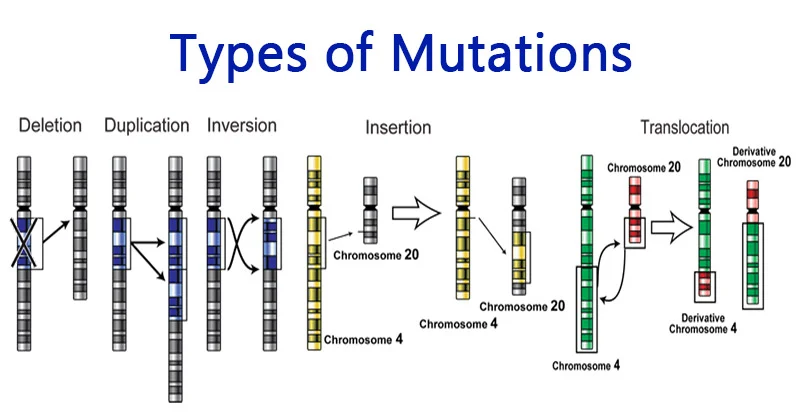
Structural changes to chromosomes can also lead to genetic disorders:
- Deletions: Loss of a chromosome segment
- Duplications: Repetition of a chromosome segment
- Inversions: Reversal of a chromosome segment
- Translocations: Transfer of a segment from one chromosome to another
These changes can disrupt gene function and produce new phenotypes.
Mutations, Variation, and Natural Selection
Changes in genotype may affect phenotypes that are subject to natural selection. Genetic changes that enhance survival and reproduction can be selected for by environmental conditions, so over time the frequency of beneficial variations can increase in a population.
Horizontal Gene Transfer in Prokaryotes
Prokaryotes can gain genetic information from sources other than a parent cell, which increases genetic variation:
- Transformation: Uptake of DNA from the environment. When bacterial cells die and break open, their DNA is released, and some bacteria can take up that free DNA and add it to their genome.
- Transduction: Viral transmission of genetic information. When a virus that infects bacteria replicates, it can accidentally package host DNA and carry it to the next cell it infects.
- Conjugation: Cell-to-cell transfer of DNA through direct contact, often moving plasmids from a donor to a recipient cell.
- Transposition: Movement of DNA segments within and between DNA molecules. Transposable elements can move from one location to another, sometimes disrupting genes or creating new combinations.
Viral Recombination
Related viruses can recombine genetic information if they infect the same host cell. When two related viruses co-infect a cell, their genetic material can mix, producing new viral strains with combinations of genes from both parents.
Variation-Increasing Processes Are Conserved
Reproductive processes that increase genetic variation are evolutionarily conserved and are shared by various organisms. Bacteria use transformation, transduction, conjugation, and transposition; viruses recombine when co-infecting cells; and eukaryotes increase variation through processes like meiosis and crossing over. The fact that so many different organisms have ways to increase variation shows how important genetic diversity is for adaptation and survival.
Example: Sickle Cell Anemia
Sickle cell anemia shows how a change in genotype can produce a phenotype subject to natural selection. A single nucleotide change in the gene for the beta-globin part of hemoglobin replaces glutamic acid with valine.
- Red blood cells take on a sickle shape, which can block blood vessels.
- Individuals with two sickle alleles experience severe health problems.
- Carriers (heterozygotes) have a selective advantage in regions where malaria is common, because the sickle allele provides some resistance to the malaria parasite.
This example shows how a mutation that is harmful in one context can be beneficial in another, tying genotype, phenotype, and natural selection together.
Example: Resistance Mutations
- Antibiotic resistance mutations in bacteria let them survive antibiotics, increasing their chance of surviving and reproducing.
- Pesticide resistance mutations in insects let them survive pesticide exposure and pass resistance to offspring.
How to Use This on the AP Biology Exam
Multiple Choice
Read mutation questions carefully and track the effect at each level: nucleotide to codon to amino acid to protein to phenotype. If a question gives you a DNA or mRNA sequence and a genetic code chart, work out the codon change first, then decide whether it is silent, missense, nonsense, or a frameshift.
Free Response
When a prompt asks you to connect a mutation to phenotype, do not stop at the molecular change. Provide reasoning that links the DNA change to a change in the type or amount of protein, then to the phenotype, then (if asked) to survival or selection. Stating only that a mutation "causes a disease" usually will not support a stronger score without that chain of reasoning.
Common Trap
Remember that not every mutation changes phenotype. Use silent and neutral mutations as your go-to evidence when a question pushes you to assume all mutations are harmful. Also keep frameshift and point mutations separate: a point mutation changes one nucleotide and does not, by itself, shift the reading frame.
Common Misconceptions
- Misconception: All mutations are harmful.Actually: Mutations can be beneficial, detrimental, or neutral, and the outcome depends on the environment. Silent and neutral mutations often have no effect on phenotype at all.
- Misconception: Point mutations cause frameshifts.Actually: A point mutation substitutes one nucleotide and keeps the reading frame intact. Frameshifts come from insertions or deletions that are not multiples of three.
- Misconception: Mutations denature proteins.Actually: A mutation changes the DNA sequence, which can alter the amino acid sequence and therefore the protein's structure or function. Denaturation is a separate process caused by conditions like heat or pH, not by the mutation itself.
- Misconception: A gene and an allele are the same thing.Actually: A gene is a section of DNA that codes for a product; an allele is one version of that gene. Mutations can create new alleles.
- Misconception: Nonsense and silent mutations are types of frameshift.Actually: Both are point mutations. A nonsense mutation creates a premature stop codon, and a silent mutation does not change the amino acid sequence.
- Misconception: Aneuploidy and polyploidy are the same.Actually: Aneuploidy is one extra or missing chromosome, often from nondisjunction. Polyploidy is having extra whole sets of chromosomes.
Related AP Biology Guides
Practice Questions for 6.7
1 of 10
Frequencies of the sickle-cell allele () were compared among human populations with different malaria incidence.
Which population would serve as the best control?
A.
A population with high rates of other mosquito-borne viral diseases
B.
A population routinely treated with antimalarial medicines
C.
A population living where malaria has been completely eradicated
D.
A population with high malaria incidence but no sickle-cell allele
Vocabulary
The following words are mentioned explicitly in the AP® course framework for this topic.Term | Definition |
|---|---|
aneuploidy | An abnormal number of chromosomes resulting from nondisjunction, often causing new phenotypes. |
beneficial mutation | A mutation that has a positive effect on the organism's phenotype or survival. |
chromosome structure | The physical organization of chromosomes, including the arrangement and integrity of genetic material; alterations can lead to genetic disorders. |
conjugation | A process of horizontal gene transfer in prokaryotes involving direct cell-to-cell transfer of DNA. |
cystic fibrosis | A genetic disorder caused by mutations in the CFTR gene that disrupt ion transport in cells. |
detrimental mutation | A mutation that has a negative effect on the organism's phenotype or survival. |
DNA repair mechanisms | Cellular processes that identify and correct errors in DNA to maintain genetic integrity. |
DNA replication | The process by which DNA makes an exact copy of itself, which can be subject to errors that cause mutations. |
DNA sequences | The specific order of nucleotide bases (A, T, G, C) in a DNA molecule that encodes genetic information. |
frameshift mutation | A type of mutation in which one or more nucleotides are inserted or deleted, causing the reading frame of the genetic code to shift. |
genetic variation | Differences in DNA sequences and alleles that exist within a population. |
genotype | The genetic makeup of an organism; the specific alleles present for each gene. |
meiosis | A process of cell division in diploid organisms that produces haploid gamete cells, reducing chromosome number by half for sexual reproduction. |
mitosis | A process of cell division in eukaryotes that produces two genetically identical daughter cells, each with a complete copy of the parent cell's genome. |
mutation | An alteration in a DNA sequence that can cause changes in the type or amount of protein produced and the resulting phenotype. |
mutations | Random changes in DNA sequences that create new genetic variations in populations. |
natural selection | A major mechanism of evolution in which individuals with more favorable phenotypes are more likely to survive and reproduce, passing advantageous traits to subsequent generations. |
neutral mutation | A mutation that has no effect on the organism's phenotype or protein function. |
nondisjunction | The failure of chromosomes to separate properly during mitosis or meiosis, resulting in changes in chromosome number. |
nonsense mutation | A type of point mutation that results in a premature stop codon, terminating protein synthesis early. |
phenotype | The observable physical and biochemical characteristics of an organism, determined by both genetic and environmental factors. |
point mutation | A type of mutation in which one nucleotide is substituted for a different nucleotide in the DNA sequence. |
prokaryotes | Single-celled organisms without a membrane-bound nucleus, such as bacteria and archaea. |
reading frame | The grouping of nucleotides into consecutive triplets (codons) that are read during translation to produce a protein. |
recombination | The process by which genetic material is exchanged between homologous chromosomes, creating new combinations of alleles. |
reproductive processes | Biological mechanisms that generate genetic variation and are conserved across different organisms. |
sickle cell anemia | A genetic disorder caused by mutations in hemoglobin genes that result in abnormal red blood cell shape and reduced oxygen transport. |
silent mutation | A type of mutation in which a change in the nucleotide sequence has no effect on the amino acid sequence or protein produced. |
transduction | A process of horizontal gene transfer in prokaryotes where viruses transfer genetic information from one cell to another. |
transformation | A process of horizontal gene transfer in prokaryotes where cells take up DNA from their environment. |
transposition | The movement of DNA segments (transposons) within or between DNA molecules, creating genetic variation. |
triploidy | A condition in which an organism has three complete sets of chromosomes instead of the normal two. |
variation | Differences in traits among individuals within a population due to genetic and environmental factors. |
Frequently Asked Questions
What is a mutation in AP Biology?
A mutation is an alteration in a DNA sequence. It can affect the type or amount of protein produced and may change phenotype.
What are the main types of mutations in AP Bio?
The main types are point mutations, frameshift mutations, nonsense mutations, and silent mutations. AP Bio also covers chromosome-number changes such as nondisjunction.
What is the difference between point and frameshift mutations?
A point mutation substitutes one nucleotide and keeps the reading frame intact. A frameshift mutation comes from an insertion or deletion that shifts the reading frame.
What is a nonsense mutation?
A nonsense mutation is a point mutation that creates a premature stop codon, often producing a shortened protein.
Are all mutations harmful?
No. Mutations can be beneficial, detrimental, or neutral depending on their effect and the environmental context.
How do mutations create genetic variation?
Mutations introduce new DNA sequence differences. Those differences can create new phenotypes, giving natural selection variation to act on.
See Fiveable more often in Google
Mark Fiveable as a preferred source and Google is more likely to show you our guides in Top Stories, with a "preferred" badge in AI Mode and AI Overviews.