3.2 Environmental Impacts on Enzyme Function

🧬AP Biology Unit 3 Review
3.2 Environmental Impacts on Enzyme Function
🧬 AP Biology
Enzymes only work well within certain temperature and pH ranges because conditions outside that range break the hydrogen bonds holding their shape, which can denature them and stop catalysis. Reaction rate also depends on substrate and product concentrations, plus inhibitors that either compete for the active site or bind an allosteric site. For AP Biology, connect each environmental change to active-site shape and reaction rate.
Why This Matters for the AP Biology Exam
Enzyme questions show up constantly because they tie structure to function, a core idea you will use across the whole course. On the AP Biology exam, you may need to read enzyme activity graphs, calculate or compare reaction rates, and explain why a change in temperature, pH, concentration, or an inhibitor raises or lowers activity. Free-response prompts often ask you to make a claim about an enzyme's behavior and back it with evidence and reasoning, so being able to connect a structural change to a functional outcome is what earns points.
Key Takeaways
- Denaturation happens when temperature, pH, or chemical changes disrupt the bonds (especially hydrogen bonds) holding an enzyme's shape, which harms the active site and stops catalysis.
- Denaturation is sometimes reversible (the enzyme can refold and regain activity), but often it is not.
- Each enzyme has an optimal temperature and optimal pH; activity drops on either side of that range.
- Raising temperature speeds up reactions by increasing collisions between enzyme and substrate, but only up to the optimal temperature, after which the enzyme denatures.
- The relative concentrations of substrate and product control how efficiently a reaction proceeds.
- Competitive inhibitors bind reversibly at the active site; noncompetitive inhibitors bind at an allosteric site and change enzyme activity.
How Environment Affects Enzyme Activity
Changing the environment changes how fast an enzyme works, and sometimes whether it works at all. When a protein is denatured, its shape is disrupted and it loses function. Sometimes that change is reversible, called renaturation, where the enzyme refolds back to its active shape once the harsh conditions are removed. Often, though, denaturation is permanent. Think about boiling an egg: once the proteins set, you cannot unboil it.
The reason this matters is structure-function. An enzyme's active site only works because the protein folds into a specific 3D shape. Break the bonds holding that shape, and the active site no longer fits the substrate.
Temperature
Temperature can speed up or slow down a reaction. When it is cold, molecules move slowly, so enzymes and substrates collide less often. Fewer collisions means a slower reaction rate.
As temperature rises, molecules move faster and collide more often. Higher temperatures increase the average speed of molecules in solution, increasing the frequency of enzyme-substrate collisions and raising the reaction rate, but only until the optimal temperature is reached.

Past that optimal point, the enzyme starts to denature. The bonds that hold the amino acid chain in its 3D shape begin to break, the active site is lost, and the enzyme can no longer function. Temperatures outside the optimal range disrupt hydrogen bonds that maintain the protein's shape, which changes how efficiently it catalyzes reactions.
Enzymes that work in the human body function best around body temperature, roughly 37 degrees Celsius (about 98 degrees Fahrenheit). Too hot or too cold, and they cannot carry out the reactions the body needs.
pH
pH measures how many hydrogen ions are in a solution. Many hydrogen ions means a low pH (acidic); few hydrogen ions means a high pH (basic). Every enzyme has an optimal pH where its activity is highest. Move the pH away from that point and activity slows, and far enough away the enzyme can denature, so the substrate no longer binds the active site.
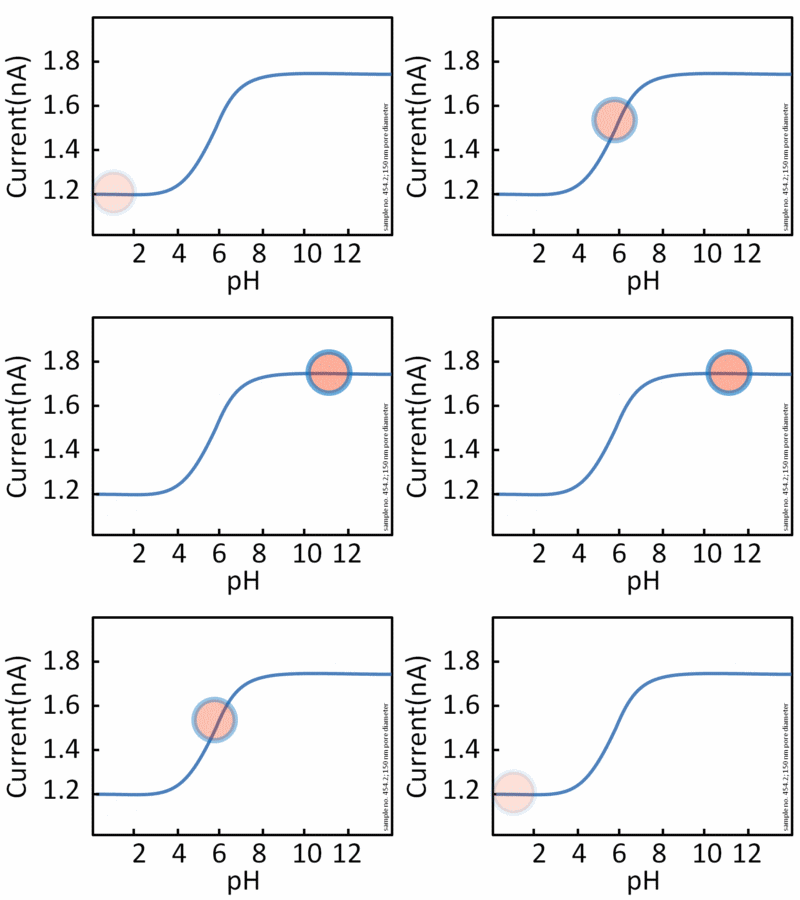
Many enzymes work best near pH 7, but not all. Pepsin, a digestive enzyme in the stomach, works best around pH 2, which makes sense for an acidic environment. Enzymes inside the lysosome also work best at an acidic pH. The reason pH matters comes back to bonding: changes in pH disrupt the hydrogen bonds between amino acids, which alters the protein's shape and therefore its function.
Concentration
The concentrations of enzyme and substrate both affect reaction rate. Raising either one generally increases the rate because there are more chances for an enzyme and substrate to meet. But if only one increases, the other becomes a limiting reagent, meaning the reaction rate is capped by whichever molecule is in short supply.
Product concentration matters too. The relative concentrations of substrate and product determine how efficiently a reaction proceeds. As products build up, they can slow the forward reaction, and in a reversible reaction, a high product concentration can even push the reaction backward.
The body keeps temperature and pH within tight ranges so its enzymes stay in their optimal conditions. If those ranges are pushed too far, like a dangerously high body temperature, enzymes can denature and cellular processes fail.
Inhibitors
Inhibitors lower enzyme activity, but they do it in different ways.
Competitive inhibitors bind reversibly to the active site. Because they compete with the substrate for the same spot, they reduce the chance that the substrate binds. They do not necessarily change the enzyme's shape; they just get in the way.
Noncompetitive inhibitors bind at an allosteric site, not the active site. Binding there changes the enzyme's activity and can alter the shape of the active site so the substrate binds less effectively, lowering the reaction rate.

For AP Biology, hold onto this contrast: competitive inhibitors bind reversibly at the active site, while noncompetitive inhibitors bind at allosteric sites and change enzyme activity.
How to Use This on the AP Biology Exam
Data and Diagrams
Expect enzyme activity graphs with reaction rate on the y-axis and a variable like temperature, pH, or substrate concentration on the x-axis. Read the peak as the optimal value, and connect the falling side of a temperature or pH curve to denaturation. When a graph levels off as substrate concentration rises, that plateau means the enzyme is saturated, so adding more substrate no longer speeds things up. If asked to calculate a reaction rate, show your work and include units in the final answer.
Written Responses
When you explain an effect, use a claim plus evidence plus reasoning structure. State what happens to the rate, then tie it back to structure-function. For example: "Increasing temperature past the optimum lowers activity because the added energy disrupts the hydrogen bonds maintaining the active site's shape, so the substrate can no longer bind." Naming the bond type that breaks is what makes the reasoning specific.
Common Trap
Be precise about inhibitor type. If the molecule binds the active site and resembles the substrate, that is competitive. If it binds elsewhere (an allosteric site) and changes the enzyme's shape or activity, that is noncompetitive. Mixing these up is an easy point to lose.
Common Misconceptions
- Misconception: Denaturation is always permanent.Actually: Not always. Some enzymes can renature and regain activity once the harsh conditions are removed, though many cannot.
- Misconception: Higher temperature always means a faster reaction.Actually: Only up to the optimal temperature. Past that point, the enzyme denatures and activity drops.
- Misconception: Denaturation breaks the enzyme's amino acid sequence.Actually: It disrupts the folded 3D shape and the bonds holding it (especially hydrogen bonds), not the order of amino acids themselves.
- Misconception: All enzymes work best at pH 7.Actually: Many do, but not all. Pepsin works best around pH 2, and lysosomal enzymes prefer acidic conditions.
- Misconception: Competitive inhibitors permanently harm the enzyme.Actually: They bind reversibly at the active site and simply compete with the substrate; they do not denature the enzyme.
- Misconception: Adding more substrate always speeds up the reaction.Actually: Once the enzyme is saturated, extra substrate has no effect because every active site is already occupied.
Related AP Biology Guides
Practice Questions for 3.2
1 of 10
A metabolic pathway proceeds A B C D E. When E accumulates, conversion of A to B decreases by 90%, although A remains abundant.
Which flowchart modification best represents the regulation in the pathway?
A.
A solid arrow from Enzyme 1 to E with a positive sign
B.
A dashed arrow from E to Enzyme 1 with a negative sign
C.
A solid arrow from E to Enzyme 1 with a positive sign
D.
A dashed arrow from E to Substrate A with a negative sign
Vocabulary
The following words are mentioned explicitly in the AP® course framework for this topic.Term | Definition |
|---|---|
active site | The specific region on an enzyme where the substrate binds and the chemical reaction is catalyzed. |
allosteric site | A binding site on an enzyme other than the active site, where regulatory molecules can bind to affect enzyme activity. |
cellular environment | The internal conditions of a cell, including temperature, pH, and concentrations of molecules, that affect enzyme function. |
chemical environment | The composition of substances surrounding an enzyme that can affect its structure and function. |
collision frequency | The rate at which enzyme and substrate molecules encounter each other in solution, affecting the rate of enzymatic reaction. |
competitive inhibitor | A molecule that binds reversibly to the active site of an enzyme, competing with substrate for binding and reducing enzyme activity. |
denaturation | The disruption of a protein's three-dimensional structure, causing loss of its biological function. |
enzymatic reaction rate | The speed at which an enzyme catalyzes the conversion of substrate to product. |
enzyme | Proteins that act as biological catalysts to speed up chemical reactions in cells by lowering activation energy. |
enzyme activity | The rate at which an enzyme catalyzes a biochemical reaction under specific cellular conditions. |
enzyme efficiency | The rate at which an enzyme catalyzes a reaction under given conditions. |
enzyme function | The ability of an enzyme to catalyze specific biochemical reactions efficiently. |
hydrogen bond | Weak attractive forces between a hydrogen atom bonded to an electronegative atom and another electronegative atom, occurring between or within biological molecules. |
noncompetitive inhibitor | A molecule that binds to an allosteric site on an enzyme, changing the enzyme's shape and reducing its activity without competing with substrate. |
optimal pH | The pH at which an enzyme exhibits maximum catalytic activity and efficiency. |
optimal temperature | The temperature at which an enzyme exhibits maximum catalytic activity and efficiency. |
product | The molecule produced as a result of an enzymatic reaction. |
product concentration | The relative amount of product molecules present in a solution, which can affect the efficiency of an enzymatic reaction. |
protein structure | The three-dimensional arrangement of amino acids in a protein, which determines its properties and function. |
reversible denaturation | The process by which a denatured enzyme can regain its original structure and catalytic activity when environmental conditions are restored. |
substrate | The molecule or substance upon which an enzyme acts during a chemical reaction. |
substrate concentration | The relative amount of substrate molecules available for an enzyme to catalyze, which affects the rate of enzymatic reaction. |
temperature | An environmental factor that affects the kinetic energy and collision frequency of molecules, influencing enzyme activity. |
Frequently Asked Questions
How do environmental factors affect enzyme function?
Environmental factors affect enzyme function by changing reaction rate or enzyme shape. Temperature, pH, substrate concentration, product concentration, and inhibitors can all change how efficiently an enzyme catalyzes a reaction.
What is enzyme denaturation?
Denaturation is a change in an enzyme's folded shape that disrupts the active site and reduces or stops catalysis. It can happen when temperature, pH, or chemical conditions disrupt bonds that maintain protein structure.
How do temperature and pH affect enzyme activity?
Temperature increases molecular motion and collision frequency up to an optimum, but high temperatures can denature enzymes. pH changes can disrupt bonding in the protein, so each enzyme works best in a specific pH range.
How do substrate and product concentrations affect enzyme reactions?
Higher substrate concentration usually increases reaction rate until enzymes become saturated. Product concentration also matters because product buildup can slow the forward reaction or shift a reversible reaction.
What is the difference between competitive and noncompetitive inhibitors?
Competitive inhibitors bind reversibly at the active site and compete with the substrate. Noncompetitive inhibitors bind at an allosteric site and change enzyme activity, often by altering the active site's shape.
How is enzyme function tested on the AP Biology exam?
AP Biology questions often use graphs, diagrams, or experiments about temperature, pH, concentration, or inhibitors. Strong answers connect the environmental change to enzyme structure, active-site shape, reaction rate, and evidence from the data.
See Fiveable more often in Google
Mark Fiveable as a preferred source and Google is more likely to show you our guides in Top Stories, with a "preferred" badge in AI Mode and AI Overviews.