5.2 Meiosis and Genetic Diversity

🧬AP Biology Unit 5 Review
5.2 Meiosis and Genetic Diversity
🧬 AP Biology
Meiosis creates genetic diversity through three main mechanisms: crossing over, independent assortment, and random fertilization. These processes shuffle maternal and paternal genetic material so gametes and the offspring they produce carry unique allele combinations. For AP Biology, separate those diversity mechanisms from nondisjunction, which is a chromosome-separation error.
AP Bio 5.2 Meiosis and Genetic Diversity
AP Bio 5.2 asks you to explain how meiosis generates genetic diversity. The core answer is that crossing over recombines alleles, independent assortment shuffles maternal and paternal chromosomes into gametes, and random fertilization combines two genetically unique gametes.
For the exam, keep the sequence precise: crossing over happens in prophase I, independent assortment is set by homologous chromosome alignment in metaphase I, and fertilization happens after meiosis. Nondisjunction is different. It is a separation error that can make gametes aneuploid instead of haploid.
Why This Matters for the AP Biology Exam
This topic is part of Unit 5, which is weighted at 8 to 11 percent of the exam. You are expected to explain how meiosis generates genetic diversity, which shows up in multiple-choice questions and free-response prompts. Diversity also connects directly to evolution and natural selection later in the course, because the variation meiosis creates is the raw material that natural selection acts on.
On free-response questions, you may be asked to explain or model how crossing over and independent assortment increase variation, or to predict the haploid outcomes of meiosis and what happens when separation fails. Being able to describe these processes clearly and connect them to genetic variation is the main skill here.
Key Takeaways
- Three processes drive genetic diversity in sexual reproduction: crossing over, independent assortment, and random fertilization.
- Correct separation of homologous chromosomes in meiosis I and sister chromatids in meiosis II gives each gamete a haploid set with a mix of maternal and paternal chromosomes.
- Crossing over happens in prophase I, when non-sister chromatids of homologous chromosomes exchange genetic material to create recombinant combinations.
- Independent assortment comes from the random orientation of homologous pairs at metaphase I, producing 2^n possible combinations (2^23 in humans).
- Random fertilization adds even more variation because any sperm can fertilize any egg.
- Nondisjunction is an error, not a diversity mechanism: it produces aneuploid gametes with too many or too few chromosomes.
How Meiosis Increases Genetic Diversity
Several features of meiosis work together to make gametes genetically unique. The main contributors are crossing over, independent assortment, and random fertilization.
In normal meiosis, homologous chromosomes separate during meiosis I and sister chromatids separate during meiosis II. This correct separation ensures that each gamete receives one chromosome from each homologous pair, making the gamete haploid (n). Because the homologs originally came from both the mother and the father, each gamete ends up with an assortment of maternal and paternal chromosomes. If this separation fails, nondisjunction occurs and the resulting gametes are no longer normal haploid cells.
Crossing Over
Crossing over takes place during prophase I, the first round of cellular division in meiosis.
During this process, homologous chromosomes exchange genetic material. Homologous chromosomes are two versions of the same chromosome. For example, chromosome 2 might carry the gene for eye color. Each individual has two versions of chromosome 2, one from mom and one from dad. One version might carry a dominant allele, and the other might carry a recessive allele.
During crossing over, non-sister chromatids of homologous chromosomes exchange parts at the same location. This does not add or remove genes; it swaps versions (alleles) of the genes.
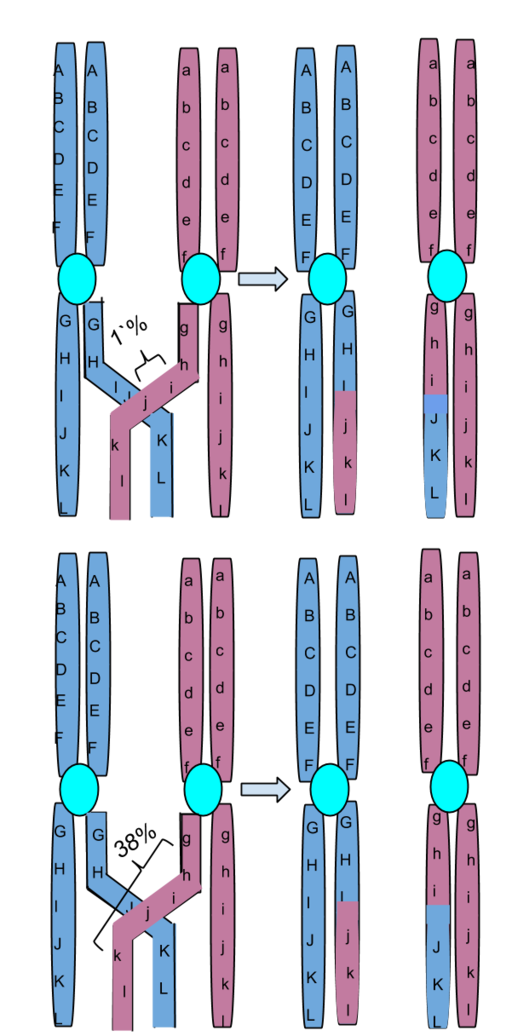
This exchange creates recombinant chromosomes with new allele combinations, increasing genetic diversity in the gametes produced by meiosis.
Independent Assortment
Independent assortment refers to the random orientation of homologous chromosome pairs during metaphase I of meiosis. Each homologous pair lines up independently of the others, so maternal and paternal homologs separate into gametes in many different combinations. Meiosis II separates sister chromatids, but the major source of independent assortment is the random alignment of homologous pairs in meiosis I.
For each homologous chromosome pair in metaphase I, there is a 50% chance that the maternal homolog faces one pole and a 50% chance that the paternal homolog faces that pole. Because each pair orients independently, meiosis can produce many different combinations of maternal and paternal chromosomes in gametes.

The number of possible chromosome combinations can be calculated with the formula 2^n, where n is the number of homologous chromosome pairs. For humans, independent assortment results in 2^23, or 8,388,608, unique combinations in a single egg or sperm. This does not even include the extra variation that crossing over and random fertilization contribute.
Random Fertilization
Random fertilization means any sperm has a chance to join with the egg. Thousands of sperm can potentially fertilize one mature egg, and each carries a distinct combination of genetic material. Because each egg and each sperm is genetically unique, random fertilization makes it extraordinarily unlikely that the same two parents would ever produce genetically identical offspring in separate fertilization events.
Nondisjunction
Nondisjunction is a meiotic error, not a normal mechanism of genetic diversity. It occurs when chromosomes do not separate properly, producing gametes with an abnormal number of chromosomes rather than the normal haploid (n) set. This can happen if chromosomes fail to separate during anaphase I or anaphase II.

If nondisjunction happens during meiosis I, homologous chromosomes fail to separate, so all four resulting gametes are aneuploid: two have one extra chromosome (n + 1) and two have one fewer chromosome (n - 1). If nondisjunction happens during meiosis II, sister chromatids fail to separate in one cell, so two gametes are normal (n), one is n + 1, and one is n - 1.
Gametes with abnormal chromosome numbers often lead to miscarriages or genetic disorders. As an application of this idea, Down syndrome results from an extra copy of chromosome 21, which fits the n + 1 situation.

How to Use This on the AP Biology Exam
Free Response
If a prompt asks how meiosis generates genetic diversity, name and explain all three contributors: crossing over, independent assortment, and random fertilization. Tie each one to the result of new allele combinations. A response that only says "crossing over" usually does not support a stronger score.
Models and Diagrams
You may be asked to construct or analyze a model of chromosomal exchange and use it to predict outcomes, such as the haploid results of meiosis or what happens after a crossing-over event. Practice drawing chromosomes with labeled maternal and paternal homologs so you can show recombinant products clearly.
Predicting Outcomes
Be ready to predict the chromosome content of gametes after nondisjunction. Track whether the error happened in meiosis I (all four gametes affected) or meiosis II (two normal, two abnormal). Use the n + 1 and n - 1 labels to describe aneuploid gametes precisely.
Common Trap
Watch for questions that mix up where each process happens. Crossing over occurs in prophase I, while independent assortment is set during metaphase I. Keep these phases straight.
Common Misconceptions
- Misconception: Crossing over adds or deletes genes.Actually: Crossing over does not add or delete genes. It swaps alleles between homologous chromosomes at the same location, creating new combinations.
- Misconception: Independent assortment is the same as crossing over.Actually: Independent assortment is not the same as crossing over. Independent assortment is about how homologous pairs line up at metaphase I, while crossing over is the physical exchange of segments in prophase I.
- Misconception: Nondisjunction is a source of healthy variation.Actually: Nondisjunction is an error, not a source of healthy variation. It produces gametes with the wrong number of chromosomes.
- Misconception: The 2^n formula includes variation from crossing over or random fertilization.Actually: The 2^n formula counts combinations from independent assortment only. It does not include the extra variation from crossing over or random fertilization, so the actual diversity is much higher.
- Misconception: Separating sister chromatids in meiosis II is the main source of allele shuffling.Actually: Sister chromatids are identical (except where crossing over has occurred), so separating them in meiosis II is not the main source of allele shuffling. The major reshuffling happens in meiosis I.
Related AP Biology Guides
Practice Questions for 5.2
1 of 10
A model of prophase I in a fungal species shows specific DNA segments exchanged between homologous chromosomes during meiosis.
Which of the following best explains how the model demonstrates genetic variation?
A.
It shows that chromosomes align randomly, producing different combinations in daughter cells.
B.
It shows that replication errors introduce mutations before meiosis begins in cells.
C.
It shows that sister chromatids separate, ensuring that each gamete receives one chromosome.
D.
It shows that homologous chromosomes exchange DNA segments, creating new allele combinations in gametes.
Vocabulary
The following words are mentioned explicitly in the AP® course framework for this topic.Term | Definition |
|---|---|
crossing over | The exchange of genetic material between non-sister chromatids of homologous chromosomes during prophase I of meiosis. |
fertilization | The fusion of two gametes to form a diploid zygote, combining genetic material from both parents. |
gamete | A haploid reproductive cell (sperm or egg) produced by meiosis that fuses with another gamete during fertilization. |
genetic diversity | The variety of different alleles and genes present within a population or species. |
haploid | A cell or organism containing a single set of chromosomes, typically represented as n. |
homologous chromosomes | Pairs of chromosomes, one inherited from each parent, that have the same genes at corresponding locations. |
maternal chromosomes | Chromosomes inherited from the mother. |
meiosis | A process of cell division in diploid organisms that produces haploid gamete cells, reducing chromosome number by half for sexual reproduction. |
meiosis I | The first division of meiosis in which homologous chromosomes separate, reducing the chromosome number from diploid to haploid. |
meiosis II | The second division of meiosis in which sister chromatids separate, similar to mitosis. |
non-sister chromatids | Chromatids from different homologous chromosomes that can exchange genetic material during crossing over. |
nondisjunction | The failure of chromosomes to separate properly during mitosis or meiosis, resulting in changes in chromosome number. |
paternal chromosomes | Chromosomes inherited from the father. |
prophase I | The first stage of meiosis I in which homologous chromosomes pair up and crossing over occurs. |
random assortment | The random distribution of homologous chromosome pairs to daughter cells during meiosis I, contributing to genetic variation. |
recombination | The process by which genetic material is exchanged between homologous chromosomes, creating new combinations of alleles. |
sexual reproduction | Reproduction involving the fusion of gametes from two parents, producing genetically diverse offspring. |
sister chromatids | Two identical copies of a chromosome joined at the centromere, formed after DNA replication. |
Frequently Asked Questions
What is AP Bio 5.2 about?
AP Bio 5.2 focuses on how meiosis generates genetic diversity. You need to explain crossing over, independent assortment, random fertilization, and what happens when chromosome separation fails.
How does meiosis create genetic diversity?
Meiosis creates genetic diversity through crossing over in prophase I, random assortment of chromosomes during meiosis, and fertilization between genetically unique gametes.
What is crossing over in meiosis?
Crossing over is the exchange of genetic material between non-sister chromatids of homologous chromosomes during prophase I. It creates recombinant chromosomes with new allele combinations.
What is independent assortment in AP Biology?
Independent assortment is the random orientation of homologous chromosome pairs during metaphase I. It produces many possible combinations of maternal and paternal chromosomes in gametes.
How does random fertilization increase genetic diversity?
Random fertilization increases genetic diversity because any genetically unique sperm can fertilize any genetically unique egg, creating many possible allele combinations in offspring.
Is nondisjunction a source of genetic diversity?
Nondisjunction is a meiotic error, not a normal diversity mechanism. It happens when chromosomes fail to separate correctly, producing gametes with too many or too few chromosomes.
See Fiveable more often in Google
Mark Fiveable as a preferred source and Google is more likely to show you our guides in Top Stories, with a "preferred" badge in AI Mode and AI Overviews.