5.4 Non-Mendelian Genetics

🧬AP Biology Unit 5 Review
5.4 Non-Mendelian Genetics
🧬 AP Biology
Non-Mendelian genetics covers inheritance patterns that do not give Mendel's predicted ratios, including genetic linkage, codominance, incomplete dominance, sex-linked traits, pleiotropy, and non-nuclear inheritance. You can spot these patterns when observed phenotypic ratios statistically differ from what Mendel's laws predict.
Non-Mendelian Genetics in AP Bio
In AP Biology, non-Mendelian genetics means inheritance patterns that do not match the simple ratios predicted by Mendel's laws. The main patterns in Topic 5.4 are genetic linkage, codominance, incomplete dominance, sex-linked inheritance, pleiotropy, and non-nuclear inheritance from mitochondria or chloroplasts.
The exam focus is evidence. If observed phenotypic ratios differ from expected Mendelian ratios, you may need to use quantitative analysis, often chi-square, to decide whether the difference is meaningful and then explain which non-Mendelian pattern fits the data.
Why This Matters for the AP Biology Exam
This topic builds your ability to explain deviations from Mendel's model of inheritance, which shows up across the heredity material on the AP Biology exam. You will often need to use data, including pedigrees and cross results, to figure out whether a trait is sex-linked, codominant, incompletely dominant, linked, or inherited through organelles. This connects directly to data analysis and statistical reasoning: when observed ratios differ from expected Mendelian ratios, a chi-square goodness-of-fit test helps you decide whether that difference is meaningful. Being precise about genotypes, phenotypes, and ratios matters, since confusing genotypic and phenotypic ratios is a common source of lost points.
Key Takeaways
- Non-Mendelian inheritance is identified when observed phenotypic ratios statistically differ from predicted Mendelian ratios, which you can test using chi-square.
- Genes on the same chromosome are genetically linked; recombination frequency between them gives map distance in map units (centimorgans).
- Codominance shows both alleles fully in the heterozygote; incomplete dominance gives a blended intermediate phenotype.
- Sex-linked traits sit on the X or Y chromosome, and X-linked recessive traits show up more often in XY individuals because they carry only one X.
- Pleiotropy means one gene affects multiple traits, so those traits do not segregate independently.
- Non-nuclear inheritance (mitochondrial and chloroplast DNA) is typically maternal and does not follow Mendelian rules.
Inheritance Beyond Mendel's Laws
Many traits do not follow the ratios predicted by Mendel's laws. You identify these traits through quantitative analysis: when the observed phenotypic ratios statistically differ from the predicted ratios, the inheritance pattern is likely non-Mendelian.
Identifying Non-Mendelian Patterns Through Statistical Analysis
When you run a genetic cross, you compare observed phenotypic ratios with the ratios Mendel's laws predict:
- Expected Mendelian ratios: 3:1 (monohybrid cross) or 9:3:3:1 (dihybrid cross)
- A chi-square goodness-of-fit test lets you compare observed and expected counts
- If the observed ratios differ significantly from expected ratios, the inheritance pattern may deviate from simple dominant/recessive inheritance
- Common non-Mendelian patterns include genetic linkage, sex linkage, codominance, and incomplete dominance
State your null hypothesis carefully: it predicts no significant difference between observed and expected results. A common exam mistake is identifying an alternate hypothesis instead of the null. If the chi-square value is large enough, you reject the null hypothesis and conclude the difference is meaningful.
Genetically Linked Genes and Gene Mapping
Genes located on the same chromosome are genetically linked. Linked genes tend to be inherited together during meiosis unless crossing over separates them. The frequency of recombination between two genes tells you how far apart they are on the chromosome.
The probability that linked genes segregate together can be used to calculate the map distance (or map units) between them. This is called gene mapping or genetic mapping:
- 1% recombination frequency = 1 map unit (one centimorgan)
- Recombination frequency = (number of recombinant offspring / total offspring) × 100
- Example: if 15 of 100 offspring are recombinants, the two genes are about 15 map units apart
- The greater the distance between two genes, the more likely crossing over occurs between them
- Genes far apart on the same chromosome (more than 50 map units) can appear to assort independently
Sex-Linked Traits
Sex-linked traits are determined by genes on a sex chromosome, X or Y. Most lie on the X chromosome. X-linked recessive traits appear more often in XY individuals because they have only one X chromosome, so they express whatever allele is on that single X. They cannot be heterozygous for an X-linked gene. Y-linked traits pass from father to son.
Pedigree Analysis of Sex-Linked Traits

You can often predict sex-linked inheritance from data, including pedigrees that show the genotypes and phenotypes of parents and offspring. Patterns that point to X-linked recessive inheritance include:
- Affected XY individuals appear more frequently than affected XX individuals
- Affected XY individuals often have unaffected parents
- The trait can skip generations, passing from an affected grandfather through a carrier daughter to an affected grandson
- A carrier mother can pass the trait to her sons
To work through a pedigree, first decide whether the trait is X-linked or Y-linked. For an X-linked recessive trait, an affected XY individual usually inherits the allele from a carrier or affected mother, and fathers do not pass X-linked traits to their sons. An affected XX individual must inherit the recessive allele from both parents. For Y-linked traits, only XY individuals are affected, and an affected father passes the trait to all sons. Use the phenotypes of parents and offspring to infer likely genotypes and predict expected offspring ratios.
Colorblindness and hemophilia are common examples of X-linked traits.
Worked example with a Punnett square:
- Mother: X^B X^b, heterozygous and a carrier. She has normal color vision because the trait is recessive.
- Father: X^B Y, normal color vision.
- Daughters: one X^B X^B (homozygous, normal vision) and one X^B X^b (carrier, normal vision).
- Sons: one X^B Y (normal vision) and one X^b Y (colorblind).
Even though both parents have normal color vision, this cross can still produce a colorblind son because the mother carries a recessive allele on one X.
Incomplete Dominance
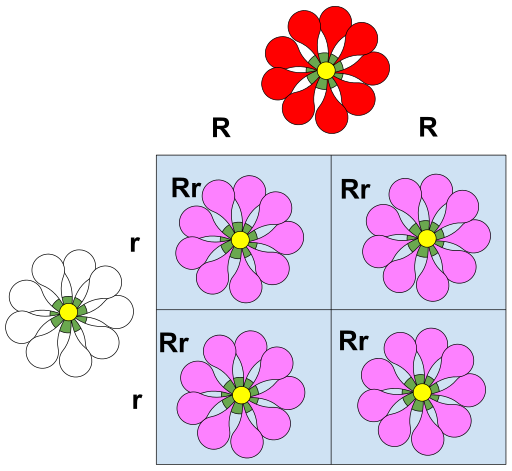
Incomplete dominance occurs when neither allele can mask the other, so the heterozygote shows a blended phenotype between the two homozygotes. A classic example is flower color: a cross between a red-flowered and a white-flowered plant can produce pink-flowered heterozygotes. The pink is a true blend, not one color winning out.
Even when you write the alleles with capital and lowercase letters, neither allele is actually dominant in incomplete dominance, which is why the heterozygote looks intermediate.
Codominance

Codominance occurs when both alleles are fully and distinctly expressed in the heterozygote, so the heterozygote has a different phenotype than either homozygote. Unlike incomplete dominance, the two traits are not blended; both show up at once. Roan coat color in cattle is a good example: a red homozygote crossed with a white homozygote produces heterozygous offspring that show both red and white hairs together. The ABO blood group is another codominance example, where the A and B alleles are both expressed in an AB individual.
Pleiotropy
Pleiotropy occurs when a single gene affects multiple traits or effects. Because one gene influences several characteristics, those traits do not segregate independently the way Mendel's laws would predict.
Examples of pleiotropy include:
- Marfan syndrome: a mutation in the fibrillin gene affects the skeletal system, eyes, and cardiovascular system
- Phenylketonuria (PKU): a single gene mutation affects metabolism and can lead to several connected effects if untreated
Non-Nuclear Inheritance
Some traits come from DNA outside the nucleus, specifically in mitochondria and chloroplasts.
- Chloroplasts and mitochondria are randomly assorted to gametes and daughter cells, so traits determined by their DNA do not follow simple Mendelian rules.
- In animals, mitochondria are usually transmitted by the egg and not by sperm, so mitochondrial traits are typically maternally inherited.
- In plants, mitochondria and chloroplasts are transmitted in the ovule and not in the pollen, so both mitochondrial and chloroplast traits are typically maternally inherited.
How to Use This on the AP Biology Exam
MCQ
- Match a described pattern to its name. If the heterozygote is a blend, think incomplete dominance; if both alleles show fully, think codominance.
- For sex-linked questions, check whether affected individuals are mostly XY and whether the trait skips generations through carrier mothers.
- If two genes are inherited together more often than expected, suspect linkage and think about recombination frequency.
Free Response
- When asked to explain a deviation from Mendel's model, name the specific pattern and explain the mechanism behind it, not just the result.
- For pedigree questions, assign genotypes using correct notation (for example, X^B X^b) and justify how parent genotypes produce the offspring you predict.
- Be exact about which ratio you are giving. State whether it is a genotypic ratio or a phenotypic ratio.
Problem Solving
- Recombination frequency = (recombinant offspring / total offspring) × 100, and 1% equals 1 map unit.
- For a chi-square comparison, state the null hypothesis (no significant difference between observed and expected), calculate the value, and decide whether to reject or fail to reject it.
Common Trap
- Mixing up genotypic and phenotypic ratios costs points often. Read the question to see which one it wants.
Common Misconceptions
- Misconception: Incomplete dominance and codominance are the same.Actually: Incomplete dominance and codominance are not the same. Incomplete dominance blends the two phenotypes into an intermediate; codominance shows both phenotypes fully and separately in the heterozygote.
- Misconception: Capital and lowercase letters always mean dominant and recessive.Actually: Capital and lowercase letters do not always mean dominant and recessive. In incomplete dominance, neither allele is dominant even if the notation looks like standard Mendelian alleles.
- Misconception: XY individuals are heterozygous for X-linked genes.Actually: XY individuals are not heterozygous for X-linked genes. With only one X chromosome, they express whatever allele that single X carries.
- Misconception: A significant chi-square result proves a specific cause.Actually: A significant chi-square result does not prove a specific cause. It tells you the observed and expected ratios differ enough to reject the null hypothesis, which is your signal to look for a non-Mendelian explanation.
- Misconception: The null hypothesis is the alternate hypothesis.Actually: The null hypothesis is not the alternate hypothesis. The null predicts no significant difference between observed and expected results, and students often state the alternate by mistake.
- Misconception: Mitochondrial traits are inherited from both parents in animals.Actually: Mitochondrial traits are not inherited from both parents in animals. They are typically passed down maternally through the egg, so they do not follow Mendelian patterns.
Related AP Biology Guides
Practice Questions for 5.4
1 of 10
A blood protein from individuals with genotypes , , and was separated by gel electrophoresis, as shown in the diagram.
Which claim about the and alleles is best supported?
A.
The alleles are codominant, but only one protein product is expressed.
B.
The alleles are codominant because the proteins combine into an intermediate phenotype.
C.
The alleles are codominant because both distinct protein products are expressed.
D.
The alleles show incomplete dominance because an intermediate protein is produced.
Vocabulary
The following words are mentioned explicitly in the AP® course framework for this topic.Term | Definition |
|---|---|
chloroplast DNA | Genetic material located in chloroplasts that can be inherited independently of nuclear DNA, typically through the maternal lineage in plants. |
codominance | A pattern of inheritance in which both alleles are fully expressed in the heterozygote, resulting in a phenotype different from either homozygote. |
deviations from Mendel's model | Patterns of inheritance that do not follow the predicted ratios and rules established by Mendel's laws of inheritance. |
genetic mapping | The process of determining the relative positions and distances of genes on a chromosome based on recombination frequencies. |
genetically linked | Genes located close together on the same chromosome that tend to be inherited together. |
incomplete dominance | A pattern of inheritance in which neither allele is completely dominant, resulting in a blended phenotype in the heterozygote that is intermediate between the two homozygous phenotypes. |
map distance | The relative distance between two genes on a chromosome, measured in map units and calculated based on the frequency of recombination between them. |
maternal inheritance | A pattern of inheritance in which traits are transmitted only or primarily through the female parent, typically due to organellar DNA in the egg or ovule. |
mitochondrial DNA | Genetic material located in mitochondria that can be inherited independently of nuclear DNA, typically through the maternal lineage. |
non-nuclear inheritance | Inheritance of traits determined by genes located in organelles such as mitochondria and chloroplasts rather than in the nucleus. |
phenotypic ratios | The proportions of different observable traits in offspring, compared to predicted ratios based on genetic crosses. |
pleiotropy | A phenomenon in which a single gene influences the expression of multiple, seemingly unrelated traits. |
sex-linked traits | Traits determined by genes located on sex chromosomes (X or Y), which show inheritance patterns different from autosomal traits. |
Frequently Asked Questions
What is non-Mendelian genetics in AP Bio?
Non-Mendelian genetics includes inheritance patterns that do not follow Mendel's predicted ratios. AP Bio examples include linked genes, codominance, incomplete dominance, sex-linked traits, pleiotropy, and non-nuclear inheritance.
What are linked genes?
Linked genes are genes located on the same chromosome. They tend to be inherited together unless crossing over separates them during meiosis.
How do you calculate map distance?
Map distance is calculated from recombination frequency. Use recombinant offspring divided by total offspring, multiplied by 100. A recombination frequency of 1 percent equals 1 map unit, or 1 centimorgan.
What is the difference between codominance and incomplete dominance?
In codominance, both alleles are fully expressed in the heterozygote. In incomplete dominance, the heterozygote has a blended intermediate phenotype.
What are sex-linked traits?
Sex-linked traits are determined by genes on the X or Y chromosome. X-linked recessive traits often appear more often in XY individuals because they have only one X chromosome.
What is non-nuclear inheritance?
Non-nuclear inheritance involves genes outside the nucleus, usually in mitochondria or chloroplasts. These traits do not follow simple Mendelian rules and are often maternally inherited in animals.
See Fiveable more often in Google
Mark Fiveable as a preferred source and Google is more likely to show you our guides in Top Stories, with a "preferred" badge in AI Mode and AI Overviews.