Fiveable

🧬AP Biology Unit 3 Review

QR code for AP Biology practice questions

3.1 Enzymes

🧬AP Biology
Unit 3 Review

3.1 Enzymes

Written by the Fiveable Content Team • Last updated September 2025
Verified for the 2026 exam
Verified for the 2026 examWritten by the Fiveable Content Team • Last updated September 2025
🧬AP Biology
Unit & Topic Study Guides
Pep mascot

Skills you’ll gain in this topic:

  • Describe the structure of enzymes and their active sites.
  • Explain how enzymes lower activation energy in biochemical reactions.
  • Illustrate how enzyme specificity impacts substrate interactions.
  • Predict how changes in enzyme structure affect activity.
  • Relate enzyme structure to its role in cellular processes.
Pep mascot
more resources to help you study

Living Organisms and Energy

One of the ways in which living systems maintain their highly complex organization is through the constant input of energy. This energy is typically obtained through metabolic processes, such as respiration or photosynthesis, which involve the conversion of nutrients into usable energy. In addition to providing the energy needed to fuel cellular processes, this constant input of energy also helps to maintain the structural integrity of the cell. For these processes to occur, enzymes are required.

Enzymes are a crucial component of the highly complex organization of living systems. These specialized proteins act as catalysts, speeding up chemical reactions within cells and enabling them to carry out the many functions necessary for life. Enzymes are involved in a wide range of cellular processes, including metabolismcell division, and gene expression, and they are essential for the proper functioning of cells. ⚡

Source: Wikimedia Commons

Shape of Enzymes

It is important to understand the structure of enzymes and how it relates to their function as enzymes are the workhorses of the cell, catalyzing the chemical reactions necessary for metabolism, growth, and reproduction. The structure of enzymes plays a critical role in their ability to carry out these functions.

Enzymes are composed of one or more polypeptide chains, which are long chains of amino acids. The specific sequence of amino acids in an enzyme determines its primary structure. The primary structure is the linear sequence of amino acids in a polypeptide or protein. However, primary structure alone cannot account for the complexity and diversity of enzyme function, this is where the higher levels of structure come into play.

The specific arrangement of the amino acid residues in space determines the enzyme's three-dimensional structure, which is crucial for its function. The three-dimensional structure of enzymes can be divided into several levels:

  • Secondary structure, which refers to the local patterning of the amino acids, such as the formation of alpha-helices or beta-sheets.
  • Tertiary structure, which refers to the overall three-dimensional conformation of the enzyme, including the location of the active site and other functional groups.
  • Quaternary structure, which refers to the spatial relationship between the subunits in multimeric enzymes (Multimeric refers to a complex of multiple identical or non-identical subunits).

Enzymes function by binding to substrate molecules and catalyzing specific chemical reactions. The active site of an enzyme is the region of the enzyme where the substrate binds and the reaction takes place. The three-dimensional structure of the enzyme, including the active site, must be complementary to the substrate in order for the enzyme to bind to it and catalyze the reaction.

Source: WikiMedia Commons.

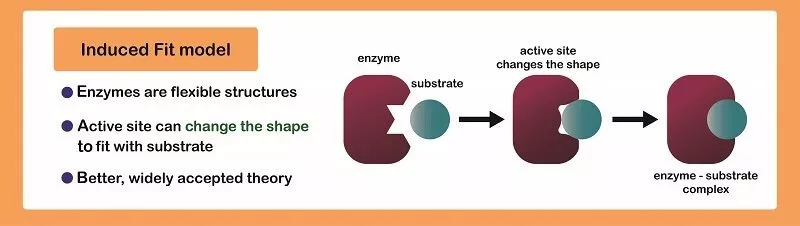
Furthermore, enzymes are dynamic molecules that can change shape upon binding to substrate or other molecules, this is known as the induced fit mechanism. This conformational change can enhance the specificity and efficiency of the enzyme-substrate interaction, thus increasing the rate of the chemical reaction.

Source: WikiMedia Commons.

Active Site

Enzymes have a specific region called the active site, which is where the substrate(s) bind and the chemical reaction takes place. The active site is usually a depression or cleft on the surface of the enzyme and is often lined with specific amino acids that interact with the substrate.

Enzymes are highly specific and only catalyze specific reactions. This specificity is due to the specific shape of the active site, which only fits the substrate for which it is intended.

In order for an enzyme-mediated chemical reaction to occur, the substrate must first bind to the active site of the enzyme. The active site is a specific region on the surface of the enzyme that is designed to interact with the substrate.

The shape and charge of the substrate must be compatible with the active site of the enzyme in order for the substrate to bind effectively. This is because the active site is specifically shaped to fit the substrate, and the amino acids that make up the active site often have specific charges that interact with the substrate.

If the shape or charge of the substrate is not compatible with the active site of the enzyme, the substrate will not bind effectively, and the chemical reaction will not occur.

Likewise, enzymes can be regulated to control the rate of a reaction. This can be done by several mechanisms, including allosteric regulation, where a molecule binds to a specific site on the enzyme (called an allosteric site) and changes the shape of the active site, causing the enzyme to either become more or less active. Enzymes can also be regulated by the concentration of substrate or the presence of an inhibitor. 👎

Source: Jack Westin

Induced Fit

Induced fit is a mechanism (model) of enzyme catalysis in which the enzyme changes its conformation or shape upon binding to the substrate, resulting in a tighter and more specific binding of the enzyme and substrate, and ultimately, a more efficient catalytic reaction.

In induced fit, the enzyme's active site is not a rigid, pre-formed structure that exactly matches the substrate's shape (think of a glove snugly fitting into your hand), but rather a flexible structure that adjusts its conformation upon binding to the substrate. As the substrate enters the active site, the enzyme's amino acid residues in the active site move slightly to adjust their positions, resulting in a tighter fit between the enzyme and substrate. This tighter fit allows for more efficient formation of the transition state, which is the high-energy intermediate between the substrate and the products, and hence increases the rate of the reaction.

Source: Biology Dictionary

This mechanism of enzyme catalysis can also play a role in substrate specificity. When the enzyme's active site is flexible, it can adjust its conformation to fit a variety of different substrates. However, the adjustments it makes to bind different substrates may be different, and only the substrate that fits the active site the best will be catalyzed with the highest efficiency.

In addition, induced fit can also contribute to the regulation of enzyme activity by controlling the rate of substrate binding and product release. Some enzymes can tightly bind the substrate only in certain conditions such as the presence of a cofactor or a specific environment, in these cases the induced fit mechanism is more relevant for the regulation of the enzyme activity than for substrate specificity.

Frequently Asked Questions

What are enzymes and how do they work in cells?

Enzymes are protein catalysts in cells that speed up biological reactions by lowering the activation energy (EK 3.1.A.1). Each enzyme has an active site whose shape and charge fit specific substrates—the enzyme–substrate complex—so reactions are substrate-specific (EK 3.1.A.2). Models: lock-and-key (fit) and induced-fit (active site molds around substrate). Enzymes stabilize the transition state and increase reaction rate without being consumed. Cofactors or coenzymes can be required for activity. Regulation: competitive inhibitors bind the active site; noncompetitive (allosteric) inhibitors bind elsewhere and change enzyme shape. Environmental effects: enzymes have an optimum temperature and pH; extremes cause denaturation and loss of activity. On the AP exam you’ll be asked to explain rate changes, interpret enzyme graphs, and predict effects of inhibitors or pH/temp shifts (Topic 3.1/3.2). Review the Topic 3.1 study guide for examples and practice (https://library.fiveable.me/ap-biology/unit-3/enzyme-structure/study-guide/jsjBfuk2jmYAZVrmVwtF) and try AP-style practice questions (https://library.fiveable.me/practice/ap-biology).

Why do enzymes speed up chemical reactions?

Enzymes speed up biological reactions by lowering the activation energy needed to reach the transition state (EK 3.1.A.1). They do this by binding substrates at a specific active site (enzyme-substrate complex)—often via an induced-fit—which orients reactants, stabilizes the transition state, and increases effective collisions. That specificity (shape + charge) makes catalysis efficient; some enzymes also need cofactors or coenzymes to help the chemistry. Because enzymes lower the energy barrier (not ΔG), they increase reaction rate without changing the reaction’s overall free energy. On the AP exam, link this idea to LO 3.1.A (how enzymes affect reaction rates) and use terms like activation energy, active site, induced-fit, and transition-state stabilization. Want a quick review or practice problems tied to Topic 3.1? See the Topic 3.1 study guide (https://library.fiveable.me/ap-biology/unit-3/enzyme-structure/study-guide/jsjBfuk2jmYAZVrmVwtF) and Unit 3 resources (https://library.fiveable.me/ap-biology/unit-3), plus 1000+ practice questions (https://library.fiveable.me/practice/ap-biology).

What's the difference between a catalyst and an enzyme?

A catalyst is any substance that speeds up a chemical reaction by lowering the activation energy without being consumed. An enzyme is a biological catalyst—usually a protein—that does that inside living cells (CED EK 3.1.A.1). Key differences: enzymes have specific active sites that bind particular substrates (substrate specificity, enzyme-substrate complex, induced fit), so they stabilize the transition state and greatly increase catalytic efficiency. Enzymes are also regulated: cofactors/coenzymes, allosteric sites, competitive and noncompetitive inhibitors, and they’re sensitive to temperature and pH (CED keywords). In short: all enzymes are catalysts, but not all catalysts are enzymes. For AP Bio, link this to LO 3.1.A (how enzymes change reaction rates) and review enzyme structure details in the Topic 3.1 study guide (https://library.fiveable.me/ap-biology/unit-3/enzyme-structure/study-guide/jsjBfuk2jmYAZVrmVwtF). For extra practice, try problems at (https://library.fiveable.me/practice/ap-biology).

How does the active site of an enzyme work with substrates?

The active site is the small pocket on an enzyme where the substrate fits—think of it as the enzyme’s working surface. For a reaction to occur, the substrate’s shape and charge must match the active site (substrate specificity). When the substrate binds, an enzyme-substrate complex forms; the enzyme stabilizes the transition state and lowers the activation energy, so the reaction goes faster (LO 3.1.A, EK 3.1.A.1). Binding often follows the induced-fit model: the active site changes shape slightly to grip the substrate more tightly, improving catalytic efficiency. Some enzymes need cofactors or coenzymes to form an active site that works; inhibitors (competitive or noncompetitive/allosteric) can block the site or change its shape and slow/stop activity. Environmental factors (temperature, pH) can denature the active site and reduce activity (see Topic 3.1 and related Topic 3.2/3.3). For a quick review tied to the AP framework, check the Topic 3.1 study guide (https://library.fiveable.me/ap-biology/unit-3/enzyme-structure/study-guide/jsjBfuk2jmYAZVrmVwtF) and more unit resources (https://library.fiveable.me/ap-biology/unit-3). Practice over 1,000 questions here: (https://library.fiveable.me/practice/ap-biology).

I'm confused about activation energy - how do enzymes lower it?

Activation energy is the extra energy reactants need to reach the transition state before a reaction proceeds. Enzymes lower that barrier mainly by stabilizing the transition state at the active site—they bind substrates with complementary shape/charge (induced fit), orient them properly, strain bonds, and create a microenvironment (e.g., acidic/basic side chains or bound cofactors) that makes the high-energy transition state easier to form. That doesn’t change ΔG of the overall reaction—it just reduces the activation energy so more molecules can react per unit time, which increases reaction rate (LO 3.1.A; EK 3.1.A.1/3.1.A.2). Think of the enzyme as providing a different pathway with a lower hill to climb. For more AP-aligned review of enzyme structure and these concepts, see the Topic 3.1 study guide (https://library.fiveable.me/ap-biology/unit-3/enzyme-structure/study-guide/jsjBfuk2jmYAZVrmVwtF). For broader unit review and lots of practice, check Unit 3 (https://library.fiveable.me/ap-biology/unit-3) and practice problems (https://library.fiveable.me/practice/ap-biology).

What happens when an enzyme and substrate bind together?

When an enzyme and its substrate bind, the substrate fits into the enzyme’s active site to form an enzyme–substrate complex. The enzyme’s shape and charge match the substrate (substrate specificity), and binding often causes a slight change in the enzyme’s shape (the induced-fit model). That binding stabilizes the reaction’s transition state and lowers the activation energy, so the reaction rate increases (EK 3.1.A.1, EK 3.1.A.2). After the chemical reaction occurs, products are released and the enzyme is free to catalyze more reactions—enzymes aren’t consumed, so they improve catalytic efficiency. Cofactors or coenzymes may be required for binding or catalysis. Environmental factors (temperature, pH) and inhibitors (competitive or noncompetitive) can prevent effective binding by altering the active site or blocking it. For AP review, see the Topic 3.1 study guide (https://library.fiveable.me/ap-biology/unit-3/enzyme-structure/study-guide/jsjBfuk2jmYAZVrmVwtF) and more unit resources (https://library.fiveable.me/ap-biology/unit-3).

Why does the shape of an enzyme matter so much?

Shape matters because an enzyme’s function depends on its active site fitting the substrate—like a lock-and-key (or better: induced fit) so the substrate’s shape and charge match the active site (EK 3.1.A.2). That precise fit lets the enzyme stabilize the transition state and lower activation energy, so reactions run faster (EK 3.1.A.1). If the enzyme’s shape changes (mutations, heat, wrong pH, or binding of an allosteric regulator), the active site may no longer bind substrate or position it for catalysis—reducing catalytic efficiency or stopping the reaction. Shape also determines where inhibitors or cofactors bind (competitive vs noncompetitive/allosteric regulation). For AP exam framing, connect shape → substrate specificity → rate change (LO 3.1.A). For a quick review, check the Topic 3.1 study guide (https://library.fiveable.me/ap-biology/unit-3/enzyme-structure/study-guide/jsjBfuk2jmYAZVrmVwtF); more unit review and practice questions are at (https://library.fiveable.me/ap-biology/unit-3) and (https://library.fiveable.me/practice/ap-biology).

Can someone explain the enzyme-substrate complex model in simple terms?

Think of an enzyme as a protein with a special pocket called the active site that fits its substrate (the reactant). When the substrate binds, they form the enzyme–substrate complex—a temporary combo where the enzyme holds the substrate in just the right orientation. That binding lowers the activation energy (makes it easier) so the reaction proceeds faster (LO 3.1.A; EK 3.1.A.1). Two common ways to picture this: the lock-and-key model (active site already matched to the substrate) and the induced-fit model (the active site changes shape slightly to snugly wrap the substrate). Specificity depends on shape and charge—only compatible substrates bind (EK 3.1.A.2). Cofactors or coenzymes can be required, and inhibitors (competitive/noncompetitive) block binding or change the active site. Environmental factors (temperature, pH) affect folding and activity. For a quick AP review, check the Topic 3.1 study guide (https://library.fiveable.me/ap-biology/unit-3/enzyme-structure/study-guide/jsjBfuk2jmYAZVrmVwtF); more unit resources and practice questions are at (https://library.fiveable.me/ap-biology/unit-3) and (https://library.fiveable.me/practice/ap-biology).

What would happen if we didn't have enzymes in our bodies?

Enzymes speed up biological reactions by lowering activation energy and stabilizing the transition state (LO 3.1.A; EK 3.1.A.1). If you didn’t have enzymes, nearly all metabolic reactions (digestion, DNA replication, cellular respiration, photosynthesis) would be astronomically slower—too slow to sustain life. To get those reactions to meaningful rates without enzymes, cells would need much higher temperatures or extreme conditions that would denature proteins and damage cells. Also, without enzyme specificity (active sites, induced-fit), reactions would be unregulated, so pathways couldn’t be fine-tuned by cofactors, allosteric regulation, or inhibitors. On the AP exam, be ready to link enzyme structure (active site, substrate specificity) to rate changes and to explain effects of temperature/pH on activity (see Topic 3.1 and 3.3). For a focused review, check the Topic 3.1 study guide (https://library.fiveable.me/ap-biology/unit-3/enzyme-structure/study-guide/jsjBfuk2jmYAZVrmVwtF), the Unit 3 overview (https://library.fiveable.me/ap-biology/unit-3), and practice questions (https://library.fiveable.me/practice/ap-biology).

How do enzymes know which substrates to bind to?

Enzymes “know” which substrates to bind because the substrate’s shape and charge fit the enzyme’s active site—think lock-and-key or induced-fit models. The active site has a specific 3D shape and chemical environment (charged, polar, nonpolar residues) that matches the substrate’s shape and functional groups (EK 3.1.A.2). When the substrate binds, the enzyme stabilizes the transition state and lowers activation energy, increasing reaction rate (LO 3.1.A). In many enzymes the active site slightly changes shape around the substrate (induced fit), improving specificity and catalysis. Cofactors or coenzymes can also be required to create the right charge/shape for binding. Remember environmental factors (pH, temperature) can alter enzyme shape and prevent proper binding—those are covered in Topic 3.3. For a quick AP-aligned refresher, check the Topic 3.1 study guide (https://library.fiveable.me/ap-biology/unit-3/enzyme-structure/study-guide/jsjBfuk2jmYAZVrmVwtF). For more practice, try the AP Bio question bank (https://library.fiveable.me/practice/ap-biology).

Why are enzymes called biological catalysts?

Enzymes are called biological catalysts because they’re proteins in cells that speed up chemical reactions without being permanently changed or used up. They lower the activation energy needed to reach the transition state (so reactions happen faster at biological temperatures), often by stabilizing that transition state in the enzyme–substrate complex. Specificity comes from the active site—only substrates with compatible shape and charge fit (lock-and-key or induced-fit models), which increases catalytic efficiency. Enzymes can also require cofactors or coenzymes and are regulated by things like allosteric sites, competitive/noncompetitive inhibitors, temperature and pH (denaturation or optimum pH affect activity). For AP exam framing: LO 3.1.A and EK 3.1.A.1–A.2 are exactly about this—explain rate effects, activation energy, and substrate-active site compatibility. Review this topic study guide (https://library.fiveable.me/ap-biology/unit-3/enzyme-structure/study-guide/jsjBfuk2jmYAZVrmVwtF), the unit overview (https://library.fiveable.me/ap-biology/unit-3), and practice problems (https://library.fiveable.me/practice/ap-biology).

I don't understand how enzyme shape affects function - can someone help?

Enzyme shape = function because the active site’s 3D geometry and charge must match the substrate (substrate specificity). If the active site fits the substrate, the enzyme stabilizes the transition state and lowers activation energy so the reaction speeds up (EK 3.1.A.1, EK 3.1.A.2). Two models: lock-and-key (perfect fit) and induced fit (enzyme changes shape slightly to grip substrate). Change the shape—by mutation, heat, or wrong pH—and the active site no longer binds effectively (denaturation), so catalytic efficiency drops. Shape also explains regulation: cofactors/coenzymes can complete an active site, competitive inhibitors block the active site, and noncompetitive/allosteric regulators change enzyme shape away from the active site to turn activity up or down. For AP prep, know these terms and how they link to rate changes. Review Topic 3.1 study guide (https://library.fiveable.me/ap-biology/unit-3/enzyme-structure/study-guide/jsjBfuk2jmYAZVrmVwtF) and practice problems (https://library.fiveable.me/practice/ap-biology).

What's the relationship between enzyme structure and what it does?

Enzyme structure determines function because the enzyme’s 3-D shape creates a specific active site that fits substrates by shape and charge (substrate specificity). When substrate binds, an enzyme–substrate complex forms and the enzyme lowers activation energy—often by stabilizing the transition state (EK 3.1.A.1). Models you should know: lock-and-key (perfect fit) and induced fit (active site shifts to snugly accommodate substrate). Small changes in amino acid sequence, cofactors/coenzymes, or in folding (denaturation from extreme pH or temperature) can block the active site or change charge distribution and stop catalysis. Allosteric regulation and competitive vs. noncompetitive inhibitors alter activity by changing enzyme shape or blocking the active site (EK 3.1.A.2). This is exactly what AP asks you to explain for LO 3.1.A—how structure affects reaction rate. For a quick topic review check the Topic 3.1 study guide (https://library.fiveable.me/ap-biology/unit-3/enzyme-structure/study-guide/jsjBfuk2jmYAZVrmVwtF) and try practice questions (https://library.fiveable.me/practice/ap-biology).

How do enzymes help regulate biological processes?

Enzymes regulate biological processes by controlling how fast specific chemical reactions happen. As protein catalysts they lower the activation energy and stabilize the transition state, so reactions reach products much faster without changing ΔG (EK 3.1.A.1). Substrate specificity comes from the active site shape/charge (lock-and-key and induced-fit models, EK 3.1.A.2), so only certain substrates bind to form an enzyme–substrate complex. Regulation happens several ways: cells use cofactors/coenzymes to activate enzymes, allosteric regulation to switch activity up or down, and inhibitors—competitive (binds active site) or noncompetitive/allosteric (changes enzyme shape). Environmental factors (temperature, pH) affect catalytic efficiency and can denature enzymes or change activity. These ideas map directly to LO 3.1.A on the AP exam. For a focused review, see the Topic 3.1 study guide (https://library.fiveable.me/ap-biology/unit-3/enzyme-structure/study-guide/jsjBfuk2jmYAZVrmVwtF) and practice questions (https://library.fiveable.me/practice/ap-biology).

Do all enzymes work the same way or are there different types?

Short answer: different types—and they don’t all work exactly the same. Enzymes are protein catalysts that all lower activation energy, but they differ in how they bind and are regulated. Key AP ideas: each enzyme has a specific active site (substrate specificity)—models include lock-and-key and induced fit—and stabilizes the transition state. Some require cofactors or coenzymes to work. Regulation varies: allosteric enzymes change shape at sites away from the active site, and inhibitors act competitively (compete at the active site) or noncompetitively (bind elsewhere). Environmental effects (temperature, pH) change activity and can denature enzymes (see trypsin pH graph in the CED sample questions). These differences matter for LO 3.1.A on the AP exam because you’ll explain rate changes, specificity, and regulation. For a focused review, check the Topic 3.1 study guide (https://library.fiveable.me/ap-biology/unit-3/enzyme-structure/study-guide/jsjBfuk2jmYAZVrmVwtF) and practice problems (https://library.fiveable.me/practice/ap-biology).