Skills you'll gain in this topic:
- Describe plasma membrane structure using the fluid mosaic model.
- Explain how selective permeability regulates the cell's internal environment.
- Identify roles of membrane proteins in transport and cell communication.
- Predict molecule movement based on membrane structure and gradients.
- Relate membrane structure to cellular homeostasis maintenance.

Plasma Membranes
The plasma membrane is made up of a phospholipid bilayer. These have 2 parts, a hydrophobic (water-hating) part, and a hydrophilic (water-loving) part.
The hydrophilic heads, comprised of a phosphate group, face the outside and inside of the cell, where water is present. The hydrophobic tails, comprised of fatty acids, face inward and do not interact with water.
Image courtesy of Wikimedia CommonsAs seen below, there are proteins embedded into the plasma membrane. These proteins can be hydrophobic, hydrophilic, charged, uncharged, polar, or non-polar depending on the configuration of the amino acids in the protein. So that means the hydrophilic part of the protein will be embedded in the hydrophilic part of the membrane while the hydrophobic part of the protein will hide inside with the tails.
Image courtesy of Wikimedia CommonsThe cell membrane also has glycoproteins and glycolipids attached to it along with steroids. These groups help with cell signaling and the attachment of the cell to other structures.
Models of the plasma membrane are given the name: fluid mosaic model. This represents the fact that the membrane is fluid and somewhat moveable. The proteins embedded in the membrane, which serve a variety of functions, create the mosaic portion of the name.
These proteins come to play a vital role in almost everything. There are five broad categories for these transmembrane proteins.
- adhesion proteins - form junction between cells
- receptor proteins - receive messages such as hormones (act as docking site)
- transport proteins - pumps that actively transport stuff using ATP
- channel proteins - form channel that passively transport stuff
- cell surface markers - act as ID card for the cell
🎥 Watch AP Biology - Plasma Membranes
Membrane Permeability
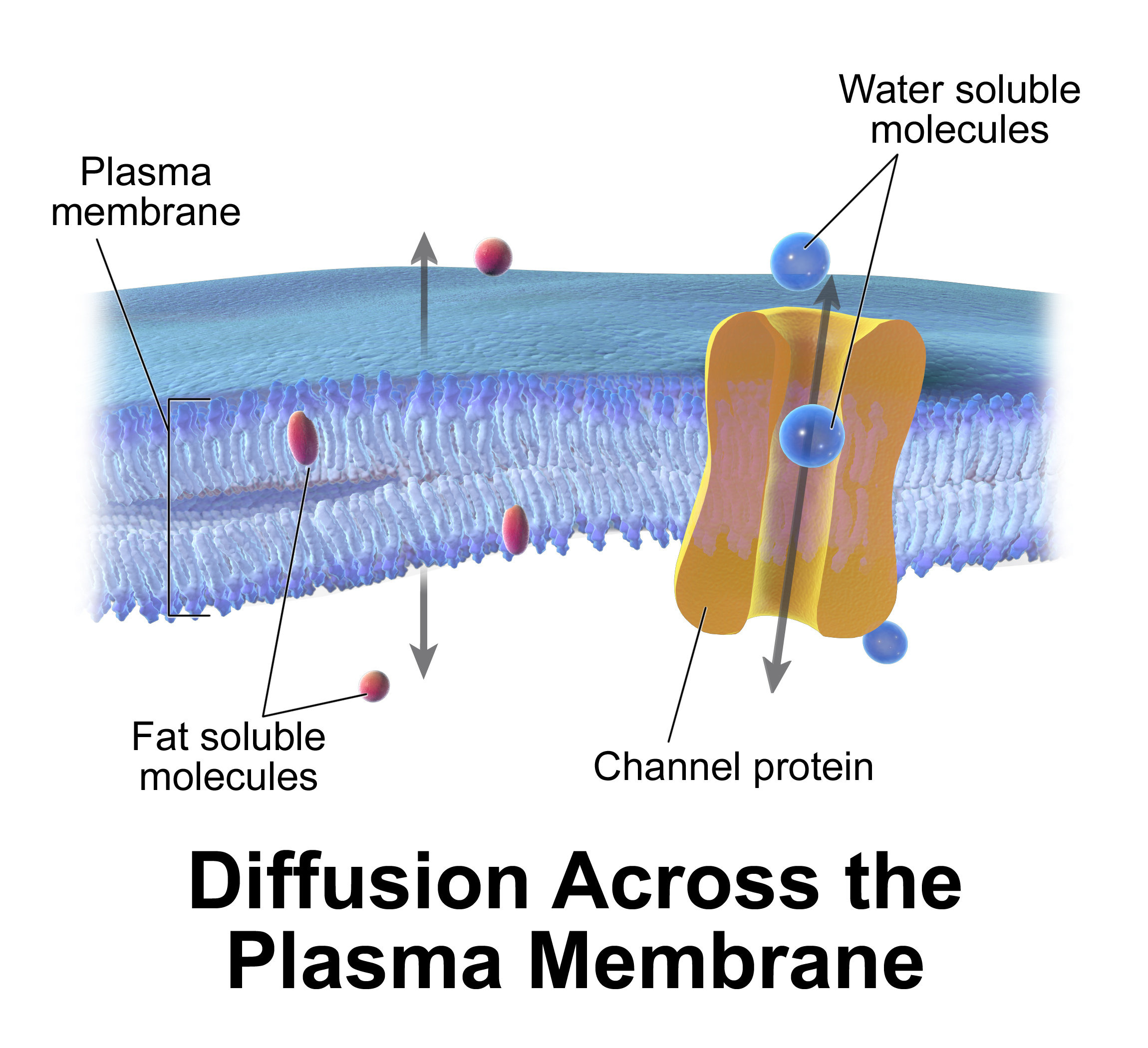
Thanks to the structure of the membrane, with the hydrophobic tails and hydrophilic heads, the cellular membrane has selective permeability. This allows some substances to cross easily, while others may not be able to cross or may require a special transport protein to do so.
The membrane acts like a barrier separating the inside of the cell from the external environment of the cell.
Small, non-polar molecules are able to freely cross the cell membrane, while polar or charged molecules require transport proteins to cross. If a molecule is small, polar, and uncharged (like water!) it may be able to pass through the membrane in small quantities but requires a transport protein to move across in any larger quantities.
Specific examples of molecules that can freely pass:
- N₂ (nitrogen gas) - small and nonpolar
- O₂ (oxygen) - small and nonpolar
- CO₂ (carbon dioxide) - small and nonpolar
Small polar, uncharged molecules that can pass in small amounts:
- H₂O (water) - can pass through in limited quantities
- NH₃ (ammonia) - another small polar molecule that can cross in small amounts
The hydrophobic fatty acid tails are what controls the movement of substances described above. They repel charged and polar molecules and make it very challenging for them to come across.
Image courtesy of Wikimedia CommonsCell Walls: Additional Protection and Permeability Control
Cell walls provide a structural boundary outside the plasma membrane in certain organisms. Unlike the plasma membrane, cell walls are found in:
- Bacteria - made of peptidoglycan
- Archaea - made of various polymers (not peptidoglycan)
- Fungi - made of chitin
- Plants - made of cellulose
Functions of Cell Walls
- Structural Support: Cell walls maintain cell shape and provide mechanical strength
- Permeability Barrier: They act as a filter for some substances trying to reach the plasma membrane
- Protection from Osmotic Lysis: Cell walls prevent cells from bursting when water enters the cell in hypotonic environments
The cell wall works together with the plasma membrane to control what enters and exits the cell. While the plasma membrane provides selective permeability based on molecular properties, the cell wall provides:
- A first line of defense against large particles
- Protection from mechanical damage
- Prevention of over-expansion when water enters the cell
This is especially important for plant cells, which can take in large amounts of water without bursting thanks to their rigid cell walls. The cell wall allows water and small dissolved substances to pass through to reach the plasma membrane, but blocks larger particles and provides structural support.
The plasma membrane is more than just a boundary—it's a sophisticated gateway that controls what enters and exits the cell. Its unique structure, with phospholipids arranged in a bilayer alongside embedded proteins, creates a selectively permeable barrier that maintains the cell's internal environment. This selective permeability, combined with the additional protection provided by cell walls in certain organisms, allows cells to maintain different conditions inside than outside. Understanding how the plasma membrane works, along with the supporting role of cell walls, is crucial for explaining nearly all cellular processes, from nutrient uptake to responding to environmental changes.
Vocabulary
The following words are mentioned explicitly in the College Board Course and Exam Description for this topic.
| Term | Definition |
|---|---|
| cell wall | A rigid structural layer outside the cell membrane that provides support, maintains cell shape, and acts as a permeability barrier in bacteria, archaea, fungi, and plants. |
| hydrocarbon tail | The nonpolar, hydrophobic portions of phospholipids that form the interior of the membrane and prevent ion and polar molecule movement. |
| hydrophilic substance | Water-loving polar molecules and ions that cannot easily cross the hydrophobic membrane interior and require transport proteins or channels. |
| hydrophobic interior | The nonpolar region in the middle of the phospholipid bilayer that repels water and polar molecules. |
| ion | Charged particles that cannot freely cross the hydrophobic membrane interior and require transport proteins or channels for movement. |
| nonpolar molecule | Molecules that lack a net electric charge and can pass freely across the hydrophobic interior of the membrane. |
| osmotic lysis | The rupture of a cell membrane due to water entering the cell in a hypotonic environment; prevented by the cell wall in plant cells, bacteria, archaea, and fungi. |
| permeability barrier | A selective barrier that controls which substances can pass between the internal and external cellular environments. |
| phospholipid | Amphipathic molecules with hydrophilic phosphate heads and hydrophobic fatty acid tails that form the basic structure of the cell membrane. |
| plasma membrane | The selectively permeable membrane that surrounds the cell, composed of phospholipids, proteins, and other molecules that regulate what enters and exits the cell. |
| polar molecule | Molecules with uneven distribution of electrical charge that generally cannot cross the hydrophobic membrane interior without assistance. |
| selective permeability | The property of a membrane that allows certain substances to pass through while restricting the passage of others. |
| structural boundary | The physical barrier provided by the cell wall that defines and maintains the shape and integrity of the cell. |
| transport protein | Embedded membrane proteins that facilitate the movement of hydrophilic substances across the membrane. |
Frequently Asked Questions
What is membrane permeability and why is it important for cells?
Membrane permeability is how easily substances cross the plasma membrane—and it’s selective because the membrane has a phospholipid bilayer with a hydrophobic (nonpolar) core. Small nonpolar molecules (O2, CO2, N2) cross freely by simple diffusion, small uncharged polar molecules (like some H2O or NH3) pass a little, but ions and large polar molecules can’t cross the hydrophobic core without membrane proteins. Cells use integral proteins (channels, carriers, aquaporins) for facilitated diffusion or active transport to move those substances. This selective permeability keeps the internal environment different from the outside (homeostasis), controls nutrient uptake, waste removal, signal transduction, and prevents osmotic lysis (cell wall helps too in plants/bacteria). For AP Bio, this links to LO 2.4.A/B—know the roles of phospholipids, transport proteins, aquaporins, channels, and how cell walls affect osmotic stability. Review the Topic 2 study guide (https://library.fiveable.me/ap-biology/unit-2/plasma-membranes/study-guide/1aW0ZDGzS56ism3BJwTi), the Unit 2 overview (https://library.fiveable.me/ap-biology/unit-2), and practice questions (https://library.fiveable.me/practice/ap-biology) to prep for MC and FRQ items on membranes.
How does the structure of the phospholipid bilayer make membranes selectively permeable?
The phospholipid bilayer is what makes the membrane selectively permeable because of its polar heads and nonpolar tails. Phospholipid heads face the watery inside and outside of the cell, while the hydrophobic hydrocarbon tails form a nonpolar interior (the hydrophobic core). That hydrophobic interior blocks ions and large polar molecules from crossing directly (EK 2.4.A.1, EK 2.4.A.3). Small nonpolar molecules (N2, O2, CO2) diffuse freely through the core, and small uncharged polar molecules (like H2O or NH3) cross a bit but slowly (EK 2.4.A.2–A.3). Large polar molecules and ions need embedded proteins—channels, carrier proteins, aquaporins, or porins—for facilitated diffusion or active transport. Cholesterol in the membrane also affects fluidity and permeability by packing between phospholipids. For quick review tied to the CED, see the Topic 2 study guide (https://library.fiveable.me/ap-biology/unit-2/plasma-membranes/study-guide/1aW0ZDGzS56ism3BJwTi), the Unit 2 overview (https://library.fiveable.me/ap-biology/unit-2), and extra practice problems (https://library.fiveable.me/practice/ap-biology).
Why can oxygen and carbon dioxide pass through cell membranes easily but glucose can't?
Oxygen (O2) and carbon dioxide (CO2) cross membranes easily because they’re small, nonpolar molecules. The phospholipid bilayer has a hydrophobic core (nonpolar fatty-acid tails) that lets other nonpolar molecules dissolve and diffuse straight through by simple diffusion (EK 2.4.A.1–A.2). Glucose is large and polar, so it can’t pass the hydrophobic interior—the bilayer repels polar/charged stuff (EK 2.4.A.3). That’s why glucose needs membrane proteins (carrier proteins or facilitated diffusion; sometimes active transport) to get across. Small uncharged polar molecules (like H2O) can cross a bit or use aquaporins, but big polar sugars can’t without transporters. This is exactly what LO 2.4.A expects you to explain on the AP (use terms: phospholipid bilayer, hydrophobic core, transport proteins, facilitated diffusion). For a quick CED-aligned refresher, see the Topic 2.4 study guide (https://library.fiveable.me/ap-biology/unit-2/plasma-membranes/study-guide/1aW0ZDGzS56ism3BJwTi) and try practice questions at (https://library.fiveable.me/practice/ap-biology).
What's the difference between hydrophobic and hydrophilic substances when it comes to crossing membranes?
Short answer: hydrophobic (nonpolar) stuff crosses the membrane much more easily than hydrophilic (polar or charged) stuff because the membrane’s interior is hydrophobic—the phospholipid tails form a nonpolar core that repels polar molecules and ions (CED EK 2.4.A.1–3). Details you should know for AP Bio: - Small nonpolar molecules (N2, O2, CO2) diffuse freely through the bilayer (simple diffusion). - Small polar, uncharged molecules (H2O, NH3) can cross a little but much slower; water also uses aquaporins for faster movement. - Ions and large polar molecules can’t get through the hydrophobic core—they need integral proteins (ion channels, carrier proteins) or facilitated diffusion / active transport. - This selective permeability is why membranes control cell internal conditions (EK 2.4.A.2–3). Want practice? Review the Topic 2.4 study guide (https://library.fiveable.me/ap-biology/unit-2/plasma-membranes/study-guide/1aW0ZDGzS56ism3BJwTi) and try problems at (https://library.fiveable.me/practice/ap-biology).
I'm confused about how water can pass through membranes - isn't water polar?
Good question—water’s polarity does seem like it should stop it from crossing the hydrophobic membrane, but there are two ways it gets through. 1) Simple diffusion/osmosis: Water is small and uncharged, so a little H2O can squeeze across the phospholipid bilayer’s hydrophobic core by simple diffusion (EK 2.4.A.3). This is slow compared to nonpolar gases. 2) Facilitated diffusion via aquaporins: Most cells speed water movement with channel proteins called aquaporins (integral membrane proteins). Those channels let lots of water pass quickly without letting ions through (EK 2.4.A.2, keywords: aquaporins, facilitated diffusion, hydrophobic core). On the AP exam, you should be able to explain selective permeability by referencing the bilayer’s hydrophobic interior and transport proteins (LO 2.4.A). For a concise review, check the Topic 2.4 study guide (https://library.fiveable.me/ap-biology/unit-2/plasma-membranes/study-guide/1aW0ZDGzS56ism3BJwTi) and try practice questions (https://library.fiveable.me/practice/ap-biology).
Can someone explain why ions need transport proteins to cross membranes?
Ions need transport proteins because the phospholipid bilayer has a hydrophobic (nonpolar) core that repels charged, polar particles. Charged ions (Na+, K+, Cl–, etc.) carry a hydration shell and can’t pass through the nonpolar fatty-acid tails—so simple diffusion won’t work (EK 2.4.A.1–A.3 / LO 2.4.A). Transport proteins (ion channels and carrier proteins) provide a polar pathway across the membrane: ion channels form selective pores for fast, passive movement down electrochemical gradients; carrier proteins (including pumps) bind and change shape to move solutes, sometimes using ATP for active transport against gradients. Size, charge, and hydration explain why ions need proteins; small uncharged gases (O2, CO2) cross freely. This is a core AP idea you should know for multiple-choice and free-response questions on membrane permeability (see the Topic 2.4 study guide for review: https://library.fiveable.me/ap-biology/unit-2/plasma-membranes/study-guide/1aW0ZDGzS56ism3BJwTi). For extra practice, try problems at (https://library.fiveable.me/practice/ap-biology).
What makes the interior of cell membranes hydrophobic?
The interior of cell membranes is hydrophobic because the membrane is a phospholipid bilayer whose phospholipids have polar (hydrophilic) heads facing the water on each side and nonpolar hydrocarbon tails pointing inward. Those fatty acid tails are nonpolar and repel water, creating a hydrophobic core (EK 2.4.A.1, EK 2.4.A.3). That nonpolar region prevents ions and large polar molecules from crossing directly, so those substances need integral membrane proteins (channels, carriers, aquaporins) to get through. Cholesterol also sits among the tails and affects membrane fluidity and packing, which can strengthen the hydrophobic barrier. On the AP exam, be ready to connect “hydrophobic interior” to selective permeability: small nonpolar gases (N2, O2, CO2) diffuse easily, small uncharged polar molecules (like some H2O) pass slowly, and ions/polar solutes require transport proteins. For a concise review, see the Topic 2.4 study guide (https://library.fiveable.me/ap-biology/unit-2/plasma-membranes/study-guide/1aW0ZDGzS56ism3BJwTi); more practice is at (https://library.fiveable.me/practice/ap-biology).
How do small nonpolar molecules like N₂ and O₂ get across cell membranes?
Small nonpolar gases (N2, O2, CO2) cross the plasma membrane by simple diffusion: they dissolve in the membrane’s hydrophobic core and move down their concentration gradient without needing proteins. The phospholipid bilayer has nonpolar hydrocarbon tails that make a hydrophobic interior (EK 2.4.A.1–2), so small nonpolar molecules “freely pass” across the membrane (EK 2.4.A.2). Rate of crossing depends on concentration difference, membrane fluidity (temperature, cholesterol), molecule size, and membrane thickness. By contrast, ions and large polar molecules can’t cross the hydrophobic core and need channels or carriers (facilitated diffusion). (For AP-style answers, emphasize membrane structure → selective permeability → simple diffusion.) Review this in the Topic 2.4 study guide (https://library.fiveable.me/ap-biology/unit-2/plasma-membranes/study-guide/1aW0ZDGzS56ism3BJwTi) and practice related questions at (https://library.fiveable.me/practice/ap-biology).
Why do plant cells have cell walls but animal cells don't?
Plant cells have rigid cell walls because of what they need to do that animal cells don’t. The cell wall (made mainly of cellulose in plants) provides a strong structural boundary that maintains shape, resists gravity, and protects cells from bursting when water enters by osmosis (prevents osmotic lysis)—all points aligned with EK 2.4.B. Plant cells sit in hypotonic environments and use a rigid wall plus a large central vacuole to create turgor pressure for support. Animal cells lack walls so they can be more flexible, move, and engage in processes like endocytosis/exocytosis; instead they rely on an extracellular matrix for structural support. This is tested in the CED under LO 2.4.B (cell wall role) and connects to membrane permeability ideas (hydrophobic core, transport proteins) in LO 2.4.A. For more review, see the Topic 2 study guide (https://library.fiveable.me/ap-biology/unit-2/plasma-membranes/study-guide/1aW0ZDGzS56ism3BJwTi) or the unit overview (https://library.fiveable.me/ap-biology/unit-2). Practice problems are at (https://library.fiveable.me/practice/ap-biology).
What's the difference between a cell membrane and a cell wall in terms of what they let through?
Short answer: the plasma membrane is the selective barrier that controls what actually gets into the cytoplasm; the cell wall is a mostly structural, porous layer outside the membrane that doesn’t do the same level of molecular selection. Why: the phospholipid bilayer has a hydrophobic core, so small nonpolar molecules (N2, O2, CO2) diffuse freely, small uncharged polar molecules (like H2O, NH3) cross slowly or through aquaporins, and ions/large polar molecules need channels or carrier proteins (LO 2.4.A, EKs 2.4.A.1–A.3). By contrast, cell walls (cellulose in plants, peptidoglycan in bacteria, chitin in fungi) provide shape and protect against osmotic lysis but are porous—many solutes and water pass through the wall to reach the membrane; some microbes have porins in outer layers, but selective transport is still done by the membrane (LO 2.4.B, EK 2.4.B.1). For a focused review on membranes and permeability for the AP exam, see the Topic 2 study guide (https://library.fiveable.me/ap-biology/unit-2/plasma-membranes/study-guide/1aW0ZDGzS56ism3BJwTi). You can practice related questions at https://library.fiveable.me/practice/ap-biology.
How do cell walls protect cells from osmotic lysis?
Cell walls protect cells from osmotic lysis by providing a rigid, external mesh that resists the inward pressure created when water moves into a cell by osmosis. When a cell is in a hypotonic environment, water enters across the plasma membrane (sometimes through aquaporins) and raises internal turgor pressure. The cell wall (made of peptidoglycan in bacteria, cellulose in plants, or chitin in fungi) physically counteracts that pressure so the plasma membrane doesn’t burst—this is exactly what EK 2.4.B.1 describes. If water loss occurs instead, the rigid wall also helps maintain shape (plant cells become flaccid but don’t lyse). For AP review, see Topic 2.4 in the Unit 2 study guide (https://library.fiveable.me/ap-biology/unit-2/plasma-membranes/study-guide/1aW0ZDGzS56ism3BJwTi) and try practice questions at (https://library.fiveable.me/practice/ap-biology) to reinforce these ideas.
I don't understand why ammonia can pass through membranes in small amounts - isn't it polar?
Good question—NH3 is polar, but two things let some of it cross the membrane. First, NH3 is small and uncharged, so it can diffuse slowly through the hydrophobic core of the phospholipid bilayer (EK 2.4.A.3). Second, ammonia exists in equilibrium with its ion form, NH4+. The charged NH4+ can’t cross the membrane without a transporter, but the uncharged NH3 can—so membranes are permeable to “small polar, uncharged” molecules like H2O and NH3 in small amounts. The rate is much lower than for nonpolar gases (N2, O2, CO2) and far lower than facilitated transport for ions or large polar molecules (EK 2.4.A.1–A.3). For a quick review of how membrane structure controls selective permeability, check the Topic 2 study guide (https://library.fiveable.me/ap-biology/unit-2/plasma-membranes/study-guide/1aW0ZDGzS56ism3BJwTi) and practice problems (https://library.fiveable.me/practice/ap-biology).
What would happen to a cell if its membrane wasn't selectively permeable?
If a cell membrane weren’t selectively permeable, the cell would lose control of its internal environment (homeostasis). The phospholipid bilayer’s hydrophobic core normally blocks ions and large polar molecules, so without selectivity ions and solutes would flow freely in and out. Consequences: huge disruption of ion gradients (no membrane potential → nerves and muscles fail), uncontrolled osmosis (water could rush in and cause osmotic lysis or rush out and plasmolysis), loss of ATP production tied to gradients, and inability to regulate concentrations of nutrients and wastes. Transport proteins (ion channels, carrier proteins, aquaporins) and processes like facilitated diffusion would be useless or uncontrolled. Cell walls can help some cells resist osmotic lysis (EK 2.4.B.1), but many animal cells would still die. This connects directly to LO 2.4.A and the EKs about hydrophobic interior and selective passage of N2, O2, CO2 versus ions/polar molecules. For a quick refresher, check the Topic 2.4 study guide on Fiveable (https://library.fiveable.me/ap-biology/unit-2/plasma-membranes/study-guide/1aW0ZDGzS56ism3BJwTi) and try practice questions (https://library.fiveable.me/practice/ap-biology).
How do the hydrocarbon tails of phospholipids prevent ions from crossing membranes?
The hydrocarbon tails of phospholipids form the hydrophobic core of the bilayer—a nonpolar, water-repelling region. Ions are charged and highly hydrophilic, so moving an ion from water into that nonpolar interior is energetically unfavorable (it would have to lose its stabilizing interactions with water). Because the tails can’t stabilize charge, ions can’t cross the membrane by simple diffusion. That’s why cells use integral membrane proteins (ion channels and carrier proteins) to let ions through in a controlled way (EK 2.4.A.1–3 in the CED). Small nonpolar molecules cross freely and small uncharged polar molecules (like some H2O) pass slowly, but ions require protein pathways (facilitated diffusion or active transport). For a focused review, see the Topic 2 plasma membranes study guide (https://library.fiveable.me/ap-biology/unit-2/plasma-membranes/study-guide/1aW0ZDGzS56ism3BJwTi) and try practice questions (https://library.fiveable.me/practice/ap-biology).
Why do bacteria, fungi, and plants all have cell walls but animals don't need them?
Because of their lifestyles and needs. Bacteria, fungi, and plants have rigid cell walls (peptidoglycan in bacteria, chitin in fungi, cellulose in plants) that provide a structural boundary, act as a permeability barrier for some substances, and protect cells from osmotic lysis (EK 2.4.B.1). Those walls let stationary or single-celled organisms resist swelling when water moves in and maintain shape. Animal cells don’t need walls because they rely on a flexible plasma membrane and extracellular matrix for support and communication. Flexibility lets animal cells change shape, move, form tissues, and perform processes like endocytosis, phagocytosis, and tight cell–cell signaling that rigid walls would block. In multicellular animals, the extracellular matrix replaces many mechanical roles of a wall while preserving membrane permeability (links to LO 2.4.B and EK 2.4.A). If you want a quick AP-style review of membrane roles and permeability, check the Topic 2 study guide (https://library.fiveable.me/ap-biology/unit-2/plasma-membranes/study-guide/1aW0ZDGzS56ism3BJwTi). For unit review and lots of practice questions, see the unit page (https://library.fiveable.me/ap-biology/unit-2) and practice problems (https://library.fiveable.me/practice/ap-biology).