5.9 Pre-Equilibrium Approximation

🧪AP Chemistry Unit 5 Review
5.9 Pre-Equilibrium Approximation
🧪 AP Chemistry
AP Chem 5.9 Pre-Equilibrium Approximation Summary
Use the pre-equilibrium approximation when a reaction mechanism has a fast, reversible first step followed by a slower rate-limiting step. You set the forward and reverse rates of the fast step equal, solve for the intermediate's concentration, and substitute that into the slow step's rate law so the final rate law only uses real reactants. This gives you a rate law you can match against experimental data.
Why This Matters for the AP Chemistry Exam
This topic builds the skill of connecting a proposed mechanism to a rate law when the slow step is not the first step. In AP Chemistry, you are expected to move between experimental data, a rate law, and a proposed mechanism, and to justify whether they agree. Pre-equilibrium reasoning is the tool that lets you handle the trickier mechanisms where the rate-limiting step depends on an intermediate. It pairs closely with identifying intermediates, recognizing the rate-determining step, and writing rate laws from elementary steps.
Key Takeaways
- Use the pre-equilibrium approximation when the first step is fast and reversible and a later step is slow (rate-limiting).
- A fast reversible step reaches equilibrium quickly, so its forward rate equals its reverse rate.
- An intermediate is produced in an earlier step and consumed later, so it must not appear in the final rate law.
- Solve the fast-step equilibrium for the intermediate concentration, then substitute it into the slow-step rate law.
- The final rate law should contain only species from the overall balanced reaction, with a combined rate constant.
- Always check that your elementary steps add up to the overall balanced equation.
How to Use This on the AP Chemistry Exam
Problem Solving
Follow these steps when a mechanism gives you a fast reversible first step and a slow second step:
- Identify the slow step and write its rate law directly from its molecularity (the elementary-step stoichiometry).
- Spot the intermediate, a species that shows up as a product in one step and a reactant in another. It cannot stay in your final rate law.
- Set the forward and reverse rates of the fast equilibrium step equal to each other.
- Solve that equality for the concentration of the intermediate.
- Substitute that expression into the slow-step rate law.
- Combine the constants into a single observed rate constant.
Worked example:
Step 1: 2NO ⇌ N₂O₂ (Fast)
Step 2: N₂O₂ + H₂ → H₂O + N₂O (Slow)
The overall reaction is:
2NO + H₂ → H₂O + N₂O
Here N₂O₂ is the intermediate because it is produced in Step 1 and consumed in Step 2.
The slow step gives:
rate = k[N₂O₂][H₂]
But N₂O₂ is an intermediate, so you cannot leave it in the rate law. Use the fast equilibrium:
forward rate = kₐ[NO]²
reverse rate = kₑ[N₂O₂]
Setting them equal:
kₐ[NO]² = kₑ[N₂O₂]
Solve for the intermediate:
[N₂O₂] = (kₐ/kₑ)[NO]²
Substitute into the slow-step rate law:
rate = k(kₐ/kₑ)[NO]²[H₂]
Combine the constants into one observed constant k":
rate = k"[NO]²[H₂]
Common Trap
Watch the difference between an intermediate and a catalyst. An intermediate is produced first, then consumed, so it appears as a product before it appears as a reactant. A catalyst is present at the start, gets consumed in one step, and is regenerated later, so its net concentration stays constant. Both can disappear from the final rate law, but they are not the same thing, and the AP exam may ask you to identify which is which.
Common Misconceptions
- Misconception: The slow step is always the first step.Actually: The slow step is not always the first step. When the slow step comes later, you cannot just read the rate law off the first step; you need the pre-equilibrium approach.
- Misconception: An intermediate can stay in a final rate law.Actually: An intermediate cannot stay in a final rate law. The rate law should only include species that appear in the overall balanced reaction.
- Misconception: You ignore a fast and reversible step.Actually: "Fast and reversible" does not mean you ignore that step. You use it to express the intermediate concentration, which is what makes the substitution possible.
- Misconception: Setting forward rate equal to reverse rate means the whole reaction is at equilibrium.Actually: Setting forward rate equal to reverse rate is an equilibrium condition for the fast step, not a claim that the whole reaction is at equilibrium.
- Misconception: Combining rate constants makes them disappear.Actually: Combining rate constants does not make them disappear. The final observed constant is built from the individual step constants, so it still depends on temperature.
- Misconception: The elementary steps do not have to add up to the overall equation.Actually: The elementary steps must add up to the overall equation. If they do not, the mechanism is not valid for that reaction.
Related AP Chemistry Guides
Practice Questions for 5.9
1 of 10
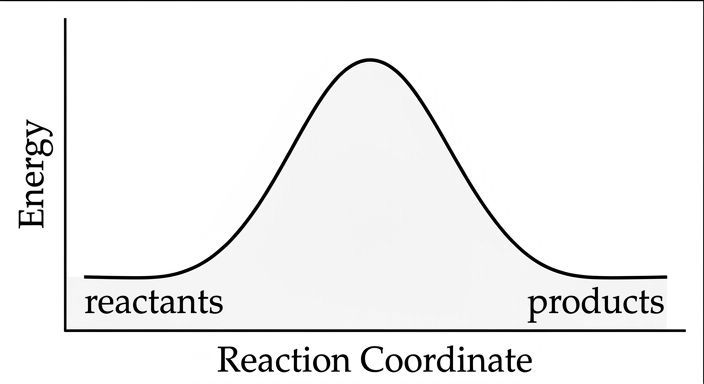
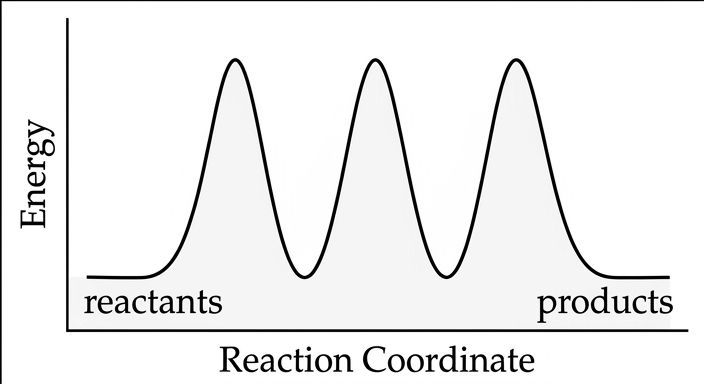
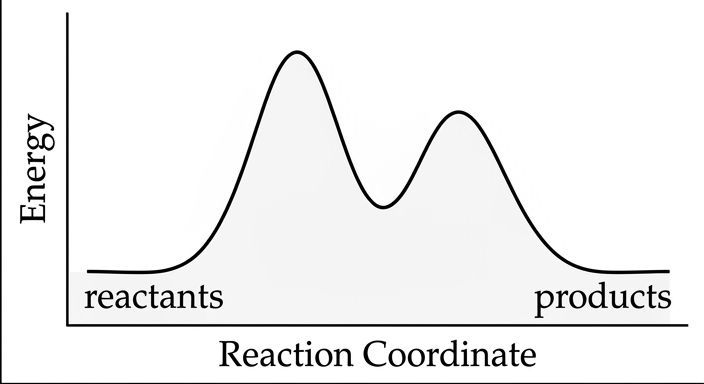
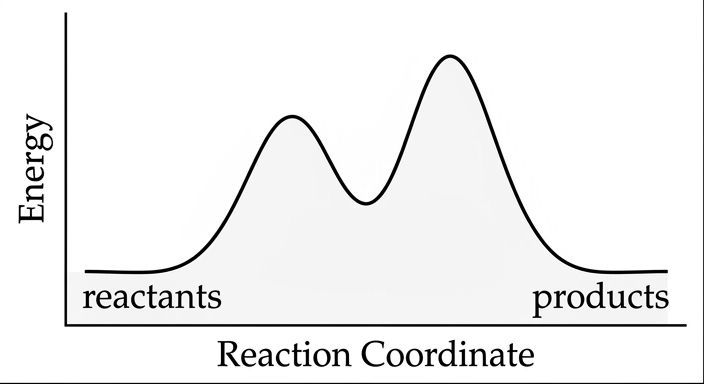
The reaction has the experimental rate law . A proposed mechanism is followed by .
Which potential energy diagram best represents the mechanism?
A.
B.
C.
D.
Vocabulary
The following words are mentioned explicitly in the AP® course framework for this topic.Term | Definition |
|---|---|
elementary reaction | A single-step reaction that represents one molecular event in a reaction mechanism, with a specific rate law determined by its molecularity. |
pre-equilibrium approximation | A method used to derive a rate law when a fast elementary step precedes a slow step, assuming the fast step reaches equilibrium quickly. |
rate law | A mathematical expression that relates the reaction rate to the concentrations of reactants, with each concentration raised to a power (order). |
rate-determining step | The slowest elementary step in a reaction mechanism that controls the overall rate of the reaction. |
reaction mechanism | The sequence of elementary steps that describes how a reaction proceeds at the molecular level. |
Frequently Asked Questions
What is the pre-equilibrium approximation in AP Chemistry?
The pre-equilibrium approximation is used when a mechanism has a fast reversible first step followed by a slower rate-limiting step. You treat the fast step as an equilibrium to express the intermediate in terms of reactants.
When do you use pre-equilibrium approximation?
Use it when the first elementary reaction is not rate limiting and the mechanism shows a fast reversible step before the slow step. The fast step helps remove the intermediate from the final rate law.
How do you derive a rate law with pre-equilibrium?
Write the slow-step rate law, identify the intermediate, set the fast forward and reverse rates equal, solve for the intermediate concentration, then substitute into the slow-step rate law.
Why can't an intermediate stay in the final rate law?
An intermediate is produced during the mechanism and consumed later, so it is not a stable reactant in the overall reaction. The final observed rate law should be written in terms of reactants from the overall reaction.
What is the difference between pre-equilibrium and steady-state approximation?
Pre-equilibrium uses a fast reversible step that reaches equilibrium before the slow step. Steady-state reasoning keeps an intermediate concentration approximately constant when formation and consumption rates balance.
What is a common mistake on AP Chem 5.9?
A common mistake is reading the final rate law directly from the slow step and leaving the intermediate in it. You must use the fast reversible step to substitute the intermediate out.
See Fiveable more often in Google
Mark Fiveable as a preferred source and Google is more likely to show you our guides in Top Stories, with a "preferred" badge in AI Mode and AI Overviews.