5.1 Reaction Rates

🧪AP Chemistry Unit 5 Review
5.1 Reaction Rates
🧪 AP Chemistry
Reaction rate measures how fast reactants turn into products, usually tracked as a change in concentration over time. You can connect the rates of different reactants and products using coefficients in the balanced equation, and you can change reaction speed by changing concentration, temperature, surface area, or adding a catalyst. For AP Chemistry, explain rate changes with collision frequency, collision energy, or activation energy.
AP Chem 5.1 Reaction Rates
In AP Chem, reaction rate measures how quickly the concentration of a reactant or product changes over time. A reactant concentration decreases, a product concentration increases, and the balanced equation tells you how the rates of different species are related.
For Topic 5.1, the exam wants you to connect measurable data to particle-level reasoning. If concentration, temperature, surface area, or a catalyst changes, explain how that change affects collision frequency, collision energy, or activation energy.
Why This Matters for the AP Chemistry Exam
Reaction rates open Unit 5 (Kinetics), which carries roughly 7 to 9 percent of the AP Chemistry exam. This topic builds the vocabulary and reasoning you need for everything that follows: rate laws, concentration-versus-time graphs, collision theory, and reaction mechanisms.
On the exam you should be ready to:
- Explain how a specific change (more concentration, higher temperature, larger surface area, a catalyst) affects rate and justify it using particle-level reasoning.
- Connect macroscopic observations (color change, gas produced, concentration data) to what is happening between particles.
- Use stoichiometry to relate the rate of one species to another in a balanced equation.
These are exactly the kinds of connections between particle behavior and measurable data that show up in both multiple-choice and free-response questions.
Key Takeaways
- Reaction rate is the change in concentration of a reactant or product per unit time, with units of (also written ).
- Reactant concentrations decrease and product concentrations increase as a reaction runs, so reactant rates carry a negative sign by convention.
- The coefficients in a balanced equation set the ratio between the rates of different species.
- Rate is influenced by concentration, temperature, surface area, catalysts, and other environmental factors.
- Average rate is measured over a time interval; instantaneous rate is the rate at a single moment (the slope of the tangent line).
- Higher temperature, higher concentration, more surface area, and catalysts generally increase rate by increasing effective collisions.
What Reaction Rate Actually Measures
Kinetics is the study of how fast a reaction converts reactants into products per unit of time. Some reactions are nearly instant and others take ages, and kinetics explains why.
A quick comparison: methane gas ignites in a flash when you bring a flame near it, while hydrogen peroxide left on a shelf breaks down very slowly. Same idea (a chemical change), wildly different speeds. (These are illustrations to build intuition, not required AP content.)
To put a number on "how fast," you track concentration over time. As a reaction runs, reactant concentration drops while product concentration rises. A reaction might start at 0.5 M reactant and fall to 0.2 M after 30 seconds. So rate is really about how quickly reactants are converted to products in a given time.
Mathematically:
The negative sign on the reactant version keeps the rate positive, since reactant concentration is decreasing. Units for rate are , also written as . Watch your time units carefully, because problems sometimes switch seconds to minutes or hours.
Average vs Instantaneous Rate
If you graph concentration versus time, the reactant curve falls and the product curve rises. Rate is the slope between points on a curve, because slope is change in concentration over change in time.
- Average rate is the change in concentration over a specific time interval (between two points). It can vary as the reaction proceeds because concentrations change.
- Instantaneous rate is the rate at one specific moment. It is the slope of the line tangent to the curve at that point. If you have taken calculus, this is the derivative, written Rate = -d[R]/dt. The AP course does not require you to do this with calculus.
The short version: average rate covers an interval, instantaneous rate captures a single instant.
Using Stoichiometry to Relate Rates
The coefficients in a balanced equation control how fast each species changes. Different species in the same reaction do not change at the same numerical rate unless their coefficients match.
Take the example reaction 2A + 3B -> C. Suppose [A] decreases by 0.2 M in 2 seconds. The rate in terms of A is:
Because B is used up 3 times for every 2 A consumed, B disappears faster than A. You scale by the coefficient ratio (3/2) to find B's rate, and you use C's coefficient the same way to find how fast C forms. A general way to write this relationship is:
Stoichiometry stays one of your most useful tools here. If you need a refresher, see this stoichiometry guide from Unit 4.
Factors That Change Reaction Rate
Several conditions speed up or slow down a reaction. For AP Chemistry, be ready to explain each one using collisions between particles.
- Concentration: More concentrated reactants usually react faster. More reactant particles in the same space means more frequent collisions.
- Temperature: Higher temperature usually means faster reactions. Particles have more kinetic energy, so more collisions have enough energy to react. Remember that temperature reflects average kinetic energy.
- Surface area: Grinding a solid into powder increases surface area, giving reactant particles more places to collide, which speeds things up.
- Catalysts: A catalyst increases rate without being used up overall. It provides an alternate pathway with lower activation energy. You will see this again in the catalysis and energy profile guide later in the unit.
- Pressure (for gases): Increasing pressure on a gas-phase reaction packs more molecules into a smaller volume, raising collision frequency and rate.
If these relationships feel shaky, reviewing the ideal gas law from Unit 3 actually helps your kinetics reasoning.
How to Use This on the AP Chemistry Exam
MCQ
- Predict the direction of a rate change when one condition shifts (more reactant, higher temperature, added catalyst, finer powder) and pick the answer that matches particle-level reasoning.
- Watch units. Rate is , and time units may switch between problems.
- Use coefficients to compare how fast two species change, not just whether they increase or decrease.
Free Response
- When asked to justify a rate change, name the particle-level cause (collision frequency, collision energy, lower activation energy) rather than just stating that rate goes up.
- Apply the negative sign correctly: reactant rates are written negative so the overall rate is positive.
- Use the coefficient ratio when relating the rate of one species to another.
Common Trap
- Reading a concentration-versus-time graph and confusing the slope (the rate) with the concentration value itself.
Common Misconceptions
- Misconception: All species in a reaction change at the same rate.Actually: Only if their coefficients are equal. In 2A + 3B -> C, B is consumed faster than A because of the 3:2 ratio.
- Misconception: A negative rate means the reaction is going backward.Actually: The negative sign just reflects that reactant concentration is decreasing. Rate itself is reported as a positive value.
- Misconception: A catalyst gets used up in the reaction.Actually: A catalyst speeds up the reaction without being consumed overall; its net concentration stays the same.
- Misconception: Average and instantaneous rate are the same number.Actually: Average rate covers an interval, while instantaneous rate is the slope at a single point, so they usually differ.
- Misconception: Higher temperature speeds reactions only by adding more collisions.Actually: The bigger reason is that more collisions now have enough energy to react, not just that there are slightly more of them.
- Misconception: Rate stays constant throughout a reaction.Actually: As reactants get used up, concentration drops and the rate usually decreases over time.
Related AP Chemistry Guides
Practice Questions for 5.1
1 of 10
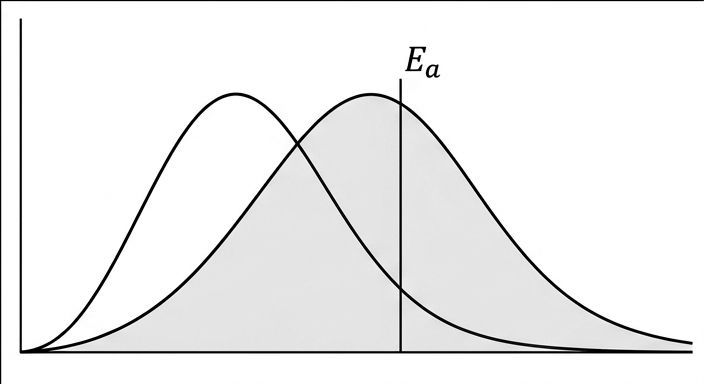
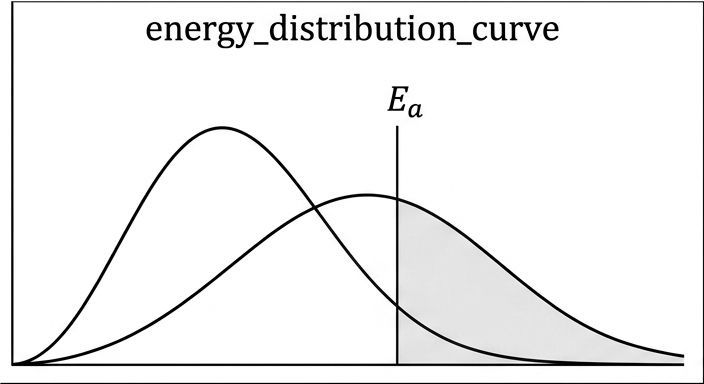
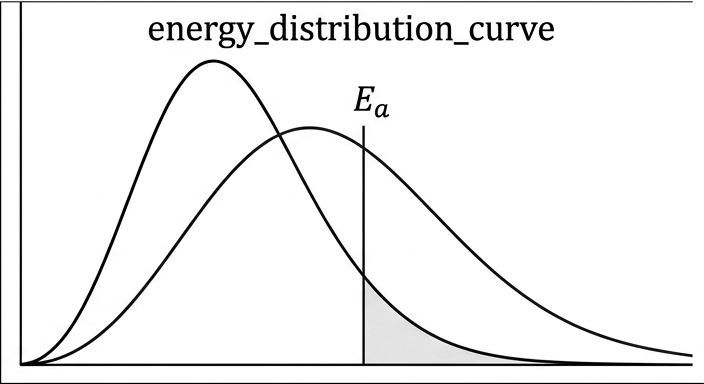
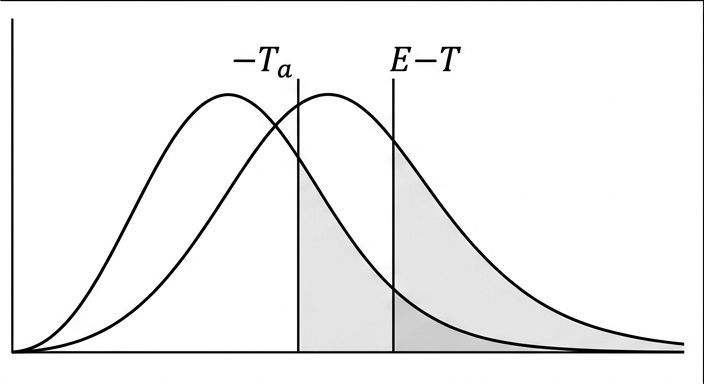
For a gas-phase reaction, increasing the temperature from to increases the reaction rate. The claim is that, at the higher temperature, a greater fraction of molecules has kinetic energy greater than or equal to .
Which graph best supports the claim?
A.
B.
C.
D.
Vocabulary
The following words are mentioned explicitly in the AP® course framework for this topic.Term | Definition |
|---|---|
catalyst | A substance that increases the rate of a chemical reaction without being consumed in the reaction. |
kinetics | The study of the rate at which a chemical reaction occurs and the factors that influence this rate. |
product concentrations | The amount of products formed in a given volume as a reaction progresses. |
reactant concentration | The amount of a reactant present in a given volume of solution, typically expressed in molarity (mol/L). |
reaction rate | The speed at which reactants are converted to products per unit of time in a chemical reaction. |
stoichiometry | The quantitative relationship between reactants and products in a balanced chemical equation that determines the rates of change of their concentrations. |
surface area | A factor that influences reaction rate by affecting the contact between reactants, particularly in heterogeneous reactions. |
temperature | A factor that influences reaction rate by affecting the kinetic energy and collision frequency of reactant molecules. |
Frequently Asked Questions
What is reaction rate in AP Chemistry?
Reaction rate is the change in concentration of a reactant or product over time. Reactant concentrations decrease, product concentrations increase, and the overall rate is reported as a positive value.
What units are used for reaction rate?
Reaction rate is often measured in mol L^-1 s^-1, also written as M s^-1. Always check whether the problem uses seconds, minutes, or another time unit.
What is the difference between average and instantaneous rate?
Average rate is measured over a time interval. Instantaneous rate is the rate at one moment, which corresponds to the slope of a tangent line on a concentration-versus-time graph.
How do coefficients affect reaction rates?
Coefficients in the balanced equation set the ratio between the rates of reactant disappearance and product formation. Species with larger coefficients change faster in proportion to those coefficients.
What factors affect reaction rate in AP Chem?
Reaction rate is affected by concentration, temperature, surface area, catalysts, pressure for gases, and other environmental factors.
How does a catalyst affect reaction rate?
A catalyst increases reaction rate by providing a pathway with lower activation energy. It is not consumed overall, even if it appears in individual mechanism steps.
See Fiveable more often in Google
Mark Fiveable as a preferred source and Google is more likely to show you our guides in Top Stories, with a "preferred" badge in AI Mode and AI Overviews.