5.8 Reaction Mechanism and Rate Law

🧪AP Chemistry Unit 5 Review
5.8 Reaction Mechanism and Rate Law
🧪 AP Chemistry
What is the reaction mechanism and rate law rule in AP Chemistry 5.8?
When a reaction mechanism has a rate-limiting first step (or every step is irreversible), the rate law comes straight from the molecularity of that slowest step. You write the rate law using the reactant concentrations in the slow step, then compare it to the experimentally determined rate law to check whether the proposed mechanism is valid.
Why This Matters for the AP Chemistry Exam
This topic connects three things you have to move between on the AP Chemistry exam: experimental data, a rate law, and a proposed mechanism. Questions often hand you a mechanism plus an experimental rate law and ask whether they agree. To answer, you identify the rate-determining step, build the rate law from its molecularity, and justify your claim. This kind of reasoning shows up in both multiple-choice questions and free-response, where you have to explain why a mechanism is or is not consistent with the data.
Key Takeaways
- A mechanism is the series of elementary steps that turn reactants into products. Add the steps together and they match the overall balanced equation.
- The rate-determining step is the slowest elementary step. It sets the overall rate law when the first step is rate limiting or when each step is irreversible.
- For an elementary step, the rate law uses the molecularity, meaning the concentrations of the reactants in that step raised to their coefficients.
- Rate laws for an overall reaction must be confirmed by experiment. A mechanism is only valid if its predicted rate law matches the experimental one.
- Intermediates cannot appear in a final rate law. You replace them using a fast-equilibrium relationship from an earlier step.
- Stoichiometric coefficients in the overall equation do not give you the rate law. Only the slow elementary step does.
Review of Mechanisms
A mechanism describes the steps a reaction goes through as it moves from reactants to products. Most reactions do not happen in one collision, so a mechanism shows you the actual sequence of events.
When you see a reaction A to B, there are usually several steps in between. A might react with an intermediate, or the reaction might be catalyzed. Each step is an elementary step, and when you add all the elementary steps together, you get the overall balanced chemical equation.
Elementary Steps

Take the reaction O₃ + 2I⁻ + H₂O → O₂ + I₂ + 2OH⁻. A proposed mechanism for it has three elementary steps:
- Ozone and iodide react slowly to form molecular oxygen and iodite ions.
- The iodite ions react with water to form hypoiodous acid and hydroxide ions.
- The hypoiodous acid reacts with iodide to form molecular iodine and more hydroxide ions.
If you add up all the steps in a mechanism, they must add to the overall reaction. That is one of the first checks you can run on any proposed mechanism.
Catalysts and Intermediates
Breaking a mechanism into steps helps you spot intermediates and catalysts. A catalyst goes into the mechanism and comes back out unchanged. In the ozone-iodide mechanism above, nothing fits that pattern, so there are no catalysts.
There are two intermediates. An intermediate is produced in one step and consumed in a later step, so it only exists while the reaction is happening. Comparing step 1 and step 2, iodite is an intermediate. Comparing step 2 and step 3, hypoiodous acid is the second intermediate.
Rate-Determining Steps


To write the rate law from a mechanism, you find the rate-determining step, which is the slowest elementary step. This step limits how fast the whole reaction can go, like the slowest worker on an assembly line.
Once you know the slow step, use the molecularity of that step to write the rate law. For an elementary step, the rate law uses the reactant concentrations in that step raised to their coefficients. This only works for elementary steps, not for the overall balanced equation.
Keep in mind that rate laws for an overall reaction must be determined experimentally. You cannot just read the rate law off the overall equation. Because of this, AP questions usually give you both a mechanism and an experimental rate law and ask, "Is this mechanism consistent with the experimental rate law?" If the predicted and experimental rate laws do not match, the mechanism cannot be correct.
How to Use This on the AP Chemistry Exam
Free Response
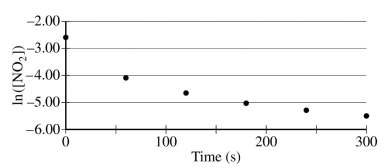
A common setup gives you experimental concentration-versus-time data, asks you to find the order and write the rate law, then gives you one or more mechanisms to check. Here is how that flows, using the 2019 free-response question on NO₂ decomposition as an example application.
The reaction: 2 NO₂ (g) → 2 NO (g) + O₂ (g)
(a) Explain how the graphs indicate that the reaction is second order.
Look for which plot is linear. A linear plot of 1/[NO₂] versus time means the reaction is second order. (For more on this, see the guide on concentration changes over time.)
Sample reasoning: The linear graph of 1/[NO₂] vs. time indicates a second-order reaction.
(b) Write the rate law.
Rate = k[NO₂]²
(c.i) Is mechanism I consistent with the rate law in part (b)?
Find the slow step, then build its rate law from molecularity. If step 1 is the slow step and involves two NO₂ molecules, the rate law is Rate = k[NO₂][NO₂] = k[NO₂]², which matches part (b).
Sample reasoning: Step 1 is slow, so it is the rate-determining step. Its rate law is rate = k[NO₂][NO₂] = k[NO₂]², which is consistent with the second-order rate law in part (b).
(c.ii) Mechanisms with an intermediate.
If the slow step contains an intermediate, you cannot leave the intermediate in the final rate law. In mechanism II, the slow step gives Rate = k[N₂O₄], but N₂O₄ is an intermediate formed in a fast first step, so it cannot appear in the overall rate law.
To fix this, use the fast first step as an equilibrium. For step 1, K_eq = [N₂O₄]/[NO₂]². Rearrange to solve for the intermediate:
[N₂O₄] = K_eq[NO₂]²
Substitute that into the slow-step rate law:
Rate = k[N₂O₄] = kK_eq[NO₂]²
This is consistent with part (b). The combined constant kK_eq just acts as a single rate constant.
Sample reasoning: Step 2 is slow, so it is the rate-determining step, giving rate = k[N₂O₄]. Because N₂O₄ is an intermediate, it cannot appear in the overall rate law. Since K_eq = [N₂O₄]/[NO₂]² in step 1, [N₂O₄] = K_eq[NO₂]². Substituting gives rate = (kK_eq)[NO₂]², which is consistent with the rate law in part (b).
Problem Solving
A reliable order of operations:
- Check that the elementary steps add up to the overall equation.
- Identify the slow (rate-determining) step.
- Write the rate law from the molecularity of the slow step.
- If an intermediate appears, replace it using a fast-equilibrium expression from an earlier step.
- Compare your predicted rate law to the experimental one to judge whether the mechanism is valid.
Common Trap
Do not pull the rate law from the coefficients of the overall balanced equation. That only works for a single elementary step, never for a multistep overall reaction.
Common Misconceptions
- Misconception: The overall equation gives the rate law.Actually: It does not. The rate law comes from the slow elementary step or from experiment, not from the overall coefficients.
- Misconception: Intermediates can stay in the rate law.Actually: They cannot. If an intermediate shows up in the slow-step rate law, you must replace it using a fast-equilibrium relationship.
- Misconception: Molecularity and reaction order are always the same thing.Actually: Order equals molecularity only for an elementary step. For an overall reaction, order is an experimental result.
- Misconception: The fast first step does not affect the rate law.Actually: When the slow step uses an intermediate made in a fast equilibrium, that earlier step is exactly what lets you rewrite the intermediate in terms of reactants.
- Misconception: A matching rate law proves the mechanism is true.Actually: A match means the mechanism is consistent with the data, not that it is definitely correct. A mismatch, on the other hand, rules a mechanism out.
- Misconception: The slow step is always step 1.Actually: It can be any step. You have to be told or shown which step is slow, then build the rate law from that one.
Related AP Chemistry Guides
Practice Questions for 5.8
1 of 10
The reaction is proposed to occur by the mechanism below. Step 1: (slow) Step 2: (fast) Initial-rate data for three trials are shown in the bar chart.
Which evidence best supports the proposed mechanism?
A.
In Trial 3, the rate remains constant, consistent with zero-order dependence on from step 2.
B.
From Trial 1 to Trial 2, doubling quadruples the rate, consistent with for a slow first step involving two .
C.
From Trial 1 to Trial 2, doubling quadruples the rate, consistent with second-order dependence on from step 2.
D.
From Trial 1 to Trial 2, doubling doubles the rate, consistent with a slow first step involving one .
Vocabulary
The following words are mentioned explicitly in the AP® course framework for this topic.Term | Definition |
|---|---|
elementary reaction | A single-step reaction that represents one molecular event in a reaction mechanism, with a specific rate law determined by its molecularity. |
irreversible | A reaction step that proceeds in only one direction and does not reverse under the reaction conditions. |
molecularity | The number of molecules that participate in an elementary step. |
rate law | A mathematical expression that relates the reaction rate to the concentrations of reactants, with each concentration raised to a power (order). |
rate-determining step | The slowest elementary step in a reaction mechanism that controls the overall rate of the reaction. |
reaction mechanism | The sequence of elementary steps that describes how a reaction proceeds at the molecular level. |
Frequently Asked Questions
How do you write a rate law from a reaction mechanism in AP Chemistry?
For AP Chemistry 5.8, find the slow elementary step and write the rate law from the reactants in that step. If the first step is rate limiting, the molecularity of that first step sets the rate law directly.
What is the rate-determining step?
The rate-determining step is the slowest elementary step in a reaction mechanism. It limits the overall reaction rate, so AP questions use it to connect a proposed mechanism to a predicted rate law.
Can the overall balanced equation give the rate law?
No. The overall balanced equation does not determine the rate law for a multistep reaction. The rate law must come from experimental data or, for an elementary slow step, from the molecularity of that elementary step.
What if an intermediate appears in the slow-step rate law?
An intermediate cannot appear in the final overall rate law. If the slow step includes an intermediate, use a fast earlier equilibrium step to rewrite the intermediate in terms of reactants.
How do you know if a proposed mechanism is valid?
A proposed mechanism must add up to the overall balanced reaction and predict a rate law consistent with the experimentally determined rate law. A match supports the mechanism, while a mismatch rules it out.
Where does this topic show up on the AP Chemistry exam?
Reaction mechanisms and rate laws can appear in MCQs and FRQs that ask you to identify the rate-determining step, write a predicted rate law, or explain whether a mechanism matches experimental kinetic data.
See Fiveable more often in Google
Mark Fiveable as a preferred source and Google is more likely to show you our guides in Top Stories, with a "preferred" badge in AI Mode and AI Overviews.