What is an Enthalpy of Formation?
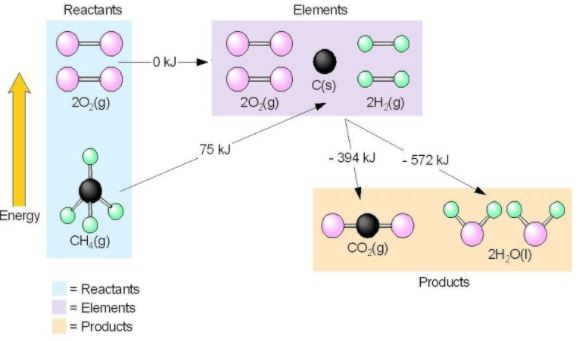
The standard enthalpy of formation (ΔHf) or standard heat of formation of a compound is the change of enthalpy during the formation of 1 mole of the substance from its constituent elements in their most stable state at standard conditions (25°C and 1atm). Essentially, it is the amount of energy it takes to form a compound.
For example, the ΔHf of CO2 can be represented as the ΔH for the following reaction: C + O2 --> CO2. Just break down the product! If the product was CO, the equation would be C + 1/2O2 --> CO.
For an element, the standard enthalpy of formation is zero.

Using ΔHf to Calculate ΔHrxn
There is a simple formula to calculate ΔHrxn from ΔHfs:
ΔHrxn = ΣnΔHf(prod) - ΣmΔHf(reactants).
n and m are the stoichiometric coefficients for each reactant and product.
📝 Note that the heat of formation formula is products - reactants, but the bond dissociation energy formula is reactants - products. Figure out a way to ensure you don't confuse the two. Luckily, the heat of formation formula is on the reference table.
Example Problem
When first doing these questions, try to write down the formula to help you memorize it.
ΔHrxn = ΣnΔHf(prod) - ΣmΔHf(reactants)
Then, simply plug values into the formula to calculate your answer. ΔHrxn = ([8 * -393.5] + [10 * -241.8]) - ([2 * -147.3] + [13 * 0]) = -5271.4 kJ
n and m are seen in this formula by the constants. There are 8 carbon dioxide molecules in the products, this is why -393.5 kJ/mol is multiplied by 8. Same goes for every other compound in this reaction.
Example Problem #2
Use standard enthalpies of formation to find the ΔH of reaction for the following reaction:
CH4(g) + 2O2 (g) --> CO2(g) + 2 H2O (l)
| Substance | kJ/mol |
|---|---|
| CH4 (g) | -74.8 |
| O2 (g) | 0 |
| CO2 (g) | -393.5 |
| H2O (g) | -241.8 |
| H2O (l) | -285.8 |
| Let's write down the formula first! |
ΔHrxn = ΣnΔHf(prod) - ΣmΔHf(reactants)
Now, plug in the values but be careful with which number you use for H2O. The table gives you two different standard enthalpies of formation, one for water vapor and one for liquid water. Be sure to use the correct one; the AP creators love to play tricks on us😉. ΔHrxn = ([2 * -285.8] + [1 * -393.5]) - ([1 * -74.8] + [2 * 0]) = -890.3 kJ/mol
Practice AP Question
The following question is from the 2014 AP Chemistry Exam - #6 part c.
In a separate experiment, the student measures the enthalpies of combustion of propene and vinyl chloride. The student determines that the combustion of 2.00 mol of vinyl chloride releases 2300 kJ of energy, according to the equation below.
Image Courtesy of College BoardUsing the table of standard enthalpies of formation below, determine whether the combustion of 2.00 mol of propene releases more, less, or the same amount of energy that 2.00 mol of vinyl chloride releases. Justify your answer with a calculation.
The balanced equation for the combustion of 2.00 mol of propene is 2 C3H6(g) + 9 O2(g) → 6 CO2(g) + 6 H2O(g).
Image Courtesy of College BoardReading all these words tells us that we have to figure out which reaction releases more energy. But in order to compare the two, we must have both heat of reactions, and we only have the heat of reaction for the combustion of vinyl chloride.
Seeing standard enthalpies of formation, you should think of ΔHrxn = ΣnΔHf(prod) - ΣmΔHf(reactants) right away, now let's plug in the values!
ΔHrxn = ([6 * -242] + [6 * -394]) - ([9 * 0] + [2 * 21]) = -3858 kJ/mol
Now all you have to do is compare -2300 to -3858 and write a statement that says the combustion of 2.00 mol of propene releases more energy than the combustion of 2.00 mol of vinyl chloride.
You must show your calculations and substitutions into the formula in order to get full credit, especially since the question said "Justify your answer with a calculation."
Vocabulary
The following words are mentioned explicitly in the College Board Course and Exam Description for this topic.
| Term | Definition |
|---|---|
| chemical process | A transformation in which substances are converted into different substances through the breaking and forming of chemical bonds. |
| enthalpy change | The difference in enthalpy between products and reactants in a chemical or physical process, representing the heat absorbed or released. |
| physical process | A change in the state or properties of matter that does not alter the identity of the substances involved. |
| product | Substances formed as a result of a chemical reaction. |
| reactant | Substances that are consumed in a chemical reaction to form products. |
| standard enthalpies of formation | The enthalpy change when one mole of a compound is formed from its elements in their standard states. |
Frequently Asked Questions
What is enthalpy of formation and why do we need to know it?
The standard enthalpy of formation (ΔH°f) is the enthalpy change when 1 mole of a compound forms from its elements in their standard states (298 K, 1 atm). By convention ΔH°f = 0 for elements in their standard states (like O2(g), C(graphite)). We need ΔH°f because it lets you get ΔH°rxn without doing calorimetry for every reaction—use the CED formula ΔH°rxn = ΣΔH°f(products) − ΣΔH°f(reactants). That’s just Hess’s law in table form: add/subtract formation enthalpies using stoichiometric coefficients. Why it matters for the AP exam: Learning Objective 6.8.A expects you to calculate reaction enthalpies from standard ΔH°f values (use correct signs, states, and coefficients). If you want practice, see the Topic 6.8 study guide (https://library.fiveable.me/ap-chemistry/unit-6/enthalpy-formation/study-guide/glO3L5mcfcUwCd0ODBej) and work problems from the AP practice set (https://library.fiveable.me/practice/ap-chemistry).
How do I calculate enthalpy change using standard enthalpies of formation?
Use the formula from the CED: ΔH°rxn = ΣΔH°f(products) − ΣΔH°f(reactants). Steps: (1) write the balanced equation with correct stoichiometric coefficients, (2) look up each species’ standard enthalpy of formation (ΔH°f) from a table (elements in their standard states have ΔH°f = 0), (3) multiply each ΔH°f by its coefficient, (4) sum the products’ terms and subtract the sum for the reactants. Result is the standard enthalpy change at 298 K and 1 atm. This is an application of Hess’s law—you’re adding formation reactions. Show units (kJ or kJ·mol−1), include sign, and report correct significant figures for the AP exam. Example (no real numbers): for A + 2B → C, ΔH°rxn = [1·ΔH°f(C)] − [1·ΔH°f(A) + 2·ΔH°f(B)]. For more review and examples, see the Topic 6.8 study guide (https://library.fiveable.me/ap-chemistry/unit-6/enthalpy-formation/study-guide/glO3L5mcfcUwCd0ODBej), the Unit 6 overview (https://library.fiveable.me/ap-chemistry/unit-6), and practice problems (https://library.fiveable.me/practice/ap-chemistry).
What's the difference between enthalpy of formation and enthalpy of reaction?
Enthalpy of formation (ΔH°f) is the enthalpy change for forming 1 mole of a compound from its elements in their standard states (298 K, 1 atm). It’s a single, tabulated value (per mole) you’ll find in tables. Enthalpy of reaction (ΔH°rxn) is the heat change for any chemical equation—it depends on stoichiometry and can be positive or negative. How they connect: AP expects you to use ΔH°rxn = ΣΔH°f(products) − ΣΔH°f(reactants) (Hess’s law). So you use standard ΔH°f values (elements in their standard states have ΔH°f = 0) to calculate the enthalpy for the whole reaction. On the exam you’ll be asked to compute ΔH°rxn from ΔH°f entries, so memorize the idea and practice problems in the Topic 6.8 study guide (Fiveable) (https://library.fiveable.me/ap-chemistry/unit-6/enthalpy-formation/study-guide/glO3L5mcfcUwCd0ODBej). For extra practice, check Unit 6 resources and the AP-style problem sets (https://library.fiveable.me/ap-chemistry/unit-6 and https://library.fiveable.me/practice/ap-chemistry).
I'm confused about the formula ΔH°reaction = ΣΔH°f products - ΣΔH°f reactants - can someone break this down?
Think of ΔH°reaction = ΣΔH°f(products) − ΣΔH°f(reactants) as “total energy to make products from elements minus total energy to make reactants from elements.” Breakdown: - ΔH°f (standard enthalpy of formation) = enthalpy change to form 1 mole of a compound from its elements in their standard states (298 K, 1 atm). Units: kJ/mol. - Σ means sum over each species, and you must multiply each ΔH°f by its stoichiometric coefficient from the balanced equation. - Subtract products minus reactants because Hess’s law: the enthalpy change for the overall reaction equals the sum of formation steps for products minus that for reactants. - Remember: ΔH°f for any element in its standard state = 0 (e.g., O2(g), C(graphite)). On the AP exam you’ll use tables of ΔH°f and apply this formula (CED 6.8.A). Want more worked examples and practice? Check the Topic 6.8 study guide (https://library.fiveable.me/ap-chemistry/unit-6/enthalpy-formation/study-guide/glO3L5mcfcUwCd0ODBej) and the practice set (https://library.fiveable.me/practice/ap-chemistry).
Why is the enthalpy of formation for elements in their standard state always zero?
The standard enthalpy of formation, ΔH°f, is defined as the enthalpy change for forming 1 mole of a compound from its elements in their standard states (298 K, 1 atm). By convention we set the reference point so that every pure element in its standard state has ΔH°f = 0. That’s not because the element has no energy, but because we need a common baseline to compare reaction enthalpies (so ΔH°rxn = ΣΔH°f(products) − ΣΔH°f(reactants) works cleanly). Choosing zero for elements prevents double-counting and makes Hess’s law calculations consistent across tables. On the AP exam you’ll always use these tabulated ΔH°f values (elements: zero) when applying the ΔH°rxn formula from the CED (6.8.A.1). For a quick refresher, see the Topic 6.8 study guide (https://library.fiveable.me/ap-chemistry/unit-6/enthalpy-formation/study-guide/glO3L5mcfcUwCd0ODBej) and try practice problems (https://library.fiveable.me/practice/ap-chemistry).
How do I know which values to use from the enthalpy of formation table?
Use the ΔH°f values for the actual chemical species and phases shown in your balanced equation, then apply ΔH°rxn = ΣΔH°f(products) − ΣΔH°f(reactants). Key tips: - Pick the value that matches the chemical formula and phase (g, l, s, aq). Tables list different numbers for different phases. - Multiply each ΔH°f by its stoichiometric coefficient before summing. - Elements in their standard states (O2(g), C(graphite), H2(g), etc.) have ΔH°f = 0—don’t include a nonzero value for them. - Use standard-state values (298 K, 1 atm) unless the problem says otherwise. The result will be in kJ per mole of reaction as written. - If a species isn’t listed, build it from formation reactions (Hess’s law) or use given combustion/ion formation data if supplied. Tables sometimes include ions—use those only when the problem is about ionic species. For step-by-step examples and AP-style practice, check the Topic 6.8 study guide (https://library.fiveable.me/ap-chemistry/unit-6/enthalpy-formation/study-guide/glO3L5mcfcUwCd0ODBej) and more practice problems (https://library.fiveable.me/practice/ap-chemistry).
What does the degree symbol mean in ΔH°f and why is it important?
The little degree symbol in ΔH°f means “standard”—ΔH°f is the standard enthalpy (molar enthalpy) of formation. Standard conditions are 1 atm pressure and usually 298 K (25°C). A standard enthalpy of formation is the enthalpy change for making 1 mol of a compound from its elements in their standard states. Elements in their standard states have ΔH°f = 0 by definition. Why that matters: AP problems use tables of ΔH°f (standard values) so you can apply the CED formula ΔH°rxn = ΣΔH°f(products) − ΣΔH°f(reactants). If you don’t use standard values (or forget the reference state), your sign or magnitude will be wrong. For exam practice and examples, see the Topic 6.8 study guide (https://library.fiveable.me/ap-chemistry/unit-6/enthalpy-formation/study-guide/glO3L5mcfcUwCd0ODBej) and try practice problems (https://library.fiveable.me/practice/ap-chemistry).
Can you explain step by step how to solve enthalpy of formation problems?
Step-by-step (AP-style) strategy for enthalpy of formation problems: 1. Write the target reaction and check it’s balanced. 2. Use the formula ΔH°rxn = ΣΔH°f(products) − ΣΔH°f(reactants) (CED 6.8.A.1). 3. From a ΔH°f table, pick values for each species at standard state (298 K, 1 atm). Remember ΔH°f = 0 for elements in their standard states (O2, H2, C(graphite)). 4. Multiply each ΔH°f by its stoichiometric coefficient before summing. Watch signs (exothermic negative, endothermic positive). 5. Compute ΔH°rxn and report units (kJ per mol of reaction as written). Use significant figures per given data. 6. If a species’ phase differs from the table, convert or use formation value for the correct phase (Hess’s law). Quick example: for H2 + 1/2 O2 → H2O(l), ΔH°rxn = ΔH°f(H2O,l) − [ΔH°f(H2)+½ΔH°f(O2)] = ΔH°f(H2O,l) − 0. For guided practice and tables, see the Topic 6.8 study guide (https://library.fiveable.me/ap-chemistry/unit-6/enthalpy-formation/study-guide/glO3L5mcfcUwCd0ODBej) and more problems at (https://library.fiveable.me/practice/ap-chemistry).
Why do we subtract reactants from products in the enthalpy formula?
Think of enthalpy (H) as a state function—it depends only on the chemical identity and amounts of reactants or products, not on the path. Standard enthalpies of formation (ΔH°f) are the enthalpies to make 1 mol of each substance from elements in their standard states. To get the reaction enthalpy you compare the total energy stored in products to the total energy stored in reactants: ΔH°rxn = Σ(ΔH°f of products × coefficients) − Σ(ΔH°f of reactants × coefficients). We subtract reactants because we’re asking “how much more (or less) enthalpy do the products have than the reactants?” If products have lower enthalpy than reactants, ΔH°rxn is negative (exothermic); if higher, it’s positive (endothermic). This is just Hess’s law applied to formation reactions: build products from elements and undo the formation of reactants, then take the net change. For step-by-step examples and AP-style practice, check the Topic 6.8 study guide (https://library.fiveable.me/ap-chemistry/unit-6/enthalpy-formation/study-guide/glO3L5mcfcUwCd0ODBej) and tons of practice problems (https://library.fiveable.me/practice/ap-chemistry).
What's the difference between standard conditions and STP when talking about enthalpy?
Standard conditions for enthalpy (the "standard state") mean each substance is at 1 atm and at 298 K (25°C); standard enthalpies of formation ΔH°f in tables are given for those conditions. STP (standard temperature and pressure) usually means 1 atm and 273.15 K (0°C) and is mainly used for gas-volume calculations (ideal gas relations). Why it matters: ΔH° is temperature dependent, so a ΔH°f listed in a table applies to 298 K, not STP. If you need ΔH at a different T (like 273 K), you must correct it (using heat capacities or Hess’s law if you have relevant data). For AP Chem: always use ΔH°f (standard enthalpy of formation) at the standard state 298 K, 1 atm when calculating ΔH°rxn = ΣΔH°f(products) − ΣΔH°f(reactants). For review and practice, see the Topic 6.8 study guide (https://library.fiveable.me/ap-chemistry/unit-6/enthalpy-formation/study-guide/glO3L5mcfcUwCd0ODBej) and more practice problems (https://library.fiveable.me/practice/ap-chemistry).
How do I remember whether enthalpy of formation is positive or negative for different compounds?
Think of ΔH°f as the enthalpy change to make 1 mol of a compound from its elements in their standard states. Two quick rules to remember: - Elements in their standard states have ΔH°f = 0 (e.g., O2(g), C(graphite)). - ΔH°f can be negative or positive—negative if making the compound releases energy (most stable products, like many ionic solids and oxides), positive if forming the compound requires net energy input (less common; some unstable or strained species). Memory tricks: - “Stable product → negative”: ionic salts and most oxides formed from elements usually have negative ΔH°f. - “Uncommon/strained → maybe positive”: molecules that are hard to assemble from elements (highly strained rings, some radicals, or unusual oxidation states) can have positive ΔH°f. - Always use the table on the exam—you won’t be asked to guess signs without data. For reaction ΔH°, use ΣΔH°f(products) − ΣΔH°f(reactants) (CED 6.8.A.1, Hess’s law). For more practice and tables/examples, check the Topic 6.8 study guide (https://library.fiveable.me/ap-chemistry/unit-6/enthalpy-formation/study-guide/glO3L5mcfcUwCd0ODBej) and Unit 6 overview (https://library.fiveable.me/ap-chemistry/unit-6). If you want lots of practice problems, try the AP practice bank (https://library.fiveable.me/practice/ap-chemistry).
I don't understand why we use tables instead of just measuring enthalpy directly in experiments.
Good question—short answer: we use tables because measuring every compound’s standard enthalpy of formation directly is impractical, sometimes impossible, and would give inconsistent results. Why: a ΔH°f is defined for forming 1 mol of a compound from elements in their standard states at 298 K and 1 atm, so you need a standard reference. Some “formation” reactions can’t be run (elements don’t combine cleanly or produce unstable intermediates), or they’re hazardous. Calorimetry measures only specific experiments (and has heat losses and different conditions), so values would vary lab-to-lab. Instead we measure a few robust reactions (combustions, heats of reaction), use Hess’s law to combine them, and compile standardized ΔH°f tables. That gives consistent, comparable data you can plug into ΔH°rxn = ΣΔH°f(products) − ΣΔH°f(reactants) on the exam (CED 6.8.A.1). For practice applying this and exam-style problems, see the Topic 6.8 study guide (https://library.fiveable.me/ap-chemistry/unit-6/enthalpy-formation/study-guide/glO3L5mcfcUwCd0ODBej) and lots of practice questions (https://library.fiveable.me/practice/ap-chemistry).
What happens if I can't find a compound's enthalpy of formation in the data table?
If a compound’s standard enthalpy of formation (ΔH°f) isn’t in your table, don’t panic—use Hess’s law. The exam expects you to get ΔH°rxn from ΔH°f via ΔH°rxn = ΣΔH°f(products) − ΣΔH°f(reactants), so build a thermochemical pathway that uses known values (remember elements in their standard states have ΔH°f = 0 at 298 K, 1 atm). Common approaches: - Combine known formation reactions of related species to algebraically get the missing ΔH°f. - Use experimental enthalpies (like ΔH°combustion) plus known ΔH°f values to solve for the unknown ΔH°f by Hess’s law. - As a last resort, use bond enthalpies to estimate ΔH (less accurate—state it’s an estimate). On the AP exam, clearly show the Hess cycle, cancel intermediate steps, and state standard conditions. For worked examples and practice problems on this topic, see the Topic 6.8 study guide (https://library.fiveable.me/ap-chemistry/unit-6/enthalpy-formation/study-guide/glO3L5mcfcUwCd0ODBej) and more Unit 6 review (https://library.fiveable.me/ap-chemistry/unit-6). For extra practice, check Fiveable’s AP Chem practice problems (https://library.fiveable.me/practice/ap-chemistry).
How does enthalpy of formation connect to bond breaking and bond forming?
Enthalpy of formation (ΔH°f) is the enthalpy change to make 1 mol of a compound from its elements in their standard states. Microscopically, any reaction enthalpy is the net of bond breaking (endothermic) and bond forming (exothermic). A ΔH°f value encodes that net for forming the compound from elements—it already includes the energy cost to break whatever bonds in elemental forms and the energy released when new bonds form. Use Hess’s law: ΔH°rxn = ΣΔH°f(products) − ΣΔH°f(reactants) to get reaction enthalpies without tracking every individual bond. On the AP exam you’ll be expected to calculate ΔH°rxn from tables of ΔH°f (CED 6.8.A.1), so practice translating bond-breaking/−forming intuition into the ΣΔH°f formula. For a focused review, see the Topic 6.8 study guide (https://library.fiveable.me/ap-chemistry/unit-6/enthalpy-formation/study-guide/glO3L5mcfcUwCd0ODBej) and more unit resources (https://library.fiveable.me/ap-chemistry/unit-6).
Why do some practice problems give me different enthalpy values for the same compound?
Short answer: you’re seeing different ΔH°f numbers because sources aren’t always using the same reference conditions, physical states, or rounding—so check the table’s assumptions before using it. Details you should know for AP Chem (CED-aligned): - Standard enthalpy of formation, ΔH°f, is defined for forming 1 mol of a compound from its elements in their standard states (298 K, 1 atm). Use ΔH°rxn = ΣΔH°f(products) − ΣΔH°f(reactants) (CED 6.8.A). - Differences come from: (1) reported physical state (e.g., H2O(l) vs H2O(g) have very different ΔH°f), (2) temperature—most tables give 298 K but some use other temps, (3) rounding or different experimental/compilation sources, (4) whether the value is for a specific ionic form or a gas/condensed phase. Elements in their standard states have ΔH°f = 0 by definition. Before solving, always note the table’s temperature and the compound’s state. For more on examples and practice, check the Topic 6.8 study guide (https://library.fiveable.me/ap-chemistry/unit-6/enthalpy-formation/study-guide/glO3L5mcfcUwCd0ODBej) and try extra problems at (https://library.fiveable.me/practice/ap-chemistry).