4.8 Introduction to Acid-Base Reactions

🧪AP Chemistry Unit 4 Review
4.8 Introduction to Acid-Base Reactions
🧪 AP Chemistry
TLDR
Acid-base reactions in AP Chemistry are proton-transfer reactions. A Brønsted-Lowry acid donates a proton (H⁺) and a base accepts one, and every reaction creates conjugate acid-base pairs that differ by exactly one H⁺. Water is central because it can both donate and accept protons in aqueous solution.
Why This Matters for the AP Chemistry Exam
This topic builds the foundation for identifying and explaining acid-base reactions, which connects directly to writing balanced and net ionic equations, classifying reaction types, and the larger acids and bases unit later in the course. You will be expected to spot Brønsted-Lowry acids, bases, and conjugate pairs in a given equation, and to explain proton transfer using particle-level reasoning. These skills support both multiple-choice questions that ask you to identify species and free-response questions that ask you to justify what is happening in a reaction. The course focuses on aqueous solutions, so water's proton-transfer behavior shows up again and again.
Key Takeaways
- A Brønsted-Lowry acid is a proton (H⁺) donor; a Brønsted-Lowry base is a proton acceptor.
- Conjugate acid-base pairs differ by exactly one H⁺. The species with the extra hydrogen is the acid.
- Water is amphiprotic: it can accept protons to form H₃O⁺ or donate protons to form OH⁻.
- Strong acids have weak conjugate bases, and the reverse holds true, so proton-transfer equilibria favor the side with the weaker acid and base.
- In aqueous solution, H⁺ is really H₃O⁺ because protons attach to water molecules.
- When writing net ionic equations for neutralizations, dissociate only strong acids and strong bases, not weak ones.
Defining Acids and Bases
There are several ways to describe acid and base behavior. AP Chemistry focuses on the Brønsted-Lowry definition, so whenever you see "Brønsted-Lowry," think transfer of a proton (a hydrogen ion).
Note that Lewis acid-base concepts are not assessed on the exam, and the emphasis is on reactions in aqueous solution.
A Proton Is a Hydrogen Ion
A proton is a positively charged particle in the nucleus of an atom. A hydrogen atom that loses its single electron becomes H⁺, which is just a bare proton. That is why "proton" and "hydrogen ion" are used interchangeably in acid-base chemistry.
In water you will often see H₃O⁺ (hydronium) written in place of H⁺, because the proton attaches to a water molecule rather than floating free.
Brønsted-Lowry Definitions
Focusing on proton transfer:
- An acid is a proton donor.
- A base is a proton acceptor.
In a reaction, a hydrogen ion moves from the acid to the base. Many acid-base reactions can run in both directions, although they usually favor one side. That tendency connects to equilibrium ideas you will study later, so keep it simple here.
Because these reactions can go both ways, there is an acid and a base on the reactant side and on the product side. This creates conjugate acid-base pairs. Given a chemical equation, you should be able to identify each pair and pick out the conjugates.
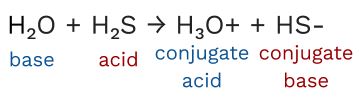
Look at this example:
H₂O + H₂S → H₃O⁺ + HS⁻
The pairs are:
- First pair: H₂O and H₃O⁺
- Second pair: H₂S and HS⁻
To tell the acid from the base inside a pair, find the one with the extra hydrogen. H₃O⁺ has one more hydrogen than H₂O, so H₃O⁺ is the conjugate acid and H₂O is the base. Try the second pair on your own.
Comparing Strengths of Conjugate Acid-Base Pairs
There is an inverse relationship between the strengths of conjugate acid-base pairs:
- Strong acids have weak conjugate bases. When an acid readily donates its proton, the conjugate base has little tendency to take it back.
- Example: HCl (strong acid) gives Cl⁻ (very weak conjugate base).
- Weak acids have stronger conjugate bases. When an acid holds its proton more tightly, the conjugate base accepts protons more readily.
- Example: CH₃COOH (weak acid) gives CH₃COO⁻ (stronger conjugate base).
- Strong bases have weak conjugate acids. When a base readily accepts protons, the conjugate acid has little tendency to give them back.
- Example: OH⁻ (strong base) gives H₂O (very weak conjugate acid).
This relationship helps you predict direction: the stronger acid donates protons to the stronger base, forming the weaker acid and weaker base. The equilibrium favors the side with the weaker acid and base.
Amphiprotic Substances
Some species are amphiprotic, meaning they can both donate and accept protons. The most important example is H₂O, but NH₃ and HCO₃⁻ also fit. These species work both ways because they have a lone pair that can bond with a proton and a transferable proton they can give away.
Water's Role in Acid-Base Reactions
Water is central to acid-base chemistry because its molecular structure lets it accept protons from and donate protons to dissolved species. This dual ability makes water the medium for acid-base reactions in aqueous solution.
When an acid dissolves in water:
- Water accepts protons from the acid, forming H₃O⁺ (hydronium).
- Example: HCl + H₂O → H₃O⁺ + Cl⁻
When a base dissolves in water:
- Water donates protons to the base, forming OH⁻ (hydroxide).
- Example: NH₃ + H₂O → NH₄⁺ + OH⁻
This is why you see H₃O⁺ instead of bare H⁺ in solution. Protons do not exist freely; they stay attached to water molecules.
Acid-Base Neutralization
A neutralization reaction occurs when an acid and base react, often forming an ionic salt and liquid water. The H⁺ from the acid combines with the OH⁻ from the base to form H₂O (l). The general pattern is:
acid + base → salt + water
To write the products, start by writing H₂O (l), since you know a proton transfers to form water. Then combine the remaining ions to form the salt. For HNO₃ (aq) and KOH (aq):
HNO₃ (aq) + KOH (aq) → H₂O (l) + KNO₃ (?)
Is the Salt Soluble?
Any nitrate salt is soluble, so KNO₃ is aqueous:
HNO₃ (aq) + KOH (aq) → H₂O (l) + KNO₃ (aq)
Net Ionic Equation
A net ionic equation shows only the species that actually change, leaving out spectator ions. For review, see an earlier study guide in this unit on net ionic equations.
One important warning: in precipitation reactions you dissociate soluble salts, but in neutralization reactions you must not dissociate weak acids and bases. They only partially dissociate into ions. So you need to know the strong acids and strong bases.
| Strong Acids | Strong Bases |
|---|---|
| HCl | Ca(OH)₂ |
| HBr | Sr(OH)₂ |
| HI | Ba(OH)₂ |
| HNO₃ | Group 1 metal + OH⁻ |
| H₂SO₄ | |
| HClO₃ | |
| HClO₄ |
HNO₃ is a strong acid and KOH is a strong base, so both dissociate completely. The complete ionic equation is:
H⁺ (aq) + NO₃⁻ (aq) + K⁺ (aq) + OH⁻ (aq) → H₂O (l) + K⁺ (aq) + NO₃⁻ (aq)
Eliminate the spectator ions (K⁺ and NO₃⁻) to get the net ionic equation:
H⁺ (aq) + OH⁻ (aq) → H₂O (l)
Finding Ion Concentrations
With a neutralization reaction you can also find ion concentrations, focusing on [H⁺] and [OH⁻]. Suppose you mix 28.0 mL of 0.250 M HNO₃ with 53.0 mL of 0.320 M KOH and need to solve for [H⁺] and [OH⁻].
Mole Calculations
Use the molarity equation and convert volumes to liters by dividing by 1000.
Molarity = moles / volume in L
HNO₃: 0.250 M = x moles / 0.0280 L, so x = 0.00700 moles of HNO₃
KOH: 0.320 M = x moles / 0.0530 L, so x = 0.0170 moles of KOH
Limiting Reactant
The limiting reactant is the one present in the smaller amount. The ratio is one-to-one for all species, so HNO₃ is the limiting reactant.
Ion With Zero Concentration
Because H⁺ comes from the limiting reactant and ends up in H₂O, its concentration is 0 after the reaction. Spectator ions cannot reach a concentration of 0; they stay in solution.
[H⁺] = 0
Solving for [OH⁻]
Finding the leftover concentration is often the hardest step. First, find the moles that reacted by relating the limiting reactant to product. Since everything is one-to-one, 0.00700 moles of KOH react.
Subtract from the starting KOH:
0.0170 - 0.00700 = 0.010 moles unreacted
Add the volumes for the total solution volume:
28.0 mL + 53.0 mL = 81.0 mL = 0.081 L
0.010 moles / 0.081 L = 0.12 M of OH⁻
Final Answers
[H⁺] = 0
[OH⁻] = 0.12 M
This kind of problem is mostly careful stoichiometry, so keep practicing.
Net Ionic Equation Practice
Write the net ionic equation for a reaction between HNO₃ and Al(OH)₃.
- Write out the products: H₂O + Al(NO₃)₃
- Balance the equation: 3HNO₃ + Al(OH)₃ → 3H₂O + Al(NO₃)₃
- Add states of matter. Al(OH)₃ is insoluble, so it stays solid: 3HNO₃ (aq) + Al(OH)₃ (s) → 3H₂O (l) + Al(NO₃)₃ (aq)
- Dissociate aqueous substances (do not dissociate the solid): 3H⁺ (aq) + 3NO₃⁻ (aq) + Al(OH)₃ (s) → 3H₂O (l) + Al³⁺ (aq) + 3NO₃⁻ (aq)
- Identify and cross out spectator ions (3NO₃⁻): 3H⁺ (aq) + Al(OH)₃ (s) → 3H₂O (l) + Al³⁺ (aq)
How to Use This on the AP Chemistry Exam
MCQ
- Given an equation, identify which species is the acid and which is the base by tracking which one loses or gains an H⁺.
- Match conjugate pairs by finding species that differ by a single proton.
- Use the strong-acid/weak-conjugate-base relationship to predict which direction a proton-transfer reaction favors.
Free Response
- Explain proton transfer in plain language, naming the proton donor and proton acceptor.
- Write balanced molecular, complete ionic, and net ionic equations for neutralizations, and be careful to leave weak acids and bases undissociated.
- Justify your classification of a reaction as acid-base by pointing to the H⁺ transfer in the equation.
Common Trap
- Do not dissociate weak acids or weak bases in ionic equations. Only strong acids and strong bases fully dissociate.
- When a salt forms, check solubility before assigning states. Nitrate, sodium, potassium, and ammonium salts are soluble.
Common Misconceptions
- Misconception: Acids and bases are defined by OH⁻ and H⁺ in their formulas.Actually: The Brønsted-Lowry definition is about proton transfer, not formula appearance. NH₃ is a base even though it has no OH⁻, because it accepts a proton.
- Misconception: H⁺ floats around freely in water.Actually: In aqueous solution the proton attaches to water, forming H₃O⁺. That is why hydronium shows up in equations.
- Misconception: A strong acid has a strong conjugate base.Actually: The opposite is true. A strong acid gives up its proton easily, so its conjugate base holds protons poorly and is weak.
- Misconception: Every salt that forms is aqueous.Actually: You still have to check solubility. An insoluble product stays as a solid and is not dissociated in the net ionic equation.
- Misconception: The limiting reactant's ion always has a leftover concentration.Actually: If the ion is fully consumed into water, its concentration goes to 0, while spectator ions remain in solution.
- Misconception: Amphiprotic means the same thing as neutral.Actually: Amphiprotic means a species can both donate and accept protons, like water, NH₃, or HCO₃⁻. It does not mean the species has no acid-base behavior.
Related AP Chemistry Guides
Practice Questions for 4.8
1 of 10
A titration curve is obtained for the addition of 0.10 M to 30.0 mL of 0.10 M .
Which statement best explains the flat region of the curve?
A.
accepts protons, forming and resisting large pH changes.
B.
donates protons, forming and resisting large pH changes.
C.
accepts protons, forming and resisting large pH changes.
D.
donates protons, forming and resisting large pH changes.
Vocabulary
The following words are mentioned explicitly in the AP® course framework for this topic.Term | Definition |
|---|---|
aqueous solution | A solution in which water is the solvent. |
Brønsted-Lowry acid | A species that donates a proton (H⁺) in a chemical reaction. |
Brønsted-Lowry base | A species that accepts a proton (H⁺) in a chemical reaction. |
conjugate acid-base pair | Two species that differ by one proton, where one is the acid form and the other is the base form of the same substance. |
ionization | The process by which an acid or base separates into ions when dissolved in water. |
proton transfer | The movement of a proton (H⁺) from one species to another in an acid-base reaction. |
Frequently Asked Questions
What is a Brønsted-Lowry acid?
A Brønsted-Lowry acid is a proton donor. In an acid-base reaction, it transfers H+ to another species.
What is a Brønsted-Lowry base?
A Brønsted-Lowry base is a proton acceptor. It accepts H+ from an acid during a proton-transfer reaction.
How do you identify conjugate acid-base pairs?
Conjugate acid-base pairs differ by exactly one H+. The species with the extra H+ is the acid form, and the species with one fewer H+ is the base form.
Why is water important in AP Chemistry acid-base reactions?
In aqueous solution, water can accept protons to form H3O+ or donate protons to form OH-. That makes water amphiprotic and central to many AP Chemistry acid-base reactions.
Are Lewis acids and bases tested in AP Chemistry?
Lewis acid-base concepts are excluded from AP Chemistry exam assessment. For Topic 4.8, focus on Brønsted-Lowry proton transfer in aqueous solution.
How is AP Chemistry 4.8 tested?
AP Chemistry 4.8 is tested by asking you to identify acids, bases, and conjugate pairs in proton-transfer reactions, especially in aqueous solution and particle-level explanations.
See Fiveable more often in Google
Mark Fiveable as a preferred source and Google is more likely to show you our guides in Top Stories, with a "preferred" badge in AI Mode and AI Overviews.