1.5 Atomic Structure and Electron Configuration

🧪AP Chemistry Unit 1 Review
1.5 Atomic Structure and Electron Configuration
🧪 AP Chemistry
A ground-state electron configuration shows how an atom's electrons fill shells and subshells using the Aufbau principle, the Pauli exclusion principle, and Hund's rule. You build it by filling subshells in order of increasing energy, such as , , , , , , then , and you can shorten it with noble gas notation. For AP Chemistry, use configurations to identify valence electrons and support periodic-trend reasoning.
What Is Electron Configuration in AP Chemistry?
Electron configuration is the notation that shows where an atom's electrons are in shells and subshells at the ground state. For AP Chemistry Topic 1.5, the key skill is using the Aufbau principle and the periodic table to write configurations for atoms and ions, then connecting those configurations to valence electrons, core electrons, and ionization energy.
Why This Matters for the AP Chemistry Exam
Atomic structure is the base layer for almost everything later in AP Chemistry. Once you can write an accurate electron configuration, you can identify valence electrons, predict ionic charges, and explain periodic trends like ionization energy and atomic radius.
This topic centers on reading and building representations of particles. You will be expected to translate between the periodic table, electron configurations, and orbital diagrams, and to use Coulomb's law qualitatively to explain why removing different electrons takes different amounts of energy. That reasoning shows up again in photoelectron spectroscopy, periodic trends, bonding, and beyond. One thing to note: assigning quantum numbers to electrons is not assessed on the AP exam, so focus on configurations and energy reasoning instead.
Key Takeaways
- An atom has a positive nucleus (protons and neutrons) surrounded by negative electrons; the atomic number equals the number of protons and, in a neutral atom, the number of electrons.
- Electrons occupy shells (energy levels) and subshells (s, p, d, f) that hold 2, 6, 10, and 14 electrons respectively.
- Build ground-state configurations with the Aufbau principle (fill lowest energy first), the Pauli exclusion principle (paired electrons have opposite spins), and Hund's rule (fill empty orbitals singly before pairing).
- Use noble-gas shorthand to shorten long configurations, and remember the 4s fills before 3d.
- Valence electrons are the outer s and p electrons; core electrons are the inner ones. Valence count drives bonding and reactivity.
- Coulomb's law explains, qualitatively, why electrons closer to the nucleus or under higher effective nuclear charge are harder to remove.
The Atom and Its Particles

An atom is built from three subatomic particles. Protons and neutrons sit in the nucleus, and electrons occupy the space around it.
| Subatomic Particle | Location | Mass (amu) | Charge | Extra Information |
|---|---|---|---|---|
| Protons | Nucleus | ~1 | +1 | Equal to the atomic number; part of the mass number. |
| Neutrons | Nucleus | ~1 | 0 | Part of the mass number. |
| Electrons | Around the nucleus | ~0 | -1 | Equal to the proton count in a neutral atom. |
The atomic number tells you how many protons an atom has. In a neutral atom, the number of electrons matches the number of protons, which is what you start from when writing an electron configuration.
Coulomb's Law
Once you know an atom's structure, Coulomb's law helps you reason about the attraction between charged particles, like the pull between the nucleus and an electron.
The force depends on two things:
- Magnitude of charge ( and ): larger charges mean a stronger attraction.
- Distance between the charges (): smaller distance means a stronger attraction.
For AP Chemistry, you use this qualitatively. The takeaway is that an electron closer to the nucleus, or one feeling a higher effective nuclear charge, is held more tightly and takes more energy to remove. That idea directly connects to ionization energy, which you will see again in periodic trends and photoelectron spectroscopy.
Electron Shells and Subshells

Electrons are organized into shells (energy levels labeled by the principal number n) and subshells (sublevels labeled s, p, d, f). Each subshell holds a fixed maximum number of electrons:
| Subshell | Max electrons |
|---|---|
| s | 2 |
| p | 6 |
| d | 10 |
| f | 14 |
The lower the energy level and the closer to the nucleus, the lower the energy of the electron. The outermost electrons, called valence electrons, are highest in energy and matter most for bonding.
Core vs. Valence Electrons
- Valence electrons are the outer electrons, found in the highest-numbered s and p subshells. These drive an atom's reactivity and bonding.
- Core electrons are the inner electrons closer to the nucleus.
To count valence electrons, look at the highest principal energy level (largest n) and add up the electrons in its s and p subshells.
Writing Electron Configurations
An electron configuration shows the arrangement of an atom's electrons across subshells. Three rules govern how you build a ground-state configuration.
- Aufbau principle: fill subshells in order of increasing energy: 1s, 2s, 2p, 3s, 3p, 4s, 3d, 4p, and so on. Notice that 4s fills before 3d.
- Pauli exclusion principle: an orbital holds at most two electrons, and they must have opposite spins (one up, one down).
- Hund's rule: within a subshell, electrons spread out into empty orbitals singly before any orbital gets a second electron. This keeps energy as low as possible.
You can use the periodic table as a map. The table is divided into blocks (s-block, p-block, d-block, f-block) that line up with the subshell being filled.
Step by Step: Boron (element 5)

Boron has 5 electrons. Read across the periodic table like a book, starting at hydrogen, and note each block you pass through until you reach boron.
- 1s: H, He = 2 electrons
- 2s: Li, Be = 2 electrons
- 2p: B = 1 electron
Each count becomes a superscript:
The superscripts add to 5, matching boron's electron count. Two electrons fill 1s, two fill 2s, and one sits in 2p.
Noble-Gas Shorthand

For atoms farther into the periodic table, full configurations get long. The noble-gas shortcut replaces the inner electrons with the previous noble gas in brackets, then continues from there. For boron, the noble gas before it is helium:
Both forms are correct. If you use the shortcut, always put the noble gas in brackets.
Iron (element 26)

Iron's configuration includes the d block, which is written after 4s:
Using noble-gas shorthand with argon:
Counting Valence Electrons: Arsenic (element 33)

Arsenic's configuration ends in . To count valence electrons, look at the highest energy level, n = 4, and add only the s and p electrons: valence electrons. The 3d electrons are not valence electrons here because they are in a lower-numbered shell.
Orbital Diagrams
Orbital diagrams show each orbital as a box (or line) and each electron as an arrow. They make the three rules easy to see:
- Electrons fill lowest-energy orbitals first (Aufbau).
- Paired arrows point in opposite directions (Pauli exclusion).
- Electrons go into separate orbitals of the same subshell before pairing up (Hund's rule).
These diagrams are useful when a question asks about the number of unpaired electrons, which connects to magnetic behavior and bonding later on.
How to Use This on the AP Chemistry Exam
Multiple Choice
- Match an element to its ground-state configuration, or spot the error in an incorrect one.
- Count valence or unpaired electrons from a configuration or orbital diagram.
- Use Coulomb's law qualitatively to rank how tightly different electrons are held.
Free Response
- Write or complete an electron configuration for an atom or ion.
- Explain, using effective nuclear charge and distance from the nucleus, why one electron takes more energy to remove than another.
- Connect a configuration to a periodic trend or to a representation like a photoelectron spectrum.
Common Trap
- Remember 4s fills before 3d when writing, but when removing electrons to form a cation, take them from the highest n first (the 4s electrons before 3d). Watch the order carefully.
Problem Solving
- Start from the atomic number to get the electron count, then build the configuration block by block and check that your superscripts add up to that count.
Common Misconceptions
- Misconception: Electrons orbit like planets.Actually: The Bohr picture of fixed circular orbits is a useful starting model, but electrons actually occupy subshells and orbitals described by quantum mechanics. Use it as a stepping stone, not the full picture.
- Misconception: All inner electrons are d and f electrons.Actually: Core vs. valence depends on the energy level, not the subshell type. Valence electrons are the outer s and p electrons in the highest n; core electrons are everything below that.
- Misconception: 3d fills only after 4s, so remove 3d first.Actually: Filling and removal follow different orders. You fill 4s before 3d, but you remove 4s electrons first when forming cations.
- Misconception: Coulomb's law needs exact numbers on the AP exam.Actually: You apply it qualitatively here. Focus on how charge magnitude and distance change the strength of attraction, not on plugging in a value for k.
- Misconception: Hund's rule is about spin direction.Actually: Hund's rule is about spreading electrons into separate orbitals before pairing. Opposite spins for paired electrons come from the Pauli exclusion principle.
- Misconception: Mass number equals atomic number.Actually: The atomic number counts protons (and electrons in a neutral atom). The mass number counts protons plus neutrons. Use the atomic number to get the electron count for a configuration.
Related AP Chemistry Guides
Practice Questions for 1.5
1 of 10
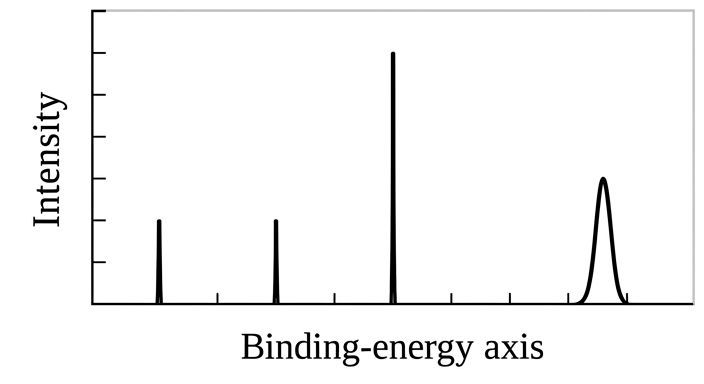
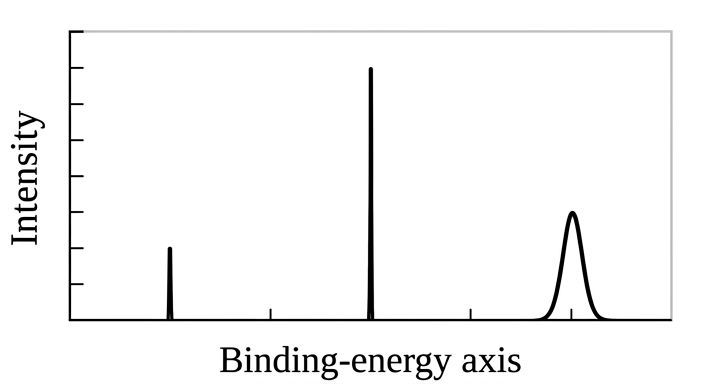
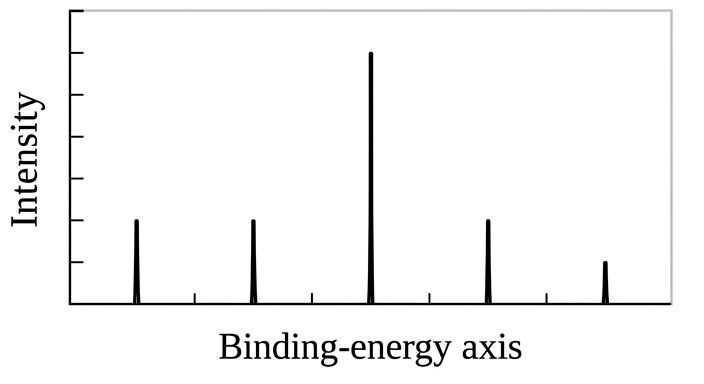
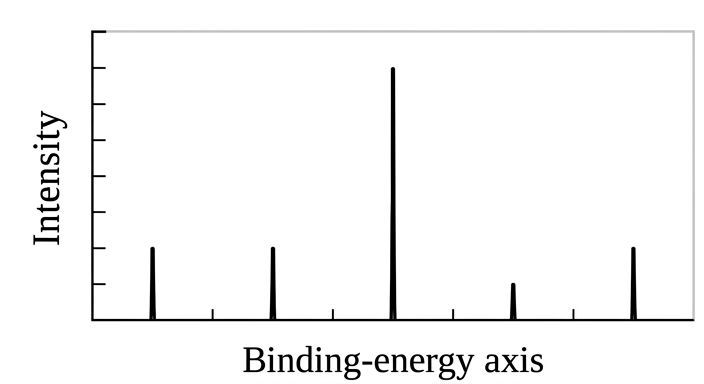
The complete photoelectron spectrum of a neutral Al atom is used to evaluate the claim that its valence electrons occupy two different subshells.
Which simulated PES graph best supports the claim?
A.
B.
C.
D.
Vocabulary
The following words are mentioned explicitly in the AP® course framework for this topic.Term | Definition |
|---|---|
Aufbau principle | The rule that electrons fill orbitals in order of increasing energy, with lower energy orbitals filled before higher energy orbitals. |
core electrons | Inner electrons in an atom that are not in the outermost shell and do not participate in bonding. |
Coulomb's law | The principle that the electrostatic force between charged particles is proportional to the product of their charges and inversely proportional to the square of the distance between them. |
effective charge | The net positive charge experienced by an electron in an atom, accounting for shielding by inner electrons. |
electrons | Negatively charged subatomic particles that orbit the nucleus of an atom. |
ground-state electron configuration | The arrangement of electrons in an atom or ion in its lowest energy state, following the Aufbau principle. |
ionization energy | The energy required to remove an electron from an atom in the gas phase. |
neutrons | Neutral subatomic particles found in the nucleus of an atom. |
nucleus | The positively charged center of an atom composed of protons and neutrons. |
protons | Positively charged subatomic particles found in the nucleus of an atom. |
shell | Energy levels in an atom that contain electrons, designated by principal quantum numbers (n = 1, 2, 3, etc.). |
shielding | The reduction in the effective nuclear charge experienced by outer electrons due to repulsion from inner electrons. |
subshell | A subdivision of an electron shell characterized by a specific orbital type (s, p, d, or f) and containing orbitals of similar energy. |
valence electrons | Electrons in the outermost shell of an atom that participate in bonding and determine many properties of substances. |
Frequently Asked Questions
What is electron configuration in AP Chemistry?
Electron configuration is the notation that shows how an atom or ion's electrons fill shells and subshells in the ground state. In AP Chemistry Topic 1.5, you use the Aufbau principle and periodic table to build configurations.
What is the Aufbau principle?
The Aufbau principle says electrons fill lower-energy subshells before higher-energy subshells. A common filling order is 1s, 2s, 2p, 3s, 3p, 4s, then 3d, which matches how the periodic table blocks are read.
What are valence electrons and core electrons?
Valence electrons are the outer electrons, usually the highest-numbered s and p electrons for main-group elements. Core electrons are the inner electrons. Valence electrons are most important for bonding and reactivity.
How does Coulomb's law connect to electron configuration?
Coulomb's law explains that attraction increases with larger charge and shorter distance. Electrons closer to the nucleus or experiencing higher effective nuclear charge are held more tightly and require more energy to remove.
How do you write noble-gas shorthand?
Use the previous noble gas in brackets to represent the core electrons, then write the remaining subshells. For example, boron can be written as [He] 2s2 2p1 instead of the full 1s2 2s2 2p1 configuration.
Are quantum numbers tested in AP Chemistry Topic 1.5?
No. The AP Chemistry CED excludes assigning quantum numbers to electrons in subshells. Focus on ground-state electron configurations, valence and core electrons, and qualitative Coulomb's law reasoning.
See Fiveable more often in Google
Mark Fiveable as a preferred source and Google is more likely to show you our guides in Top Stories, with a "preferred" badge in AI Mode and AI Overviews.