AP exam review verified for 2027

AP Chem Unit 1 Review: Atomic Structure & Properties

Review AP Chem Unit 1 to build the quantitative and conceptual foundation the entire course depends on. From mole calculations and mass spectra to electron configurations and periodic trends, this unit connects atomic structure to measurable chemical behavior.

Use the topic guides, key terms, and practice questions available for every topic in this unit to work through each concept before moving to compounds and reactions.

What is AP Chem unit 1?

Unit 1 asks two big questions: how do chemists count atoms they cannot see, and how does an atom's internal structure determine its properties? The first four topics answer the counting question through moles, mass spectra, empirical formulas, and mixture analysis. The last four topics answer the structure question through electron configurations, PES data, periodic trends, and valence electron behavior.

Unit 1 establishes the mole as the bridge between lab-scale mass and particle-scale atoms, then uses electron configuration and periodic trends to explain why elements behave the way they do. These two threads, quantitative measurement and atomic structure, run through every later unit in AP Chemistry.

Counting atoms with the mole

Because individual atoms cannot be counted in the lab, chemists use the mole. One mole equals 6.022 x 10^23 particles (Avogadro's number). The equation n = m/M connects moles (n), mass in grams (m), and molar mass in g/mol (M). Dimensional analysis keeps units organized across grams, moles, and particles conversions.


Atomic structure and electron configuration

Atoms contain a positive nucleus (protons and neutrons) surrounded by electrons in shells and subshells. The Aufbau principle, Pauli exclusion principle, and Hund's rule govern how electrons fill subshells in order 1s, 2s, 2p, 3s, 3p, 4s, 3d, and so on. Coulomb's law (F proportional to q1q2/r^2) explains why electrons closer to the nucleus or facing higher nuclear charge are held more tightly.

Periodic trends and reactivity

Effective nuclear charge (Z_eff) and electron shielding explain trends in atomic radius, ionization energy, electron affinity, and electronegativity across and down the periodic table. Valence electrons determine ion charges: main-group metals lose electrons to form cations, nonmetals gain electrons to form anions, and elements in the same group form analogous compounds.

Atomic structure drives all of chemistry

Every major topic in AP Chemistry, from bonding and intermolecular forces to equilibrium and electrochemistry, traces back to how electrons are arranged in atoms and how strongly the nucleus holds them. Unit 1 gives you the language (moles, configurations, trends) and the reasoning tool (Coulomb's law) to explain chemical behavior quantitatively and conceptually throughout the course.

AP Chem unit 1 topics

1.1

Moles and Molar Mass

Use n = m/M and Avogadro's number to convert between grams, moles, and particles. Molar mass is read from the periodic table as g/mol.

open guide
1.2

Mass Spectra of Elements

Read mass spectra to identify isotopes and their relative abundances. Calculate average atomic mass using the weighted average formula.

open guide
1.3

Elemental Composition of Pure Substances

Convert mass percent to moles and find the lowest whole-number ratio to determine an empirical formula. The law of definite proportions applies to all pure compounds.

open guide
1.4

Composition of Mixtures

Distinguish pure substances from mixtures. Use elemental analysis data to determine the relative amounts of components and assess purity.

open guide
1.5

Atomic Structure and Electron Configuration

Write ground-state electron configurations using the Aufbau principle, Pauli exclusion principle, and Hund's rule. Identify core and valence electrons. Apply Coulomb's law to explain electron energies.

open guide
1.6

Photoelectron Spectroscopy

Interpret PES spectra by connecting peak position to binding energy and peak height to electron count. Explain differences in binding energy using Z_eff and shielding.

open guide
1.7

Periodic Trends

Explain trends in atomic radius, ionization energy, electronegativity, and electron affinity using effective nuclear charge, the shell model, and Coulomb's law.

open guide
1.8

Valence Electrons and Ionic Compounds

Predict ion charges from group number and valence electron count. Explain ionic bond formation and reactivity patterns using Coulombic attraction and periodic position.

open guide
practice snapshot

Hardest AP Chemistry unit 1 topics

This snapshot uses Fiveable practice activity to show where students tend to miss questions and which review moves are worth prioritizing first.

64%average MCQ accuracy

Across 27k multiple-choice practice attempts for this unit.

27kMCQ attempts

Practice activity included in this snapshot.

51%average FRQ score

Across 93 scored free-response attempts for this unit.

Hardest topics in unit 1

MCQ miss rate
1.5

Review Atomic Structure and Electron Configuration with attention to how the concept appears in AP-style source and evidence questions.

41%3,454 tries
1.3

Review Elemental Composition of Pure Substances with attention to how the concept appears in AP-style source and evidence questions.

37%3,388 tries
1.1

Review Moles and Molar Mass with attention to how the concept appears in AP-style source and evidence questions.

36%6,692 tries
1.2

Review Mass Spectra of Elements with attention to how the concept appears in AP-style source and evidence questions.

28%3,451 tries

Unit 1 review notes

1.1

Moles and Molar Mass

The mole is the unit that connects lab-measurable mass to the number of particles reacting. One mole of any substance contains 6.022 x 10^23 particles (Avogadro's number, NA). The molar mass of an element or compound in g/mol is numerically equal to its atomic or molecular mass in amu. Use n = m/M and dimensional analysis to convert among grams, moles, and particles.

  • n = m/M: Moles equal mass in grams divided by molar mass in g/mol. Rearrange to find mass (m = nM) or molar mass (M = m/n).
  • Avogadro's number: 6.022 x 10^23 mol^-1; multiply moles by NA to get number of particles, or divide particle count by NA to get moles.
  • Molar mass from the periodic table: Sum the atomic masses of all atoms in the formula. For NaCl: 22.99 + 35.45 = 58.44 g/mol.
  • Dimensional analysis: Write conversion factors so unwanted units cancel. For grams to particles: (g) x (1 mol / M g) x (6.022 x 10^23 particles / 1 mol).
Given 18.0 g of water (M = 18.02 g/mol), calculate the number of moles and then the number of molecules.
Starting quantityConversion factorResult
Mass (g)divide by molar mass (g/mol)Moles (mol)
Moles (mol)multiply by molar mass (g/mol)Mass (g)
Moles (mol)multiply by 6.022 x 10^23Particles
Particlesdivide by 6.022 x 10^23Moles (mol)
1.2

Mass Spectra of Elements

A mass spectrum of a single element shows one peak per isotope. The position of each peak on the x-axis gives the isotope's mass (m/z for singly charged monatomic ions), and the peak height is proportional to that isotope's relative abundance in nature. Use the weighted average formula to calculate average atomic mass: average mass = sum of (isotopic mass x fractional abundance) for all isotopes. The result should match the value on the periodic table.

  • Isotope: Atoms of the same element with the same number of protons but different numbers of neutrons, giving different masses.
  • Relative abundance: The fraction (or percent) of each isotope in a natural sample; peak heights in a mass spectrum reflect these proportions.
  • Weighted average atomic mass: Average mass = sum of (mass of isotope x fractional abundance). For chlorine: (34.97 x 0.7576) + (36.97 x 0.2424) = 35.45 amu.
  • Average atomic mass: The value on the periodic table; a weighted average of all naturally occurring isotopes, not the mass of any single isotope.
A mass spectrum of boron shows two peaks: mass 10 at 20% relative abundance and mass 11 at 80%. Calculate the average atomic mass of boron.
Peak featureWhat it tells you
Peak position (m/z)Mass of that isotope
Peak heightRelative abundance of that isotope
Number of peaksNumber of naturally occurring isotopes
1.3

Empirical Formulas and Mixture Composition

Topics 1.3 and 1.4 both use mass data to determine composition, so they share the same core skill: convert mass percentages to moles, find the simplest whole-number ratio, and interpret what that ratio means for a pure substance or a mixture. The law of definite proportions guarantees that a pure compound always has the same mass ratio of elements. Mixtures do not have fixed ratios, but elemental analysis can still determine their composition and purity.

  • Empirical formula: The lowest whole-number ratio of atoms in a compound. Found by converting mass percent to moles, dividing by the smallest mole value, and rounding to whole numbers.
  • Law of definite proportions: Any pure sample of a compound always contains the same elements in the same mass ratio, regardless of sample size or source.
  • Pure substance vs. mixture: A pure substance has one type of atom, molecule, or formula unit with fixed composition. A mixture contains two or more types whose proportions can vary.
  • Elemental analysis: An experimental technique (such as combustion analysis) that measures the mass of each element in a sample to determine composition or purity.
  • Formula unit: The simplest collection of ions that represents the ratio in an ionic compound, such as one Na+ and one Cl- for NaCl.
A compound is 40.0% carbon, 6.7% hydrogen, and 53.3% oxygen by mass. Determine its empirical formula.
FeaturePure substanceMixture
CompositionFixed ratio by law of definite proportionsVariable proportions
Particle typesOne type (atom, molecule, or formula unit)Two or more types
Empirical formulaUniquely definedNot applicable
Elemental analysis useDetermine formulaDetermine composition and purity
1.5

Atomic Structure and Electron Configuration

An atom's nucleus contains protons (positive) and neutrons (neutral); electrons (negative) occupy shells and subshells outside the nucleus. Ground-state electron configurations are built using the Aufbau principle (fill lowest energy subshells first), the Pauli exclusion principle (no two electrons share all four quantum numbers), and Hund's rule (maximize unpaired electrons within a subshell). Coulomb's law (F proportional to q1q2/r^2) explains why electrons in lower shells or facing higher nuclear charge require more energy to remove.

  • Aufbau principle: Electrons fill subshells in order of increasing energy: 1s, 2s, 2p, 3s, 3p, 4s, 3d, 4p, and so on.
  • Core vs. valence electrons: Core electrons are in inner shells and do not participate in bonding. Valence electrons are in the outermost shell and determine reactivity.
  • Noble gas notation: Shorthand that replaces the core electron configuration with the symbol of the preceding noble gas in brackets, e.g., [Ne] 3s^2 3p^4 for sulfur.
  • Coulomb's law: Electrostatic force is proportional to the product of charges and inversely proportional to the square of the distance. Larger charge or smaller distance means stronger attraction.
  • Subshells: Subdivisions of electron shells labeled s, p, d, and f, holding 2, 6, 10, and 14 electrons respectively.
Write the ground-state electron configuration of a chlorine atom (Z = 17) using both full notation and noble gas shorthand. Identify the valence electrons.
1.6

Photoelectron Spectroscopy

Photoelectron spectroscopy (PES) measures the energy required to remove electrons from each subshell of an atom. In a PES spectrum, the x-axis shows binding energy (how tightly electrons are held) and the y-axis shows relative peak height, which is proportional to the number of electrons in that subshell. Peaks at high binding energy correspond to core electrons close to the nucleus; peaks at low binding energy correspond to valence electrons. You can read a PES spectrum to reconstruct an electron configuration and explain differences in binding energy using effective nuclear charge and shielding.

  • Binding energy (PES): The energy required to remove an electron from a specific subshell; higher binding energy means the electron is held more tightly by the nucleus.
  • Peak height in PES: Proportional to the number of electrons in that subshell. A peak twice as tall as another indicates twice as many electrons.
  • Photoelectron spectroscopy (PES): An experimental technique that fires photons at atoms and measures the kinetic energy of ejected electrons to determine subshell binding energies.
  • Shielding: Inner electrons reduce the effective nuclear charge felt by outer electrons, lowering their binding energy relative to core electrons.
A PES spectrum shows three peaks. The peak at highest binding energy is shortest, the middle peak is taller, and the peak at lowest binding energy is tallest. Identify the element and assign each peak to a subshell.
PES peak featureWhat it indicates
High binding energy positionCore electrons, close to nucleus, strongly attracted
Low binding energy positionValence electrons, farther from nucleus, more shielded
Tall peakMore electrons in that subshell
Short peakFewer electrons in that subshell
1.7

Periodic Trends

Periodic trends are explained by three interconnected ideas: effective nuclear charge (Z_eff), the shell model, and Coulomb's law. Z_eff is the net positive charge an electron experiences after accounting for shielding by inner electrons. As Z_eff increases, electrons are pulled closer and held more tightly. Moving across a period, Z_eff increases because protons are added but shielding stays roughly constant. Moving down a group, a new shell is added, increasing distance and shielding, which outweighs the increase in nuclear charge.

  • Effective nuclear charge: The net positive charge felt by a valence electron after inner electrons partially cancel the full nuclear charge. Z_eff increases across a period.
  • Atomic radius: Decreases across a period (higher Z_eff pulls electrons closer) and increases down a group (new shells add distance).
  • First ionization energy: Increases across a period (higher Z_eff holds electrons more tightly) and decreases down a group (valence electrons are farther away and more shielded).
  • Electronegativity: Increases across a period and decreases down a group, following the same logic as ionization energy. Fluorine has the highest electronegativity.
  • Electron affinity: The energy released when a neutral atom gains an electron. Generally becomes more negative (more energy released) across a period, with exceptions at filled and half-filled subshells.
Rank Na, Mg, and Al in order of increasing first ionization energy and explain the trend using Z_eff.
PropertyAcross a period (left to right)Down a group
Atomic radiusDecreasesIncreases
First ionization energyGenerally increasesDecreases
ElectronegativityIncreasesDecreases
Electron affinityGenerally more negativeLess negative
Effective nuclear chargeIncreasesRoughly constant for valence e-
1.8

Valence Electrons and Ionic Compounds

Valence electrons determine how an element reacts and what ions it forms. Main-group elements in the same column have the same number of valence electrons and form analogous compounds. Metals lose valence electrons to form cations; nonmetals gain electrons to form anions. The charge of an ion in an ionic compound is predicted by the element's group number and the tendency to reach a noble gas electron configuration. Coulombic attraction between oppositely charged ions holds ionic compounds together.

  • Valence electrons: Electrons in the outermost shell; equal to the group number for main-group elements and the primary factor in determining reactivity and ion charge.
  • Cation: Formed when an atom loses one or more electrons, giving it a positive charge. Group 1 metals form 1+ cations; Group 2 metals form 2+ cations.
  • Anion: Formed when an atom gains one or more electrons, giving it a negative charge. Group 17 nonmetals form 1- anions; Group 16 nonmetals form 2- anions.
  • Ionic bonds: Electrostatic attraction between a cation and an anion. Strength increases with higher ion charges and smaller ionic radii, as described by Coulomb's law.
  • Octet rule: Atoms tend to gain, lose, or share electrons to achieve eight valence electrons, matching the configuration of the nearest noble gas.
Predict the charge of ions formed by Ca, O, and Al. Write the formula of the ionic compound formed between Ca and O.
GroupValence electronsTypical ion chargeExample
Group 111+Na+
Group 222+Mg2+
Group 1662-O2-
Group 1771-Cl-

Practice AP Chem unit 1 questions

Try stimulus-based AP practice questions and written prompts after you review the notes.

Example stimulus-based MCQs

open all practice
visual_answers

Stimulus-based practice question

An unknown main-group element X has the ground-state electron configuration [Kr]5s24d105p4[Kr] 5s^2 4d^{10} 5p^4.

Question

Which of the following Lewis electron-dot diagrams correctly represents a neutral atom of element X?

Answer choice A
Answer choice B
Answer choice C
Answer choice D
visual_answers

Stimulus-based practice question

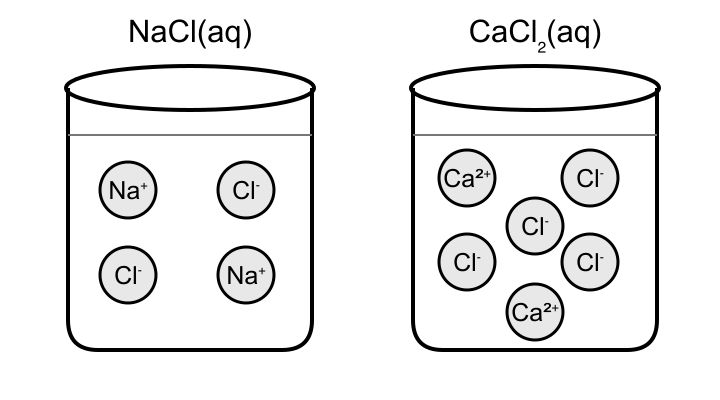
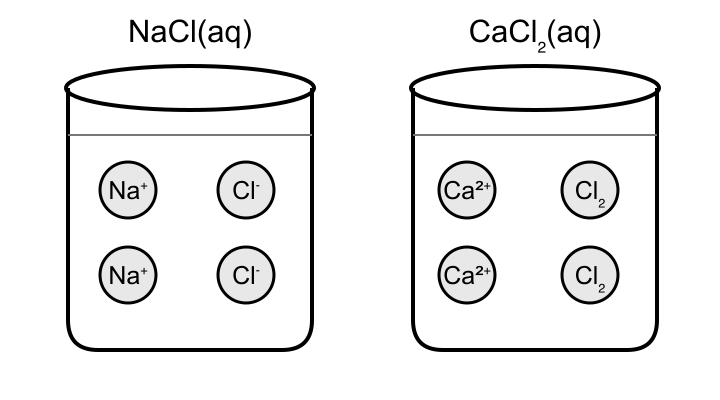
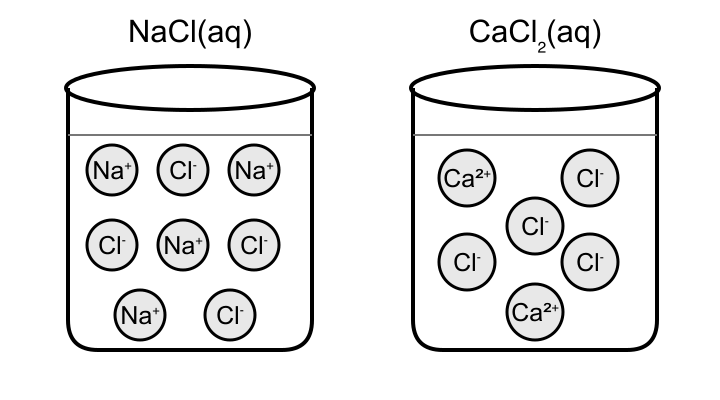
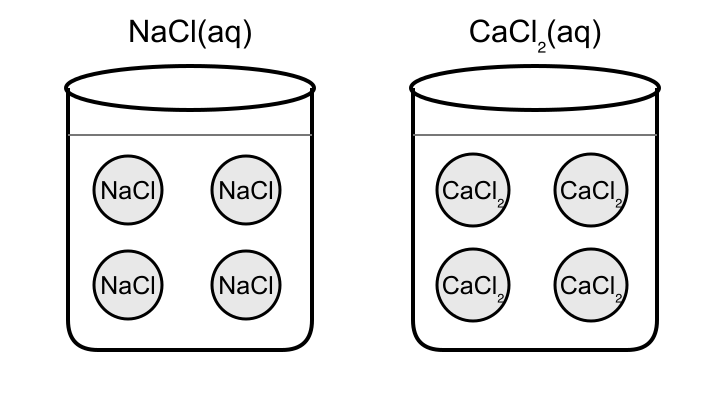
Equal amounts of NaCl(s)NaCl(s) and CaCl2(s)CaCl_2(s) are separately dissolved completely in water. A solution of CaCl2CaCl_2 has greater electrical conductivity than a solution of $NaCl$.

Question

Which particulate representation best justifies the claim?

Answer choice A
Answer choice B
Answer choice C
Answer choice D

Example FRQs

open all FRQs
SAQ

Photoelectron spectroscopy and atomic structure analysis

6. A scientist analyzes a pure sample of an unknown element, Element Q, using photoelectron spectroscopy (PES). The generated spectrum is shown in Figure 1.

A.

Identify Element Q and write its complete ground-state electron configuration.

Figure 1. Photoelectron spectrum (PES) of Element Q (binding energy axis reversed, logarithmic scale).

Figure 1
B.

The binding energy of the 1s electrons in an atom of Magnesium (Mg) is 131 MJ/mol. Explain why the binding energy of the 1s electrons in Element Q (shown in Figure 1) is greater than that of Magnesium.

C.

Using the periodic table, compare the atomic radius of Element Q to the atomic radius of Selenium (Se). Justify your answer using principles of atomic structure.

Table 1. Isotopic data for Element Q

Isotope

Isotopic Mass (amu)

Relative Abundance (%)

Q-32

31.97

95.00

Q-33

32.97

0.75

Q-34

33.97

4.25

D.

Calculate the average atomic mass of Element Q based on the data provided in Table 1. Show your work. The scientist performs mass spectrometry on the sample of Element Q and obtains the data in Table 1.

SAQ

Photoelectron spectroscopy and atomic electron configuration

5. A scientist investigates the atomic structure and properties of Element X. The scientist obtains the photoelectron spectrum of Element X shown in Figure 1.

Figure 1. Photoelectron spectrum of Element X (binding energy in MJ/mol; x-axis decreases left to right).

Figure 1
A.

Based on the photoelectron spectrum in Figure 1, write the complete ground-state electron configuration for Element X.

B.

A student claims that the peak representing the 1s electrons in Element X has a lower binding energy than the peak representing the 1s electrons in Nitrogen (Z=7). Do you agree or disagree? Justify your answer.

C.

The first ionization energy of Sulfur is slightly lower than that of Element X, despite Sulfur having a higher nuclear charge. Justify this observation based on the electron configurations of the two atoms. The scientist compares Element X to Sulfur (Z=16), which is located directly to the right of Element X in the periodic table.

Table 1. Molar mass data for reaction components

Substance

Molar Mass (g/mol)

Element X

30.97

Chlorine (Cl)

35.45

Compound XCl3

137.32

D.

A 6.20 g sample of Element X reacts completely to form XCl3. Calculate the mass, in grams, of XCl3 produced. Element X reacts with excess Chlorine gas to form the compound XCl3 according to the equation: 2X(s)+3Cl2(g)2XCl3(s)2 X(s) + 3 Cl_2(g) \rightarrow 2 XCl_3(s). Relevant data is provided in Table 1.

FRQ

Titanium properties, isotopes, electron configuration

3. Answer the following questions about titanium and its compounds.

Titanium is a transition metal with atomic number 22. It is widely used in aerospace applications due to its high strength-to-weight ratio and resistance to corrosion.

Figure 1. Mass spectrum of titanium (isotopic abundances used for average atomic mass calculation)

Figure 1
A.

Calculate the average atomic mass of titanium using the isotopic abundance data provided in Figure 1. Show your work.

B.

Write the complete ground-state electron configuration for a neutral titanium atom.

Figure 2. Photoelectron spectrum of titanium (valence region): binding energy and relative peak intensities

Figure 2
C.

The photoelectron spectrum in the range of 0 to 10 MJ/mol for titanium is shown in Figure 2.

i.

Identify the subshell corresponding to Peak B in Figure 2. Justify your answer based on the relative height of the peaks.

ii.

Explain why Peak C has a higher binding energy than Peak D, even though the electrons in subshell C are added after the electrons in subshell D during the Aufbau filling process.

Table 1. Experimental data for the reaction of titanium with chlorine

Measurement

Mass (g)

Mass of empty crucible

25.00

Mass of crucible + titanium

26.44

Mass of crucible + titanium chloride product

29.63

D.

Calculate the empirical formula of the titanium chloride compound formed. Show your work. A student heats the 1.44 g sample of titanium powder in an excess of chlorine gas, Cl2(g)Cl_2(g), to form a solid titanium chloride compound. The data are recorded in Table 1.

E.

The student performs the experiment again but stops heating before all the titanium has reacted. Would the calculated ratio of moles of Cl to moles of Ti be greater than, less than, or equal to the actual ratio in the compound? Justify your answer.

F.
i.

Write the complete ground-state electron configuration for the Ti2+Ti^{2+} ion.

ii.

Explain why the atomic radius of calcium (atomic number 20) is larger than the atomic radius of titanium (atomic number 22).

Key terms

TermDefinition
MoleA unit of amount equal to 6.022 x 10^23 particles (Avogadro's number). One mole of any substance has a mass in grams equal to its molar mass.
Avogadro's Number6.022 x 10^23 mol^-1; the number of atoms, molecules, or formula units in one mole of a substance.
Dimensional AnalysisA unit-conversion method in which conversion factors are written so unwanted units cancel, used to move between grams, moles, and particles.
IsotopeAtoms of the same element with the same number of protons but different numbers of neutrons, giving them different masses.
Average Atomic MassThe weighted average of all naturally occurring isotopes of an element, calculated as the sum of (isotopic mass x fractional abundance) for each isotope.
relative abundanceThe fraction or percent of each isotope present in a natural sample of an element; reflected by peak heights in a mass spectrum.
Empirical FormulaThe simplest whole-number ratio of atoms in a compound, determined by converting mass percent data to moles and reducing to the lowest ratio.
Law of Definite ProportionsA pure compound always contains the same elements in the same mass ratio, regardless of sample size or origin.
Aufbau PrincipleElectrons fill subshells in order of increasing energy (1s, 2s, 2p, 3s, 3p, 4s, 3d, ...) before occupying higher-energy subshells.
Effective Nuclear ChargeThe net positive charge experienced by a valence electron after inner (core) electrons partially shield the full nuclear charge. Increases across a period.
shieldingThe reduction in effective nuclear charge felt by outer electrons due to repulsion from inner electrons; increases down a group as more shells are added.
Photoelectron Spectroscopy (PES)A technique that measures the energy required to remove electrons from each subshell of an atom. Peak position gives binding energy; peak height gives relative electron count.
First Ionization EnergyThe energy required to remove the outermost electron from a neutral gaseous atom. Increases across a period and decreases down a group due to changes in Z_eff and atomic radius.
Coulomb's LawElectrostatic force is proportional to the product of the two charges and inversely proportional to the square of the distance between them. Used to explain electron binding energies and periodic trends.

Common unit 1 mistakes

Using mass number instead of molar mass

Molar mass comes from the weighted average atomic mass on the periodic table, not the mass number of a specific isotope. For chlorine, use 35.45 g/mol, not 35 g/mol, in mole calculations.

Confusing peak height and peak position in spectra

In both mass spectra and PES spectra, position and height mean different things. In a mass spectrum, position gives isotopic mass and height gives relative abundance. In a PES spectrum, position gives binding energy and height gives the number of electrons in that subshell.

Rounding too early in empirical formula calculations

After dividing mole values by the smallest, ratios like 1.5 or 1.33 are not rounding errors; they signal you need to multiply all values by 2 or 3 to reach whole numbers. Only round when the decimal is within about 0.05 of a whole number.

Writing ion electron configurations by removing the wrong electrons

For transition metal cations, remove electrons from the 4s subshell before the 3d subshell. Fe loses its two 4s electrons first to become Fe2+ ([Ar] 3d^6), not by removing 3d electrons.

Explaining periodic trends with memorized arrows instead of reasoning

AP Chemistry rewards explanations that cite Z_eff, shielding, and Coulomb's law. Saying 'ionization energy increases across a period because Z_eff increases and valence electrons are pulled closer to the nucleus' is stronger than stating the trend without a cause.

How this unit shows up on the AP exam

Quantitative reasoning with moles and composition data

AP Chemistry frequently presents mass data, percent composition, or spectral data and asks you to calculate moles, determine empirical formulas, or find average atomic mass. Show every conversion factor and keep units visible. A common task pattern is a multi-step calculation that moves from grams to moles to particles, or from mass percent to empirical formula, requiring you to justify each step rather than just report a number.

Connecting experimental data to atomic structure

PES spectra and mass spectra are standard data-interpretation tasks in AP Chemistry. You may be given a spectrum and asked to identify subshells, count electrons, assign an element, or explain why one peak appears at higher binding energy than another. The explanation must invoke Z_eff, shielding, or Coulomb's law, not just describe the spectrum.

Explaining periodic trends with causal reasoning

Rather than asking you to state a trend, AP Chemistry tasks often ask you to explain why a trend exists or to compare two specific elements. Strong responses cite effective nuclear charge, the number of electron shells, and Coulomb's law to justify differences in atomic radius, ionization energy, electronegativity, or ion charge. This reasoning pattern also appears in later units when bonding strength, acid strength, and reactivity are compared.

Final unit 1 review checklist

  • Unit 1 final review checklistUse this checklist to confirm you can handle every major skill in Unit 1 before the exam.
  • Mole calculationsConvert fluently among grams, moles, and particles using n = m/M and Avogadro's number with dimensional analysis. Show units at every step.
  • Mass spectra and average atomic massRead a mass spectrum to identify isotopes and their relative abundances. Calculate average atomic mass using the weighted average formula and verify against the periodic table.
  • Empirical formulas and mixture compositionConvert mass percent data to moles, divide by the smallest value, and scale to whole numbers to write an empirical formula. Distinguish pure substances from mixtures and explain how elemental analysis determines purity.
  • Electron configurationsWrite full and noble-gas-shorthand ground-state configurations for atoms and common ions. Identify valence and core electrons. Apply Coulomb's law to explain why electrons in different subshells have different energies.
  • Photoelectron spectroscopyAssign PES peaks to subshells using peak position (binding energy) and peak height (electron count). Explain why core electrons appear at higher binding energy than valence electrons.
  • Periodic trendsPredict and explain the direction of trends in atomic radius, first ionization energy, electronegativity, and electron affinity using Z_eff, shielding, and Coulomb's law. Justify exceptions such as the drop in ionization energy from Be to B.
  • Valence electrons and ionic compoundsPredict ion charges from group number. Write formulas for ionic compounds. Explain reactivity patterns for main-group elements using valence electron count and Coulombic attraction.

How to study unit 1

Step 1: Mole calculations and mass spectra (Topics 1.1-1.2)Start with the mole concept. Practice converting grams to moles to particles using n = m/M and dimensional analysis until the unit cancellation is automatic. Then work through mass spectrum problems: read peak positions for isotopic masses, read heights for relative abundances, and calculate weighted average atomic mass. Check your answer against the periodic table value.
Step 2: Empirical formulas and mixture composition (Topics 1.3-1.4)Practice the full empirical formula algorithm: assume 100 g, convert mass percents to moles, divide by the smallest mole value, and scale to whole numbers. Then review how elemental analysis applies to mixtures, focusing on how mass data reveals composition and purity rather than a fixed formula.
Step 3: Electron configurations and Coulomb's law (Topic 1.5)Write ground-state configurations for at least 10 elements and their common ions using full notation and noble gas shorthand. Practice identifying valence and core electrons. For each configuration, use Coulomb's law to explain why electrons in the 1s subshell have higher ionization energy than electrons in the 2s subshell.
Step 4: Photoelectron spectroscopy (Topic 1.6)Work through PES spectrum interpretation problems. For a given spectrum, assign each peak to a subshell, count electrons from peak heights, and reconstruct the electron configuration. Practice explaining why peaks shift position when comparing two elements in the same period.
Step 5: Periodic trends and ionic compounds (Topics 1.7-1.8)Review the four main trends (atomic radius, ionization energy, electronegativity, electron affinity) and practice writing explanations that cite Z_eff, shielding, and Coulomb's law rather than just stating the direction. Finish by predicting ion charges from group number, writing ionic compound formulas, and explaining reactivity differences between groups using valence electron count.

More ways to review

Topic study guides

Open the individual guides for Unit 1 when you want a closer review of one topic.

browse guides

FRQ practice

Practice free-response reasoning and compare your answer with scoring guidance.

practice FRQs

Cram archive videos

Watch past review streams filtered to Unit 1 when you want a video walkthrough.

open videos

Cheatsheets

Use unit cheatsheets for a quick visual review after you work through the notes.

open cheatsheets

Score calculator

Estimate your broader AP score goal after you review the course and exam format.

open calculator

Frequently Asked Questions

What topics are covered in AP Chem Unit 1?

AP Chem Unit 1 covers 8 topics built around electron configuration and atomic structure: Moles and Molar Mass, Mass Spectra of Elements, Elemental Composition of Pure Substances, Composition of Mixtures, Atomic Structure and Electron Configuration, Photoelectron Spectroscopy, Periodic Trends, and Valence Electrons and Ionic Compounds. Together they build the atomic foundation the rest of the course depends on. See the full topic breakdown at AP Chem Unit 1.

How much of the AP Chem exam is Unit 1?

AP Chem Unit 1 makes up 7-9% of the AP exam. That weight covers atomic structure and electron configuration, moles and molar mass, periodic trends, photoelectron spectroscopy, and related topics. It's a smaller unit by percentage, but the concepts show up as background knowledge throughout the entire exam, so a shaky Unit 1 can quietly hurt later answers.

What's on the AP Chem Unit 1 progress check (MCQ and FRQ)?

The AP Chem Unit 1 progress check includes both MCQ and FRQ parts drawn from all 8 unit topics. MCQ questions test moles and molar mass calculations, mass spectra interpretation, and periodic trends. The FRQ portion typically asks you to explain electron configuration or analyze photoelectron spectroscopy data. Practicing these question types before the progress check is the best way to spot gaps early. Find matched practice at AP Chem Unit 1.

How do I practice AP Chem Unit 1 FRQs?

AP Chem Unit 1 FRQs most often ask you to explain electron configuration patterns, interpret photoelectron spectroscopy data, or justify periodic trends using atomic structure. To practice, work through questions that ask you to write and explain full electron configurations, read PES graphs, and connect molar mass to elemental composition. Writing out your reasoning in complete sentences, not just numbers, is what earns points. Practice FRQs for this unit at AP Chem Unit 1.

Where can I find AP Chem Unit 1 practice questions?

The best place to find AP Chem Unit 1 practice questions, including multiple-choice and practice test sets, is AP Chem Unit 1. That page has MCQ practice covering moles, molar mass, electron configuration, and periodic trends, plus FRQ-style prompts on photoelectron spectroscopy and valence electrons. Working through both question types gives you the closest experience to the real exam format.

How should I study AP Chem Unit 1?

Start AP Chem Unit 1 by locking in moles and molar mass calculations, since those show up in almost every quantitative problem later. Then work through electron configuration rules and practice writing them out from memory. Use PES graphs to check your understanding of photoelectron spectroscopy, and drill periodic trends by explaining why they exist, not just memorizing the direction. Short daily review sessions beat one long cram. Organize your study plan around the full topic list at AP Chem Unit 1.

Ready to review Unit 1?Start with the notes, check the topic cards, and use the practice or resource links when they are available for this course.