AP Chemistry Unit 1 Cheatsheet: Atomic Structure and Properties

AP Chemistry Unit 1 Cheatsheet: Atomic Structure and Properties

Start with the first 3 sections of the Unit 1 one-page cheatsheet below. The full sheet is a PDF you can print.

Moles, Molar Mass & Avogadro's Number

Core equation: n = m/M

  • n = moles
  • m = mass (g)
  • M = molar mass (g/mol)

Key insight: Cannot count particles directly in lab. Avogadro's number (N_A = 6.022 × 10²³ mol⁻¹) bridges moles to particle count.

Atomic mass unit (amu) connection: Average mass of one particle in amu = molar mass in g/mol numerically. Example: C-12 has mass 12 amu; molar mass = 12 g/mol.

Solving strategy: Use dimensional analysis with conversion factors: moles ↔ grams ↔ particles.
Periodic Trends & Effective Nuclear Charge

Periodic table organization: Based on electron configuration patterns and filled/partially filled shells.

Key trends (left to right across period, top to bottom down group):

PropertyTrend
Atomic radiusDecreases →; Increases ↓
Ionization energyIncreases →; Decreases ↓
Electron affinityIncreases →; Decreases ↓
ElectronegativityIncreases →; Decreases ↓

Why? Effective nuclear charge (Zeff) = actual protons − shielding by inner electrons. More Zeff = stronger attraction to nucleus.

Mixtures vs. Pure Substances

Pure substance: Single type of particle (atom, molecule, or formula unit). Fixed composition.

Mixture: Two or more types of particles. Variable composition.

Elemental analysis use: Determines relative number of atoms and purity of a substance.

Example: A sample labeled "NaCl" might be 95% NaCl + 5% H₂O (mixture). Elemental analysis reveals actual composition.

The rest of the Unit 1 sheet

6 more sections are on the one-page PDF:

  • Mass Spectra & Isotopic Abundance

  • Photoelectron Spectroscopy (PES)

  • Common Confusions & Test Strategies

  • Empirical Formula from Composition

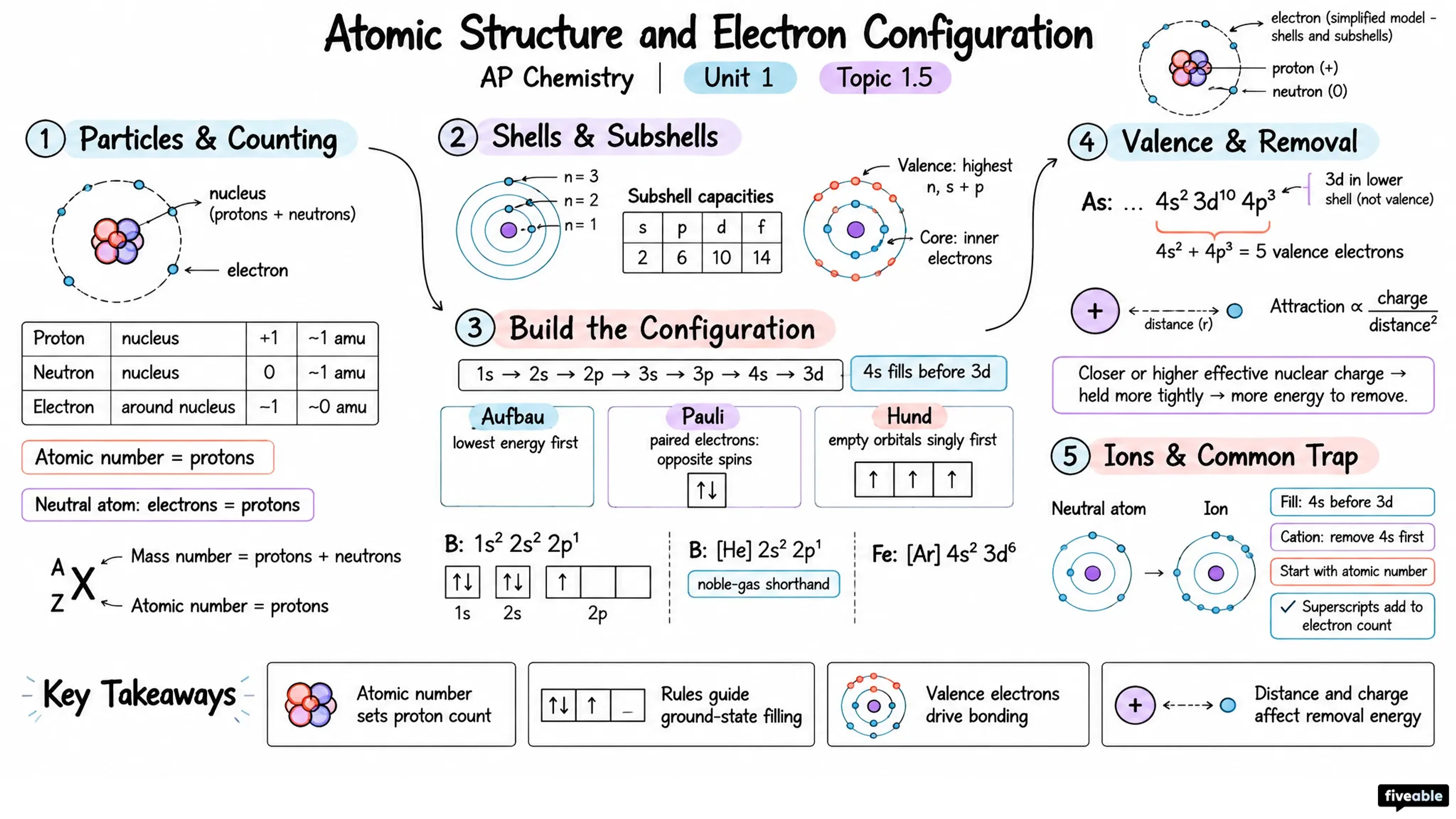
  • Atomic Structure & Electron Configuration

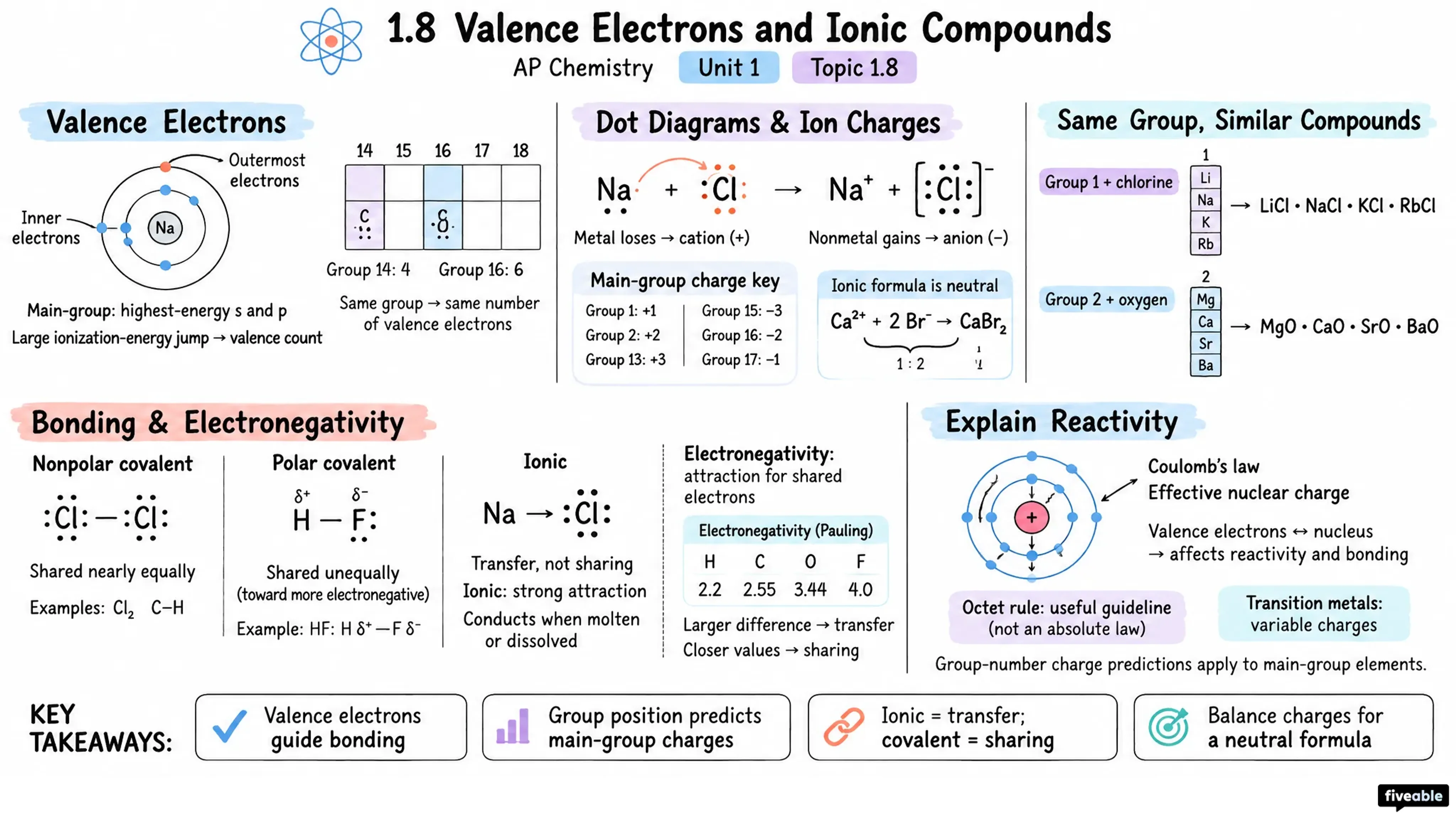
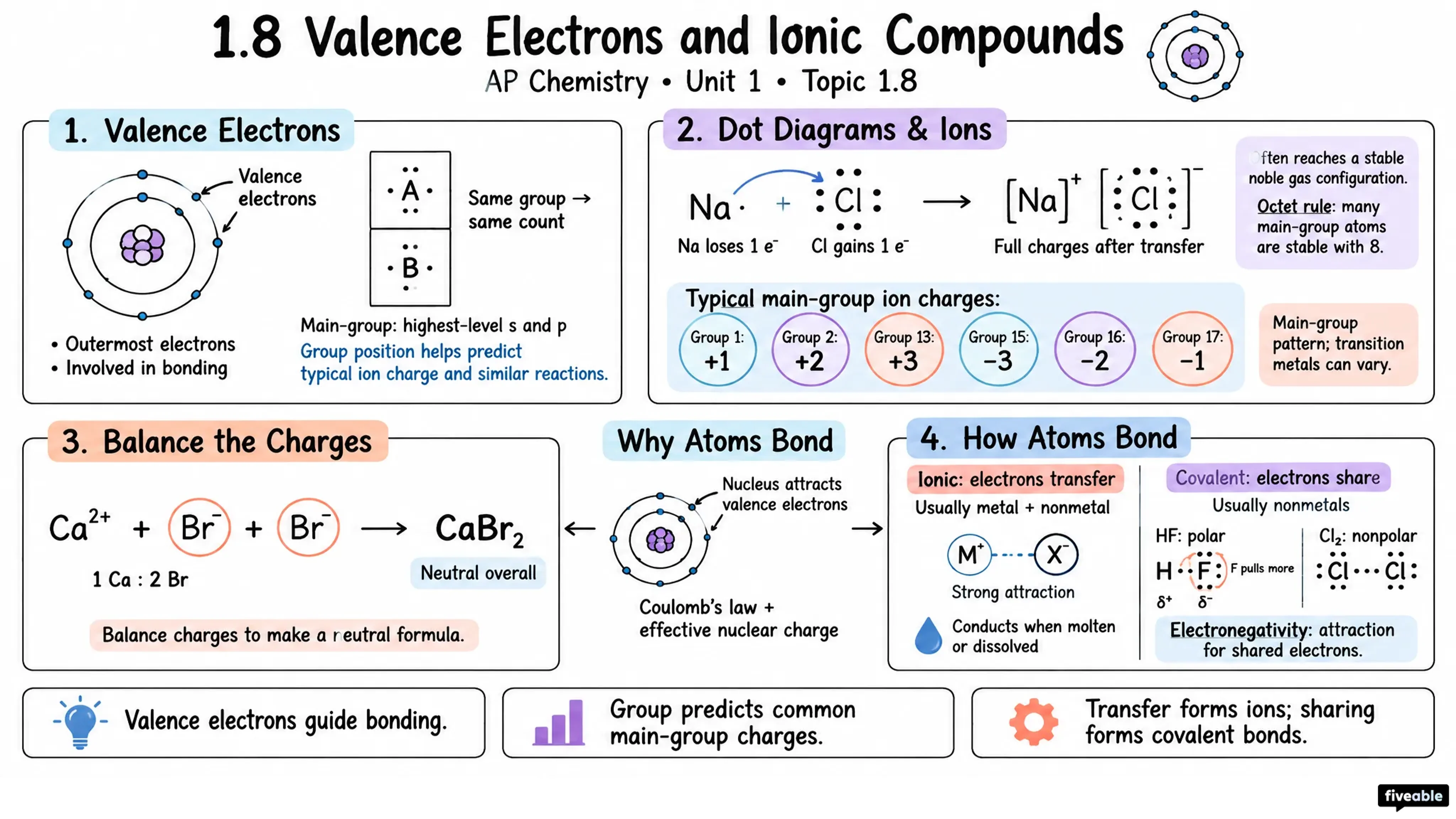
  • Valence Electrons & Ionic Compounds

Made by you

Visual Cheatsheets

Pick a Unit 1 topic and a format: flowchart, comparison chart, vocab sheet, Cornell notes and more. Ready in about a minute.

Printable PDF · from the Fiveable shop

AP Chemistry Unit 1 Cheatsheet

1 page · Atomic Structure and Properties · PDF

Visual Cheatsheets

One topic, the format you pick, ready in about a minute

Format

Topic

Takes 30–60 seconds

Preview: Standard

Unit 1: Atomic Structure & Properties, topic by topic

Each topic has a full study guide. See the whole unit.