3.18 The Universal Negro Improvement Association

✊🏿AP African American Studies Unit 3 Review
3.18 The Universal Negro Improvement Association
✊🏿 AP African American Studies
3.1
The Reconstruction Amendments
3.2
Social Life: Reuniting Black Families and the Freedmen's Bureau
3.3
Black Codes, Land, and Labor
3.4
The Defeat of Reconstruction
3.5
Disenfranchisement and Jim Crow Laws
3.6
White Supremacist Violence and the Red Summer
3.7
The Color Line and Double Consciousness in American Society
3.8
Lifting as We Climb: Uplift Ideologies and Black Women's Rights and Leadership
3.9
Black Organizations and Institutions
3.10
HBCUs, Black Greek Letter Organizations, and Black Education
3.11
The New Negro Movement and the Harlem Renaissance
3.12
Photography and Social Change
3.13
Envisioning Africa in Harlem Renaissance Poetry
3.14
Symphony in Black: Black Performance in Music, Theater, and Film
3.15
Black History Education and African American Studies
3.16
The Great Migration
3.17
Afro-Caribbean Migration
3.18
The Universal Negro Improvement Association
The Universal Negro Improvement Association (UNIA), founded by Marcus Garvey, was the largest pan-African movement in African American history. It worked to unite Black people worldwide around racial pride, economic independence, and self-determination, and its Back-to-Africa vision and red, black, and green flag shaped Black nationalist thought across the diaspora.
Why This Matters for the AP African American Studies Exam
This topic builds your understanding of Black nationalism, pan-Africanism, and self-determination during the 1920s, ideas that connect backward to earlier emigration debates and forward to later Black Power movements. You should be able to describe what UNIA stood for and how it operated, and explain how Garvey's ideas spread through the African diaspora.
The required sources here give you practice with both text and visual analysis. You can use Garvey's "Address to the Second UNIA Convention" to analyze argument and tone, and the photographs of Garvey to interpret how leaders presented themselves to the public. These are the kinds of skills the exam rewards: reading a source closely and connecting it to the larger story of Black political thought.
Key Takeaways
- Marcus Garvey founded the UNIA, the largest pan-African movement in African American history, with thousands of members across the Caribbean, Latin America, and Africa.
- The UNIA promoted unity, racial pride, and self-reliance, and challenged white supremacy through economic and political empowerment.
- Garvey's Back-to-Africa movement popularized "Africa for the Africans" and founded the Black Star Line, a steamship company meant to support repatriation to Africa.
- Garvey encouraged African Americans to embrace their shared African heritage and to build separatist Black institutions for industrial, political, and educational advancement.
- The UNIA's goal of Black liberation from colonialism became a model for later Black nationalist movements, and its red, black, and green flag is still a symbol of Black solidarity worldwide.
- Required sources include Garvey's "Address to the Second UNIA Convention" (1921) and two 1924 photographs of Garvey.
Mission and Methods of UNIA
UNIA as a Pan-African Movement
Marcus Garvey, a Jamaican-born Black nationalist leader, founded the Universal Negro Improvement Association (UNIA) to unite people of African descent around the world. It became the largest pan-African movement in African American history and maintained thousands of members in countries throughout the Caribbean, Latin America, and Africa.
The UNIA aimed to promote unity, pride, and self-reliance among Black people and to challenge white supremacy through economic and political empowerment. Garvey believed Black communities could advance fastest by building and supporting their own institutions rather than depending on a society that excluded them.
The Back-to-Africa Movement
Garvey's Back-to-Africa movement popularized the phrase "Africa for the Africans." He argued that African Americans faced such deep, systemic racism in the United States that real freedom and equality there were unlikely, so he encouraged resettlement in Africa and the building of independent Black nations.
To support this vision, Garvey founded the Black Star Line, a steamship company meant to repatriate African Americans to Africa and to promote trade between Africa and the diaspora. The company is a useful example of how Garvey tied economic ventures directly to his political goals.
Impact of Garvey and UNIA
Embracing African Heritage
Garvey inspired African Americans to embrace their shared African heritage and take pride in their identity at a time of intense racial violence and discrimination. He championed industrial, political, and educational advancement and self-determination through separatist Black institutions, arguing that Black communities needed their own businesses, schools, and organizations to be truly independent.
UNIA's Black Liberation Goal
Garvey outlined the UNIA's objective to achieve Black liberation from colonialism across the African diaspora. This framework became a model for later Black nationalist movements throughout the twentieth century.
Garvey also created the red, black, and green flag as a symbol of Black pride and unity. It continues to be used by advocates of Black solidarity and freedom worldwide.
As an application of Garvey's influence, later leaders and movements such as Malcolm X, the Nation of Islam, and the Rastafari movement in Jamaica drew on his ideas. Treat these as examples of his long reach, not as required content for this topic.
How to Use This on the AP African American Studies Exam
Using Sources Effectively
When you read Garvey's "Address to the Second UNIA Convention," look for his main claims and his tone. Notice how he calls for African liberation, demands global recognition for Black people, and criticizes powers that divided African land without consent. Pull short quotes and explain what they reveal about his vision of self-determination.
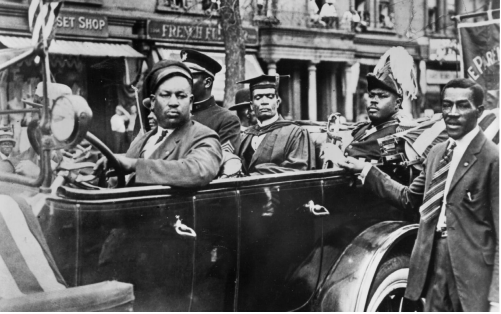
For the 1924 photographs of Garvey, analyze how he presents himself. Consider what his setting, posture, and clothing communicate about leadership, dignity, and Black pride. Visual sources count as evidence too, so describe specific details and connect them to UNIA's message.
Making Connections
Be ready to connect UNIA to earlier ideas about emigration and belonging and to later Black nationalist movements. A strong response shows continuity and change: how Garvey built on existing ideas of racial pride and self-determination, and how his framework shaped movements that came after.
Common Trap
Do not reduce Garvey to only the Back-to-Africa idea. His larger goals included economic independence, racial pride, education, and global Black solidarity. Mentioning the full mission will make your answers more accurate and complete.
Common Misconceptions
- Misconception: Garvey was asking every African American to physically move to Africa.Actually: Garvey was not asking every African American to physically move to Africa. The Back-to-Africa movement was part of a broader vision of self-determination, pride, and independent Black institutions.
- Misconception: The UNIA was only a United States organization.Actually: The UNIA was not only a United States organization. It was a global pan-African movement with members across the Caribbean, Latin America, and Africa.
- Misconception: Garvey and the UNIA invented Black nationalism by themselves.Actually: Garvey and the UNIA did not invent Black nationalism by themselves, but the UNIA's framework became a model that shaped many later Black nationalist movements.
- Misconception: Connecting the red, black, and green flag to specific national flags or later leaders is required content for this topic.Actually: The red, black, and green flag is a lasting symbol of Black solidarity, but connecting it to specific national flags or later leaders is an application of Garvey's influence, not required content for this topic.
Required Sources
"Address to the Second UNIA Convention" by Marcus Garvey, 1921
Garvey's 1921 address articulated a vision of Black self-reliance, economic empowerment, and repatriation to Africa that resonated with many African Americans frustrated by persistent racism and inequality. The speech captures his philosophy of Black nationalism and pride.
Key ideas to analyze:
- Call for African liberation and emancipation worldwide
- Quote: "We have come to the conclusion that speedily there must be an emancipated Negro race everywhere; and on going back to our respective homes we go with our determination to lay down, if needs be, the last drop of our blood for the defense of Africa and for the emancipation of our race."
- Explanation: This shows the urgency Garvey placed on African liberation and global emancipation, even at great personal cost.
- Warning of impending racial conflict and call for preparation
- Quote: "The handwriting is on the wall, and as we go back to our respective homes we shall serve notice upon the world that we are also coming; coming with a united effort; coming with a united determination, a determination that Africa shall be free from coast to coast."
- Explanation: Garvey uses "handwriting on the wall" to argue that major change is coming and to call for unity and determination.
- Quote: "Four hundred million Negroes of the world, I am asking you to prepare yourselves, so that you will not be found wanting when that day comes."
- Explanation: He urges readiness while still hoping change can come through shifts in global racial attitudes.
- Criticism of the League of Nations and demand for self-governance
- Quote: "An insult was hurled at the civilized Negroes of the world when they thus took upon themselves the right to parcel out and apportion as they pleased 608,000 square miles of our own land; for we never gave it up; we never sold it."
- Explanation: Garvey criticizes powerful nations for dividing African territory without consulting African people.
- Quote: "Africa, by right of heritage, is the property of the African races, and those at home and those abroad are now sufficiently civilized to conduct the affairs of their own homeland."
- Explanation: He asserts the right of Africans to govern their own continent and their readiness for self-rule.
- Awakening of consciousness and demand for global recognition
- Quote: "The world ought to understand that the Negro has come to life, possessed with a new conscience and a new soul. The old Negro is buried, and it is well the world knew it."
- Explanation: This signals a new, empowered identity and a break from past acquiescence.
- Quote: "Hence 400,000,000 Negroes demand a place in the political sun of the world."
- Explanation: Garvey demands equal political standing and recognition on the global stage.
Marcus Garvey at His Desk, 1924
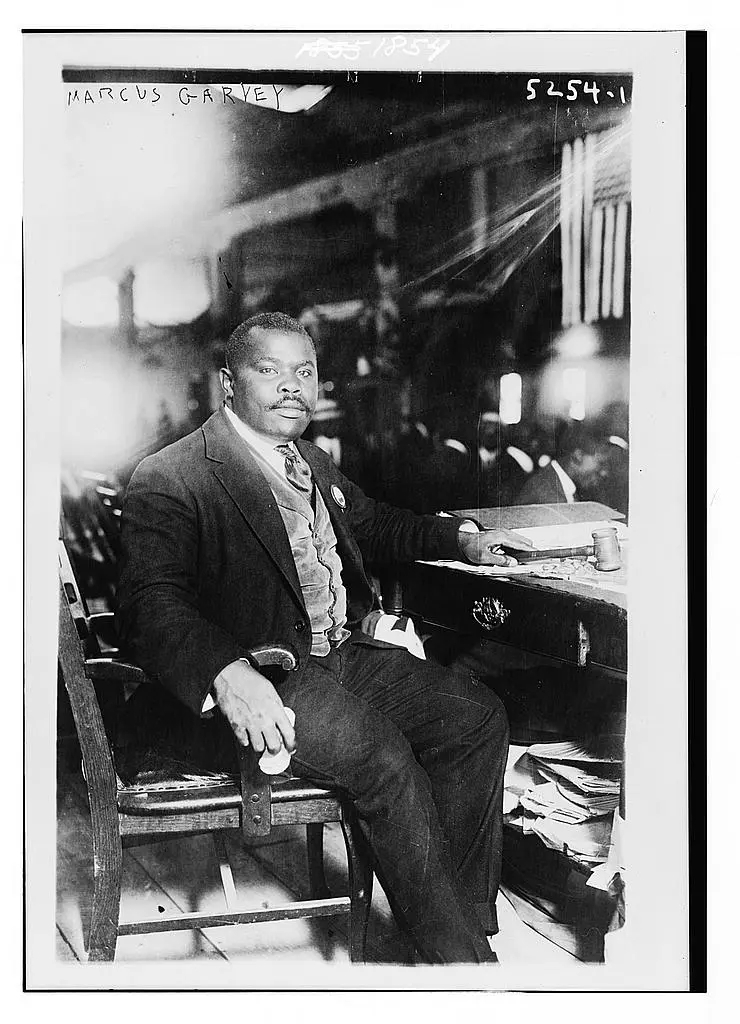
This 1924 photograph shows Garvey in a leadership setting. Analyze how his posture, setting, and presentation communicate dignity, seriousness, and authority, all reinforcing UNIA's message of Black pride and self-determination.
Marcus Garvey in Harlem, 1924
This 1924 photograph places Garvey in Harlem, a center of Black political and cultural life in the 1920s. Consider how the image presents him publicly as a leader and how it connects to UNIA's goal of uniting and inspiring Black communities.
Related AP African American Studies Guides
Practice Questions for 3.18
1 of 10
In his 1921 UNIA Convention address, Garvey stated: 'Four hundred million Negroes of the world, I am asking you to prepare yourselves, so that you will not be found wanting when that day comes,' referring to an anticipated global racial conflict. Speaking to UNIA delegates from multiple countries, Garvey's call for preparation was historically significant primarily because it
A.
demonstrated that Garvey believed racial conflict could be avoided through peaceful negotiation and integration with white institutions
B.
proved that African Americans had already achieved military superiority over white nations and were prepared for immediate armed conflict
C.
indicated that Garvey sought to encourage African Americans to abandon diaspora organizing and focus exclusively on American national politics
D.
mobilized diaspora consciousness around collective racial identity and readiness for liberation struggle against global white supremacy
Vocabulary
The following words are mentioned explicitly in the AP® course framework for this topic.Term | Definition |
|---|---|
African diaspora | The dispersal and communities of people of African descent throughout the world, particularly resulting from the transatlantic slave trade and subsequent migration. |
African heritage | The cultural, historical, and ancestral connections to Africa and African traditions maintained by African Americans. |
Back-to-Africa movement | A movement led by Marcus Garvey that promoted the return and repatriation of African Americans to Africa, popularizing the phrase 'Africa for the Africans.' |
Black liberation | The political and social goal of achieving freedom, equality, and self-determination for Black people. |
Black nationalist movements | Political and social movements that emphasize Black pride, self-governance, and the advancement of Black interests and independence. |
Black solidarity | Unity and collective action among people of African descent based on shared identity, interests, and goals. |
Black Star Line | A steamship company founded by Marcus Garvey to facilitate the repatriation of African Americans to Africa. |
colonialism | The practice of establishing political and economic control over distant territories and their peoples, often justified through claims of civilization and superiority. |
Marcus Garvey | Jamaican-born activist and founder of the Universal Negro Improvement Association who advocated for Black pride, African heritage, and self-determination for people of African descent. |
pan-African movement | A political and cultural movement that seeks to unite people of African descent across national and continental boundaries. |
repatriation | The process of returning people to their country or ancestral homeland, as promoted by Garvey's movement for African Americans returning to Africa. |
self-determination | The right of a people to govern themselves and make decisions about their own political, economic, and social futures without external control. |
separatist Black institutions | Independent organizations and institutions created and controlled by African Americans to serve their own communities and advance their interests. |
Universal Negro Improvement Association (UNIA) | An organization founded by Marcus Garvey that aimed to unite Black people across the African diaspora and was the largest pan-African movement in African American history. |
Frequently Asked Questions
What was the Universal Negro Improvement Association?
The Universal Negro Improvement Association, or UNIA, was a global pan-African movement led by Marcus Garvey. It aimed to unite Black people worldwide around pride, self-reliance, economic independence, and self-determination.
What did Marcus Garvey believe?
Marcus Garvey promoted Black pride, shared African heritage, separatist Black institutions, economic advancement, education, and political self-determination. His ideas became important to later Black nationalist movements.
What was the Back-to-Africa movement?
Garvey’s Back-to-Africa movement popularized the phrase Africa for the Africans and encouraged Black self-determination connected to Africa. In this topic, treat it as part of a broader UNIA mission, not the whole movement.
What was the Black Star Line?
The Black Star Line was a steamship company Garvey founded to support repatriation to Africa and trade across the African diaspora. It shows how UNIA tied economic projects to political goals.
Why is the red, black, and green flag important?
The UNIA’s red, black, and green flag became a lasting symbol of Black solidarity and freedom worldwide. For AP African American Studies, it shows Garvey’s long influence on political thought across the diaspora.
What sources should I know for Topic 3.18?
Know Garvey’s Address to the Second UNIA Convention and the 1924 photographs of Garvey at his desk and in Harlem. Use them to analyze message, tone, leadership image, and the public presentation of Black pride.
See Fiveable more often in Google
Mark Fiveable as a preferred source and Google is more likely to show you our guides in Top Stories, with a "preferred" badge in AI Mode and AI Overviews.