3.4 The Defeat of Reconstruction

✊🏿AP African American Studies Unit 3 Review
3.4 The Defeat of Reconstruction
✊🏿 AP African American Studies
3.1
The Reconstruction Amendments
3.2
Social Life: Reuniting Black Families and the Freedmen's Bureau
3.3
Black Codes, Land, and Labor
3.4
The Defeat of Reconstruction
3.5
Disenfranchisement and Jim Crow Laws
3.6
White Supremacist Violence and the Red Summer
3.7
The Color Line and Double Consciousness in American Society
3.8
Lifting as We Climb: Uplift Ideologies and Black Women's Rights and Leadership
3.9
Black Organizations and Institutions
3.10
HBCUs, Black Greek Letter Organizations, and Black Education
3.11
The New Negro Movement and the Harlem Renaissance
3.12
Photography and Social Change
3.13
Envisioning Africa in Harlem Renaissance Poetry
3.14
Symphony in Black: Black Performance in Music, Theater, and Film
3.15
Black History Education and African American Studies
3.16
The Great Migration
3.17
Afro-Caribbean Migration
3.18
The Universal Negro Improvement Association
After the Compromise of 1877 pulled federal troops out of the South, the gains African Americans made during Reconstruction were taken apart through new state constitutions, voter suppression, racial violence, and legalized segregation. The 1896 Supreme Court ruling in Plessy v. Ferguson then upheld "separate but equal," giving legal cover to segregation.
Why This Matters for the AP African American Studies Exam
This topic helps you explain causation and continuity and change over time: how reforms from one era can be dismantled in the next. You should be able to trace how political deals, laws, court rulings, and violence worked together to undo Reconstruction.
The required source here is the Plessy v. Ferguson ruling, so be ready to analyze how the Court justified "separate but equal" and what that meant in practice. This kind of source analysis and argument-building shows up across the exam, and connecting Reconstruction's defeat to later struggles for civil rights gives you strong evidence for bigger-picture questions.
Key Takeaways
- The Compromise of 1877 followed the disputed election of 1876 and led to the withdrawal of federal troops, ending Reconstruction.
- Some Southern states rewrote their constitutions to create de jure (legally required) segregation.
- Black voting was suppressed through poll taxes, literacy tests, and grandfather clauses.
- Racial violence, including lynching and terror from groups like the Ku Klux Klan, endangered African Americans and former Confederate opponents.
- Plessy v. Ferguson (1896) upheld a Louisiana segregated railcar law and made "separate but equal" the legal basis for segregation.
- In practice, "separate but equal" meant separate and unequal, and it stood until Brown v. Board of Education (1954) began dismantling it.
How Reconstruction Was Dismantled
Reconstruction aimed to rebuild the South and secure citizenship and rights for African Americans. Those efforts were taken apart through both laws and violence, reversing much of the progress of the late 1860s and 1870s.
The Election of 1876 and the Compromise of 1877
The presidential election of 1876 was disputed and close. The Compromise of 1877 resolved the standoff by allowing Rutherford B. Hayes to take the presidency in exchange for withdrawing federal troops from the South. Without federal enforcement, the protections that had supported Black civil and political rights collapsed.
This shift opened the door to:
- The end of federal enforcement of Black civil rights in the South
- The return of white supremacist control of Southern state governments
- The spread of segregation laws
De Jure Segregation in State Constitutions
After 1877, some Southern states rewrote their state constitutions to require segregation by law. "De jure" means segregation was written into the legal code, not just practiced informally. These changes worked against the rights African Americans had gained through the Reconstruction Amendments and pushed Black communities into second-class status in public life.
Black Voter Suppression
States used several tools to keep Black men from voting without openly violating the Fifteenth Amendment:
- Poll taxes: fees required to vote, which many poor African Americans could not afford
- Literacy tests: reading and interpretation requirements that were used to deny the vote, hitting people who had been denied education under slavery
- Grandfather clauses: rules that let a man vote only if his grandfather had been eligible before the Civil War, which excluded most Black voters while exempting many white voters from literacy tests and poll taxes
Voter intimidation and violence reinforced these laws, cutting off Black political power for generations.
Racial Violence and Retaliation
As Black political power was stripped away, white supremacists and political terrorist groups used violence to control Black communities. Lynching, the extrajudicial murder of people without a trial, was used as public terror meant to instill fear. Former Confederates and groups like the Ku Klux Klan targeted Black citizens, Black political leaders, and white allies through threats, beatings, and murder. This violence was driven by white supremacist beliefs that were used to justify oppression and discrimination.
Plessy v. Ferguson (1896)
Homer Plessy, a man of mixed racial heritage, challenged Louisiana's law requiring segregated railroad cars. In Plessy v. Ferguson (1896), the Supreme Court upheld that law and established the "separate but equal" doctrine, ruling that segregated facilities were constitutional as long as they were supposedly equal.
The decision became the legal basis for segregation across many parts of American life, including transportation, schools, and other public facilities. It stood until the Supreme Court's ruling in Brown v. Board of Education (1954) began to dismantle it.
"Separate but Equal" in Practice
Although the Court said facilities had to be equal, in reality segregation produced separate and unequal conditions:
- Black schools were often underfunded and overcrowded
- Public services like parks, libraries, and hospitals were inferior or unavailable to Black residents
- Segregation laws locked Black citizens into second-class status with fewer chances to advance
The harm from this system lasted well beyond 1896, and even after Plessy was overturned, legal and economic barriers continued to disadvantage African Americans.
Required Source
Plessy v. Ferguson Supreme Court ruling, 1896
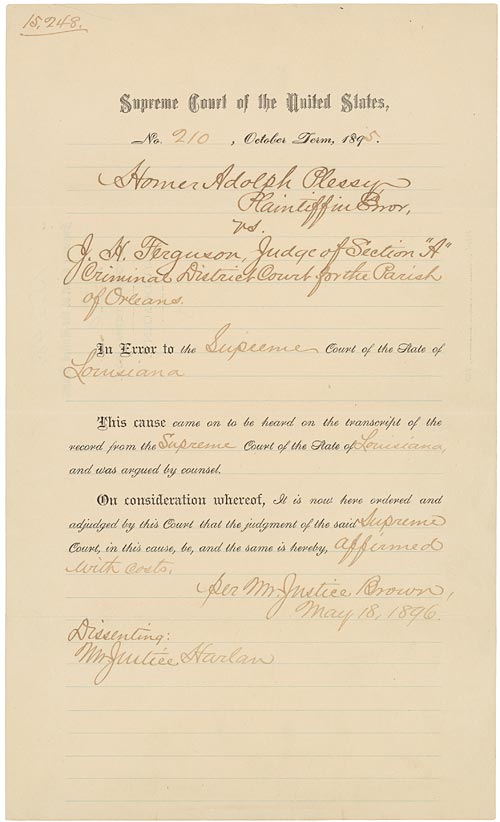
The Plessy v. Ferguson ruling upheld the constitutionality of racial segregation under the "separate but equal" doctrine. This decision gave legal cover to Jim Crow laws and helped institutionalize racial discrimination across the United States, especially in public accommodations and services.
When you analyze this source, focus on how the Court justified segregation as constitutional and how that reasoning clashed with the equal protection promise of the Fourteenth Amendment. The ruling set a precedent that supported segregation and unequal treatment for decades, until Brown v. Board of Education (1954) began to overturn it.
How to Use This on the AP African American Studies Exam
Using Sources Effectively
When you work with the Plessy v. Ferguson ruling, identify the "separate but equal" doctrine, explain the Court's reasoning, and contrast the claim of equality with the unequal reality. Strong answers connect the ruling to the Fourteenth Amendment and to the broader Jim Crow system.
Causation
Be ready to explain what caused Reconstruction's defeat. Link the disputed election of 1876, the Compromise of 1877 and troop withdrawal, new state constitutions, voter suppression, and racial violence as connected causes, not separate facts.
Continuity and Change
Show that rights won during Reconstruction were rolled back afterward, and that the fight to reclaim them continued into the twentieth century. Naming Brown v. Board of Education (1954) as the turning point against "separate but equal" gives you a clear marker of change over time.
Common Trap
Do not treat the end of Reconstruction as a single event. It came from a combination of political deals, laws, court rulings, and violence working together.
Common Misconceptions
- Misconception: The Compromise of 1877 made segregation legal.Actually: The compromise withdrew federal troops and ended Reconstruction. Legalized segregation came later through new state constitutions and rulings like Plessy v. Ferguson.
- Misconception: Plessy v. Ferguson was only about trains.Actually: It started with a Louisiana railcar law, but its "separate but equal" doctrine became the legal basis for segregation across many areas of life.
- Misconception: Separate but equal meant facilities were actually equal.Actually: In practice, Black schools, parks, libraries, and hospitals were underfunded or unavailable. The system was separate and unequal.
- Misconception: The Fifteenth Amendment guaranteed Black men could always vote.Actually: States used poll taxes, literacy tests, and grandfather clauses to suppress Black voting without openly naming race.
- Misconception: Brown v. Board of Education instantly ended segregation.Actually: It began to dismantle "separate but equal" in 1954, but legal and economic barriers continued long after.
Related AP African American Studies Guides
Practice Questions for 3.4
1 of 10
Records from three Southern states show Black landownership percentages of 22% in South Carolina (1875), 18% in Georgia (1875), and 16% in Louisiana (1875), declining to 8%, 6%, and 4% respectively by 1900. What does this geographic variation in land loss most directly suggest about the mechanisms dismantling Black economic independence?
A.
All three states experienced similar proportional land loss, proving decline was inevitable.
B.
Black landownership declined most sharply in states with larger Black populations.
C.
South Carolina's higher initial ownership indicates fewer property restrictions than Georgia or Louisiana.
D.
White supremacist organization and enforcement intensity varied significantly across states.
Vocabulary
The following words are mentioned explicitly in the AP® course framework for this topic.Term | Definition |
|---|---|
Brown v. Board of Education | A landmark 1954 Supreme Court decision that ruled that 'separate but equal' public schools were unconstitutional and violated the Equal Protection Clause. |
Compromise of 1877 | A political agreement following the disputed 1876 presidential election that ended Reconstruction by withdrawing federal troops from the South in exchange for Republican Rutherford B. Hayes becoming president. |
de jure segregation | Racial segregation mandated by law through state constitutions and legislation. |
grandfather clauses | Provisions that exempted certain voters (typically white voters whose grandfathers could vote before Reconstruction) from literacy tests and poll taxes, used to suppress Black voting. |
Ku Klux Klan | A white supremacist political terrorist group that used violence and intimidation against African Americans and their allies during and after Reconstruction. |
literacy tests | Tests of reading and writing ability required for voter registration, used to disenfranchise Black voters despite the Fifteenth Amendment. |
lynching | Extrajudicial execution and racial violence perpetrated against African Americans, often by mobs, as a tool of terror and social control. |
Plessy v. Ferguson | An 1896 Supreme Court decision that established the 'separate but equal' doctrine, allowing racial segregation in public facilities. |
poll taxes | Taxes imposed on voters as a requirement to vote, used to suppress Black voting by making voting financially inaccessible. |
Reconstruction-era reforms | Political, social, and economic changes implemented during Reconstruction (1865-1877) to integrate formerly enslaved people into American society and rebuild the South. |
separate but equal | A legal doctrine established by Plessy v. Ferguson that permitted racial segregation as long as separate facilities were theoretically equal, used to justify segregation laws. |
white supremacist doctrine | Ideology asserting the superiority of white people and justifying racial hierarchy, discrimination, and violence against African Americans. |
Frequently Asked Questions
What was the defeat of Reconstruction?
The defeat of Reconstruction was the rollback of many Reconstruction-era gains after federal enforcement weakened, especially through the Compromise of 1877, voter suppression, racial terror, and segregation laws.
What did the Compromise of 1877 do?
The Compromise of 1877 resolved the disputed 1876 presidential election and led to the withdrawal of federal troops from the South. That removal weakened protection for Black civil and political rights.
How did Southern states suppress Black voting?
Southern states used poll taxes, literacy tests, grandfather clauses, intimidation, and violence to prevent Black men from voting while avoiding direct mention of race in some laws.
What did Plessy v. Ferguson decide?
Plessy v. Ferguson upheld racial segregation under the separate but equal doctrine. In practice, this doctrine gave legal cover to Jim Crow segregation and unequal public facilities.
Why was separate but equal unequal in practice?
Although the phrase claimed equality, Black schools, transportation, hospitals, libraries, and other public services were often underfunded, inferior, or unavailable.
How is the defeat of Reconstruction tested on the AP exam?
AP questions may ask you to explain causation, analyze Plessy v. Ferguson, or connect Reconstruction-era gains to later disenfranchisement, Jim Crow, and civil rights struggles.
See Fiveable more often in Google
Mark Fiveable as a preferred source and Google is more likely to show you our guides in Top Stories, with a "preferred" badge in AI Mode and AI Overviews.