1.10 Kinship and Political Leadership

✊🏿AP African American Studies Unit 1 Review
1.10 Kinship and Political Leadership
✊🏿 AP African American Studies
1.1
What Is African American Studies?
1.2
The African Continent: A Varied Landscape
1.3
Population Growth and Ethnolinguistic Diversity
1.4
Africa's Ancient Societies
1.5
The Sudanic Empires: Ghana, Mali, and Songhai
1.6
Learning Traditions
1.7
Indigenous Cosmologies and Religious Syncretism
1.8
Culture and Trade in Southern and East Africa
1.9
West Central Africa: The Kingdom of Kongo
1.10
Kinship and Political Leadership
1.11
Global Africans
In early West and Central African societies, kinship held communities together and often formed the basis for political alliances, while women served as spiritual leaders, advisors, traders, educators, and farmers. Two leaders stand out for comparison: Queen Idia of Benin, the first iyoba (queen mother), advised her son and used spiritual and medicinal knowledge in war, while Queen Njinga of Ndongo and Matamba used diplomacy and military leadership to defend her kingdom against Portuguese expansion.
Why This Matters for the AP African American Studies Exam
This topic builds two skills you will use across the exam. First, you practice comparison by analyzing how Queen Idia and Queen Njinga led in different ways and contexts. Second, you connect early African political structures to the larger story of the African diaspora, which sets up later units on enslavement, resistance, and Black women's leadership.
It also gives you specific evidence and required images to work with for source analysis. Being able to describe what a source shows, who made it, and why it matters is the core of analyzing visual and historical sources in this course.
Key Takeaways
- Kinship means relationships based on blood, marriage, or social ties, and it often shaped political alliances in West and Central Africa.
- Women held many roles: spiritual leaders, political advisors, market traders, educators, and agriculturalists.
- Queen Idia became the first iyoba (queen mother) in the Kingdom of Benin in the late fifteenth century and advised her son, the king.
- Queen Njinga became queen of Ndongo and Matamba in the early seventeenth century and led roughly 30 years of guerilla warfare against the Portuguese.
- Both queens personally led armies; Idia relied on spiritual power and medicinal knowledge, while Njinga used guerilla tactics, diplomacy, and the slave trade to build power.
- Idia's ivory mask became the symbol of FESTAC in 1977, and Njinga's example led to nearly 100 more years of women rulers in Matamba.
Kinship and Women's Roles
Kinship in African societies
Kinship is the connection between people related by blood, marriage, or other social ties. In many early West and Central African societies, family groups held together by extended kinship ties formed the building blocks of community, and those ties often became the basis for political alliances. Marriage between families and shared lineage could bind different groups into larger political units.
Women's roles
Women in West and Central African societies held a wide range of important roles. They served as:
- Spiritual leaders
- Political advisors
- Market traders
- Educators
- Agriculturalists
These roles show that women's influence reached into religion, governance, the economy, and education, not just the household.
Queen Idia vs. Queen Njinga
Queen Idia of Benin
Queen Idia became the first iyoba (queen mother) in the Kingdom of Benin, present-day Nigeria, in the late fifteenth century. She served as a political advisor to her son, the king. She also led armies into battle and relied on spiritual power and medicinal knowledge to bring victories to Benin.
Queen Njinga of Ndongo-Matamba
In the early seventeenth century, Queen Njinga became queen of the kingdoms of Ndongo and Matamba, present-day Angola. This is the same period when people from the kingdom of Ndongo became the first large group of enslaved Africans to arrive in the American colonies.
Njinga engaged in about 30 years of guerilla warfare against the Portuguese to maintain sovereignty and control of her kingdom. She participated in the slave trade to amass wealth and political influence, and she expanded Matamba's military by offering sanctuary to people who escaped Portuguese enslavement and joined her forces.
Leadership comparison
| Queen Idia | Both | Queen Njinga |
|---|---|---|
| First iyoba (queen mother) of Benin | Personally led armies into battle | Queen of Ndongo and Matamba |
| Advised her son, the king | Used leadership to protect and strengthen their kingdoms | Fought about 30 years of guerilla warfare against the Portuguese |
| Relied on spiritual power and medicinal knowledge in war | Became diaspora-wide symbols of Black women's leadership | Participated in the slave trade and offered sanctuary to escapees to build her forces |
Legacy of Queen Idia and Queen Njinga
Queen Idia's legacy
Queen Idia became an iconic symbol of Black women's leadership throughout the African diaspora. In 1977, an ivory mask of her face was adopted as the symbol for FESTAC, the Second World Black Festival of Arts and Culture. That choice connected her image to a global celebration of Black art and culture and kept her leadership visible across the diaspora.
Queen Njinga's legacy
Queen Njinga's reign solidified her legacy as a skilled political and military leader throughout the African diaspora. The strength of her example led to nearly 100 more years of women rulers in Matamba, showing how her leadership opened lasting space for women in power in the region.
Required Sources
Illustration of Queen Njinga, Seventeenth Century
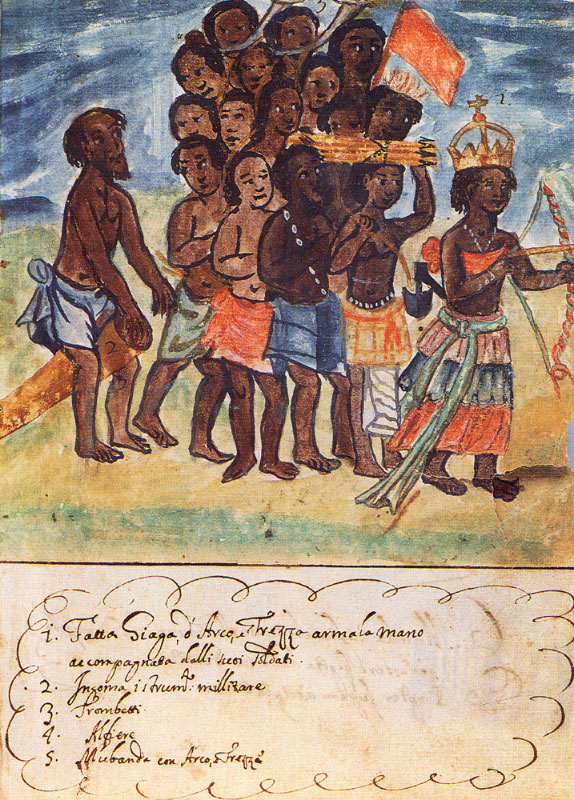
This seventeenth-century illustration depicts Queen Njinga of Ndongo and Matamba, who resisted Portuguese colonial expansion in present-day Angola. Her diplomacy, military skill, and political strategy let her defend her people's sovereignty against enslavement for decades. The image is useful as evidence of powerful female leadership and sophisticated political structures in early Africa.
Image of Queen Mother Pendant Mask: Iyoba, Sixteenth Century

This sixteenth-century ivory mask of Queen Idia was designed as a pendant to be worn to inspire Benin's warriors. Its details carry meaning: faces adorn the top of her head to represent her skill in diplomacy and trade with the Portuguese, iron scarifications on her forehead identify her as a warrior, and the beads above her face depict Afro-textured hair, valorizing the beauty of her natural features. The mask reflects the role of the iyoba and the artistic skill of Benin.
How to Use This on the AP African American Studies Exam
Using Sources Effectively
For the required images, practice naming three things: what the source shows, who or what it represents, and why it matters. For the Queen Idia mask, point to specific details like the iron scarifications (warrior identity) and the faces on her head (diplomacy and trade with the Portuguese). For the Njinga illustration, connect it to her resistance against the Portuguese and her role as a powerful woman leader.
Comparison
Be ready to compare Idia and Njinga clearly. A strong comparison names a shared trait and a real difference. Both personally led armies, but Idia leaned on spiritual power and medicinal knowledge while Njinga relied on long-term guerilla warfare, diplomacy, and participation in the slave trade to build power.
Common Trap
Do not blur the two queens together. Keep their kingdoms, time periods, and methods straight: Idia in Benin in the late fifteenth century, Njinga in Ndongo-Matamba in the early seventeenth century.
Common Misconceptions
- Misconception: Kinship is only about parents and children.Actually: Kinship is not only about parents and children. It includes extended ties through blood, marriage, and social connection, and those ties shaped political alliances.
- Misconception: Women's roles were limited to the home.Actually: Women's roles were not limited to the home. Women served as spiritual leaders, political advisors, market traders, educators, and agriculturalists.
- Misconception: Queen Idia was the ruling monarch.Actually: Queen Idia was not the ruling monarch. She was the first iyoba (queen mother) and a political advisor to her son, the king.
- Misconception: Queen Njinga simply opposed the slave trade in all forms.Actually: Queen Njinga did not simply oppose the slave trade in all forms. She participated in it to gain wealth and political influence while also offering sanctuary to people who escaped Portuguese enslavement.
- Misconception: The two queens led in the same time and place.Actually: The two queens led in different times and places. Idia was in Benin in the late fifteenth century, and Njinga ruled Ndongo and Matamba in the early seventeenth century.
Related AP African American Studies Guides
Practice Questions for 1.10
1 of 10
Read this paraphrase of the source (not a direct quotation):
The Met describes Njinga making alliances with Portugal and later the Dutch, strengthening her forces by welcoming fugitives and soldiers, and developing Matamba’s position in regional commerce. Her strategies changed as relations with foreign powers changed.
Source: The Metropolitan Museum of Art, Ana Nzinga, Queen of Ndongo.
Which interpretation of her leadership is best supported by this account?
A.
She combined diplomatic, military, and commercial strategies to sustain her state.
B.
She ended all relations with European powers permanently.
C.
She abandoned commerce when foreign powers threatened her rule.
D.
She relied exclusively on warfare and refused negotiations.
Vocabulary
The following words are mentioned explicitly in the AP® course framework for this topic.Term | Definition |
|---|---|
African diaspora | The dispersal and communities of people of African descent throughout the world, particularly resulting from the transatlantic slave trade and subsequent migration. |
agriculturalists | Women in West and Central African societies who engaged in farming and food production as a primary economic activity. |
extended kinship ties | Family relationships that extended beyond the nuclear family to include distant relatives, forming the foundation for holding family groups together in early West and Central African societies. |
FESTAC | The Second World Black Festival of Arts and Culture, held in 1977, which adopted an ivory mask of Queen Idia as its symbol. |
guerilla warfare | Irregular military tactics involving small-scale, surprise attacks used by Queen Njinga against Portuguese forces for 30 years to maintain sovereignty. |
iyoba | The title for queen mother in the Kingdom of Benin, a position of political authority and advisory power to the king. |
Kingdom of Benin | A West African kingdom in present-day Nigeria where Queen Idia served as the first iyoba in the late fifteenth century. |
Kingdom of Matamba | A Central African kingdom in present-day Angola that Queen Njinga ruled alongside Ndongo and expanded militarily. |
Kingdom of Ndongo | A Central African kingdom in present-day Angola ruled by Queen Njinga in the early seventeenth century. |
kinship | Family relationships and connections that formed the basis for social organization, political alliances, and community structure in early West and Central African societies. |
market traders | Women in West and Central African societies who engaged in the buying and selling of goods in commercial exchanges. |
medicinal knowledge | Expertise in healing practices and remedies that Queen Idia employed to contribute to Benin's military success. |
Ndongo-Matamba | An African kingdom ruled by Queen Njinga, known for its women rulers who continued her legacy for nearly 100 years after her reign. |
political advisors | Women in West and Central African societies who provided counsel and guidance on matters of governance and decision-making to political leaders. |
political alliances | Formal or informal agreements between groups or families, often formed through kinship connections, to support each other's interests and maintain social order. |
Queen Idia | A historical queen of Benin whose ivory mask became an iconic symbol of Black women's leadership when adopted as the symbol for FESTAC in 1977. |
Queen Njinga | A skilled political and military leader of Ndongo-Matamba whose reign solidified her legacy as a prominent African ruler throughout the African diaspora. |
sovereignty | The power and authority of a kingdom to govern itself independently, which Queen Njinga fought to maintain against Portuguese control. |
spiritual leaders | Women in West and Central African societies who held religious or ceremonial authority and guided spiritual practices within their communities. |
spiritual power | A form of authority and influence based on religious or mystical knowledge that Queen Idia used to secure military victories for Benin. |
Frequently Asked Questions
What is kinship in AP African American Studies?
Kinship means relationships based on blood, marriage, or other social ties. In many early West and Central African societies, kinship connected family groups and helped form political alliances.
What roles did women play in early West and Central African societies?
Women served as spiritual leaders, political advisors, market traders, educators, and agriculturalists, showing influence across religion, governance, economy, and education.
Who was Queen Idia of Benin?
Queen Idia became the first iyoba, or queen mother, in the Kingdom of Benin in the late fifteenth century. She advised her son, the king, and became a symbol of Black women's leadership.
Who was Queen Njinga of Ndongo-Matamba?
Queen Njinga ruled Ndongo and Matamba in the early seventeenth century. She used diplomacy, military strategy, and political alliances to maintain sovereignty against Portuguese expansion.
How are Queen Idia and Queen Njinga similar and different?
Both were powerful women leaders connected to military and political authority. Idia was an iyoba and advisor in Benin, while Njinga was a sovereign ruler of Ndongo and Matamba.
What required sources matter for Topic 1.10?
The required sources are the seventeenth-century illustration of Queen Njinga and the sixteenth-century Queen Mother Pendant Mask: Iyoba. Use them to connect visual evidence to leadership and legacy.
See Fiveable more often in Google
Mark Fiveable as a preferred source and Google is more likely to show you our guides in Top Stories, with a "preferred" badge in AI Mode and AI Overviews.