2.5 Slave Auctions and the Domestic Slave Trade

✊🏿AP African American Studies Unit 2 Review
2.5 Slave Auctions and the Domestic Slave Trade
✊🏿 AP African American Studies
2.1
African Explorers in the Americas
2.2
Departure Zones in Africa and the Slave Trade to the United States
2.3
Capture and the Impact of the Slave Trade on West African Societies
2.4
African Resistance on Slave Ships and the Antislavery Movement
2.5
Slave Auctions and the Domestic Slave Trade
2.6
Labor, Culture, and Economy
2.7
Slavery and American Law: Slave Codes and Landmark Cases
2.8
The Social Construction of Race and the Reproduction of Status
2.9
Creating African American Culture
2.10
Black Pride, Identity, and the Question of Naming
2.11
The Stono Rebellion and Fort Mose
2.12
Legacies of the Haitian Revolution
2.13
Resistance and Revolts in the United States
2.14
Black Organizing in the North: Freedom, Women's Rights, and Education
2.15
Maroon Societies and Autonomous Black Communities
2.16
Diasporic Connections: Slavery and Freedom in Brazil
2.17
African Americans in Indigenous Territory
2.18
Debates About Emigration, Colonization, and Belonging in America
2.19
Black Political Thought: Radical Resistance
2.20
Race to the Promised Land: Abolitionism and the Underground Railroad
2.21
Legacies of Resistance in African American Art and Photography
2.22
Gender and Resistance in Slave Narratives
2.23
The Civil War and Black Communities
2.24
Freedom Days: Commemorating the Ongoing Struggle for Freedom
Slave auctions were public sites of violence and family separation where enslaved people were treated as property. After the United States banned the transatlantic slave trade in 1808, the enslaved population grew through childbirth, and the booming cotton economy fueled the domestic slave trade, forcing over a million African Americans from the upper South to the lower South in what became known as the Second Middle Passage.
Why This Matters for the AP African American Studies Exam
This topic builds skills you use across the exam: analyzing primary sources, tracing cause and effect, and explaining how writers and artists shaped political movements. You should be ready to read a source like a slave narrative or an auction broadside and explain what it reveals about commodification, family separation, and resistance. You should also be able to connect the 1808 ban, the cotton boom, and the forced migration of the Second Middle Passage as a chain of causes and effects.
The required sources here, Solomon Northup's Twelve Years a Slave and the Charleston Courthouse auction broadside, are strong evidence for arguments about the brutality of the domestic slave trade and the abolitionist writing that exposed it.
Key Takeaways
- Slave auctions used law and white supremacist doctrine to punish resistance, sometimes whipping people in front of their families.
- Enslaved people were treated as commodities to be inspected, bought, and sold, which caused trauma and broke apart families.
- African American writers used narratives and poetry to describe being sold and to counter the false claim that slavery was a benign institution.
- After the 1808 ban on the transatlantic slave trade, the enslaved population grew mainly through childbirth to meet demand for agricultural labor.
- The lower South's slave-cotton system made enslaved laborers especially valuable, driving forced relocation from the upper South.
- The Second Middle Passage displaced over one million African Americans, the largest forced migration in American history.
Nature of Slave Auctions
Enslavers used the law and white supremacist doctrine to assault the bodies, minds, and spirits of enslaved Africans and their descendants. Auctions were not just sales. They were sites of control.
At some auctions, people who resisted being sold were punished severely by whipping, at times in front of their families and friends. This public violence let enslavers assert control and instill fear meant to discourage resistance.
Auctions also treated enslaved people as commodities to be inspected, bought, and sold. This stripped people of their humanity and inflicted lasting trauma, especially when families were separated and loved ones were sent to distant places.
African American Abolitionist Writings
Literary Genres for Auction Experiences
African American writers used different literary genres, including narratives and poetry, to express the physical and emotional effects of being sold at auction into unknown territory. Slave narratives let formerly enslaved people record the anguish of family separation and the dehumanizing nature of auctions. Poetry let writers capture the despair of being torn from loved ones and reduced to property.
The required excerpt from Solomon Northup's Twelve Years a Slave is a clear example of this kind of firsthand account. Northup, a free African American musician, was kidnapped and illegally sold into slavery on a cotton plantation in Louisiana, so his narrative gives an eyewitness view of the auction system.
The named books and plays below are examples of abolitionist writing, not required sources for this topic. Treat them as supporting context if you use them.
- Frederick Douglass's Narrative of the Life of Frederick Douglass (1845) recounts the cruelty of slavery from a formerly enslaved author.
- Frances Ellen Watkins Harper's poem "The Slave Auction" (1854) expresses the grief of families torn apart at sale.
- William Wells Brown's play The Escape (1858) dramatized the lengths enslaved people would go to avoid being sold away from family.
Countering Claims of "Benign Slavery"
Enslavers often claimed slavery was a benign, harmless institution. African American writers used their firsthand experiences to counter that claim and advance the cause of abolition. By describing the brutality and family separation that happened at auctions, they shattered the myth of the contented enslaved person.
Their works appealed to readers' sense of justice and shared humanity and pushed for an end to slavery.
The Cotton Industry's Displacement
Population Growth After 1808
After the United States government formally banned the transatlantic slave trade in 1808, the enslaved population grew primarily through childbirth rather than new importations. This growth met the rising demand for enslaved agricultural laborers.
Because new legal importation was banned, enslavers relied on the enslaved population reproducing within the United States. The enslaved population continued to grow into the millions by the time of emancipation in 1865.
Slave-Cotton System in the Lower South
The lower South (South Carolina, Georgia, Florida, Alabama, Mississippi, Louisiana, and Texas) was shaped by the slave-cotton system. Cotton was labor-intensive, so enslaved African Americans were especially valuable as commodities because of the high demand for enslaved laborers.
As cotton agriculture expanded, demand for enslaved labor rose with it. That demand drove mass sales and relocations that tore apart families and communities and caused suffering that affected generations.
Two related developments help explain why the cotton economy expanded. The invention of the cotton gin increased United States production, profits, and dependency on cotton as a cash crop. The forced removal of Indigenous communities through the Trail of Tears opened land for large-scale cotton production.
The Second Middle Passage
During the cotton boom in the first half of the nineteenth century, many African Americans were forcibly relocated through the domestic slave trade from the upper South (inland states like Virginia, Tennessee, Kentucky, Arkansas, and Missouri) to the lower South. Enslavers in the upper South sold people to traders who moved them to cotton plantations.
This forced relocation became known as the Second Middle Passage. Enslaved people were marched hundreds of miles in chains, enduring physical and emotional hardship. Over one million African Americans were displaced, over two-and-a-half times more people than had arrived from Africa during the original Middle Passage. This was the largest forced migration in American history.
Required Sources
Excerpt from Twelve Years a Slave: Narrative of Solomon Northup (1853)
Solomon Northup's account gives a rare firsthand perspective from someone who experienced both freedom and bondage. He was a free Black man from New York who was kidnapped and sold into slavery, so his narrative shows the constant threat of kidnapping that free Black Americans faced and the dehumanizing reality of the auction.
The excerpt below captures a mother, Eliza, pleading not to be separated from her son at a sale.
"She wanted to be with her children, she said, the little time she had to live. All the frowns and threats of Freeman, could not wholly silence the afflicted mother. She kept on begging and beseeching them, most piteously not to separate the three. Over and over again she told them how she loved her boy. A great many times she repeated her former promises - how very faithful and obedient she would be; how hard she would labor day and night, to the last moment of her life, if he would only buy them all together. But it was of no avail; the man could not afford it. The bargain was agreed upon, and Randall must go alone. Then Eliza ran to him; embraced him passionately; kissed him again and again; told him to remember her - all the while her tears falling in the boy's face like rain.
Freeman damned her, calling her a blubbering, bawling wench, and ordered her to go to her place, and behave herself; and be somebody. He swore he wouldn't stand such stuff but a little longer. He would soon give her something to cry about, if she was not mighty careful, and that she might depend upon.
The planter from Baton Rouge, with his new purchases, was ready to depart.
"Don't cry, mama. I will be a good boy. Don't cry," said Randall, looking back, as they passed out of the door.
What has become of the lad, God knows. It was a mournful scene indeed. I would have cried myself if I had dared."
Broadside for an Auction of Enslaved Persons at the Charleston Courthouse, 1859
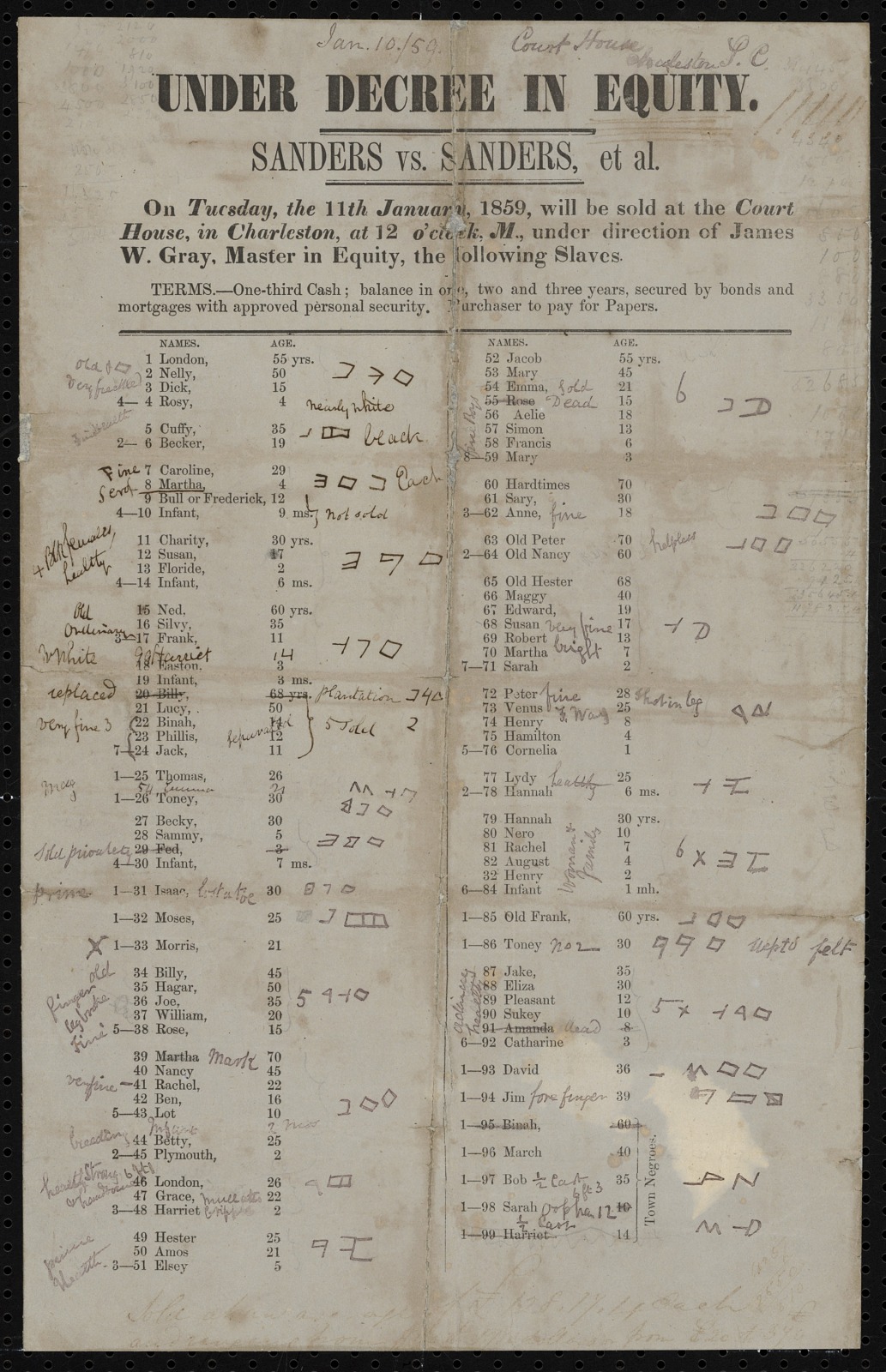
This broadside advertises a public sale of enslaved people and shows how human beings were treated as property and the economic foundation of slavery. It gives direct evidence of the commodification at the center of the slave system and connects to the trauma of family separation and the denial of basic rights.
How to Use This on the AP African American Studies Exam
Using Sources Effectively
When you read a source like the Twelve Years a Slave excerpt or the Charleston broadside, identify who made it, the purpose, and what it reveals. For Northup's narrative, point to the family separation scene as evidence of the auction's cruelty and as abolitionist argument. For the broadside, note how it presents people as property for sale.
Causation
Practice linking the chain of causes: the 1808 ban on the transatlantic slave trade pushed enslavers to rely on childbirth, the cotton boom raised demand for labor in the lower South, and that demand drove the domestic slave trade and the Second Middle Passage.
Argumentation
If you build an argument about how enslaved people and their allies resisted, use abolitionist writing about auctions as evidence. Explain that writers used narratives and poetry to counter the claim that slavery was benign and to support abolition.
Common Trap
Do not confuse the Second Middle Passage with the original Middle Passage. The original Middle Passage was the transatlantic crossing. The Second Middle Passage was the forced internal migration within the United States from the upper South to the lower South.
Common Misconceptions
- Misconception: The 1808 ban ended slavery and stopped the slave trade inside the country.Actually: The 1808 ban did not end slavery or stop the slave trade inside the country. It banned new legal importation from abroad, and the domestic slave trade grew afterward.
- Misconception: The Second Middle Passage was a sea voyage from Africa.Actually: The Second Middle Passage was not a sea voyage from Africa. It was a forced migration within the United States, often on foot over hundreds of miles.
- Misconception: Abolitionist writing about auctions was just emotional storytelling.Actually: Abolitionist writing about auctions was not just emotional storytelling. It was a deliberate political strategy to counter the myth that slavery was a benign institution.
- Misconception: Slave auctions were simple economic transactions.Actually: Slave auctions were not simple economic transactions. They were sites of violence and control, and resistance to sale could be met with public whipping.
- Misconception: Frederick Douglass's narrative, Harper's poem, and Brown's play are the required sources for this topic.Actually: Frederick Douglass's narrative, Harper's poem, and Brown's play are useful examples of abolitionist writing, but the required sources for this topic are Northup's Twelve Years a Slave and the Charleston auction broadside.
Related AP African American Studies Guides
Practice Questions for 2.5
1 of 10
Based on the 1859 Charleston courthouse broadside advertising enslaved persons for sale, the document's structure—listing individuals by age, skill, and price—provides evidence for which claim about how the domestic slave trade functioned?
A.
The Charleston courthouse broadside demonstrates that enslaved people were valued primarily for their moral character and potential for Christian conversion.
B.
The broadside's use of specific prices for each individual proves that enslaved people received fair market compensation for their labor.
C.
The Charleston courthouse broadside proves that enslaved people voluntarily participated in auctions by agreeing to be listed for sale.
D.
Enslaved people were systematized as commodities whose market value was determined by measurable characteristics tied to labor productivity and reproductive capacity.
Vocabulary
The following words are mentioned explicitly in the AP® course framework for this topic.Term | Definition |
|---|---|
abolition | The movement to end slavery and the slave trade, and the legal elimination of slavery as an institution. |
cotton industry | The economic system centered on the production and trade of cotton, which became the dominant agricultural enterprise in the United States South during the nineteenth century. |
domestic slave trade | The internal trade and sale of enslaved people within the United States, particularly the forced migration of enslaved individuals from the Upper South to the Lower South during the nineteenth century. |
enslaved | Held in bondage or slavery; forced into servitude without freedom or rights. |
enslaved African American families | Family units of African Americans held in bondage whose members were subject to forced separation and displacement. |
enslaved population | The total number of people held in slavery, which grew through natural increase after the transatlantic slave trade was banned. |
enslavers | White individuals who held legal ownership of enslaved people and controlled their labor, bodies, and lives in the American South. |
forced migration | The involuntary relocation of a population, as experienced by enslaved African Americans during the domestic slave trade. |
literary genres | Different forms of written expression, such as narratives and poetry, used to communicate ideas and experiences. |
lower South | The southern states including South Carolina, Georgia, Florida, Alabama, Mississippi, Louisiana, and Texas that dominated the slave-cotton system. |
narratives | First-person accounts or stories, often autobiographical, used by African American writers to document their experiences with slavery. |
poetry | A literary form using language, rhythm, and imagery to express emotions and ideas, used by African American writers to critique slavery. |
Second Middle Passage | The forced migration of over one million African Americans from the upper South to the lower South during the cotton boom of the nineteenth century. |
slave auctions | Public sales where enslaved African Americans were bought and sold, often separating families and sending people to unknown destinations. |
slave-cotton system | The economic and social system in the lower South that relied on enslaved African American labor to produce cotton as a commodity. |
transatlantic slave trade | The forced migration of millions of Africans across the Atlantic Ocean to the Americas, beginning in the 16th century and lasting until the 19th century. |
upper South | The inland southern states including Virginia, Tennessee, Kentucky, Arkansas, and Missouri from which enslaved people were forcibly relocated. |
white supremacist doctrine | Ideology asserting the superiority of white people and justifying racial hierarchy, discrimination, and violence against African Americans. |
Frequently Asked Questions
What were slave auctions in the domestic slave trade?
Slave auctions were sales where enslaved African Americans were treated as property and sold to buyers. For AP African American Studies 2.5, connect auctions to commodification, family separation, white supremacist law, and the physical and emotional harm described in abolitionist writings.
Why did the domestic slave trade grow after 1808?
After the United States banned the transatlantic slave trade in 1808, enslavers relied on the enslaved population within the United States to meet labor demand. The cotton boom made enslaved labor especially profitable in the lower South, so the domestic slave trade expanded.
What was the Second Middle Passage?
The Second Middle Passage was the forced relocation of more than one million African Americans from the upper South to the lower South during the nineteenth century. It was tied to cotton expansion and became the largest forced migration in American history.
How did the cotton boom shape the domestic slave trade?
The cotton boom increased demand for enslaved agricultural labor in states such as South Carolina, Georgia, Alabama, Mississippi, Louisiana, and Texas. That demand raised the market value of enslaved people and drove forced sales from the upper South to the lower South.
How did African American writers use slave narratives?
African American writers used narratives and poetry to show the trauma of auction sales, family separation, and being sent into unknown territory. These writings challenged enslavers' claims that slavery was benign and helped advance abolition and equality.
What required sources connect to AP African American Studies 2.5?
The required sources are an excerpt from Solomon Northup's Twelve Years a Slave and the 1859 broadside for an auction of enslaved persons at the Charleston Courthouse. Use them as evidence about auctions, commodification, cotton expansion, and abolitionist testimony.
See Fiveable more often in Google
Mark Fiveable as a preferred source and Google is more likely to show you our guides in Top Stories, with a "preferred" badge in AI Mode and AI Overviews.