2.2 Departure Zones in Africa and the Slave Trade to the United States

✊🏿AP African American Studies Unit 2 Review
2.2 Departure Zones in Africa and the Slave Trade to the United States
✊🏿 AP African American Studies
2.1
African Explorers in the Americas
2.2
Departure Zones in Africa and the Slave Trade to the United States
2.3
Capture and the Impact of the Slave Trade on West African Societies
2.4
African Resistance on Slave Ships and the Antislavery Movement
2.5
Slave Auctions and the Domestic Slave Trade
2.6
Labor, Culture, and Economy
2.7
Slavery and American Law: Slave Codes and Landmark Cases
2.8
The Social Construction of Race and the Reproduction of Status
2.9
Creating African American Culture
2.10
Black Pride, Identity, and the Question of Naming
2.11
The Stono Rebellion and Fort Mose
2.12
Legacies of the Haitian Revolution
2.13
Resistance and Revolts in the United States
2.14
Black Organizing in the North: Freedom, Women's Rights, and Education
2.15
Maroon Societies and Autonomous Black Communities
2.16
Diasporic Connections: Slavery and Freedom in Brazil
2.17
African Americans in Indigenous Territory
2.18
Debates About Emigration, Colonization, and Belonging in America
2.19
Black Political Thought: Radical Resistance
2.20
Race to the Promised Land: Abolitionism and the Underground Railroad
2.21
Legacies of Resistance in African American Art and Photography
2.22
Gender and Resistance in Slave Narratives
2.23
The Civil War and Black Communities
2.24
Freedom Days: Commemorating the Ongoing Struggle for Freedom
The transatlantic slave trade forcibly carried more than 12.5 million Africans to the Americas over roughly 350 years, but only about 5 percent (around 388,000) came directly to what became the United States. Most enslaved people sent to mainland North America came from nine African regions, with Senegambia and Angola together making up nearly half, and their different origins shaped African American languages, music, religion, and community life.
Why This Matters for the AP African American Studies Exam
This topic builds the foundation for the whole story of enslavement and resistance in Unit 2, which carries a large share of the exam. You need to be able to describe the scale and geographic reach of the trade, identify where in Africa enslaved people were taken from, and explain how that mix of origins produced diverse Black communities. These are causation and continuity-and-change skills you can use to analyze the two required maps and to connect departure zones to later topics like culture creation and resistance.
Key Takeaways
- The trade lasted from the early 1500s to the mid-1800s and forced more than 12.5 million Africans to the Americas; before the 1800s, more people came to the Americas from Africa than from any other region.
- Only about 5 percent (roughly 388,000) came directly from Africa to what became the United States; most went to the Caribbean and South America.
- About 48 percent of Africans brought directly to the United States landed in Charleston, South Carolina, the center of U.S. slave trading.
- The top five enslaving nations were Portugal, Great Britain, France, Spain, and the Netherlands.
- Enslaved people sent to mainland North America came mainly from nine regions, with Senegambia and Angola making up nearly half.
- Different ethnic groups (Wolof, Akan, Igbo, Yoruba, and others) blended traditions, and nearly half came from Muslim or Christian regions of Africa.
Scale of the Transatlantic Slave Trade
The transatlantic slave trade forcibly transported more than 12.5 million Africans to the Americas over more than 350 years, from the early 1500s to the mid-1800s. Because of this trade, before the nineteenth century more people arrived in the Americas from Africa than from any other region in the world.
Of those who survived the journey, only about 5 percent (approximately 388,000) were brought directly from Africa to what is now the United States. The majority were taken to the Caribbean and South America. Portugal, Great Britain, France, Spain, and the Netherlands were the top five enslaving nations in this trade.
The Domestic Slave Trade
About 48 percent of all Africans brought directly to the United States arrived through Charleston, South Carolina, making it the center of U.S. slave trading.
Suffering did not end on arrival. Many enslaved people were later sold and moved again through the domestic slave trade inside the United States, a forced internal migration that grew after the federal government banned the importation of enslaved people in 1808. This internal trade continued until the end of the Civil War. (You will study this domestic trade in more detail in a later topic.)
Primary African Slave-Trading Zones
Enslaved Africans transported directly to mainland North America came primarily from locations that correspond to nine contemporary African regions:
Senegambia, Sierra Leone, Liberia, Côte d'Ivoire, Ghana, Benin, Nigeria, Angola, and Mozambique.
Captives from Senegambia and Angola together made up nearly half of those taken to mainland North America. About one-quarter came from the Senegambia region and another quarter from Angola in West Central Africa. This wide range of origins helped shape the languages, music, food, and religious practices of African American communities, and the spread of different groups across the American South created distinct local Black communities.
African Ethnic Distribution and Cultural Influence
The forced interaction of diverse African ethnic groups produced multiple combinations of African-based cultural practices, languages, and belief systems within African American communities.
Diversity of African Ethnicities
The ancestors of early African Americans in mainland North America came from numerous West and Central African ethnic groups, including the Wolof, Akan, Igbo, and Yoruba. As these groups interacted, their cultures blended into new combinations of traditions, languages, music, and beliefs. These adaptations helped enslaved Africans hold on to a sense of identity.
Nearly half of those who arrived in the United States came from societies in Muslim or Christian regions of Africa. For example, many enslaved Africans from Senegambia were Muslim, while some from the Kingdom of Kongo region were already familiar with Catholicism.
Regional Distribution Patterns
Because different groups landed in different places, the cultural makeup of Black communities varied across the South. The distribution patterns of numerous African ethnic groups created diverse Black communities with distinctive combinations of African-based cultural practices, languages, and beliefs.
One well-known result is the Gullah creole language of the Sea Islands of South Carolina and Georgia, which blends English with several West African languages. African influences also show up across American culture in music, foodways, and spiritual traditions. Treat specific examples like Gullah as illustrations of this blending process rather than the whole list you need to memorize.
Required Sources
Map Showing an Overview of the Slave Trade Out of Africa
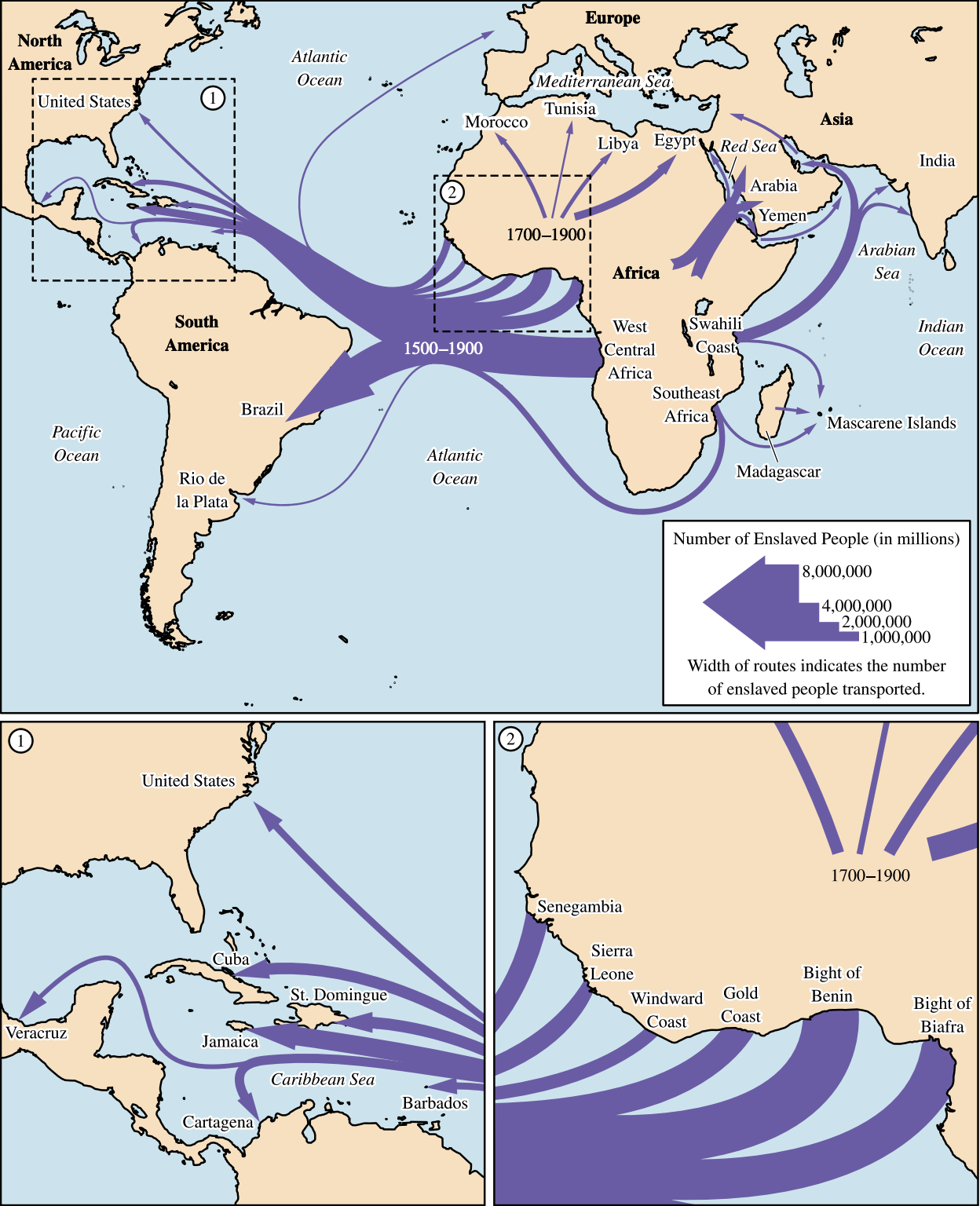
This map shows the scale and routes of the transatlantic slave trade, one of the largest forced migrations in history. It connects Africa, Europe, and the Americas and helps you see how the trade fed European colonial economies. Use it to describe the geographic scope of the trade and to support claims about where enslaved people were taken and where they arrived.
Map Showing the Regional Origins of Enslaved People Forcibly Transported to North America

This map shows the specific African regions that enslaved people in North America came from. It pushes back on the idea of a single, uniform African identity by highlighting the many ethnic and cultural backgrounds involved. Use it to explain how varied origins led to different patterns of cultural retention and community formation across the United States.
How to Use This on the AP African American Studies Exam
Using Sources Effectively
When you get one of the two required maps, name what it shows (scale and routes, or regional origins), then connect it to a claim. A strong move is to point out that most enslaved Africans did not go to the United States and that Senegambia and Angola were the largest source regions.
Causation and Continuity
Practice explaining cause and effect: different departure zones meant different ethnic groups, which led to varied cultural blends across the South. You can also trace continuity by linking these origins to later cultural creation, such as creole languages and music traditions.
Common Trap
Do not turn illustrative examples into required facts. Gullah, specific foods, and specific music genres are good examples of cultural blending, but the testable point is that diverse African origins combined into new African American cultures.
Common Misconceptions
- Misconception: Most enslaved Africans came to the United States.Actually: Most enslaved Africans did not come to the United States. Only about 5 percent of those transported across the Atlantic came directly to what became the United States; most went to the Caribbean and South America.
- Misconception: Africa was one culture.Actually: "Africa" was not one culture. Enslaved people came from many regions and ethnic groups, such as the Wolof, Akan, Igbo, and Yoruba, each with its own languages and traditions.
- Misconception: The 1808 ban ended slavery and the domestic slave trade.Actually: The 1808 ban did not end slavery or the slave trade inside the country. After importation was banned, the enslaved population grew mainly through childbirth, and the domestic slave trade continued until the Civil War.
- Misconception: All enslaved Africans practiced only traditional African religions.Actually: Not all enslaved Africans practiced only traditional African religions. Nearly half came from Muslim or Christian regions, so Islam and Christianity were already part of many people's backgrounds before arrival.
- Misconception: Charleston's 48 percent figure refers to every enslaved person in the country.Actually: Charleston's 48 percent figure refers to Africans brought directly from Africa to the United States, not to every enslaved person in the country.
Related AP African American Studies Guides
Practice Questions for 2.2
1 of 10
Which of the following best supports the claim that interaction of diverse African ethnic groups in the United States created new cultural forms rather than simply preserving separate traditions?
A.
Gullah blended English with multiple West African languages into a new linguistic form.
B.
Enslaved people from Angola and Congo settled as distinct communities in the Carolinas.
C.
Enslaved Africans from Christian and Muslim regions maintained their original religions.
D.
Enslaved people from Senegambia maintained their Wolof language and cultural practices.
Vocabulary
The following words are mentioned explicitly in the AP® course framework for this topic.Term | Definition |
|---|---|
African American communities | Communities of people of African descent living in the United States, characterized by shared cultural, social, and historical experiences. |
African ethnic groups | Distinct populations from Africa identified by shared cultural, linguistic, and social characteristics, such as the Wolof, Akan, Igbo, and Yoruba. |
African-based cultural practices | Traditions, customs, and ways of life originating from Africa that were maintained and adapted by enslaved Africans and their descendants in the United States. |
Akan | An African ethnic group from West Africa whose members were among those enslaved and brought to the United States. |
Angola | A slave-trading region in Central Africa that, along with Senegambia, supplied nearly half of the enslaved Africans transported to mainland North America. |
Benin | A slave-trading region in West Africa from which enslaved Africans were forcibly taken to mainland North America. |
Charleston, South Carolina | The primary port and center of the United States slave trade, where approximately 48 percent of all Africans brought directly to the United States landed. |
Côte d'Ivoire | A slave-trading region in West Africa from which enslaved Africans were forcibly taken to mainland North America. |
distribution patterns | The geographic spread and settlement of different African ethnic groups throughout regions of the United States, particularly the American South. |
enslaved Africans | People of African descent who were forcibly captured and transported across the Atlantic Ocean to be held in bondage in the Americas. |
geographic scope | The spatial extent and distribution of the transatlantic slave trade, including departure zones in Africa and arrival destinations in the Americas. |
Ghana | The first major Sudanic empire that flourished from the seventh to thirteenth centuries and was renowned for gold mines and trans-Saharan trade. |
Igbo | An African ethnic group from West Africa whose members were among those enslaved and brought to the United States. |
Liberia | A slave-trading region in West Africa from which enslaved Africans were forcibly taken to mainland North America. |
Mozambique | A slave-trading region in East Africa from which enslaved Africans were forcibly taken to mainland North America. |
Nigeria | A slave-trading region in West Africa from which enslaved Africans were forcibly taken to mainland North America. |
scale | The size or magnitude of the transatlantic slave trade, measured by the number of enslaved people forcibly transported (over 12.5 million). |
Senegambia | A slave-trading region in West Africa that, along with Angola, supplied nearly half of the enslaved Africans transported to mainland North America. |
Sierra Leone | A West African location identified by emigrationists as a promising area for African American relocation due to its large population of Afro-descendants. |
slave-trading zones | Geographic regions in Africa from which enslaved people were forcibly taken and transported, primarily to mainland North America. |
transatlantic slave trade | The forced migration of millions of Africans across the Atlantic Ocean to the Americas, beginning in the 16th century and lasting until the 19th century. |
West and Central African ethnic groups | Distinct populations from the West and Central regions of Africa whose members were enslaved and transported to the United States. |
Wolof | An African ethnic group from West Africa whose members were among those enslaved and brought to the United States. |
Yoruba | An African ethnic group whose spiritual traditions, including veneration of orishas, have been carried forward in African diasporic religions in the Americas. |
Frequently Asked Questions
What is AP African American Studies 2.2 about?
Topic 2.2 covers the scale of the transatlantic slave trade, the African departure zones tied to mainland North America, and how different African origins shaped African American communities in the United States.
How many enslaved Africans were transported across the Atlantic?
More than 12.5 million enslaved Africans were forcibly transported to the Americas from the early 1500s to the mid-1800s. Only about 5 percent, or roughly 388,000 people, came directly from Africa to what became the United States.
What were the main African departure zones for North America?
The nine contemporary African regions are Senegambia, Sierra Leone, Liberia, Cote dIvoire, Ghana, Benin, Nigeria, Angola, and Mozambique. Senegambia and Angola together made up nearly half of those taken directly to mainland North America.
What was the main destination region for enslaved Africans in the Americas?
Most enslaved Africans transported across the Atlantic were taken to the Caribbean and South America, not directly to what became the United States. For the U.S. specifically, Charleston, South Carolina received about 48 percent of direct arrivals from Africa.
How did African ethnic origins shape Black communities?
People came from many West and Central African ethnic groups, including Wolof, Akan, Igbo, and Yoruba communities. Their interactions created varied combinations of language, music, foodways, belief systems, and local Black cultures in the American South.
What required sources should I know for Topic 2.2?
Know the map showing an overview of the slave trade out of Africa and the map showing regional origins of enslaved people transported to North America. Use them to support claims about scale, routes, source regions, and cultural diversity.
See Fiveable more often in Google
Mark Fiveable as a preferred source and Google is more likely to show you our guides in Top Stories, with a "preferred" badge in AI Mode and AI Overviews.