2.1 African Explorers in the Americas

✊🏿AP African American Studies Unit 2 Review
2.1 African Explorers in the Americas
✊🏿 AP African American Studies
2.1
African Explorers in the Americas
2.2
Departure Zones in Africa and the Slave Trade to the United States
2.3
Capture and the Impact of the Slave Trade on West African Societies
2.4
African Resistance on Slave Ships and the Antislavery Movement
2.5
Slave Auctions and the Domestic Slave Trade
2.6
Labor, Culture, and Economy
2.7
Slavery and American Law: Slave Codes and Landmark Cases
2.8
The Social Construction of Race and the Reproduction of Status
2.9
Creating African American Culture
2.10
Black Pride, Identity, and the Question of Naming
2.11
The Stono Rebellion and Fort Mose
2.12
Legacies of the Haitian Revolution
2.13
Resistance and Revolts in the United States
2.14
Black Organizing in the North: Freedom, Women's Rights, and Education
2.15
Maroon Societies and Autonomous Black Communities
2.16
Diasporic Connections: Slavery and Freedom in Brazil
2.17
African Americans in Indigenous Territory
2.18
Debates About Emigration, Colonization, and Belonging in America
2.19
Black Political Thought: Radical Resistance
2.20
Race to the Promised Land: Abolitionism and the Underground Railroad
2.21
Legacies of Resistance in African American Art and Photography
2.22
Gender and Resistance in Slave Narratives
2.23
The Civil War and Black Communities
2.24
Freedom Days: Commemorating the Ongoing Struggle for Freedom
Ladinos were free and enslaved Africans who already knew Iberian languages and customs and traveled with the earliest European expeditions to the Americas, making them the first Africans in the territory that became the United States. They worked as cultural intermediaries during the early 1500s, before chattel slavery became the dominant system, and filled roles ranging from conquistadores to enslaved laborers to free skilled workers.
Why This Matters for the AP African American Studies Exam
This topic sets up a major theme you will return to all through AP African American Studies: African people shaped the Americas from the very beginning, not just after large-scale plantation slavery took hold. Understanding ladinos and Atlantic creoles helps you explain change over time, because it shows the world before chattel slavery hardened racial categories.
You can use this material to practice source analysis with Juan Garrido's 1538 petition, where you evaluate how a Black conquistador described his own service to argue for recognition. It also gives you specific evidence to support arguments about the diverse roles Africans played in colonization, which is the kind of claim that strengthens written responses across the course.
Key Takeaways
- Ladinos were free and enslaved Africans familiar with Iberian culture who joined the earliest European explorations and were the first Africans in the land that became the United States.
- Ladinos belonged to a generation called Atlantic creoles, who worked as intermediaries before chattel slavery shaped and gained some social mobility through their language and trade skills.
- Africans played three major roles during early colonization: conquistadores, enslaved laborers in mining and agriculture, and free skilled workers and artisans.
- Juan Garrido, born in the Kingdom of Kongo, was a free conquistador and the first known African to reach North America, exploring present-day Florida in 1513.
- Estevanico (Esteban), an enslaved healer from Morocco, was forced to serve as an explorer and translator in Texas and the Southwest before being killed by Indigenous groups resisting Spanish colonization.
- Spain's early role in the slave trade and its claim to "La Florida" (covering Florida, South Carolina, and Georgia) explain why Africans were present in early colonization.
Ladinos and the Atlantic Creole Generation
Ladinos were free and enslaved Africans who already knew Iberian languages and customs from the Iberian Peninsula and traveled with Europeans on their earliest journeys to the Americas. Among them were the first Africans to arrive in the territory that became the United States.
These Africans were part of a generation known as Atlantic creoles. Atlantic creoles worked as intermediaries before chattel slavery became the dominant system. Their familiarity with multiple languages, cultural norms, and commercial practices gave them a measure of social mobility that later generations of enslaved people would rarely have.
Why Ladinos Mattered
Ladinos mattered to European efforts to claim Indigenous lands. Their skills as translators and go-betweens helped Iberian colonizers communicate and trade with Indigenous peoples. Black participation in the colonization of the Americas grew out of Spain's early role in the slave trade and the presence of enslaved and free Africans in the parties of Spanish explorers who claimed "La Florida," Spain's name for an area that included Florida, South Carolina, and Georgia.
The Diverse Roles Africans Played
In the fifteenth and sixteenth centuries, Africans in the Americas filled three major roles:
- Conquistadores, who took part in military expansion, often hoping to gain or keep their freedom
- Enslaved laborers, who worked mostly in mining and agriculture to produce profit for Europeans
- Free skilled workers and artisans, who contributed specialized crafts and labor
This range matters because it shows that the early African presence in the Americas was not a single experience. People moved through the colonial system in very different positions, and some used their skills to hold on to freedom.
Juan Garrido
Juan Garrido was a conquistador born in the Kingdom of Kongo who later moved to Lisbon, Portugal. A free man, he became the first known African to arrive in North America when he explored present-day Florida during a Spanish expedition in 1513. Garrido maintained his freedom by serving in the Spanish military forces and taking part in efforts to take control of Indigenous populations. His story shows how some Africans navigated the colonial system to preserve their freedom.
Estevanico
Estevanico, also called Esteban, was an enslaved African healer from Morocco. In 1528 he was forced to work as an explorer and translator in Texas and in territory that became the southwestern United States. His linguistic knowledge was exploited for colonial expansion. He was eventually killed by Indigenous groups who were resisting Spanish colonialism. His life shows how Africans were often caught between European colonial ambitions and Indigenous resistance.
Required Sources
Image of Juan Garrido on a Spanish Expedition, Sixteenth Century
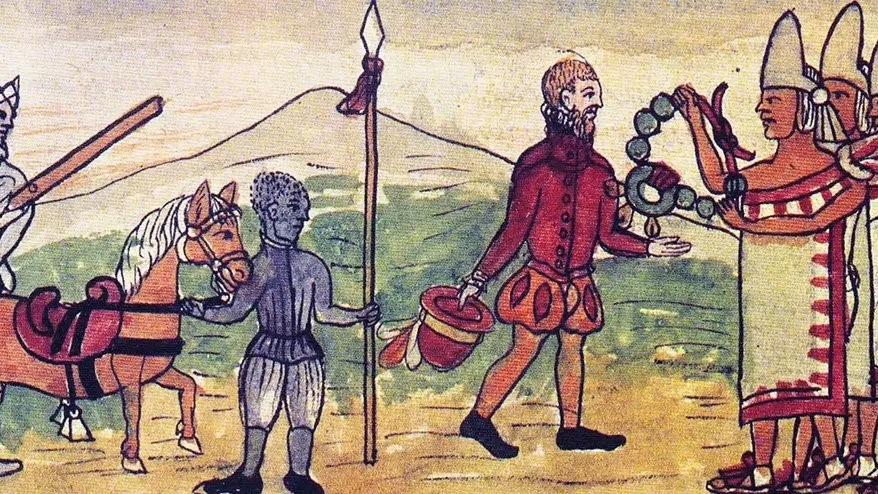
Juan Garrido's presence on Spanish expeditions challenges common assumptions about race in early colonial exploration. As a free Black conquistador, his role complicates simple narratives that treat all Africans in this era as enslaved. The image is useful for thinking about how Africans participated in colonization in ways beyond the more widely known history of slavery.
Juan Garrido's Petition, 1538
Juan Garrido's petition is a rare firsthand account from an African man in the early Spanish colonization of the Americas. In it, Garrido asks the Spanish crown to recognize and compensate his decades of service. The document shows the strategies people of African descent used to negotiate their position in emerging colonial societies, and it gives you a primary source to analyze for point of view and purpose.
In the petition, Garrido identifies himself as "black in color" and asks the Spanish crown to recognize decades of unpaid service. He emphasizes that he served at his own expense, lived as a married resident of Mexico City, traveled on Spanish expeditions, and experimented with growing wheat in New Spain. For AP source analysis, focus on how Garrido presents loyalty, service, and economic contribution to make a case for reward and recognition.
How to Use This on the AP African American Studies Exam
Using Sources Effectively
When you work with Garrido's petition, do not just summarize it. Ask who is speaking, who the audience is, and what he wants. Garrido is a free Black man addressing the Spanish crown, and his goal is recognition and reward. Notice how he frames himself as a loyal servant who paid his own expenses. That framing is a strategy, and naming the strategy earns more than retelling the events.
Building Arguments
Use Garrido and Estevanico as contrasting evidence. Garrido stayed free through military service; Estevanico was enslaved and forced into dangerous expeditions. Putting them side by side lets you show the range of African experiences in early colonization instead of treating Africans as one group.
Common Trap
Do not collapse the timeline. Ladinos and Atlantic creoles came before chattel slavery became dominant, so describing this period as if plantation slavery already ruled everything is a continuity/change error. Mark the shift clearly.
Common Misconceptions
- Misconception: Africans only arrived as enslaved plantation laborers.Actually: Some of the earliest Africans in the Americas were ladinos and Atlantic creoles who worked as intermediaries, and some were free skilled workers or conquistadores.
- Misconception: Juan Garrido and Estevanico had the same status.Actually: Garrido was a free conquistador; Estevanico was enslaved. Treating them as identical misses the whole point of this topic.
- Misconception: "Atlantic creole" describes a place or a single ethnic group.Actually: It describes a generation of Africans defined by their intermediary roles and their fluency across languages, cultures, and trade, not one homeland.
- Misconception: Ladinos were powerless.Actually: Their language and trade skills gave them a measure of social mobility that became much rarer once chattel slavery took hold.
- Misconception: "La Florida" only meant the modern state of Florida.Actually: Spain used the name for a larger region that also included South Carolina and Georgia.
Related AP African American Studies Guides
Practice Questions for 2.1
1 of 10
According to the sixteenth-century historical record, which of the following claims about African conquistadores is supported by evidence from Juan Garrido's documented participation in Spanish military campaigns?
A.
Some free Africans maintained their freedom by serving in Spanish military forces and participating in conquest
B.
African conquistadores were prohibited from participating in the conquest of Indigenous territories in the Americas
C.
African conquistadores received equal compensation and land grants as European soldiers for their military service
D.
African conquistadores served primarily as translators rather than as military combatants in Spanish expeditions
Vocabulary
The following words are mentioned explicitly in the AP® course framework for this topic.Term | Definition |
|---|---|
Atlantic creoles | A generation of Africans who worked as intermediaries before the predominance of chattel slavery, possessing familiarity with multiple languages, cultural norms, and commercial practices that granted them social mobility. |
chattel slavery | A system of slavery in which enslaved people are treated as property that can be bought, sold, and inherited, characterized as race-based, inheritable, and lifelong. |
colonization of the Americas | The process of European establishment and control of territories in the Americas during the fifteenth and sixteenth centuries. |
conquistadores | Spanish military conquerors who participated in the conquest of Indigenous populations in the Americas, some of whom were African. |
enslaved laborers | Africans forced to work in mining and agriculture in the Americas to produce profit for European colonizers. |
Estevanico | An enslaved African healer from Morocco who served as an explorer and translator for Spanish colonizers in Texas and the southwestern United States in 1528. |
Iberian culture | The culture and practices of the Iberian Peninsula, including Spain and Portugal, which influenced the ladinos who participated in early American exploration. |
Juan Garrido | A free African conquistador born in the Kingdom of Kongo who became the first known African to arrive in North America, exploring present-day Florida in 1513 during a Spanish expedition. |
Kingdom of Kongo | A West Central African state that established political and religious ties with Portugal in the late 15th century and became a major participant in the transatlantic slave trade. |
La Florida | Spain's name for a colonial territory in North America that included present-day Florida, South Carolina, and Georgia. |
ladinos | Free and enslaved Africans familiar with Iberian culture who journeyed with Europeans in early sixteenth-century explorations of the Americas and were among the first Africans in the territory that became the United States. |
skilled workers and artisans | Free Africans in the Americas who possessed specialized trades and crafts during the period of colonization. |
Frequently Asked Questions
Who were ladinos in AP African American Studies?
Ladinos were free and enslaved Africans familiar with Iberian languages and customs who traveled with Europeans in the early sixteenth century. They were among the first Africans in the territory that became the United States.
What were Atlantic creoles?
Atlantic creoles were Africans who worked as cultural and linguistic intermediaries before chattel slavery became the dominant system. Their language skills, trade knowledge, and familiarity with multiple cultures gave some of them social mobility.
Why were ladinos important in early American colonization?
Ladinos helped Iberian colonizers communicate, travel, trade, and claim Indigenous lands. Their presence shows that Africans shaped the Americas from the earliest period of European colonization, before plantation slavery became dominant.
Who was Juan Garrido?
Juan Garrido was a free man born in the Kingdom of Kongo who moved to Lisbon and served on Spanish expeditions. He is the first known African to arrive in North America, reaching present-day Florida in 1513.
Who was Estevanico?
Estevanico, also called Esteban, was an enslaved African healer from Morocco who was forced to work as an explorer and translator in Texas and the Southwest beginning in 1528. His story shows a very different African experience from Juan Garrido’s.
What sources should I know for Topic 2.1?
Know Juan Garrido’s 1538 petition and the image of Juan Garrido on a Spanish expedition. Use them to analyze point of view, purpose, status, and how people of African descent described or were shown in early colonial society.
See Fiveable more often in Google
Mark Fiveable as a preferred source and Google is more likely to show you our guides in Top Stories, with a "preferred" badge in AI Mode and AI Overviews.