3.16 The Great Migration

✊🏿AP African American Studies Unit 3 Review
3.16 The Great Migration
✊🏿 AP African American Studies
3.1
The Reconstruction Amendments
3.2
Social Life: Reuniting Black Families and the Freedmen's Bureau
3.3
Black Codes, Land, and Labor
3.4
The Defeat of Reconstruction
3.5
Disenfranchisement and Jim Crow Laws
3.6
White Supremacist Violence and the Red Summer
3.7
The Color Line and Double Consciousness in American Society
3.8
Lifting as We Climb: Uplift Ideologies and Black Women's Rights and Leadership
3.9
Black Organizations and Institutions
3.10
HBCUs, Black Greek Letter Organizations, and Black Education
3.11
The New Negro Movement and the Harlem Renaissance
3.12
Photography and Social Change
3.13
Envisioning Africa in Harlem Renaissance Poetry
3.14
Symphony in Black: Black Performance in Music, Theater, and Film
3.15
Black History Education and African American Studies
3.16
The Great Migration
3.17
Afro-Caribbean Migration
3.18
The Universal Negro Improvement Association
The Great Migration was one of the largest internal moves in United States history. Roughly six million African Americans left the South for cities in the North, Midwest, and West from the 1910s to the 1970s, pushed by racial violence, Jim Crow, and failing farms, and pulled by wartime factory jobs.
Why This Matters for the AP African American Studies Exam
This topic is a strong example of causation and continuity and change over time, two ways of thinking the exam rewards. You should be able to explain both push and pull factors and trace how migration connected to later cultural movements and civil rights organizing.
It also pairs history with sources. The required materials here, especially Jacob Lawrence's The Migration Series and the migration map, give you practice analyzing how visual art and data document a historical movement. Being able to read a panel or a map and connect it to causes and effects is exactly the kind of source analysis the course asks for.
Key Takeaways
- The Great Migration moved about six million African Americans out of the South in waves from the 1910s to the 1970s, into the North, Midwest, and West.
- Causes combined push and pull: Jim Crow, lynching, and racial violence pushed people out, while wartime labor shortages and industrial jobs pulled them north.
- Environmental damage, including floods, boll weevil infestations, and spoiled crops, deepened poverty in the rural South.
- Railroads and the Black press made the move possible by providing transportation and spreading encouragement and instructions for leaving.
- The migration turned African Americans from a mostly rural population into a mostly urban one and spread Black Southern culture into cities like New York, Chicago, Pittsburgh, and Los Angeles.
- The National Urban League, founded in 1910 as an interracial organization, helped migrants find housing and jobs and later supported civil rights efforts.
The Causes of the Great Migration
What the Great Migration Was
The Great Migration was one of the largest internal migrations in United States history. About six million African Americans relocated in waves from the South to the North, Midwest, and West from the 1910s to the 1970s. This was a long, gradual process, not a single event. People left in search of economic opportunity, safety from racial violence, and better living conditions.
A helpful way to organize the causes is push factors (things driving people out of the South) and pull factors (things attracting them north). The exam often rewards this kind of cause analysis.
Labor Shortages in the North (Pull Factor)
Labor shortages in the North during the First World War and the Second World War opened up jobs in northern industrial cities. Factories, steel mills, and other industries needed workers, and these jobs appealed to African Americans looking for economic opportunity. Compared with low-paying agricultural work in the South, northern industrial wages offered a real chance to support a family.
Environmental Factors in the South (Push Factor)
Natural and agricultural disasters made conditions in the South even harder. Floods, boll weevil infestations, and spoiled crops devastated Southern farming and left many Black Southerners impoverished. When crops failed, wages and farm labor demand dropped, giving more people a reason to leave.
Safety from Racial Violence (Push Factor)
The dangers of unchecked lynching and racial violence pushed many African Americans to leave the Jim Crow South. Families relocated in search of safety. Moving north offered the hope of raising children away from the constant threat of racial terror and the legal oppression of segregation.
Transportation and Information
A new railway system and the Black press made the migration possible. Trains gave people a practical way to travel long distances, and Black newspapers spread encouragement along with instructions for leaving the South and finding work.
The Chicago Defender is a good example of a Black newspaper that promoted migration and shared information about northern opportunities. Use it as an illustration of how the Black press worked, not as required content on its own.
Impact on Communities and Culture
Transformation of American Cities
The migration transformed American cities, Black communities, and Black cultural movements. It infused cities such as New York, Chicago, Pittsburgh, and Los Angeles with Black Southern culture and helped create a shared culture among African American communities across the country. Black-owned businesses, churches, and community organizations grew in these urban centers.
The Harlem Renaissance and the rise of urban Black neighborhoods are clear applications of this cultural shift. The blues and jazz also developed new styles as people moved north, which connects this topic to the music covered elsewhere in the unit.
From Rural to Urban Life
The Great Migration changed African Americans from a primarily rural people into primarily urban dwellers. Adjusting to city life meant learning new skills and navigating different social norms. People also formed new connections to their northern surroundings, such as engaging with nature for leisure, like visiting parks, rather than for labor on a farm.
Rising Racial Tensions
As underpaid and disempowered Black workers began leaving the South, racial tensions increased. Many employers resisted the departure of African American laborers because they relied on that cheap labor, and at times they had migrants unjustly arrested to keep them from leaving. White resistance reflected a desire to preserve both cheap labor and the existing racial hierarchy.
The National Urban League
The National Urban League was founded in New York City in 1910 as an interracial organization. It assisted African Americans migrating from the rural South, helping them adjust to northern urban life and secure housing and jobs through services like job training and education. The Urban League later supported A. Philip Randolph's 1941 March on Washington and worked directly with the Southern Christian Leadership Conference during the Civil Rights movement, showing how this migration era organization connected to later activism.
Required Sources
The Migration Series by Jacob Lawrence, 1940-1941 (various panels, in particular Panel No. 1)
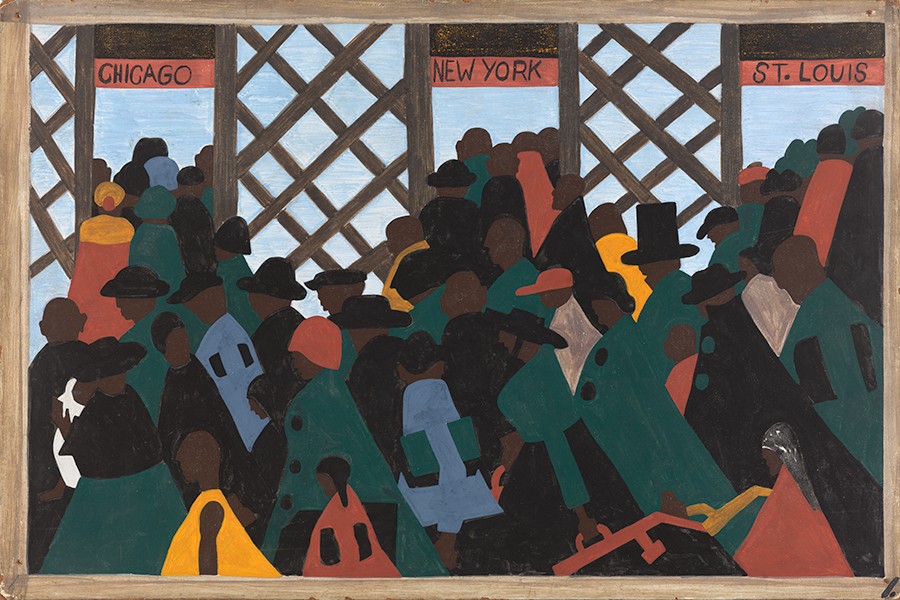
Jacob Lawrence's The Migration Series chronicles African Americans' hopes and challenges during the Great Migration. The work is known for its social realism, using bold colors and clear shapes to depict historical moments, social issues, and the everyday lives of African Americans. Panel No. 1 shows the departure of African Americans from the South and sets the tone for the whole series.
When you analyze this source, connect the imagery to specific causes and effects. A crowd boarding trains, for example, links directly to the role of the railway system and the search for opportunity in northern cities.
Map of The Great Migration
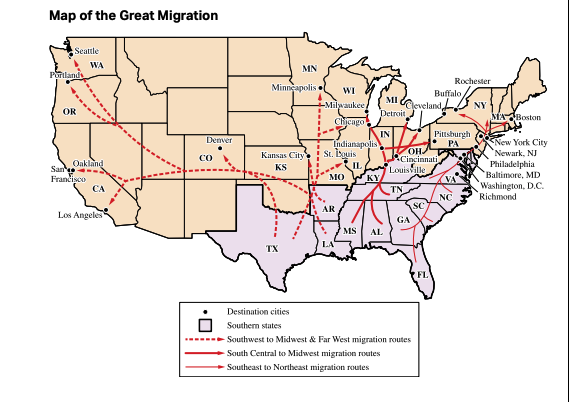
A map of the Great Migration shows the scale and direction of this demographic shift, tracing movement out of the rural South toward the North, Midwest, and West. Maps like this help you see migration patterns and connect geography to the causes and effects you study, from escaping Jim Crow to building new communities in northern cities.
How to Use This on the AP African American Studies Exam
Using Sources Effectively
Practice reading the required visual sources closely. With Jacob Lawrence's Panel No. 1, describe what you see, then explain what it reveals about the migration's causes or effects. With the migration map, point to specific directions of movement and link them to push and pull factors.
Causation
Be ready to explain why the migration happened using both push factors (Jim Crow, lynching, racial violence, failed crops) and pull factors (wartime labor shortages and industrial jobs). Naming a cause is not enough. Explain how it pushed or pulled people.
Continuity and Change
Show how the migration changed Black life, especially the shift from rural to urban and the spread of Southern Black culture into northern cities. You can also trace continuity by connecting migration era institutions like the National Urban League to later civil rights organizing.
Common Trap
Do not treat the Great Migration as one quick event. It happened in waves across decades, from the 1910s to the 1970s, and was driven by several overlapping causes at once.
Common Misconceptions
- Misconception: The Great Migration was a single sudden event.Actually: The Great Migration was not a single sudden event. It unfolded in waves over roughly six decades.
- Misconception: People left only for jobs.Actually: People did not leave only for jobs. Safety from lynching and Jim Crow violence was a major push factor alongside economic opportunity.
- Misconception: The North was free of racism.Actually: The North was not free of racism. Migrants still faced discrimination, and the move sometimes sparked new tensions rather than ending them.
- Misconception: The National Urban League was an all-Black organization.Actually: The National Urban League was founded as an interracial organization, not an all-Black one, and its work stretched from migration era support into the later Civil Rights movement.
- Misconception: The Harlem Renaissance and the growth of urban blues and jazz caused the migration.Actually: The Harlem Renaissance and the growth of urban blues and jazz are results connected to the migration, not causes of it.
Related AP African American Studies Guides
Practice Questions for 3.16
1 of 10
Jacob Lawrence's decision to depict the Great Migration through a series of modernist paintings rather than realistic portraiture most likely reflected his purpose of accomplishing which of the following?
A.
Critiquing the National Urban League's failure to adequately support migrants in their transition to urban life
B.
Appealing exclusively to white Northern audiences who were unfamiliar with African American rural Southern culture
C.
Documenting the exact geographic routes that African Americans traveled during their northward journey
D.
Presenting African American migrants as dynamic modern subjects worthy of serious artistic attention
Vocabulary
The following words are mentioned explicitly in the AP® course framework for this topic.Term | Definition |
|---|---|
A. Philip Randolph | African American labor leader and civil rights activist who organized the 1941 March on Washington to protest racial discrimination in defense industries. |
Black communities | Organized groups and neighborhoods of African Americans sharing cultural, social, and economic ties, particularly in urban centers during and after the Great Migration. |
Black cultural movements | Organized artistic, intellectual, and social movements created and led by African Americans, including music, literature, and cultural expression that emerged from Black urban communities. |
Black press | African American-owned and operated newspapers and publications that provided news, documentation of community life, and platforms for protesting racial discrimination. |
Black Southern culture | The distinctive cultural traditions, practices, and values of African Americans in the American South, including music, religion, and social customs that migrated northward. |
boll weevils | Insects that destroyed cotton crops in the South, contributing to economic hardship for Black agricultural workers. |
economic opportunities | Employment, business ventures, and financial prospects that attracted Caribbean migrants to the United States. |
Great Migration | The movement of approximately six million African Americans from the South to the North, Midwest, and western United States in waves from the 1910s to 1970s in search of economic opportunities and safety. |
industrial cities | Urban centers in the North characterized by manufacturing and factory-based economies that attracted migrant workers. |
internal migration | The movement of people within a country from one region to another, as opposed to migration between countries. |
interracial organization | An organization composed of and serving members from multiple racial groups working toward common goals. |
Jim Crow South | The region of the United States where Jim Crow laws enforced racial segregation and discrimination against African Americans. |
labor shortages | A shortage of available workers in a particular region or industry, creating increased job opportunities. |
lynching | Extrajudicial execution and racial violence perpetrated against African Americans, often by mobs, as a tool of terror and social control. |
March on Washington | A 1941 protest organized by A. Philip Randolph demanding equal employment opportunities for African Americans in defense industries during World War II. |
National Urban League | An interracial organization founded in New York City in 1910 that assisted African Americans migrating from the South by helping them secure housing, employment, and acclimate to urban life. |
racial tensions | Heightened conflict and hostility between racial groups, often resulting from competition for resources, employment, and social status. |
racial violence | Physical harm, intimidation, and brutality perpetrated against people because of their race. |
Southern Christian Leadership Conference | A civil rights organization led by Dr. Martin Luther King Jr. that coordinated nonviolent protests and activism during the Civil Rights movement. |
urban dwellers | People who live in cities and urban areas, as opposed to rural or agricultural communities. |
Frequently Asked Questions
What was the Great Migration?
The Great Migration was one of the largest internal migrations in United States history. About six million African Americans relocated in waves from the South to the North, Midwest, and West from the 1910s to the 1970s.
What caused the Great Migration?
The Great Migration had push and pull factors. Jim Crow, lynching, racial violence, floods, boll weevils, and spoiled crops pushed many Black Southerners out of the South, while industrial jobs during World War I and World War II pulled migrants toward northern and western cities.
How did the Black press and railroads support the Great Migration?
Railroads gave migrants a practical way to travel long distances, while the Black press provided encouragement, information, and instructions for leaving the South. Together, transportation and information networks helped make the migration possible.
How did the Great Migration change Black communities?
The Great Migration transformed many African Americans from primarily rural Southerners into urban dwellers. It reshaped cities such as New York, Chicago, Pittsburgh, and Los Angeles and carried Black Southern culture into new urban communities.
Why is Jacob Lawrence's Migration Series important?
Jacob Lawrence's Migration Series documents the hopes, challenges, causes, and effects of the Great Migration through visual art. On the AP exam, use details from a panel to connect imagery to historical evidence such as trains, migration routes, work, or urban life.
How should I use the Great Migration on the AP African American Studies exam?
Use this topic for causation, continuity and change, and source analysis. Explain specific push and pull factors, describe effects on Black communities and American culture, and connect required sources such as the migration map or Jacob Lawrence panels to the historical argument.
See Fiveable more often in Google
Mark Fiveable as a preferred source and Google is more likely to show you our guides in Top Stories, with a "preferred" badge in AI Mode and AI Overviews.