2.6 Labor, Culture, and Economy

✊🏿AP African American Studies Unit 2 Review
2.6 Labor, Culture, and Economy
✊🏿 AP African American Studies
2.1
African Explorers in the Americas
2.2
Departure Zones in Africa and the Slave Trade to the United States
2.3
Capture and the Impact of the Slave Trade on West African Societies
2.4
African Resistance on Slave Ships and the Antislavery Movement
2.5
Slave Auctions and the Domestic Slave Trade
2.6
Labor, Culture, and Economy
2.7
Slavery and American Law: Slave Codes and Landmark Cases
2.8
The Social Construction of Race and the Reproduction of Status
2.9
Creating African American Culture
2.10
Black Pride, Identity, and the Question of Naming
2.11
The Stono Rebellion and Fort Mose
2.12
Legacies of the Haitian Revolution
2.13
Resistance and Revolts in the United States
2.14
Black Organizing in the North: Freedom, Women's Rights, and Education
2.15
Maroon Societies and Autonomous Black Communities
2.16
Diasporic Connections: Slavery and Freedom in Brazil
2.17
African Americans in Indigenous Territory
2.18
Debates About Emigration, Colonization, and Belonging in America
2.19
Black Political Thought: Radical Resistance
2.20
Race to the Promised Land: Abolitionism and the Underground Railroad
2.21
Legacies of Resistance in African American Art and Photography
2.22
Gender and Resistance in Slave Narratives
2.23
The Civil War and Black Communities
2.24
Freedom Days: Commemorating the Ongoing Struggle for Freedom
AP African American Studies Topic 2.6 connects labor systems to culture and the economy. You need to describe the wide range of work enslaved people performed, explain how the gang system and task system shaped music and language, and evaluate how enslaved labor built wealth that enslaved people and their descendants were denied.
Students are expected to:
- Describe the range and variety of specialized roles performed by enslaved people.
- Explain how slave labor systems affected the formation of African American musical and linguistic practices
- Evaluate the economic effects of enslaved people’s commodification and labor, within and outside of African American communities.
Enslaved people in America performed a wide range of labor tasks, from domestic work to skilled trades. Their roles varied based on location, with some bound to institutions like churches or colleges. Many brought valuable skills from Africa, which enslavers exploited for profit.
Slavery had a profound economic impact, creating interdependence between North and South. It formed the foundation of the American economy, but enslaved people were alienated from the wealth they produced. This led to deep-rooted racial wealth disparities that persist today.
Specialized Roles of Enslaved People
Domestic vs Agricultural
Enslaved people, regardless of age or gender, carried out diverse labor tasks in both urban and rural settings, including:
- Domestic work (cooking, cleaning, childcare)
- Agricultural work (planting, harvesting, tending to livestock)
- Skilled labor (blacksmithing, carpentry, tailoring)
In many regions, domestic servants and agricultural laborers were organized into distinct roles with different expectations and supervision. Enslavers could reassign people between these roles at will—moving someone from the house to the fields (or vice versa), or hiring out skilled workers to urban employers—based on profit or preference. For example, an enslaved cook might be reassigned to field labor during harvest, and a blacksmith could be hired out seasonally to a town workshop.
Institutional Enslavement
Institutional Enslavement refers to enslaved people being bound to institutions rather than individuals like on plantations.
Institutions that enslaved people and their respective specialized tasks were:
- Churches: Maintaining church grounds
- Factories: Performing manufacturing and workshop tasks (e.g., textile milling, ironworks, brickmaking).
- Colleges: Serving as laborers on college campuses
Skills and commodification
Many enslaved Africans brought valuable skills to the Americas, which enslavers exploited for profit, such as: Blacksmithing, Basket-weaving, and Cultivation of rice and indigo
African Americans developed specializations that enslavers commodified, including: Painting, Carpentry, Tailoring, Music, and Healing
Despite the commodification of their skills, African Americans used them to:
- Survive the harsh conditions of slavery
- Create and maintain cultural practices
- Build community and support networks
Slave labor and cultural practices
Gang vs Task Systems
Enslavers organized agricultural labor primarily to maximize productivity through two systems: the gang system and the task system. The gang system’s close supervision limited autonomy and opportunities for resistance, while the task system afforded comparatively more autonomy, which helped some enslaved people maintain cultural and linguistic practices. Under the Gang System, enslaved people were forced to work in groups under the watch and discipline of an overseer from sunup to sundown, often assisted by enslaved "drivers," as they cultivated crops like cotton, sugar, and tobacco. This system perpetuated slavery by requiring enslaved individuals to work in large, closely monitored groups, which maximized productivity while offering little to no autonomy. The brutality of the Gang System kept enslaved people under constant surveillance, minimizing opportunities for resistance or escape and ensuring the owner's control over their labor.
In response to the Gang System, enslaved people developed work songs, often in English, with syncopated rhythms designed to maintain the pace of labor. These songs not only helped synchronize work but also fostered a sense of community and collective strength, providing an emotional outlet and a way to uplift morale in the face of grueling conditions.
By contrast, the Task System required enslaved people to work individually until they completed a daily quota, often with less direct supervision than the Gang System. This system was primarily used in the cultivation of labor-intensive crops like rice and indigo, where specialized knowledge of tidal flows, irrigation, and planting techniques was essential.
Due to the reduced oversight under the Task System, some enslaved people were able to preserve elements of their cultural and linguistic heritage. One notable example is the development of the Gullah creole language in the Carolina low-country. Gullah, a unique blend of African languages and English, served not only as a means of communication but also as a testament to the resilience and cultural retention of enslaved Africans. This linguistic tradition, along with other cultural practices such as basket weaving, folklore, and spiritual rituals, allowed enslaved communities to maintain a connection to their African ancestry despite the dehumanizing conditions of slavery.
Economic impact of slavery
North-South Economic Interdependence and Slavery’s Cemented Role
The development of slavery developed a complex economic interdependence between the North and South, where the industrialized North relied heavily on the South’s production of cotton and other cash crops for manufacturing and trade. In turn, the agricultural South depended on the North for manufactured goods, financial services, and trade networks. This economic interdependence ensured that even cities and states that did not directly engage in the African slave trade still benefited from the institution of slavery.
For example, Northern textile mills thrived by processing cotton cultivated through the forced labor of enslaved Africans, while Northern banks provided crucial loans to Southern plantation owners to finance land purchases, equipment, plantation operations, and the purchase of enslaved people. Northern merchants also profited from trading goods produced by enslaved labor, further entrenching the North’s economic prosperity in the exploitation of enslaved people. This mutual reliance demonstrates that slavery was not merely a Southern issue but a deeply rooted national institution that fueled the economic growth of the United States for decades.
Even after the 13th Amendment abolished slavery in 1865, the economic structures established during this period persisted. The wealth accumulated through slavery laid the foundation for industries, financial systems, and social hierarchies that continued to shape the country long after the formal end of the institution. The legacy of this economic interdependence highlights how deeply intertwined the entire nation was with the exploitation of enslaved Africans, cementing slavery’s presence in American history and its lasting impact on economic and social systems.
Wealth Disparities From Slavery
For centuries, slavery cemented profound wealth disparities along racial lines in America. Enslaved African Americans were denied wages, legal rights, and the ability to accumulate property, preventing them from passing down any form of wealth to their descendants. The rare exceptions to these laws were entirely dependent on the decisions of enslavers, making economic mobility virtually impossible for the vast majority of enslaved people.
This systemic denial of wealth accumulation had long-lasting consequences, contributing directly to the persistent economic inequalities that continue to affect African Americans today. The lack of generational wealth resulted in lower rates of homeownership among Black families, reducing their ability to build equity and secure financial stability. Limited access to quality education and well-paying job opportunities further exacerbated these disparities, creating cycles of poverty that have endured across generations. Additionally, the enduring income and wealth gaps between white and Black Americans can be traced back to the economic exploitation of enslaved labor, highlighting the lasting impact of slavery on the nation’s economic landscape.
Context: After emancipation, later discriminatory systems reinforced these disparities.
Required Sources
Sugar Cane Harvest, Antigua, West Indies 1823, 1826
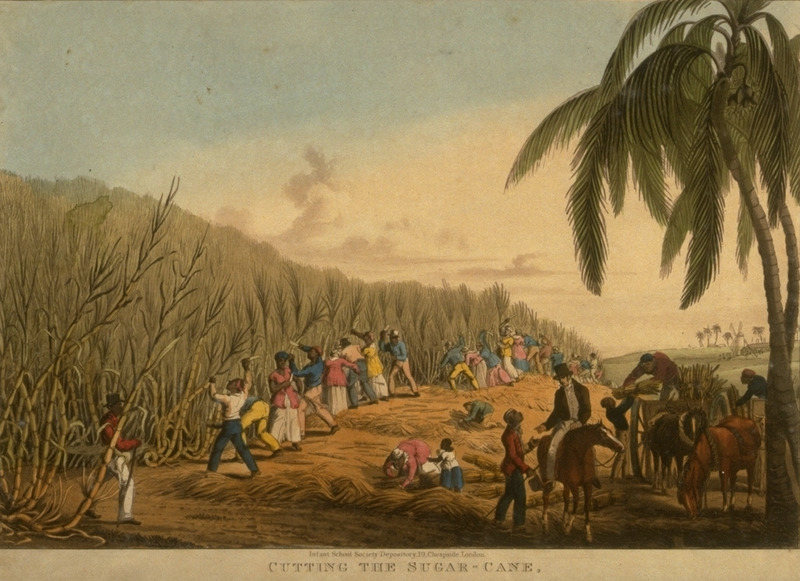
This image provides a rare glimpse into the harsh realities of plantation life in the Caribbean during the early 19th century. It captures the backbreaking labor of enslaved Africans harvesting sugar cane, a crop that fueled the transatlantic slave trade and shaped the economies of colonial powers.
The visual representation of sugar production in Antigua offers valuable insight into the interconnected nature of slavery, colonialism, and economic exploitation in the Americas. It serves as a powerful reminder of the human cost of the sugar industry and the resilience of enslaved individuals who endured such brutal working conditions.
Broadside Advertising "Valuable Slaves at Auction" in New Orleans, 1859
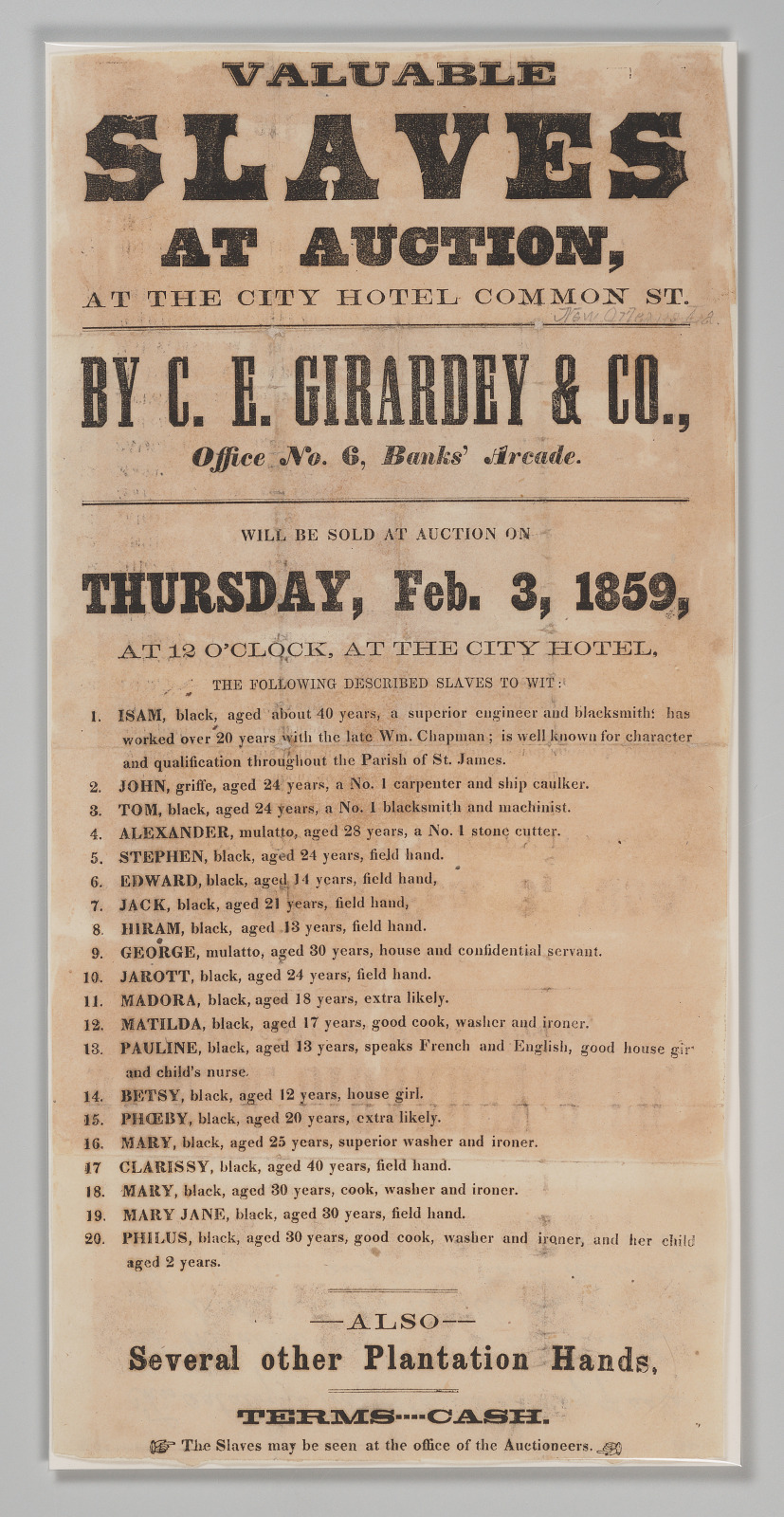
This broadside provides a stark, firsthand glimpse into the brutal reality of the American slave trade. It demonstrates how enslaved individuals were dehumanized and commodified, treated as property to be bought and sold. The document reveals the cold, businesslike nature of human trafficking in the antebellum South.
As a primary source, this advertisement offers valuable insights into the economic aspects of slavery and the language used to market human beings. It serves as tangible evidence of the institutionalized racism and exploitation that formed the foundation of the Southern economy prior to the Civil War, making it an essential resource for understanding this dark chapter in American history.
This broadside lists a wide range of specialized roles—such as engineer, ship caulker, and ironer—along with ages and languages spoken, illustrating the diversity of enslaved people’s skills. It also uses racial designations like “black,” “mulatto,” and “griffe” (three-quarters Black and one-quarter Indigenous), reflecting lingering French and Spanish nomenclature in New Orleans.
Rice Fanner Basket, Circa 1863

The rice fanner basket represents a tangible link to the agricultural labor practices of enslaved African Americans in the antebellum South. This tool was essential for the cultivation of rice, a crop that played a significant role in the economic development of coastal regions, particularly in South Carolina and Georgia.
The artifact serves as a poignant reminder of the skills, knowledge, and forced labor contributions of enslaved Africans to American agriculture. It highlights the complex relationship between African agricultural traditions and the exploitation of enslaved workers, shedding light on the often-overlooked technological and cultural exchanges that occurred during the era of slavery.
The coiled construction of Lowcountry rice baskets closely resembles basket-making traditions in Senegal and Angola, evidencing the transfer of African agricultural and artistic knowledge to the Carolinas. Fanner baskets were used to winnow rice—fanning away chaff—linking African techniques to rice cultivation in the task system. Some African women reportedly hid rice seeds in their hair during the Middle Passage, symbolizing intentional knowledge transfer.
Takeaways
- Enslaved people engaged in an array of tasks like domestic work, blacksmithing, weaving, and agricultural work
- Institutional Enslavement: People were bound to institutions like Churches or Factories rather than individuals
- Enslavers organized agricultural labor primarily to maximize productivity through two systems: the gang system and the task system. The gang system’s close supervision limited autonomy and opportunities for resistance, while the task system afforded comparatively more autonomy, which helped some enslaved people maintain cultural and linguistic practices.
- Gang System: enslaved people were forced to work in groups under the watch and discipline of an overseer from sunup to sundown, often assisted by enslaved "drivers," as they cultivated crops like cotton, sugar, and tobacco.
- Task System: Task System required enslaved people to work individually until they completed a daily quota, often with less direct supervision than the Gang System
- The North and South were economically interdependent; even where slavery had been abolished and in many cities that did not directly traffic enslaved people, Northern industries, merchants, insurers, and banks profited from commodities and credit tied to enslaved labor.
- Slavery left generational racial wealth disparities since enslaved people could not own property or inherit wealth.
Optional Sources
- Image of Cultivating Tobacco, Virginia, 1798 (Slaveryimages.org)
Practice Questions for 2.6
1 of 10
A Northern textile mill owner in 1850 advertised his business as 'the finest cotton manufacturer in New England, built on enterprise and innovation.' The significance of this advertisement can best be explained as demonstrating how Northern economic actors obscured their dependence on enslaved labor while profiting from the commodification of enslaved people's work.
A.
Northern mill owners publicly acknowledged their dependence on enslaved labor to justify higher prices for their manufactured goods.
B.
The advertisement proves that Northern businesses rejected slavery and built their wealth through independent industrial innovation.
C.
Northern merchants benefited economically from slavery while publicly distancing themselves from direct participation in the institution.
D.
Northern textile manufacturers were more ethical than Southern plantation owners because they did not directly enslave people.
Vocabulary
The following words are mentioned explicitly in the AP® course framework for this topic.Term | Definition |
|---|---|
African slave trade | The transatlantic trade system that forcibly transported enslaved Africans to the Americas, generating wealth for merchants and traders even in regions not directly participating. |
agricultural labor | Work related to farming and crop production, including planting, harvesting, and field work performed by enslaved people. |
alienated from wealth | Separated or excluded from benefiting from or owning the economic value and resources that one's labor creates or produces. |
basket-weaving | The craft of creating baskets from woven materials, a skill many enslaved Africans brought to the Americas. |
blacksmithing | The craft of working with metal to create tools, hardware, and other metal goods, a skill many enslaved Africans brought to the Americas. |
commodification | The process of treating people as goods or commodities to be bought and sold, rather than as human beings with inherent rights. |
domestic labor | Work performed within households, such as cooking, cleaning, childcare, and other household tasks performed by enslaved people. |
economic interdependence | A mutual economic relationship between regions or groups where each relies on the other for economic benefit, as between the North and South during the slavery era. |
gang system | A labor system in which enslaved workers labored in groups from sunup to sundown under the supervision of an overseer, commonly used for cultivating crops like cotton, sugar, and tobacco. |
Gullah creole language | A creole language that developed among enslaved and free African Americans in the Carolina lowcountry, maintained through the task system's reduced supervision. |
indigo cultivation | The agricultural practice of growing indigo plants for dye production, a skill many enslaved Africans brought to the Americas. |
overseer | A supervisor who watched over and disciplined enslaved laborers working in the gang system. |
rice cultivation | The agricultural practice of growing rice, a skill many enslaved Africans brought to the Americas. |
skilled labor | Specialized work requiring training and expertise, such as blacksmithing, carpentry, tailoring, and other crafts performed by enslaved people. |
slave labor systems | Organized systems of forced labor used to exploit enslaved people, including the gang system and task system. |
syncopated rhythms | Musical rhythms with emphasis on weak beats or off-beats, used in work songs created by enslaved people. |
task system | A labor system in which enslaved workers completed individual daily quotas with less direct supervision, commonly used for cultivating crops like rice and indigo. |
wealth disparities | Significant and persistent differences in accumulated economic resources and assets between different groups, particularly along racial lines in American history. |
work songs | Songs created by enslaved laborers, particularly those working in gangs, featuring syncopated rhythms to maintain the pace of work. |
Frequently Asked Questions
What is the difference between the task system and gang system?
In the gang system, enslaved laborers worked in groups from sunup to sundown under close supervision. In the task system, enslaved people worked individually until they completed a daily quota, often with less direct supervision.
How did the gang system shape African American music?
The gang system encouraged work songs in English with syncopated rhythms that helped maintain pace, coordinate labor, and support community under harsh working conditions.
How did the task system affect Gullah culture?
Because the task system often involved less direct supervision, some enslaved people in the Carolina Lowcountry preserved more linguistic and cultural practices, including the development of the Gullah creole language.
What specialized labor did enslaved people perform?
Enslaved people performed domestic, agricultural, and skilled labor, including cooking, childcare, blacksmithing, carpentry, tailoring, basket-weaving, rice cultivation, indigo cultivation, music, and healing.
How did slavery connect the North and South economically?
Slavery fostered economic interdependence because Northern textile mills, merchants, banks, insurers, and trade networks benefited from commodities and credit tied to enslaved labor in the South.
What required sources are used for AP African American Studies 2.6?
The required sources are Sugar Cane Harvest, Antigua, West Indies 1823, 1826; Broadside Advertising "Valuable Slaves at Auction" in New Orleans, 1859; and Rice Fanner Basket, circa 1863.
See Fiveable more often in Google
Mark Fiveable as a preferred source and Google is more likely to show you our guides in Top Stories, with a "preferred" badge in AI Mode and AI Overviews.