3.14 Symphony in Black: Black Performance in Music, Theater, and Film

✊🏿AP African American Studies Unit 3 Review
3.14 Symphony in Black: Black Performance in Music, Theater, and Film
✊🏿 AP African American Studies
3.1
The Reconstruction Amendments
3.2
Social Life: Reuniting Black Families and the Freedmen's Bureau
3.3
Black Codes, Land, and Labor
3.4
The Defeat of Reconstruction
3.5
Disenfranchisement and Jim Crow Laws
3.6
White Supremacist Violence and the Red Summer
3.7
The Color Line and Double Consciousness in American Society
3.8
Lifting as We Climb: Uplift Ideologies and Black Women's Rights and Leadership
3.9
Black Organizations and Institutions
3.10
HBCUs, Black Greek Letter Organizations, and Black Education
3.11
The New Negro Movement and the Harlem Renaissance
3.12
Photography and Social Change
3.13
Envisioning Africa in Harlem Renaissance Poetry
3.14
Symphony in Black: Black Performance in Music, Theater, and Film
3.15
Black History Education and African American Studies
3.16
The Great Migration
3.17
Afro-Caribbean Migration
3.18
The Universal Negro Improvement Association
In the 1930s and 1940s, African American artists shaped American music, theater, and film. Blues and jazz grew out of Black Southern life and spread nationwide through the Great Migration and radio, while performers like Duke Ellington, Ethel Waters, and Katherine Dunham broke barriers on Broadway, in Hollywood, and on early television.
Why This Matters for the AP African American Studies Exam
This topic builds your skills in analyzing how cultural production reflects and responds to African American life. You will work with required sources like Duke Ellington's "It Don't Mean a Thing" and images from Cabin in the Sky, so practice describing what these works show and connecting them to bigger ideas like the Harlem Renaissance, the Jazz Age, and the Great Migration.
The exam rewards you for using specific evidence and tracing change over time. Being able to explain how blues and jazz evolved, or why all-Black Hollywood musicals mattered, gives you concrete examples to support arguments about Black cultural innovation and resistance against stereotypes.
Key Takeaways
- The Harlem Renaissance and Jazz Age expanded chances for Black record labels, musicians, and vocalists, and radio spread blues, gospel, and jazz across the country.
- Blues started as acoustic music in the American South with roots in slavery, then developed an electric version as people moved north during the Great Migration. It uses repetition, call and response, and vernacular language to express despair, hope, love, and loss.
- Jazz is often called the United States' most distinctive contribution to the arts. It began in African American communities in New Orleans and developed new styles after migration, from big band to free jazz, and keeps evolving today.
- Black performers thrived in cabarets, on Broadway, and in film. Hollywood produced all-Black musicals such as Cabin in the Sky (1943).
- Ethel Waters was the first African American to star in her own television show, in 1939.
- Duke Ellington produced the short musical film Symphony in Black: A Rhapsody of Negro Life (1935), which depicts scenes of African American work, love, and religious life.
African American Music in the 1930s and 1940s
Harlem Renaissance and the Jazz Age
In the early decades of the twentieth century, the Harlem Renaissance and the Jazz Age opened new doors for African American artists to reach wider audiences. As the New Negro movement grew, Black artists pushed for fuller cultural expression, and music became one of the main outlets.
- Record labels began signing more African American musicians and vocalists.
- Black intellectual and cultural life flourished in Harlem, the New York City neighborhood at the center of the Harlem Renaissance.
- Radio broadcasts spread blues, gospel, and jazz across the nation.
This cultural shift gave Black creators a much larger platform to celebrate Black identity and challenge stereotypes.
Blues Origins and Evolution
Blues music has its roots in slavery. Early blues was acoustic folk music in the American South, often performed by a single singer with a guitar or harmonica. Its lyrics drew from shared African American experiences, expressing both hardship and resilience.
As the Great Migration moved African Americans from the rural South to northern cities, the blues changed:
- An electric, amplified version evolved in northern cities as people moved during the Great Migration.
- The heightened emotion of blues conveys themes such as despair and hope, love, and loss.
- Common features include repetition, call and response, and vernacular language.
Jazz as an American Art Form
Jazz has been described as the United States' most distinctive contribution to the arts. Like the blues, it originated among African American communities in the South, specifically in New Orleans, and blended different musical traditions with improvisation and syncopation.
Jazz spread and developed new styles as African Americans migrated to the North, Midwest, and West.
- The genre stretches from big band to free jazz.
- It continues to evolve in the present day.
The fact that jazz is recognized as a uniquely American art form is also a source of pride rooted in African American innovation.
African American Theater and Film in the 1930s and 1940s
Black Performers Break Through
Black performers flourished in cabarets, on Broadway, and in film in the early twentieth century. Even though Black actors were often limited to stereotypical roles in mainstream Hollywood, these performances created openings for greater recognition of Black talent.
Hollywood also produced all-Black musicals that gave Black actors, musicians, and dancers a showcase. Cabin in the Sky (1943) featured prominent Black performers, including Ethel Waters.
Ethel Waters was the first African American to star in her own television show, in 1939. In an era with very few opportunities for Black performers in television, this was a landmark moment.
Note on examples: Specific titles like Shuffle Along and Stormy Weather, and performers like Josephine Baker, Lena Horne, and Louis Armstrong, are useful illustrations of Black entertainment in this era, but Cabin in the Sky and Ethel Waters are the names tied directly to the required content for this topic.
Required Sources
Duke Ellington - "It Don't Mean a Thing" (1943)
Duke Ellington's "It Don't Mean a Thing" shows the swing rhythm and call-and-response structure that define jazz. It blends improvisation with sophisticated orchestration.
The piece entertained audiences while also showing Black excellence during an era of segregation. Ellington's mainstream success challenged racial barriers and helped open the door for later African American artists. Ellington also produced the short musical film Symphony in Black: A Rhapsody of Negro Life (1935), which depicts scenes of African American work, love, and religious life.
Katherine Dunham, Cabin in the Sky, 1940
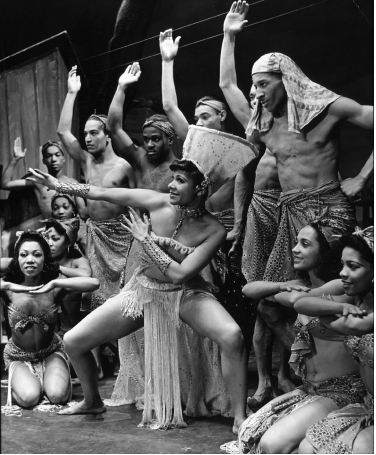
Katherine Dunham's choreography brought African and Caribbean dance forms together with ballet and modern dance. Her work raised the profile of Black dance and culture on the stage and challenged stereotypes about Black performers.
Dunham's approach to movement and storytelling influenced later dancers and choreographers and helped expand recognition for Black artists in American theater.
Ethel Waters in Cabin in the Sky, 1943
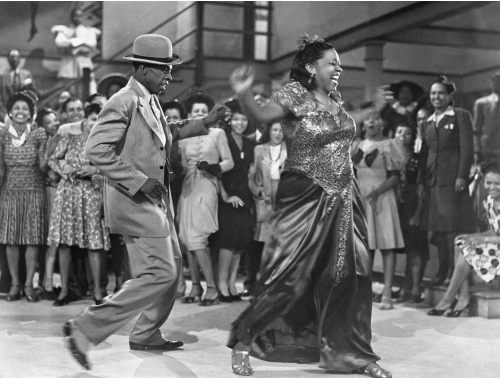
Ethel Waters' starring role in the 1943 film was a breakthrough for African American performers in Hollywood. As one of the first all-Black major studio productions, the film offered rare leading roles for Black actors during an era of limited on-screen representation.
Her performance helped challenge stereotypes and displayed the depth of talent in the Black entertainment community.
Cast of Cabin in the Sky, 1943

The 1943 film Cabin in the Sky was a major Hollywood production with an all-Black cast. It highlighted the talent of Black performers and pushed back against racial stereotypes common in the industry.
Released during World War II, the film reflected both new opportunities for Black artists and the racial limits of the era. Studying its reception offers insight into how African Americans were portrayed in mainstream media during this period.
How to Use This on the AP African American Studies Exam
Using Sources Effectively
When you get a required source from this topic, describe what it actually shows before you interpret it. For the Ellington video, point to features like swing rhythm and call and response. For the Cabin in the Sky images, note the all-Black cast and the showcase of Black musicians and dancers, then connect that to challenging stereotypes.
Continuity and Change
Be ready to trace how blues and jazz changed over time. A strong answer notes the move from acoustic Southern blues to electric blues in northern cities, and links that shift to the Great Migration. The same pattern works for jazz spreading from New Orleans into new regional styles.
Building Arguments
Use specific names and works as evidence. Ethel Waters starring in her own show in 1939, Duke Ellington's success, and the production of all-Black musicals all support claims about Black cultural innovation and breaking barriers.
Common Trap
Do not list every famous artist you can think of as if they are all required content. Anchor your answer in the required sources and the clearly named figures, then add extra examples only as support.
Common Misconceptions
- Misconception: Blues and jazz appeared suddenly in the 1920s.Actually: Blues and jazz did not appear suddenly in the 1920s. Blues has roots in slavery, and both genres grew out of African American communities in the South before spreading north and beyond.
- Misconception: Electric blues replaced acoustic blues by chance.Actually: Electric blues did not replace acoustic blues by chance. The shift was tied to the Great Migration, as people brought the music to northern cities where it took on amplified, urban forms.
- Misconception: All-Black Hollywood musicals meant full equality.Actually: All-Black Hollywood musicals were not full equality. Films like Cabin in the Sky gave Black performers rare leading roles, but Black actors were still often limited to stereotypical parts in mainstream film.
- Misconception: Ethel Waters starring in her own television show in 1939 meant television was open to Black performers.Actually: Ethel Waters being first to star in her own television show in 1939 does not mean television was open to Black performers. Opportunities were very limited, which is exactly why this was a landmark.
- Misconception: Jazz came from American culture in general, not from African American communities.Actually: Jazz being called America's most distinctive art form does not erase its specific origins. It came from African American communities, especially in New Orleans, not from American culture in general.
Related AP African American Studies Guides
Practice Questions for 3.14
1 of 10
Duke Ellington's decision to produce the short musical film Symphony in Black: A Rhapsody of Negro Life in 1934, depicting various scenes of African American life including work, love, and religious experiences, was most likely intended to accomplish which of the following purposes?
A.
Demonstrate the artistic sophistication and emotional depth of African American cultural experiences to mainstream audiences
B.
Compete with all-Black musicals produced by major studios to establish Ellington's dominance in Hollywood film production
C.
Document the historical conditions of slavery and Reconstruction to educate Northern audiences about Southern racial oppression
D.
Provide employment opportunities for African American musicians who had been excluded from Hollywood studio orchestras
Vocabulary
The following words are mentioned explicitly in the AP® course framework for this topic.Term | Definition |
|---|---|
African American record labels | Recording companies established by and for African Americans to produce and distribute music during the early twentieth century. |
all-Black musicals | Musical films or theatrical productions featuring exclusively African American casts, actors, musicians, and dancers, such as those produced by Hollywood in the 1930s-1940s. |
big band | A jazz style featuring large ensembles of musicians playing arranged compositions, popular during the 1930s and 1940s. |
blues | An African American musical genre characterized by expressive vocals, call-and-response patterns, and themes reflecting hardship and emotional experience. |
Broadway | The theater district in New York City known for professional theatrical productions where Black performers achieved success in the early twentieth century. |
cabarets | Nightclubs or entertainment venues featuring music, dancing, and performances, where Black performers gained prominence in the early twentieth century. |
Cabin in the Sky | A 1943 all-Black musical film that featured prominent African American actors, musicians, and dancers. |
call and response | A musical and performative technique where one voice or instrument initiates a phrase and another responds, originating from African musical traditions. |
electric blues | An evolved version of acoustic blues that developed as African Americans migrated north, incorporating electric instruments. |
free jazz | An experimental jazz style that moves away from traditional harmonic and rhythmic structures. |
gospel | A genre of African American religious music that evolved from spirituals and features powerful vocals, emotional expression, and Christian themes. |
Great Migration | The movement of approximately six million African Americans from the South to the North, Midwest, and western United States in waves from the 1910s to 1970s in search of economic opportunities and safety. |
Harlem Renaissance | A cultural and intellectual movement in the 1920s-1930s centered in Harlem, New York, that showcased African American artists, musicians, and writers and provided opportunities for wider audiences. |
jazz | An African American musical genre that emerged in New Orleans, characterized by improvisation, syncopation, and blending of African and European musical elements. |
Jazz Age | A period in the 1920s-1930s characterized by the popularity of jazz music and associated cultural changes in American society. |
radio broadcast | The transmission of African American musical genres including blues, gospel, and jazz across the nation through radio technology in the early twentieth century. |
Frequently Asked Questions
What is AP African American Studies 3.14 about?
AP African American Studies 3.14 covers African American contributions to music, theater, and film in the 1930s and 1940s. The topic connects blues, jazz, the Harlem Renaissance, radio, Duke Ellington, Cabin in the Sky, Katherine Dunham, and Ethel Waters to Black cultural innovation and wider American culture.
How did the Harlem Renaissance affect Black music?
The Harlem Renaissance and Jazz Age opened wider audiences for African American musicians, vocalists, and record labels. Radio helped blues, gospel, and jazz travel nationally, so Black musical forms became central to American popular culture while staying rooted in African American communities.
Why are blues and jazz important in this topic?
Blues and jazz show how African American communities created major American art forms from lived experience. Blues grew from the South and changed as people moved north during the Great Migration, while jazz began in African American communities in New Orleans and developed styles from big band to free jazz.
What required sources should I know for Symphony in Black?
The required sources include Duke Ellington's "It Don't Mean a Thing" (1943), Katherine Dunham in Cabin in the Sky, Ethel Waters in Cabin in the Sky, and the cast of Cabin in the Sky. The topic also notes Ellington's Symphony in Black: A Rhapsody of Negro Life (1934), which depicts scenes of African American life.
Why did Cabin in the Sky matter?
Cabin in the Sky mattered because it was a major Hollywood production with an all-Black cast at a time when Black performers had limited opportunities in mainstream film. It showcased Black actors, musicians, and dancers while also showing the racial limits of the entertainment industry in the 1940s.
How should I use this topic on the AP exam?
Use this topic to connect specific evidence to bigger claims about Black cultural production. Describe what a source shows, name the artist or work accurately, and connect it to themes like the Great Migration, the Harlem Renaissance, radio, Black performance, and the expansion of African American cultural influence.
See Fiveable more often in Google
Mark Fiveable as a preferred source and Google is more likely to show you our guides in Top Stories, with a "preferred" badge in AI Mode and AI Overviews.