3.5 Disenfranchisement and Jim Crow Laws

✊🏿AP African American Studies Unit 3 Review
3.5 Disenfranchisement and Jim Crow Laws
✊🏿 AP African American Studies
3.1
The Reconstruction Amendments
3.2
Social Life: Reuniting Black Families and the Freedmen's Bureau
3.3
Black Codes, Land, and Labor
3.4
The Defeat of Reconstruction
3.5
Disenfranchisement and Jim Crow Laws
3.6
White Supremacist Violence and the Red Summer
3.7
The Color Line and Double Consciousness in American Society
3.8
Lifting as We Climb: Uplift Ideologies and Black Women's Rights and Leadership
3.9
Black Organizations and Institutions
3.10
HBCUs, Black Greek Letter Organizations, and Black Education
3.11
The New Negro Movement and the Harlem Renaissance
3.12
Photography and Social Change
3.13
Envisioning Africa in Harlem Renaissance Poetry
3.14
Symphony in Black: Black Performance in Music, Theater, and Film
3.15
Black History Education and African American Studies
3.16
The Great Migration
3.17
Afro-Caribbean Migration
3.18
The Universal Negro Improvement Association
Jim Crow laws were local and state statutes, protected by the Supreme Court's decision in Plessy v. Ferguson (1896), that segregated public life and stripped voting power from African American men after Reconstruction.
Why This Matters for the AP African American Studies Exam
This topic connects two big ideas you will need to explain on the exam: how segregation and disenfranchisement worked, and how African Americans resisted. You will likely see required sources from this topic, including A Red Record by Ida B. Wells-Barnett and photographs of segregated facilities, so practice analyzing how each source documents racial injustice and argues against it.
Topic 3.5 also builds directly on the defeat of Reconstruction, so it is useful for tracing causation and continuity across Unit 3. When you analyze sources or build an argument, you can use this material to show how legal segregation and racial violence shaped Black life, and how Black writers and organizers responded.
Key Takeaways
- Jim Crow laws were local and state statutes, mostly but not only in the South, protected by Plessy v. Ferguson (1896) and its "separate but equal" doctrine.
- These laws limited Black men's voting rights and segregated hospitals, transportation, schools, and cemeteries; they lasted until the Civil Rights movement of the 1950s and 1960s.
- The "nadir" names the period from the end of Reconstruction to World War II as the lowest point of American race relations, marked by lynching and mob violence.
- Black journalists and writers exposed the racism behind Southern lynch laws and the false justifications used to defend mob killings.
- Activists used resistance strategies like trolley boycotts and relied on sympathetic writers in the press to publicize anti-Black violence.
- Ida B. Wells-Barnett's A Red Record is a required source that documents lynching with statistics and eyewitness accounts.
Impact of Jim Crow
Origins of the Term
The term "Jim Crow" started in the 1830s as a derogatory label for African Americans. It came from a white stage performer, Thomas Dartmouth (T.D.) Rice, who wore blackface and performed an act called "Jump, Jim Crow" that mocked Black speech and dance. The popularity of that act spread the term as a common insult.
Jim Crow laws were local and state-level statutes. They were passed primarily, but not only, in the South. Their legal protection came from the Supreme Court's decision in Plessy v. Ferguson (1896), which upheld racial segregation under the "separate but equal" doctrine. That ruling gave states the cover they needed to expand segregation across daily life.
Segregation and Disenfranchisement
Jim Crow laws limited African American men's right to vote and forced racial segregation in public life. Segregated spaces included:
- Hospitals
- Transportation
- Schools
- Cemeteries
Voter suppression tools such as literacy tests, poll taxes, and grandfather clauses are examples of how Black political power was stripped away after Reconstruction. In practice, "separate but equal" meant separate and unequal, since facilities for African Americans were almost always inferior.
These restrictions stayed in place until the Civil Rights movement of the 1950s and 1960s. For exam context, later changes like Brown v. Board of Education (1954) are connected to the earlier topic on the defeat of Reconstruction, where Plessy and Brown are the named cases. In this topic, focus on how Jim Crow worked and how people resisted it.
African American Responses During the Nadir
What the Nadir Means
African American Studies scholars call the period between the end of Reconstruction and the start of World War II the "nadir," meaning the lowest point of American race relations. The historian and Pan-Africanist Rayford W. Logan named this period. It included some of the most flagrant public acts of racism in United States history, including lynching and mob violence.
Journalism Against Lynching
Black journalists and writers highlighted the racism at the core of Southern lynch laws, which tried to justify the murder of Black people. They exposed the false excuses used to defend mob violence and showed that lynching was meant to terrorize African Americans away from any form of advancement.
Ida B. Wells-Barnett, born into slavery, became a journalist, civil rights advocate, and feminist. Her writing documented how lynching worked as racial terror, and she argued that it was used to suppress Black economic and political progress, not to punish crime. She also proposed that every African American own a Winchester rifle for self-protection given the rise in anti-Black violence after Reconstruction.
Resistance Strategies and the Press
Activists responded to attacks on their freedom with organized resistance strategies, such as trolley boycotts, where African Americans refused to ride segregated transit and put economic pressure on those companies. They also relied on sympathetic writers in the press to publicize the mistreatment and murder of African Americans.
The Black press was central to this work, spreading news of racial violence and resistance that the mainstream white press often ignored or distorted. As an example of how this organizing grew, groups like the NAACP, founded in 1909, later challenged segregation and racial violence through lawsuits and advocacy. Treat that as an application of these resistance strategies rather than required content for this topic.
Required Sources
Excerpt from Chapter 1 of A Red Record by Ida B. Wells-Barnett, 1895
A Red Record is a firsthand investigation of lynching in post-Reconstruction America. Wells-Barnett documented racial violence with statistics and eyewitness accounts, challenging the stories used to justify these killings.
Full text: https://www.gutenberg.org/files/14977/14977-h/14977-h.htm#chap1
Key points to know:
- She names three excuses used to justify violence against Black Americans: suppressing alleged "race riots" and insurrections, preventing so-called "Negro domination" in politics, and avenging supposed assaults on white women.
- She argues these excuses were fabricated to justify ongoing oppression and murder.
- She challenges the rape accusation by noting that no such charges arose when white women were left in Black men's care during slavery and war, that many lynchings followed consensual interracial relationships, and that white men assaulted Black women without consequence.
- She uses records compiled by white sources to support her case, including a year in which more people were lynched than were legally executed.
When you analyze this source, focus on how Wells-Barnett uses evidence and her position as a journalist to argue against the official justifications for lynching.
Segregated Water Fountains (date unknown)
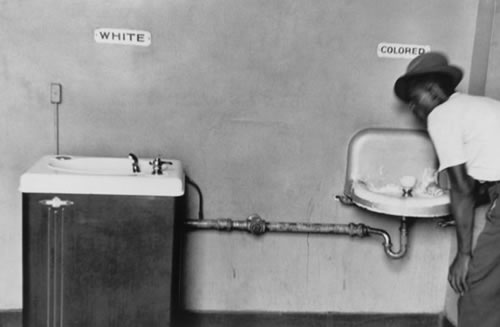
This photograph shows segregation built into everyday public facilities. It is visual evidence of how "separate but equal" worked in practice and of the daily indignities African Americans faced during the Jim Crow era. When analyzing it, consider what the image documents about power, race, and unequal resources.
Segregated Restrooms, Circa 1960

Segregated restrooms in the early 1960s show how long these segregation restrictions lasted, right up to the Civil Rights movement. Use this image to think about continuity over time and how visual sources can argue against segregation by exposing it.
How to Use This on the AP African American Studies Exam
Using Sources Effectively
- For A Red Record, identify Wells-Barnett's argument and the specific evidence she uses. Note her perspective as a journalist and how she dismantles each justification for lynching.
- For the segregation photographs, describe what is shown and explain what it reveals about "separate but equal" in daily life. Connect the image to the idea that separate almost always meant unequal.
Building an Argument
- Use Jim Crow laws and the nadir to explain how segregation and disenfranchisement were enforced after Reconstruction.
- Pair that with resistance examples like Wells-Barnett's journalism and trolley boycotts to show both oppression and Black agency.
Causation and Continuity
- Trace how the defeat of Reconstruction set up Jim Crow, then how Jim Crow lasted until the Civil Rights movement.
- This continuity over time is a strong move when a question asks how conditions changed or stayed the same.
Common Trap
- Do not treat Jim Crow as only about water fountains and restrooms. It also limited voting rights and segregated hospitals, schools, and cemeteries.
Common Misconceptions
- Misconception: Jim Crow was a single federal law.Actually: It was not. Jim Crow refers to many local and state statutes, protected nationally by the Plessy v. Ferguson decision.
- Misconception: The name Jim Crow came from a real lawmaker.Actually: It came from a blackface stage act, "Jump, Jim Crow," that mocked African Americans, and it became a common slur before it named these laws.
- Misconception: The nadir just means things were bad.Actually: It is a specific term scholars use for the lowest point of American race relations between the end of Reconstruction and World War II, and Rayford W. Logan named it.
- Misconception: African Americans were passive during this era.Actually: Writers, journalists, and activists fought back through investigative reporting, the Black press, boycotts, and self-defense.
- Misconception: Plessy v. Ferguson made things truly equal.Actually: The "separate but equal" doctrine legalized separation, but resources and facilities for African Americans were consistently inferior.
Related AP African American Studies Guides
Practice Questions for 3.5
1 of 10
In her 1895 work A Red Record, Ida B. Wells-Barnett documents lynching statistics and eyewitness accounts to support which of the following claims about racial violence in the post-Reconstruction South?
A.
Southern white mobs acted spontaneously without organized coordination or ideological motivation.
B.
Black men were lynched because they posed a genuine threat to white women's safety.
C.
Federal troops should have remained in the South to prevent all racial violence.
D.
Lynching was systematic racial terror designed to suppress Black economic and political power.
Vocabulary
The following words are mentioned explicitly in the AP® course framework for this topic.Term | Definition |
|---|---|
disenfranchisement | The denial or removal of voting rights from a group of people, particularly African American men during the Jim Crow era. |
Jim Crow laws | State and local laws that enforced racial segregation and discrimination against Black Americans, primarily in the Southern United States. |
lynch laws | Laws and legal systems in the South that sought to justify and perpetuate the killing of Black people through lynching. |
lynching | Extrajudicial execution and racial violence perpetrated against African Americans, often by mobs, as a tool of terror and social control. |
mob violence | Violent attacks by groups of white people against African Americans who attempted to move into well-resourced, predominantly white neighborhoods. |
nadir | The lowest point of American race relations, referring to the period between the end of Reconstruction and the beginning of the Second World War. |
Plessy v. Ferguson | An 1896 Supreme Court decision that established the 'separate but equal' doctrine, allowing racial segregation in public facilities. |
racial segregation | The legal and systematic separation of African Americans and white people in housing, transportation, and public services. |
Reconstruction | The period following the Civil War (1865-1877) when the federal government worked to rebuild the South and integrate formerly enslaved people into American society. |
resistance strategies | Organized methods used by African American activists to oppose racism, discrimination, and violence against their communities. |
trolley boycotts | Organized resistance strategies where African American activists refused to use segregated trolley systems to protest discrimination. |
Frequently Asked Questions
What is disenfranchisement?
Disenfranchisement means taking away or severely limiting a person's right to vote. In this topic, it refers to tools like poll taxes, literacy tests, and grandfather clauses that restricted Black political power after Reconstruction.
What were Jim Crow laws?
Jim Crow laws were state and local laws that enforced racial segregation in public life. They were especially common in the South and were protected by the Supreme Court's Plessy v. Ferguson decision.
What did Plessy v. Ferguson do?
Plessy v. Ferguson upheld racial segregation under the doctrine of separate but equal. In practice, segregated facilities were unequal and helped give legal cover to Jim Crow systems.
What does the nadir mean in African American Studies?
The nadir refers to the period from the end of Reconstruction to World War II, which scholars describe as the lowest point of American race relations because of segregation, disenfranchisement, and racial terror.
Why is Ida B. Wells-Barnett important for this topic?
Ida B. Wells-Barnett used journalism and evidence to expose lynching and challenge false justifications for racial violence. Her A Red Record is a required source for this topic.
How should I use Jim Crow and disenfranchisement on the AP exam?
Use them to explain how Reconstruction gains were restricted and how African Americans resisted through journalism, boycotts, Black institutions, and organized advocacy.
See Fiveable more often in Google
Mark Fiveable as a preferred source and Google is more likely to show you our guides in Top Stories, with a "preferred" badge in AI Mode and AI Overviews.