4.21 Black Studies, Black Futures, and Afrofuturism

✊🏿AP African American Studies Unit 4 Review
4.21 Black Studies, Black Futures, and Afrofuturism
✊🏿 AP African American Studies
4.1
The Négritude and Negrismo Movements
4.2
Anticolonialism and Black Political Thought
4.3
African Americans and the Second World War: The Double V Campaign and the G.I. Bill
4.4
Discrimination, Segregation, and the Origins of the Civil Rights Movement
4.5
Redlining and Housing Discrimination
4.6
Major Civil Rights Organizations
4.7
Black Women's Leadership and Grassroots Organizing in the Civil Rights Movement
4.8
The Arts, Music, and the Politics of Freedom
4.9
Black Religious Nationalism and the Black Power Movement
4.10
The Black Arts Movement
4.11
The Black Panther Party for Self-Defense
4.12
Black Is Beautiful and Afrocentricity
4.13
The Black Feminist Movement, Womanism, and Intersectionality
4.14
Interlocking Systems of Oppression
4.15
Economic Growth and Black Political Representation
4.16
Demographic and Religious Diversity in Contemporary Black Communities
4.17
The Evolution of African American Music: From Spirituals to Hip-Hop
4.18
Black Life in Theater, TV, and Film
4.19
African Americans and Sports
4.20
Science, Medicine, and Technology in Black Communities
4.21
Black Studies, Black Futures, and Afrofuturism
African American Studies is an interdisciplinary field that studies Black history, literature, politics, and culture in ways traditional disciplines often leave out. Afrofuturism is a creative movement that reimagines Black pasts without oppression and pictures Afrocentric futures through art, music, film, and technology.
Why This Matters for the AP African American Studies Exam
This is the final topic in the course, and it pulls together big ideas you have seen all year: Black cultural production, identity, resistance, and the building of new institutions. On the exam you may need to analyze sources like film, photography, music posters, or essays and explain how they imagine Black life. You can use the skills here to interpret visual and written sources, connect a work to its historical moment, and build evidence-based arguments about how Black expression challenges oppression and envisions the future.
This topic also gives you a clear way to talk about how a whole academic field formed, which is useful when a question asks about change over time or the impact of earlier movements like the Black Arts movement and Afrocentricity on later scholarship.
Key Takeaways
- African American Studies analyzes Black history, literature, politics, and more by combining methods from many fields and focusing on past and present Black experiences.
- The field keeps evolving as it adds new perspectives, and it offers ways to understand racial inequities and the global reach of Black expression.
- Afrofuturism reimagines Black pasts, including a past free from oppression, and envisions Afrocentric futures using technology and science.
- Afrofuturism appears across art, music, film, fashion, literature, and architecture.
- Early examples include Phillis Wheatley's visions of future freedom after abolition and Benjamin Banneker's study of the stars in his Almanac and Ephemeris.
- Characteristic Afrofuturist works emerged from the 1970s onward, such as the music of Sun Ra and films like Black Panther.
What African American Studies Contributes
African American Studies examines the global influence of Black expression and racial inequities. It studies subjects that more traditional disciplines often leave out, and it draws on history, literature, politics, and other fields at once.
- It uses both historical and present-day approaches to build a fuller picture of Black experiences.
- It keeps developing as the discipline grows and takes on new questions and methods.
- It offers frameworks for analyzing how race connects with other parts of identity and with social systems.
Because the field is interdisciplinary, it gives you tools to study a single topic from several angles, which is exactly the kind of thinking this course rewards.
Afrofuturism's Vision of Black Lives
Afrofuturism is a movement that reimagines Black pasts and envisions Afrocentric futures using technology and science. One example of a reimagined past is a past without oppression. This exploration of new possibilities comes to life across art, music, film, fashion, literature, and architecture.
- It pictures futures where Black communities thrive and define their own paths.
- It links creativity to liberation by using science and speculative storytelling.
- It pulls from African traditions, Afro-diasporic experiences, and contemporary Black life.
Early Examples
- Phillis Wheatley imagined future freedom and mobility for Black people after abolition through her poetry.
- Benjamin Banneker, a mathematician and astronomer, studied the stars in his Almanac and Ephemeris.
These early figures show that Afrofuturist thinking, picturing a freer Black future, existed long before the movement had a name.
Characteristic Works from the 1970s Onward
- Sun Ra blended avant-garde jazz with themes of space, mythology, and Black liberation.
- Black Panther presents a technologically advanced African nation, picturing Black achievement and self-determination.
The course also notes that Afrofuturism's influence shows up in performers like Jimi Hendrix, Herbie Hancock, Patti LaBelle, Janelle Monae, Missy Elliott, and Outkast. These are examples of the movement's reach, not a required checklist.
Required Sources
"Let's Talk About Black Panther and Afrofuturism" (video, 2:17)
Black Panther is a key example of Afrofuturism in mainstream film. By imagining a technologically advanced African nation untouched by colonialism, the movie challenges stereotypes about the continent and pictures Black achievement and power. It is a useful case for explaining how popular culture can reimagine Black futures.
Photograph of Nichelle Nichols as Uhura in the Star Trek Episode "A Piece of the Action," 1968
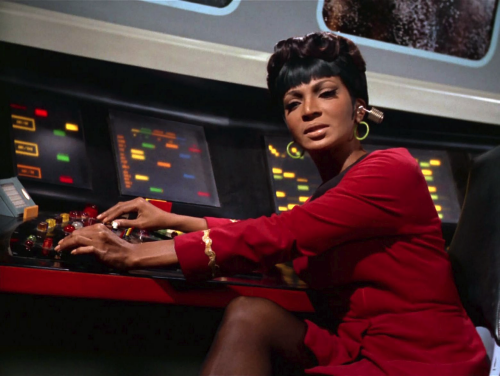
Nichelle Nichols played Lieutenant Uhura, one of the first major roles for a Black woman on a prime-time series. Her presence on the bridge of the Enterprise pictured a future where racial equality had been reached. Martin Luther King Jr., a fan of the show, urged her to stay in the role to represent the importance of Black presence in the future. Nichols later helped recruit African American, Asian American, and women astronaut applicants, and astronaut Dr. Mae Jemison cited her influence.
Poster for the Film Space Is the Place, Circa 1974
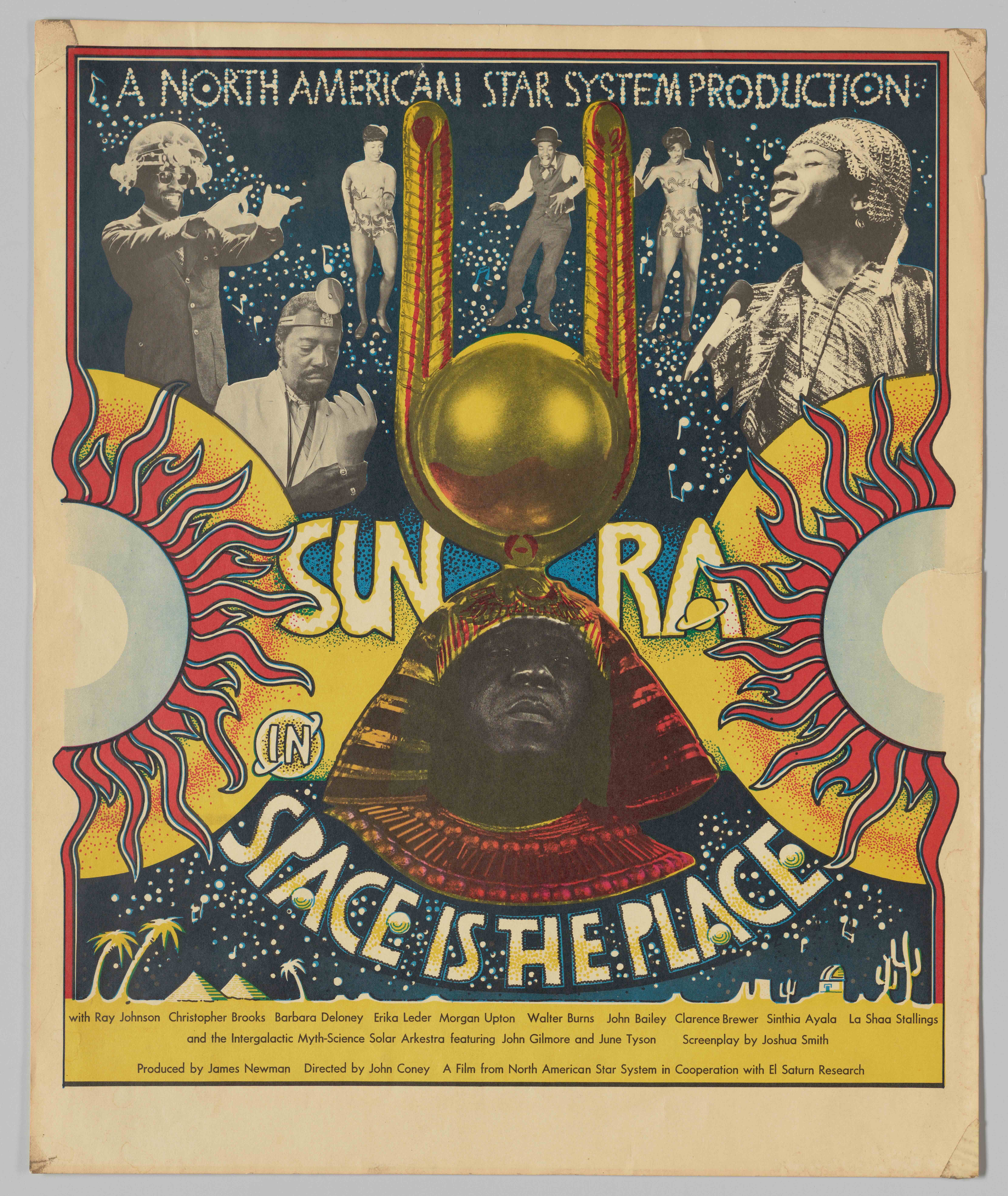
Sun Ra's film blends Afrofuturism, jazz, and science fiction. The poster reflects his cosmic style and uses space and technology as images of Black liberation and self-determination. It shows how Black artists in the 1970s reimagined their place in society and the universe.
"Culture Zone; Black to the Future" by Walter Mosley, The New York Times, 1998
Walter Mosley's essay connects African American culture, science fiction, and visions of the future. He argues that science fiction and fantasy appeal to Black readers because they open up alternative realities, let writers rewrite history, and imagine empowering futures beyond current limits. He notes that despite this potential, there were few mainstream Black science fiction writers at the time, pointing to authors like Octavia E. Butler and Samuel Delany. Mosley suggests that a genre built on challenging the status quo is well suited for Black writers to expand their creative range.
Full text: https://www.nytimes.com/1998/11/01/magazine/culture-zone-black-to-the-future.html
How to Use This on the AP African American Studies Exam
Using Sources Effectively
When you get a film still, poster, photograph, or essay, name what the source imagines about Black life and tie it to its time period. For Afrofuturist sources, point to how technology, space, or speculative storytelling stands in for freedom and self-determination.
Building Arguments
Use specific evidence. Instead of saying "Afrofuturism imagines better futures," name Sun Ra's space themes or Black Panther's vision of an uncolonized African nation, then explain what idea each one carries.
Making Connections
This topic links back to earlier units. Afrocentricity and the Black Arts movement helped build African American Studies as a field, and Phillis Wheatley and Benjamin Banneker connect Afrofuturist thinking to much earlier history. Showing those threads is a strong way to answer continuity and change questions.
Common Trap
Do not treat Afrofuturism as only about the future. It also reimagines the past, including a past without oppression. Strong answers mention both.
Common Misconceptions
- Misconception: Afrofuturism is just science fiction movies.Actually: Afrofuturism is not just science fiction movies. It spans art, music, fashion, literature, and architecture, and it includes reimagined pasts as well as futures.
- Misconception: African American Studies is only history.Actually: African American Studies is not only history. It is interdisciplinary, pulling together literature, politics, and other fields to study Black experiences.
- Misconception: Afrofuturism started in 2018 with Black Panther.Actually: Afrofuturism did not start in 2018 with Black Panther. Its characteristic works go back to the 1970s with figures like Sun Ra, and its roots reach to early thinkers like Phillis Wheatley and Benjamin Banneker.
- Misconception: Phillis Wheatley and Benjamin Banneker were part of a named movement in their own time.Actually: Phillis Wheatley and Benjamin Banneker are named as early examples of Afrofuturist thinking, but the movement's characteristic works came later. Do not assume they were part of a named movement in their own time.
- Misconception: The performers and authors listed beyond the required examples are a fixed list you must memorize as required content.Actually: The performers and authors listed beyond the required examples are illustrations of the movement's reach, not a fixed list you must memorize as required content.
Related AP African American Studies Guides
- 4.9 Black Religious Nationalism and the Black Power Movement
- 4.11 The Black Panther Party for Self-Defense
- 4.5 Redlining and Housing Discrimination
- 4.8 The Arts, Music, and the Politics of Freedom
- 4.12 Black Is Beautiful and Afrocentricity
- 4.4 Discrimination, Segregation, and the Origins of the Civil Rights Movement
Practice Questions for 4.21
1 of 10
Which of the following best explains how African American Studies' use of a diasporic framework has transformed traditional approaches to historical and sociological research?
A.
It reveals how strict adherence to established national borders remains essential for understanding Black experiences globally.
B.
It reveals how cultural and political exchanges across national borders ultimately erased distinct regional Black identities globally.
C.
It reveals how European diplomatic exchanges across national borders primarily determined Black political experiences globally.
D.
It reveals how cultural and political exchanges across national borders are essential for understanding Black experiences globally.
Vocabulary
The following words are mentioned explicitly in the AP® course framework for this topic.Term | Definition |
|---|---|
African American Studies | An interdisciplinary field of scholarly inquiry that analyzes the history, culture, and contributions of people of African descent in the United States and throughout the African diaspora. |
Afrocentric futures | Visions of the future centered on African and African American perspectives, cultures, and possibilities. |
Afrofuturism | A movement that reimagines Black pasts and envisions Afrocentric futures using technology and science, expressed through art, music, film, fashion, literature, and architecture. |
Black expression | Cultural, artistic, political, and social forms of communication and creativity produced by Black people. |
Black pasts | Historical experiences and narratives of Black people, including reimagined versions without oppression. |
interdisciplinary | Involving or combining methods and perspectives from multiple academic disciplines. |
oppression | The systematic subjugation and constraint of a group of people, particularly in the context of Black historical experiences. |
racial inequities | Systemic and structural disparities and injustices based on race. |
Frequently Asked Questions
What is Afrofuturism in AP African American Studies?
Afrofuturism is a movement that reimagines Black pasts and envisions Afrocentric futures through technology, science, art, music, film, fashion, literature, and architecture.
How does African American Studies contribute to interdisciplinary study?
African American Studies brings together history, literature, politics, culture, and other fields to examine Black experiences, global Black expression, and racial inequities that traditional disciplines often leave out.
What does Black futures mean in this topic?
Black futures refers to imagining possibilities for Black life beyond oppression, including futures shaped by Black creativity, technology, freedom, and self-definition.
What are early examples of Afrofuturism?
The course names Phillis Wheatley’s visions of future freedom after abolition and Benjamin Banneker’s astronomical work in his Almanac and Ephemeris as early examples of Afrofuturist thinking.
What required sources connect to AP African American Studies 4.21?
Required sources include a Black Panther and Afrofuturism video, a photograph of Nichelle Nichols as Uhura, a Space Is the Place poster, and Walter Mosley’s Culture Zone; Black to the Future.
How can I use Afrofuturism on the AP exam?
Use Afrofuturism to explain how Black artists and scholars imagine futures, reinterpret the past, and challenge limited representations of Black life. Tie claims to specific source details and course vocabulary.
See Fiveable more often in Google
Mark Fiveable as a preferred source and Google is more likely to show you our guides in Top Stories, with a "preferred" badge in AI Mode and AI Overviews.