2.9 Creating African American Culture

✊🏿AP African American Studies Unit 2 Review
2.9 Creating African American Culture
✊🏿 AP African American Studies
2.1
African Explorers in the Americas
2.2
Departure Zones in Africa and the Slave Trade to the United States
2.3
Capture and the Impact of the Slave Trade on West African Societies
2.4
African Resistance on Slave Ships and the Antislavery Movement
2.5
Slave Auctions and the Domestic Slave Trade
2.6
Labor, Culture, and Economy
2.7
Slavery and American Law: Slave Codes and Landmark Cases
2.8
The Social Construction of Race and the Reproduction of Status
2.9
Creating African American Culture
2.10
Black Pride, Identity, and the Question of Naming
2.11
The Stono Rebellion and Fort Mose
2.12
Legacies of the Haitian Revolution
2.13
Resistance and Revolts in the United States
2.14
Black Organizing in the North: Freedom, Women's Rights, and Education
2.15
Maroon Societies and Autonomous Black Communities
2.16
Diasporic Connections: Slavery and Freedom in Brazil
2.17
African Americans in Indigenous Territory
2.18
Debates About Emigration, Colonization, and Belonging in America
2.19
Black Political Thought: Radical Resistance
2.20
Race to the Promised Land: Abolitionism and the Underground Railroad
2.21
Legacies of Resistance in African American Art and Photography
2.22
Gender and Resistance in Slave Narratives
2.23
The Civil War and Black Communities
2.24
Freedom Days: Commemorating the Ongoing Struggle for Freedom
African American culture formed when enslaved people blended African traditions with European and Indigenous influences to create new art, music, and language. You see this in quilts and pottery, the banjo and drums, creole languages like Gullah, and spirituals that carried faith, resistance, and coded escape messages.
Why This Matters for the AP African American Studies Exam
This topic shows how enslaved African Americans built culture as a form of survival and resistance, not just entertainment. On the exam, you can use it to analyze how art, music, and language preserved African heritage while responding to life in America. It connects well to source analysis and to arguments about continuity (African roots) and change (new American forms).
Required sources here give you concrete evidence to cite, including a quilted bedcover, Frederick Douglass's My Bondage and My Freedom, David Drake's storage jar, and the spiritual "Steal Away to Jesus." Practice explaining what each source reveals about cultural creation and resistance.
Key Takeaways
- African American culture combined African ancestral traditions with local European and Indigenous influences.
- Crafts like pottery and quilting served as storytelling and memory keeping, and instruments like the banjo, drums, and gourd rattles recreated West African forms.
- Creole languages such as Gullah blended West African and European elements, continuing the African practice of building a common language across groups.
- Enslaved people reworked Christian hymns with call and response, clapping, improvisation, and syncopation, laying the foundation for gospel and the blues.
- American blues shares the same musical system as the fodet from the Senegambia region.
- Spirituals expressed hardship and hope, resisted enslavement, and used double meanings to signal escape routes on the Underground Railroad.
African American Cultural Expression
Diverse Influences on Creativity
African American creative expression drew on blended influences from African ancestors, community members, and the local European and Indigenous cultures around them. This mix produced distinctive art forms that reflected both diverse heritage and the realities of life in America.
Because the ancestors of early African Americans came from many West and Central African ethnic groups, the interaction of those groups created multiple combinations of African-based practices, languages, and beliefs within Black communities.
African Aesthetic in Crafts
African Americans incorporated African aesthetic influences into their pottery and built a tradition of quilt-making as a medium of storytelling and memory keeping. Quilts could preserve family histories and cultural traditions, turning everyday objects into visual narratives.
These crafts gave enslaved people a way to express creativity and stay connected to African heritage even under a system designed to suppress it.
African-Inspired Musical Instruments
African Americans drew from varied African and local influences to construct instruments such as rattles made from gourds, the banjo, and drums, recreating instruments similar to those found in West Africa. These instruments carried rhythmic traditions that shaped African American music and, later, many American genres.
Development of Creole Languages
Enslaved Africans arrived in the United States knowing both African and European languages. Many who had taken part in long-distance trade were used to developing a lingua franca, or common language, to communicate across groups. Enslaved African Americans continued this practice and developed creole languages.
Gullah is the clearest example. It combines elements from West African and European languages and developed among communities in the Carolina and Georgia lowcountry. Creole languages helped people communicate across linguistic boundaries, build shared identity, and sometimes communicate in ways enslavers could not easily follow.
African Influences on American Music
Adaptation of Christian Hymns
Enslaved people adapted Christian hymns they learned and combined them with rhythmic and performative elements from Africa, including call and response, clapping, improvisation, and syncopation. Paired with biblical themes, this created a distinct American musical genre that became the foundation of later genres including gospel and the blues.
This adaptation let enslaved African Americans express faith in ways that fit their cultural heritage, even though they were pressured to adopt the religion of their enslavers.
West African Roots of the Blues
Senegambians and West Central Africans arrived in large numbers in Louisiana, which influenced the development of American blues. American blues contains the same musical system as the fodet, a musical tradition from the Senegambia region. This connection shows how African musical systems carried directly into a major American genre.
Functions of Spirituals
Expression of Hardship and Hope
Musical and faith traditions combined in the form of spirituals, also called sorrow songs and jubilee songs. These were the songs enslaved people sang to articulate their hardships and their hopes. Biblical themes of suffering, redemption, and deliverance gave voice to pain while also pointing toward the hope of freedom.
Resistance Through Religious Practices
African Americans' religious practices served social, spiritual, and political purposes. Enslaved people used spirituals to resist the dehumanizing conditions of enslavement, express creativity, and communicate strategic information such as warnings, plans to run away, and methods of escape.
Double Meanings in Lyrics
The lyrics of spirituals often carried double meanings. Songs used biblical themes of redemption and deliverance to alert enslaved people to opportunities to run away via the Underground Railroad. This let people communicate about escape without raising the suspicion of enslavers.
Preservation of African Heritage
Spirituals reflect both African heritage and American identity. They preserve rhythms and performance styles from West Africa while expressing contemporary experiences in America. African performative elements appear in the ring shout found among the Gullah Geechee community in the sea islands of Georgia, Florida, and the Carolinas. Through spirituals, African Americans resisted cultural erasure and passed heritage across generations.
Required Sources
Cream and Red Appliqued Quilted Bedcover, Circa 1850-1900
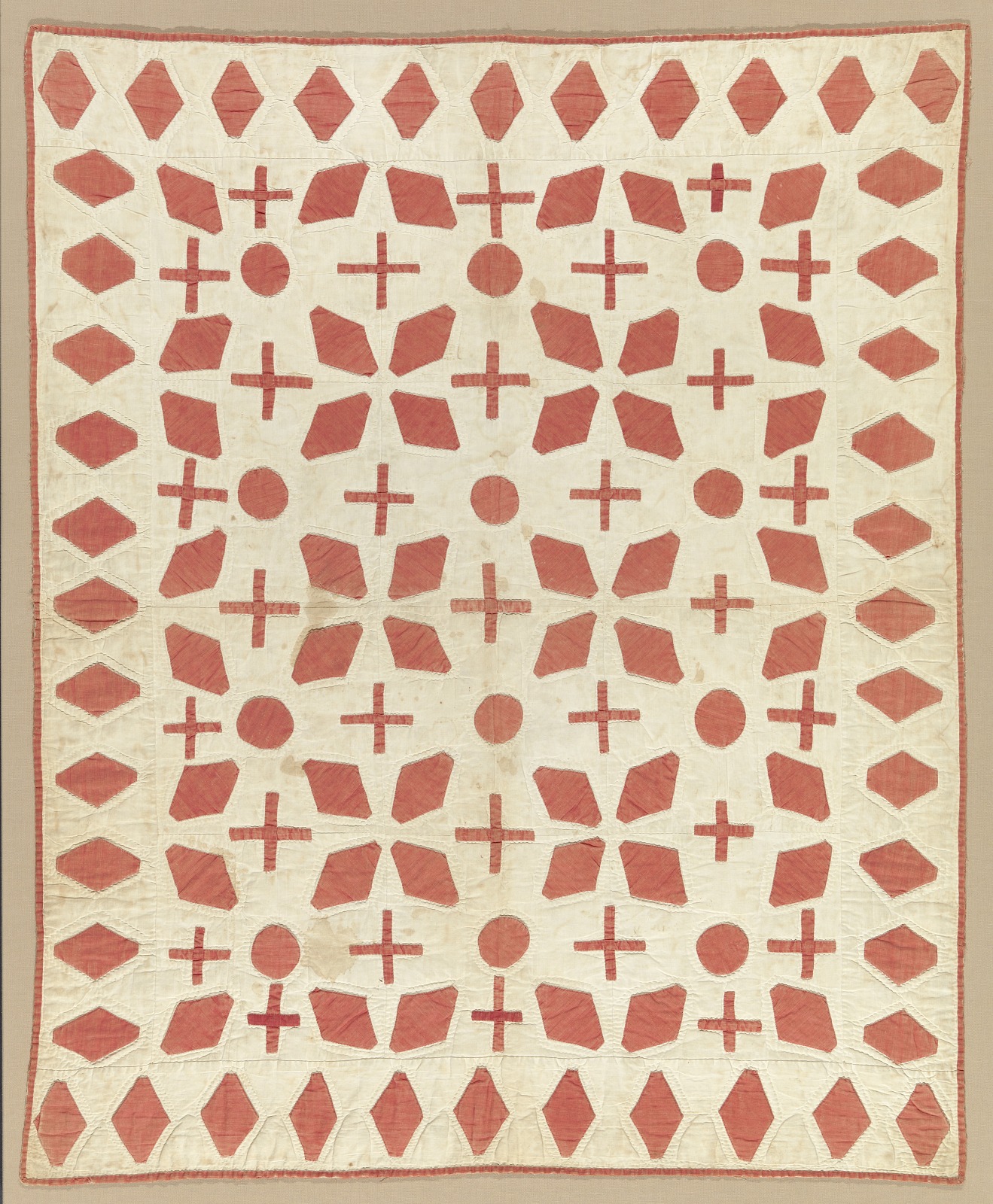
This bedcover is an artifact of African American material culture and artistry from the antebellum period. Quilting was an important tradition that served both practical and expressive purposes, with designs that could reflect African textile traditions and symbolism.
Quilts like this show how African American women created culture under oppressive conditions. They provided warmth while also serving as a medium for storytelling and preserving heritage, which makes them useful primary sources for understanding 19th-century African American life.
Excerpt from Chapter 6 of My Bondage and My Freedom by Frederick Douglass, 1855
Frederick Douglass's autobiographical work gives a firsthand account of the realities of American slavery. His descriptions expose the physical and psychological harm enslaved people endured and offer insight into how they made sense of their condition.
This chapter is especially useful for this topic because of what Douglass says about enslaved people's songs and their meaning.
Key points to use as evidence
- Douglass, as a child, questions why some people are enslaved while others hold power over them. He struggles to reconcile slavery with his understanding of God's goodness.
- He concludes slavery is man-made: "It was not color, but crime, not God, but man, that afforded the true explanation of the existence of slavery."
- He describes brutal treatment, including the whipping of Nelly by overseer Mr. Sevier.
- He describes the singing of enslaved people on the way to receive their allowance: "While on their way, they would make the dense old woods, for miles around, reverberate with their wild notes."
- He explains that the songs expressed sorrow: "They told a tale which was then altogether beyond my feeble comprehension; they were tones, loud, long and deep, breathing the prayer and complaint of souls boiling over with the bitterest anguish."
- He details poor living conditions, harsh work routines, and frequent punishments.
- He contrasts the enslaved people's suffering with the luxury of the enslavers' "great house."
Storage Jar by David Drake, 1858
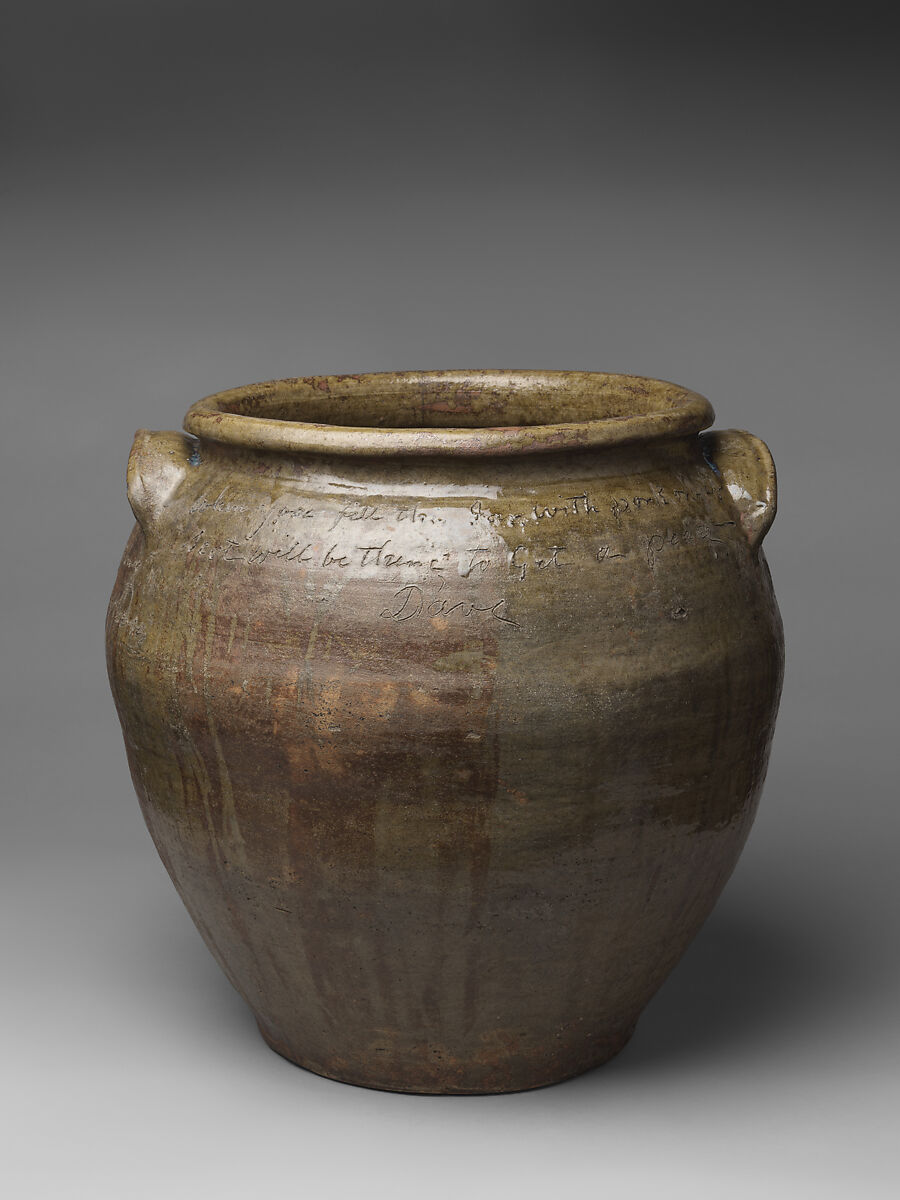
David Drake was an enslaved potter in South Carolina. Despite bans on literacy for African Americans, he exercised creative expression by inscribing short poems on the jars he created, on topics including love, family, spirituality, and slavery.
His large, skillfully made vessels and inscribed poetry show the skills, creativity, and humanity of enslaved people. Drake's work is strong evidence that enslaved African Americans maintained cultural traditions, knowledge, and personal agency despite oppressive conditions.
Gospel Performance of "Steal Away to Jesus" by Shirley Caesar and Michelle Williams, 2001
This gospel performance shows the lasting power and cultural significance of African American spirituals. Rooted in the experiences of enslaved people, songs like "Steal Away to Jesus" carried messages of hope, resistance, and faith.
The pairing of an established gospel artist with a younger artist shows how these traditions continue to be passed down and reinterpreted. It connects the historical roots of spirituals to ongoing African American religious and cultural expression.
Lyrics to "Steal Away to Jesus," Mid-Nineteenth Century
"Steal Away to Jesus" is a spiritual that emerged from the African American experience under slavery. Its lyrics carry spiritual and cultural meaning, reflecting struggle, hope, and resilience.
The metaphorical language served a dual purpose, expressing religious devotion while potentially conveying coded messages about escape from slavery. This shows how spirituals combined faith, resistance, and the hope of freedom. "Steal Away" was documented and composed by Wallace Willis, a formerly enslaved Black person in Choctaw territory in Mississippi who was displaced to Oklahoma Territory during the Trail of Tears.
Steal away, steal away, steal away to Jesus! Steal away, steal away home, I ain't got long to stay here.
My Lord, He calls me, He calls me by the thunder; The trumpet sounds within my soul, I ain't got long to stay here.
Green trees are bending, Poor sinners stand a-trembling; The trumpet sounds within my soul, I ain't got long to stay here.
My Lord, He calls me, He calls me by the lightning; The trumpet sounds within my soul, I ain't got long to stay here.
How to Use This on the AP African American Studies Exam
Using Sources Effectively
When you get a source from this topic, identify what cultural form it shows and what work that culture did. For the quilted bedcover or David Drake's jar, explain how craft preserved heritage and expressed humanity under slavery. For the spiritual lyrics or the Douglass excerpt, explain how music expressed both sorrow and hope and could carry hidden meaning.
Continuity and Change
A strong move is to show both sides at once. Point to continuity by naming African roots, such as call and response, syncopation, the banjo's West African origins, or the fodet's link to the blues. Point to change by explaining how those elements combined with Christian hymns and American experiences to create new forms like spirituals, gospel, and the blues.
Argumentation
Use specific evidence, not general claims. Instead of saying "music was important," cite that spirituals used double meanings tied to the Underground Railroad, or that Gullah blended West African and European languages. Specific examples make a stronger argument.
Common Trap
Do not treat these cultural forms as purely artistic. The point this topic emphasizes is that art, music, and language also functioned as resistance, communication, and survival.
Common Misconceptions
- Misconception: Spirituals were only sad songs.Actually: Spirituals were not only sad songs. They expressed hope and resistance and could carry coded escape information.
- Misconception: Every spiritual was a literal escape map.Actually: Not every spiritual was a literal escape map. Lyrics often had double meanings, but the main function was faith, endurance, and community as well as occasional coded signals.
- Misconception: Creole languages like Gullah are broken English.Actually: Creole languages like Gullah are not "broken English." Gullah is a full language that blends West African and European elements.
- Misconception: The banjo is originally a European instrument.Actually: The banjo is not originally a European instrument. It traces back to West African stringed instruments.
- Misconception: African American culture under slavery was just copied from Europeans.Actually: African American culture under slavery was not just copied from Europeans. It blended African, European, and Indigenous influences into new forms.
- Misconception: Gospel and the blues appeared out of nowhere.Actually: Gospel and the blues did not appear out of nowhere. They grew from the musical traditions enslaved people created, including reworked hymns and spirituals.
Related AP African American Studies Guides
- 2.10 Black Pride, Identity, and the Question of Naming
- 2.12 Legacies of the Haitian Revolution
- 2.5 Slave Auctions and the Domestic Slave Trade
- 2.8 The Social Construction of Race and the Reproduction of Status
- 2.13 Resistance and Revolts in the United States
- 2.4 African Resistance on Slave Ships and the Antislavery Movement
Practice Questions for 2.9
1 of 10
Spirituals like 'Wade in the Water' contained references to water navigation that could describe both biblical baptism and practical instructions for using water routes to escape slavery via the Underground Railroad. The double meanings in these lyrics served what primary significance for enslaved communities?
A.
Double meanings allowed enslaved people to discuss escape and resistance in ways that enslavers could not easily recognize or prevent.
B.
Double meanings demonstrated that enslaved people were confused about Christian theology and mixed it with superstitious African beliefs.
C.
Double meanings showed that enslaved people had limited vocabulary and could not express complex ideas clearly in standard English.
D.
Double meanings proved that spirituals were not authentic expressions of faith but merely tools for deception and escape planning.
Vocabulary
The following words are mentioned explicitly in the AP® course framework for this topic.Term | Definition |
|---|---|
African aesthetic influences | Artistic and cultural principles and styles derived from African traditions that shaped African American creative practices. |
African American creative expression | Forms of artistic and cultural production by African Americans that blend influences from African heritage with local American sources. |
African heritage | The cultural, historical, and ancestral connections to Africa and African traditions maintained by African Americans. |
banjo | A stringed instrument constructed by African Americans drawing from African and local influences, similar to instruments found in West Africa. |
biblical themes | Religious references to stories of redemption and deliverance from the Bible that spirituals used to express hopes for freedom and escape from enslavement. |
blues | An African American musical genre characterized by expressive vocals, call-and-response patterns, and themes reflecting hardship and emotional experience. |
call and response | A musical and performative technique where one voice or instrument initiates a phrase and another responds, originating from African musical traditions. |
Christian hymns | Religious songs that enslaved African Americans learned and adapted by combining them with African rhythmic and performative elements to create new musical genres. |
creole languages | Languages that developed when enslaved African Americans combined elements from West African and European languages to communicate across different linguistic groups. |
double meanings | The use of coded or hidden messages in spirituals that conveyed literal meanings to enslavers while communicating escape plans and warnings to enslaved people. |
fodet | A musical system from the Senegambia region that shares the same musical structure as American blues. |
gospel | A genre of African American religious music that evolved from spirituals and features powerful vocals, emotional expression, and Christian themes. |
Gullah | A creole language spoken by African Americans that combines elements from West African and European languages. |
improvisation | The spontaneous creation of music or performance without prior planning, a key element of African American musical traditions. |
jubilee songs | An alternative name for spirituals, emphasizing the songs' expression of joy, celebration, and hope for freedom. |
lingua franca | A common language developed to enable communication between people who speak different native languages, a practice African Americans continued from their ancestors' experience in long-distance trade. |
quilt-making | A textile art form practiced by African Americans that served as a medium for storytelling and preserving memory and cultural heritage. |
resistance | Active opposition or defiance against oppression, injustice, or systems of control. |
Senegambians | Enslaved Africans from the Senegambia region who arrived in large numbers in Louisiana and influenced the development of American blues. |
sorrow songs | Verses of African American spirituals that Du Bois included at the opening of each chapter in The Souls of Black Folk to reflect Black spiritual and cultural traditions. |
spirituals | Religious songs created by enslaved African Americans that blended African musical traditions with Christian themes and served as expressions of faith and resistance. |
syncopation | A rhythmic technique that emphasizes unexpected beats or off-beat accents, a foundational element in African American music. |
Underground Railroad | A covert network of Black and white abolitionists who provided transportation, shelter, and other resources to help enslaved people flee the South to free territories in the North, Canada, and Mexico during the nineteenth century. |
West African instruments | Musical instruments from West Africa that influenced the construction of instruments such as rattles, banjos, and drums created by African Americans. |
West Central Africans | Enslaved Africans from West Central Africa who arrived in large numbers in Louisiana and influenced the development of American blues. |
Frequently Asked Questions
What is AP African American Studies 2.9 about?
Topic 2.9 focuses on how African Americans created forms of self-expression in art, music, and language by blending African traditions with local European and Indigenous influences.
How did enslaved African Americans preserve African cultural influences?
They preserved and adapted African influences through pottery, quilt-making, instruments such as rattles, banjos, and drums, creole languages such as Gullah, and musical practices such as call and response.
Why are spirituals important in this topic?
Spirituals, also called sorrow songs and jubilee songs, expressed hardship, hope, faith, creativity, and resistance. Their lyrics often had double meanings tied to freedom, warning, and escape.
What required sources are useful for Topic 2.9?
Key sources include the appliqued quilted bedcover, Frederick Douglass's My Bondage and My Freedom excerpt, David Drake's storage jar, the gospel performance of Steal Away to Jesus, and the lyrics to Steal Away to Jesus.
How did African American music influence later American genres?
Enslaved people combined Christian hymns with African rhythmic and performative elements such as clapping, improvisation, syncopation, and call and response. These traditions helped lay the foundation for gospel and blues.
How should I use Topic 2.9 evidence on the AP exam?
Name the cultural form, connect it to African and local influences, and explain its function. Strong answers show how art, music, or language supported memory, communication, identity, resistance, or survival.
See Fiveable more often in Google
Mark Fiveable as a preferred source and Google is more likely to show you our guides in Top Stories, with a "preferred" badge in AI Mode and AI Overviews.