4.4 Discrimination, Segregation, and the Origins of the Civil Rights Movement

✊🏿AP African American Studies Unit 4 Review
4.4 Discrimination, Segregation, and the Origins of the Civil Rights Movement
✊🏿 AP African American Studies
4.1
The Négritude and Negrismo Movements
4.2
Anticolonialism and Black Political Thought
4.3
African Americans and the Second World War: The Double V Campaign and the G.I. Bill
4.4
Discrimination, Segregation, and the Origins of the Civil Rights Movement
4.5
Redlining and Housing Discrimination
4.6
Major Civil Rights Organizations
4.7
Black Women's Leadership and Grassroots Organizing in the Civil Rights Movement
4.8
The Arts, Music, and the Politics of Freedom
4.9
Black Religious Nationalism and the Black Power Movement
4.10
The Black Arts Movement
4.11
The Black Panther Party for Self-Defense
4.12
Black Is Beautiful and Afrocentricity
4.13
The Black Feminist Movement, Womanism, and Intersectionality
4.14
Interlocking Systems of Oppression
4.15
Economic Growth and Black Political Representation
4.16
Demographic and Religious Diversity in Contemporary Black Communities
4.17
The Evolution of African American Music: From Spirituals to Hip-Hop
4.18
Black Life in Theater, TV, and Film
4.19
African Americans and Sports
4.20
Science, Medicine, and Technology in Black Communities
4.21
Black Studies, Black Futures, and Afrofuturism
By the mid-1900s, African Americans still faced segregation and discrimination in education, housing, transportation, and voting across both the North and South, and the Civil Rights movement grew out of the push to end that system. The 1954 Supreme Court decision in Brown v. Board of Education ruled public school segregation unconstitutional and became a major legal turning point.
Why This Matters for the AP African American Studies Exam
This topic gives you a clear cause-and-effect story you can use across the exam: enduring discrimination created the conditions for the Civil Rights movement, and a single court decision reshaped the legal fight over segregation. You can practice source analysis with the Brown opinion and Gordon Parks's photographs of the Clark Doll Test, and you can build arguments about causation and continuity and change over time.
Brown is also a strong comparison anchor. You can connect it to later legislative wins like the Civil Rights Act of 1964 and the Voting Rights Act of 1965, and you can use the gap between the ruling and actual integration to show how legal change and lived reality do not always match.
Key Takeaways
- African Americans faced racial discrimination, violence, and segregation in education, housing, transportation, and voting through the mid-twentieth century, in the North and the South.
- The Civil Rights movement emerged to end segregation and secure federal protection of rights tied to the Reconstruction Amendments and the Civil Rights Act of 1875.
- Brown v. Board of Education (1954) ruled state-sanctioned school segregation unconstitutional under the Fourteenth Amendment's equal protection clause and overturned the "separate but equal" standard from Plessy v. Ferguson.
- The Clark doll test, conducted by Mamie and Kenneth Clark in the 1940s, was cited by the Court as evidence that segregation harmed children's self-esteem.
- De facto segregation continued after Brown through funding cuts, white families leaving for suburbs and private schools, police blocking integration, and some schools closing instead of integrating.
- Students like the Little Rock Nine (1957) tried to integrate schools across the South despite continued resistance.
Enduring Forms of Segregation and Discrimination
Through the mid-twentieth century, African Americans in both the North and the South kept facing racial discrimination, violence, and segregation in everyday life. This showed up most clearly in four areas:
- Education
- Housing
- Transportation
- Voting
The Reconstruction Amendments had promised citizenship, equal protection, and voting rights, and the Civil Rights Act of 1875 had outlawed racial discrimination in public places. In practice, local and state governments often ignored or undermined those protections. The Civil Rights movement grew directly out of the need to end segregation and to force federal protection of these rights.
One useful detail: the Civil Rights Act of 1875 was later struck down by the Supreme Court. That loss of federal protection is part of why the later movement pushed so hard for enforceable national civil rights law.
The examples below help illustrate how segregation worked in daily life. Treat them as applications, not as required terms for this topic.
- Jim Crow laws were state and local laws that mandated segregation in public facilities.
- Voter suppression tactics like poll taxes and literacy tests were used to keep Black citizens from voting.
- Housing discrimination, including redlining, kept many African Americans out of certain neighborhoods. (Redlining gets a full treatment in Topic 4.5.)
The Rationale Behind Brown v. Board of Education (1954)
Overturning "Separate but Equal"
In 1954, the Supreme Court ruled that racial segregation in public schools was unconstitutional in Brown v. Board of Education. The Court found that state-sanctioned school segregation violated the equal protection clause of the Fourteenth Amendment.
This overturned the doctrine of "separate but equal" set in Plessy v. Ferguson. Under that older standard, segregation was allowed as long as facilities were considered equal. In reality, schools for African American students were consistently underfunded and worse than white schools.
When you analyze the Brown opinion as a source, these are the ideas to pull out:
- Separate educational facilities are inherently unequal, even if the buildings look similar.
- Education is described as one of the most important functions of state and local government and a foundation of good citizenship.
- Segregation generates a feeling of inferiority in Black children that can affect their hearts and minds in lasting ways.
- The Court interprets the Constitution in light of education's present role in American life, not just conditions in 1868 or 1896.
The Doll Test as Evidence
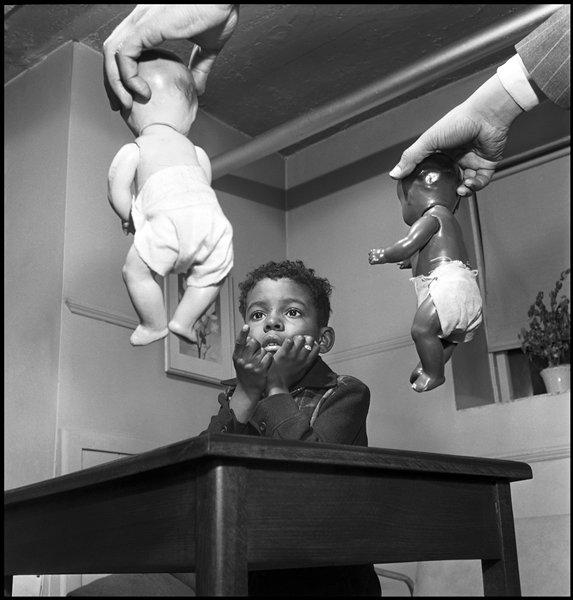
The Court cited the doll test, conducted by psychologists Mamie and Kenneth Clark in the 1940s, as a key factor in its decision. The study looked at how segregation affected the self-esteem of African American children.
In the study, children were shown dolls with different skin colors and asked questions about them. Many children associated positive traits with white dolls and negative traits with Black dolls. The Court used this as evidence that segregation caused real psychological harm, which supported the conclusion that "separate but equal" was inherently unequal.
Two required visual sources, both Gordon Parks photographs from Harlem in 1947, document this study: Clark Doll Test, Harlem and Kenneth Clark and Child During the Clark Doll Test, Harlem.
How Different Groups Responded to School Integration
De Facto Segregation Continued
Even after Brown, de facto segregation in public schools did not disappear. It continued through choices made by states, families, and local officials:
- Some states cut funding for integrated schools while still supporting schools that stayed mostly white.
- Some white families moved to the suburbs and private schools, shifting money into schools and neighborhoods that few African Americans could access.
- In some places, local and federal police were used to block integration.
- Some schools shut down rather than integrate.
Because of de facto segregation, some schools remain segregated today. One often-overlooked effect: after Brown, many Black teachers in the South lost their jobs, and their positions frequently went to white teachers with less experience.
Students Pushed for Integration
Despite the resistance, students at all age levels tried to integrate schools throughout the South. The Little Rock Nine attempted to enroll at a high school in Little Rock, Arkansas, in 1957, facing continued and organized opposition. Their effort is a strong example of how integration after Brown was contested on the ground, not automatic.
Required Sources
Clark Doll Test, Harlem by Gordon Parks, 1947
This photograph documents the Clark doll test, which examined how racial segregation shaped African American children's self-perception. The study, run by Kenneth and Mamie Clark, showed how many young Black children internalized negative messages and preferred white dolls over Black ones.
This research mattered in Brown v. Board of Education because it gave the Court evidence of segregation's psychological effects, supporting the argument for desegregation.
Brown v. Board of Education of Topeka, Opinion, May 17, 1954
This Supreme Court decision overturned the "separate but equal" doctrine from Plessy v. Ferguson and declared segregation in public schools unconstitutional. Its reach went beyond education, since it challenged the legal basis for segregation across American life.
Key ideas to use as evidence:
- Rejecting "separate but equal" in public education
- Quote: "We conclude that, in the field of public education, the doctrine of 'separate but equal' has no place. Separate educational facilities are inherently unequal."
- Why it matters: The Court rejects the Plessy precedent for schools, even when facilities are equal.
- The role of education in society
- Quote: "Today, education is perhaps the most important function of state and local governments. It is the very foundation of good citizenship."
- Why it matters: The Court frames education as necessary for full participation in society.
- The psychological harm of segregation
- Quote: "To separate them from others of similar age and qualifications solely because of their race generates a feeling of inferiority as to their status in the community that may affect their hearts and minds in a way unlikely ever to be undone."
- Why it matters: The Court looks past physical facilities to the lasting emotional damage of segregation.
- Interpreting the Constitution in the present
- Quote: "We cannot turn the clock back to 1868, when the Amendment was adopted, or even to 1896, when Plessy v. Ferguson was written. We must consider public education in the light of its full development and its present place in American life throughout the Nation."
- Why it matters: The Court reads the Fourteenth Amendment in light of current conditions, not just its original context.
How to Use This on the AP African American Studies Exam
Using Sources Effectively
For the Brown opinion, do not just summarize that segregation is unconstitutional. Point to the specific reasoning: the equal protection clause, the "inherently unequal" language, and the focus on psychological harm. For the Gordon Parks doll-test photographs, connect the image to the study's purpose and explain why the Court treated it as evidence.
Argumentation
If a prompt asks about the origins of the Civil Rights movement, link enduring discrimination in education, housing, transportation, and voting to the demand for federal protection of constitutional rights. Use Brown as a turning point, but show that legal victory and real integration were not the same thing.
Continuity and Change
Strong responses note both the change Brown created and the continuity that followed. The ruling overturned "separate but equal," yet de facto segregation persisted through funding choices, suburban flight, and school closures. That tension is exactly the kind of nuance graders reward.
Common Trap
Do not claim Brown immediately ended segregation. The decision struck down the legal standard, but resistance, de facto segregation, and the Little Rock standoff show how slow and contested the actual change was.
Common Misconceptions
- Misconception: Brown desegregated schools overnight.Actually: Brown did not desegregate schools overnight. It declared school segregation unconstitutional, but integration faced organized resistance and de facto segregation continued.
- Misconception: Brown established "separate but equal," and Plessy v. Ferguson overturned it.Actually: "Separate but equal" came from Plessy v. Ferguson, and Brown overturned it. Do not mix up which case established the doctrine and which one ended it.
- Misconception: De facto segregation is the same as legally required segregation.Actually: De facto segregation is not the same as legally required segregation. It continued through housing patterns, funding, and family choices even after legal segregation in schools was ruled unconstitutional.
- Misconception: The doll test was the entire legal basis for the Court's decision.Actually: The doll test was evidence the Court cited, not the entire legal basis. The core legal reasoning rested on the Fourteenth Amendment's equal protection clause.
- Misconception: Discrimination was only a Southern problem.Actually: Discrimination was not only a Southern problem. African Americans faced segregation and discrimination in the North as well.
Related AP African American Studies Guides
Practice Questions for 4.4
1 of 10
In the 1940s, psychologists Mamie and Kenneth Clark conducted a study asking African American children to choose between white and Black dolls. The Supreme Court's later citation of this specific study in 1954 can best be understood in the context of which legal strategy?
A.
Establishing that discriminatory hiring practices for teachers impacted student self-esteem.
B.
Proving that Southern states failed to provide equal funding for Black educational facilities.
C.
Demonstrating that segregated facilities caused inherent psychological harm to Black children.
D.
Showing that de facto segregation in Northern cities created comparable educational disparities.
Vocabulary
The following words are mentioned explicitly in the AP® course framework for this topic.Term | Definition |
|---|---|
Brown v. Board of Education | A landmark 1954 Supreme Court decision that ruled that 'separate but equal' public schools were unconstitutional and violated the Equal Protection Clause. |
Civil Rights Act of 1875 | Federal legislation that outlawed racial discrimination in public places and accommodations. |
Civil Rights movement | The social and political movement from the 1950s-1960s aimed at ending racial segregation and discrimination against African Americans. |
de facto segregation | Segregation that exists in practice through social and economic factors rather than through explicit legal requirements. |
discrimination | The unjust or prejudicial treatment of individuals or groups based on characteristics such as race, color, or religion. |
doll test | A psychological study conducted by Mamie and Kenneth Clark in the 1940s that demonstrated the negative impact of racial segregation on African American children's self-esteem. |
equal protection clause | A provision of the Fourteenth Amendment that prohibits states from denying any person equal protection under the law. |
federal protection | Legal safeguards and enforcement by the federal government to ensure rights and prevent discrimination. |
Fourteenth Amendment | Constitutional amendment ratified in 1868 that defined birthright citizenship and granted equal protection to all people, overturning the Dred Scott decision and state Black codes. |
Little Rock Nine | A group of nine African American students who attempted to integrate Little Rock High School in Arkansas in 1957, facing significant resistance and requiring federal intervention. |
Plessy v. Ferguson | An 1896 Supreme Court decision that established the 'separate but equal' doctrine, allowing racial segregation in public facilities. |
racial segregation | The legal and systematic separation of African Americans and white people in housing, transportation, and public services. |
racial violence | Physical harm, intimidation, and brutality perpetrated against people because of their race. |
Reconstruction Amendments | The 13th, 14th, and 15th Amendments to the U.S. Constitution passed after the Civil War to abolish slavery and guarantee rights to formerly enslaved people. |
school integration | The process of bringing together students of different races in the same schools, ending racial segregation in education. |
segregation | The forced separation of people based on race, enforced through laws and social practices. |
separate but equal | A legal doctrine established by Plessy v. Ferguson that permitted racial segregation as long as separate facilities were theoretically equal, used to justify segregation laws. |
state-sanctioned school segregation | Racial segregation in public schools that was officially mandated or supported by state government policies and laws. |
white flight | The migration of white families from urban areas and integrated schools to suburbs and private schools to avoid integration. |
Frequently Asked Questions
What forms of segregation and discrimination did African Americans face before the Civil Rights movement?
African Americans faced segregation, discrimination, and violence in education, housing, transportation, and voting. These barriers existed in both the North and South through the mid-twentieth century.
How did Brown v. Board of Education change segregation law?
Brown v. Board of Education (1954) ruled that public school segregation violated the Fourteenth Amendment equal protection clause. The decision overturned the separate-but-equal standard from Plessy v. Ferguson for public education.
What was the Clark Doll Test and why did it matter?
Mamie and Kenneth Clark used the doll test to study how segregation affected Black children's self-esteem. The Supreme Court cited this evidence in Brown to show that segregation caused psychological harm.
Did Brown immediately end school segregation?
No. De facto segregation and resistance continued after Brown through white flight, private schools, unequal funding, police resistance, and school closures. Legal change did not automatically create integrated schools.
Who were the Little Rock Nine?
The Little Rock Nine were nine Black students who attempted to integrate Little Rock Central High School in Arkansas in 1957. Their experience showed how strongly some communities resisted school integration after Brown.
Which required sources connect to Topic 4.4?
Topic 4.4 connects directly to the Brown v. Board of Education opinion and Gordon Parks photographs documenting the Clark Doll Test. Together, they show the legal and psychological arguments against school segregation.
See Fiveable more often in Google
Mark Fiveable as a preferred source and Google is more likely to show you our guides in Top Stories, with a "preferred" badge in AI Mode and AI Overviews.