2.8 The Social Construction of Race and the Reproduction of Status

✊🏿AP African American Studies Unit 2 Review
2.8 The Social Construction of Race and the Reproduction of Status
✊🏿 AP African American Studies
2.1
African Explorers in the Americas
2.2
Departure Zones in Africa and the Slave Trade to the United States
2.3
Capture and the Impact of the Slave Trade on West African Societies
2.4
African Resistance on Slave Ships and the Antislavery Movement
2.5
Slave Auctions and the Domestic Slave Trade
2.6
Labor, Culture, and Economy
2.7
Slavery and American Law: Slave Codes and Landmark Cases
2.8
The Social Construction of Race and the Reproduction of Status
2.9
Creating African American Culture
2.10
Black Pride, Identity, and the Question of Naming
2.11
The Stono Rebellion and Fort Mose
2.12
Legacies of the Haitian Revolution
2.13
Resistance and Revolts in the United States
2.14
Black Organizing in the North: Freedom, Women's Rights, and Education
2.15
Maroon Societies and Autonomous Black Communities
2.16
Diasporic Connections: Slavery and Freedom in Brazil
2.17
African Americans in Indigenous Territory
2.18
Debates About Emigration, Colonization, and Belonging in America
2.19
Black Political Thought: Radical Resistance
2.20
Race to the Promised Land: Abolitionism and the Underground Railroad
2.21
Legacies of Resistance in African American Art and Photography
2.22
Gender and Resistance in Slave Narratives
2.23
The Civil War and Black Communities
2.24
Freedom Days: Commemorating the Ongoing Struggle for Freedom
TLDR
Race is treated as a social construct, not a biological fact, and AP African American Studies shows you how it was built through law. The Virginia law of partus sequitur ventrem made a child's enslaved or free status follow the mother, which locked slavery into a hereditary, race-based system and turned enslaved women's reproduction into a source of profit. Later classification rules like hypodescent and the one-drop rule pushed anyone with African ancestry into a single, subordinate category.
Why This Matters for the AP African American Studies Exam
This topic connects law, identity, and power, which makes it strong material for source analysis and argument-building. You can use partus sequitur ventrem and the 1662 Virginia law to explain causation: how a single legal rule reshaped families and helped create racial categories over time. The required sources here, the Laws of Virginia (1662) and "Am I Not a Woman and a Sister?" (1849), give you concrete evidence to analyze point of view, purpose, and historical context, and to connect slavery's legal structure to gender and abolitionist activism.
You can also use this topic to support continuity and change arguments, since racial classification shifted from varying state standards before the Civil War to the broader one-drop rule afterward.
Key Takeaways
- Partus sequitur ventrem (Virginia, 1662) tied a child's legal status to the mother, codifying hereditary racial slavery and overriding English common law, which followed the father.
- The law let enslavers deny responsibility for children they fathered through assault and treated enslaved women's reproduction as a way to grow their wealth.
- Race is understood as socially constructed, not biological. More genetic variation exists within racial groups than between them.
- Phenotype shapes how people perceive race, but during slavery the law defined racial categories regardless of appearance.
- Hypodescent assigned people to the subordinate group; the one-drop rule later classified anyone with any African ancestry as Black.
- Classification rules denied many African Americans the ability to claim European or Indigenous heritage, reinforcing a single subordinate status.
How Partus Sequitur Ventrem Shaped Families and Race
Legal Status Followed the Mother
Partus sequitur ventrem was a seventeenth-century law that set a child's legal status by the status of the mother, not the father. That meant children born to enslaved women were enslaved no matter who their father was.
This broke from English common law, which usually assigned a child's status based on the father. By flipping that rule, the law codified hereditary racial slavery: the children of enslaved women would inherit their status as property. It also invalidated African Americans' claims to their own children, since the law treated those children as the property of enslavers.
Over time, this guaranteed that the enslaved population would grow with each generation through birth, which mattered even more after the United States banned the importation of enslaved people in 1808.
Mixed-Race Children and Free Fathers
The law was specifically designed to stop mixed-race children of Black women from inheriting the free status of their fathers. Under the English common law custom, a child with a free father might have been free. Partus overrode that, keeping mixed-race children born to enslaved mothers enslaved regardless of the father's race or status. This deepened racial hierarchy by cutting off freedom through paternal lineage.
Commodifying Reproduction
Partus gave male enslavers the right to deny responsibility for children they fathered with enslaved women, most often through assault. It also commodified enslaved women's reproductive lives. Because each child born added to an enslaver's labor force and wealth, enslaved women's fertility was treated as a financial asset. This logic intensified after international importation was banned, and it drove further dehumanization and exploitation of enslaved African American women.
How Racial Concepts and Classifications Emerged
Race as a Social Construct
Within African American Studies and related fields, race is understood as socially constructed, not a clear biological distinction. More genetic variation appears within racial groups than between them, which undercuts the idea of separate biological races. Current biological knowledge does not tie cultural, political, or economic achievement to "races."
Racial concepts and classifications emerged in tandem with systems of enslavement and oppression. In other words, racial categories developed alongside the systems they were used to justify.
Phenotype Versus Legal Definitions
Phenotype, meaning observable traits like skin color and hair texture, strongly shapes how people perceive racial identity. But phenotype is not a reliable indicator of ancestry.
During the era of slavery, racial categories were also defined by law, regardless of phenotype. Statutes like partus sequitur ventrem tied racial categories to rights and status such as enslaved, free, or citizen. These legal definitions were built to perpetuate slavery across generations, even when a person's appearance might suggest a different identity.
Hypodescent and the One-Drop Rule
In the United States, race classification relied on hypodescent, the practice of assigning a person to the racial group of their socially subordinate parent. Before the Civil War, states differed on how much ancestry defined a person as Black or white, with some using fractions like one-fourth or one-eighth.
In the late nineteenth and twentieth centuries, the "one-drop rule" became widespread, classifying anyone with any degree of African descent as part of a single, inferior status. Like partus and hypodescent, this rule maintained strict racial boundaries regardless of a person's actual ancestry or appearance.
Multiracial Heritage Denied
Many African Americans had European or Indigenous ancestry, often resulting from interracial relationships and sexual exploitation during slavery. Even so, race classification kept them from fully embracing multiracial or multiethnic heritage. Hypodescent and the one-drop rule meant that anyone with known African ancestry was classified as Black, which blocked access to the privileges tied to other ancestries and reinforced a single subordinate category.
Required Sources
Laws of Virginia, Act XII, General Assembly, 1662
This legislation marked a turning point in the legal codification of racial slavery in colonial America. By establishing that a child's status followed that of the mother, it ensured that children born to enslaved women would also be enslaved, regardless of the father's status.
The law reflected and reinforced a growing racial hierarchy in Virginia. It helped cement slavery as a hereditary condition based on race and laid the groundwork for the system to expand. Note the connection to Elizabeth Key, who in 1656 (born to a white father and an enslaved Black mother) became the first Black woman in North America to sue for her freedom and win. The 1662 law followed soon after, showing how colonial law shifted in response to enslaved people's efforts to gain legal freedom.
"WHEREAS some doubts have arrisen whether children got by any Englishman upon a negro woman should be slave or ffree, Be it therefore enacted and declared by this present grand assembly, that all children borne in this country shalbe held bond or free only according to the condition of the mother, And that if any christian shall committ ffornication with a negro man or woman, hee or shee soe offending shall pay double the ffines imposed by the former act."
"Am I Not a Woman and a Sister?" from The Liberator, 1849
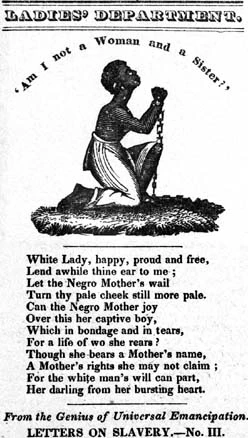
This abolitionist image challenged the dehumanization of enslaved Black women by appealing to shared humanity and sisterhood with white women. It aimed to stir empathy and moral outrage among Northern audiences, especially white women, by highlighting the gendered brutality of slavery. Published in The Liberator, William Lloyd Garrison's influential antislavery newspaper, it reached a wide audience. By adapting the well-known "Am I Not a Man and a Brother?" motif to center Black women, it reflected the growing overlap between abolitionist and early women's rights movements.
How to Use This on the AP African American Studies Exam
Using Sources Effectively
When you analyze the 1662 Virginia law, identify its purpose (settling "doubts" about status) and its effect (making slavery hereditary through the mother). For the 1849 image, focus on audience, purpose, and how it links gender to the antislavery cause. Strong responses name the source's point of view and tie it to historical context.
Causation and Continuity
Use partus sequitur ventrem to explain causation: one legal rule reshaped families, defined racial categories, and helped grow the enslaved population. For continuity and change, trace classification from varied pre-Civil War state standards to the broader one-drop rule afterward.
Common Trap
Do not write that partus simply "followed the mother" and stop there. Explain why that mattered: it overrode English common law's father-based custom, locked status into race, and made enslaved women's reproduction a source of profit.
Common Misconceptions
- Misconception: Race is biological in this course's framing.Actually: Race is not biological in this course's framing. The point is that racial categories were built through law and social systems, not discovered in biology.
- Misconception: Partus sequitur ventrem followed English tradition.Actually: Partus sequitur ventrem did not follow English tradition. It reversed the usual common law custom that tied a child's status to the father.
- Misconception: The one-drop rule and hypodescent are identical.Actually: The one-drop rule and hypodescent are related but not identical. Hypodescent assigns a person to the subordinate parent's group; the one-drop rule is the stricter version that classifies anyone with any African ancestry as Black, and it became dominant in the late nineteenth and twentieth centuries.
- Misconception: Appearance controlled legal status during slavery.Actually: Appearance did not control legal status during slavery. The law could classify someone as enslaved or Black regardless of phenotype.
- Misconception: Phenotype and ancestry are the same thing.Actually: Phenotype and ancestry are not the same thing. People were sorted by perceived traits, but those traits did not reliably reflect a person's actual heritage.
Related AP African American Studies Guides
Practice Questions for 2.8
1 of 10
Hypodescent, the practice of assigning a person to the racial group of their socially subordinate parent, became widespread in the United States. This practice is historically significant because it
A.
reflected biological reality by accurately categorizing individuals based on genetic makeup
B.
demonstrated that African Americans had achieved legal recognition of their multiracial heritage
C.
ensured mixed-race individuals inherited subordinate status regardless of other ancestral backgrounds
D.
allowed mixed-race individuals to claim the higher status of their white or Indigenous parents
Vocabulary
The following words are mentioned explicitly in the AP® course framework for this topic.Term | Definition |
|---|---|
English common law | The traditional legal system of England in which children inherited the free status of their fathers, a custom that partus sequitur ventrem overturned in colonial America. |
enslavement | The system of reducing people to the status of enslaved persons, tied to racial categories and legal definitions in order to perpetuate oppression. |
hereditary racial slavery | A system of slavery in which enslaved status is inherited from the mother, ensuring that children born to enslaved women are automatically enslaved. |
hypodescent | A racial classification system in the United States that determined a person's race based on ancestry, particularly any degree of non-white ancestry. |
mixed-race | Individuals with ancestry from multiple racial groups, particularly children born to enslaved Black women and white men. |
one-drop rule | A practice in the late nineteenth and twentieth centuries that classified a person with any degree of African descent as Black and assigned them an inferior legal and social status. |
partus sequitur ventrem | A seventeenth-century law that defined a child's legal status based on the status of their mother, establishing hereditary racial slavery in the United States. |
phenotype | Observable physical characteristics of an organism, such as skin color or hair texture, that contribute to perceptions of racial identity. |
racial categories | Legal and social classifications of people based on perceived racial identity, which emerged alongside systems of enslavement and were defined by law during slavery. |
racial taxonomies | Systems of categorizing and classifying people based on perceived racial characteristics and legal status. |
socially constructed | A concept or category created and defined by society through cultural practices and systems rather than based on inherent biological or natural differences. |
Frequently Asked Questions
What is partus sequitur ventrem?
Partus sequitur ventrem was a seventeenth-century law that made a child's legal status follow the status of the mother. In Virginia, it helped make slavery hereditary by ensuring children born to enslaved women were enslaved.
How did partus affect African American families?
Partus invalidated enslaved African Americans' claims to their children by treating those children as property. It also let enslavers deny responsibility for children they fathered with enslaved women.
What does it mean that race is socially constructed?
It means race is created and enforced through social, legal, political, and economic systems rather than clear biological divisions. AP African American Studies connects racial categories to slavery and oppression.
What is hypodescent?
Hypodescent assigns a person with mixed ancestry to the socially subordinate racial group. In the United States, it helped classify people with African ancestry as Black regardless of multiracial heritage.
What is the one-drop rule?
The one-drop rule classified anyone with any known African ancestry as Black. It became especially influential in the late nineteenth and twentieth centuries and reinforced a single subordinate racial status.
What required sources connect to AP African American Studies 2.8?
The key required sources are the Laws of Virginia, Act XII from 1662, and Am I Not a Woman and a Sister? from The Liberator in 1849. They connect legal status, gender, slavery, and abolitionist imagery.
See Fiveable more often in Google
Mark Fiveable as a preferred source and Google is more likely to show you our guides in Top Stories, with a "preferred" badge in AI Mode and AI Overviews.