3.3 Black Codes, Land, and Labor

✊🏿AP African American Studies Unit 3 Review
3.3 Black Codes, Land, and Labor
✊🏿 AP African American Studies
3.1
The Reconstruction Amendments
3.2
Social Life: Reuniting Black Families and the Freedmen's Bureau
3.3
Black Codes, Land, and Labor
3.4
The Defeat of Reconstruction
3.5
Disenfranchisement and Jim Crow Laws
3.6
White Supremacist Violence and the Red Summer
3.7
The Color Line and Double Consciousness in American Society
3.8
Lifting as We Climb: Uplift Ideologies and Black Women's Rights and Leadership
3.9
Black Organizations and Institutions
3.10
HBCUs, Black Greek Letter Organizations, and Black Education
3.11
The New Negro Movement and the Harlem Renaissance
3.12
Photography and Social Change
3.13
Envisioning Africa in Harlem Renaissance Poetry
3.14
Symphony in Black: Black Performance in Music, Theater, and Film
3.15
Black History Education and African American Studies
3.16
The Great Migration
3.17
Afro-Caribbean Migration
3.18
The Universal Negro Improvement Association
After slavery ended, Southern states used Black Codes and exploitative labor systems to keep African Americans poor and controlled. Black Codes restricted property ownership and forced people into unfair labor contracts, while sharecropping, crop liens, and convict leasing trapped Black families in cycles of debt and forced labor even though they were legally free.
Why This Matters for the AP African American Studies Exam
This topic shows how legal freedom did not equal real freedom. After the Thirteenth Amendment abolished slavery, white Southern lawmakers built new systems that recreated control over Black labor and movement. Understanding this helps you analyze cause and effect, continuity and change, and the gap between rights on paper and rights in practice.
You can use this material to:
- Analyze documents like the Land Order for Richard Brown and convict camp images as primary sources.
- Build arguments about how economic systems kept African Americans from advancing after abolition.
- Connect this period to later topics on Jim Crow, disenfranchisement, and the Great Migration.
The required sources here are visual and document based, so practice reading what each one reveals about land, labor, and racial control.
Key Takeaways
- Black Codes (1865-1866) were state laws passed during Presidential Reconstruction that restored slave-era control over Black movement, labor, and family life.
- Black Codes limited property ownership, forced people into low-pay labor contracts, and used vagrancy charges to punish those without contracts.
- Some Black Codes let the state seize Black children for unpaid apprenticeships without parental consent.
- Special Field Orders No. 15 (1865) promised land to freed families, but Andrew Johnson revoked it and returned land to former owners.
- Sharecropping and crop liens trapped farmers in cycles of debt because they owed large shares of crops and borrowed against future harvests.
- Convict leasing let prisons profit by renting out Black men arrested on minor charges, creating forced labor that resembled slavery.
Black Codes and African American Advancement
As the federal government pursued Reconstruction, several Southern states passed restrictive laws in 1865 and 1866 during Presidential Reconstruction. These Black Codes were designed to undermine the rights African Americans had just gained and to keep them as a cheap, controllable labor source. They aimed to restore the social controls and surveillance of the earlier slave codes.
Black Codes worked in several ways:
- They limited African Americans' ability to own property and pushed them into exploitative labor contracts.
- Many annual labor contracts provided very little pay, which kept conditions close to slavery under a new name.
- Vagrancy laws criminalized unemployment. People without a labor contract could be fined or imprisoned.
- People who tried to escape a labor contract faced severe punishment, including whipping and arrest.
Black Codes and Families
Some Black Codes targeted families directly. One set of laws allowed the state to take Black children and force them into unpaid apprenticeships without their parents' consent.
- These apprenticeships exploited child labor and blocked access to education.
- Removing children separated families and stripped Black communities of stability and security.
Economic Barriers After Abolition
Sherman's Special Field Orders No. 15
In 1865, Union General William T. Sherman issued Special Field Orders No. 15, often connected to the phrase "40 acres and a mule." The order aimed to redistribute about 400,000 acres of land between South Carolina and Florida to newly freed African American families in segments of 40 acres.
- The plan offered a path toward land ownership and economic independence.
- Land would have given freed families a base to build wealth over generations.
Revocation of the Land Order
President Andrew Johnson revoked Special Field Orders No. 15. Confiscated plantations were returned to their former owners or purchased by northern investors.
- Many African Americans were evicted from land they had been promised.
- With land gone, freed people had few economic options, which pushed many into sharecropping.
Sharecropping
As Black Codes restricted land ownership and job options, sharecropping became the dominant labor system in the South. In this system, tenant farmers, many of them freed African Americans, worked a landowner's property in exchange for a share of the crops.
- Sharecroppers owed a large percentage of their harvest to the landowner, leaving little for themselves.
- Landowners often controlled the contracts in ways that kept sharecroppers in lasting debt.
- This setup made economic advancement very difficult.
A key point to remember: sharecropping created a cycle of poverty and debt because farmers often borrowed against future harvests just to get supplies. That cycle blocked economic independence and mobility for African American families.
Crop Liens
Farmers with little or no cash often relied on the crop lien system. They received food and supplies on credit and borrowed against their future harvest.
- When harvests were poor, farmers could not repay what they owed, creating a cycle of debt accumulation.
- This kept African American farmers economically dependent on merchants and landowners and made escaping poverty nearly impossible.
Convict Leasing
Through convict leasing, southern prisons profited by hiring out African American men imprisoned for debt, false arrest, or other minor charges to landowners and corporations. Vagrancy and similar laws fed this system by making it easy to arrest Black men.
- Vagrancy laws criminalized poverty, which raised Black incarceration rates after the Civil War.
- Black men were disproportionately arrested on minor or false charges.
- Prisoners worked without pay under conditions akin to slave labor, with high mortality.
- The system became a profitable business for the state and reinforced racial and economic control.
Required Sources
Land Order for Richard Brown, 1865
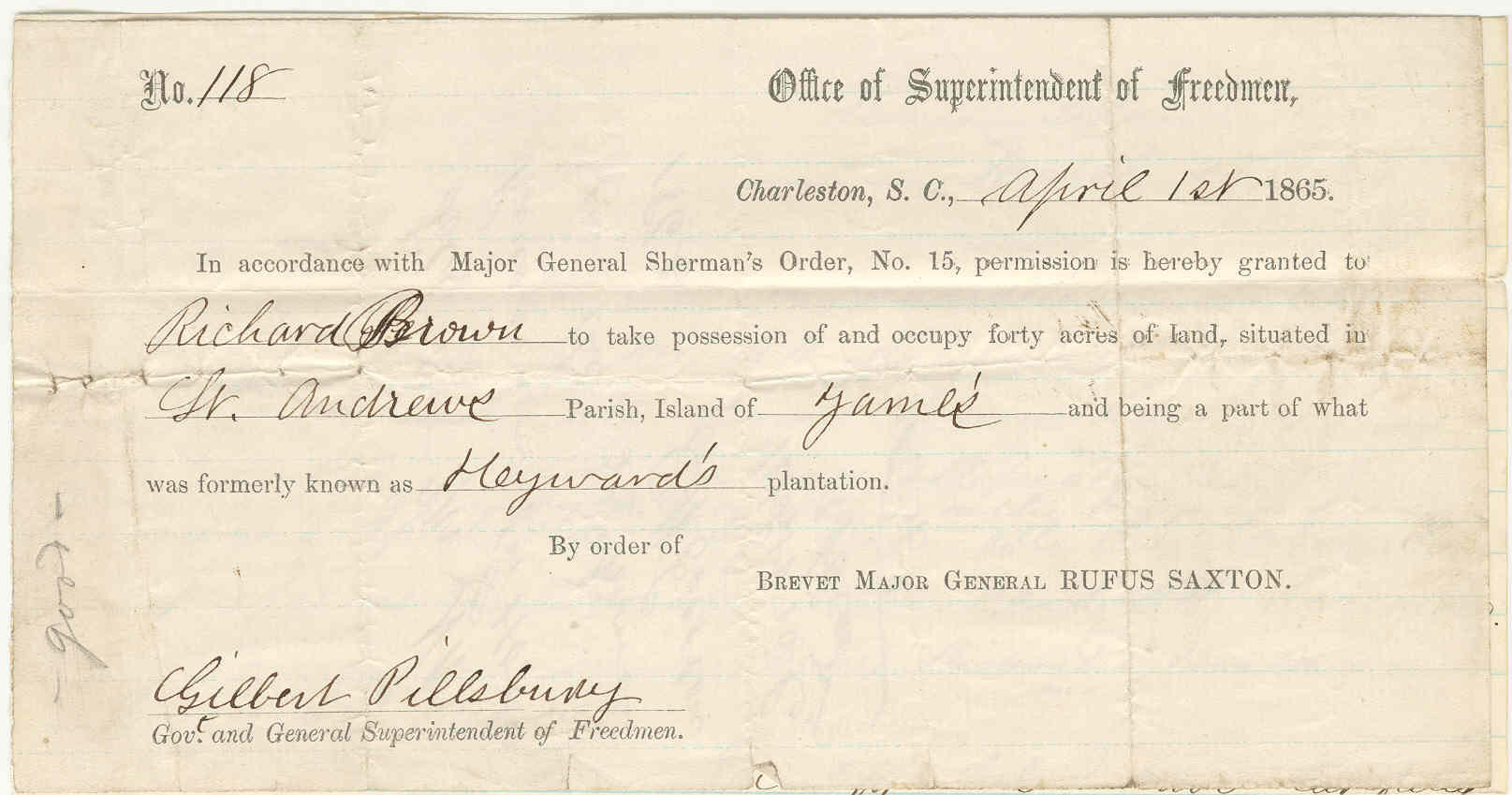
The Land Order for Richard Brown from 1865 is a tangible outcome of the land redistribution effort connected to "40 acres and a mule." It captures a brief moment of hope for economic independence among newly freed people after the Civil War.
The order also points to how that promise went unfulfilled, since most redistributed land was later returned to former owners. It is a reminder of the missed chance for economic empowerment and generational wealth for African Americans right after emancipation.
Circular No. 8 from the Bureau of Refugees, Freedmen, and Abandoned Lands, 1866

Circular No. 8 from the Freedmen's Bureau outlines policies tied to land and labor in the immediate aftermath of the Civil War. It shows the federal government's efforts to manage the transition of formerly enslaved people into free citizens.
The document reveals both the possibilities and the limits of Reconstruction-era policy. It helps you see how decisions about land and labor played out on the ground for African Americans.
Juvenile Convicts at Work in the Fields, 1903

This photograph shows young African American convicts forced into field labor in the early twentieth century. It is visual evidence of how the convict system extended slavery-like conditions after emancipation.
Use this image to examine how race, youth, and the criminal justice system intersected. It connects historical practices to the long roots of modern racial disparities in incarceration and labor.
Picture Postcard of a North Carolina Convict Camp, Circa 1910

This postcard gives a rare look into convict labor camps in the early twentieth century South. It exposes the harsh conditions that kept African Americans under control through the criminal justice system after emancipation.
The source serves as evidence of how legal systems were used to exploit Black labor. It helps connect these historical injustices to later patterns in labor and incarceration.
How to Use This on the AP African American Studies Exam
Using Sources Effectively
The required sources for this topic are documents and images, so practice describing what each one shows and what it argues.
- For the Land Order for Richard Brown and Circular No. 8, focus on land, labor, and federal policy. Ask what the document promised and what actually happened.
- For the convict labor images, focus on how visual sources reveal forced labor and racial control even after slavery was abolished.
Building Arguments
When you write about this period, connect causes to effects.
- Tie the Thirteenth Amendment's punishment clause to convict leasing.
- Show how revoking Special Field Orders No. 15 led to sharecropping and the crop lien cycle.
- Use specific terms like vagrancy laws, sharecropping, crop liens, and convict leasing as evidence.
Continuity and Change
Use this topic to trace how control over Black labor continued in new forms after slavery. Then connect it forward to later topics like Jim Crow laws, disenfranchisement, and the Great Migration, where many African Americans left the South to escape these conditions.
Common Misconceptions
- Misconception: The end of slavery meant freedom in practice for African Americans.Actually: Freedom on paper did not mean freedom in practice. The Thirteenth Amendment ended slavery, but Black Codes and labor systems recreated tight control over African Americans.
- Misconception: The "40 acres and a mule" order was never actually issued.Actually: "40 acres and a mule" was a real order, Special Field Orders No. 15, but it was revoked by Andrew Johnson, so most freed families never kept the land.
- Misconception: Sharecropping was the same as owning land.Actually: Sharecropping was not the same as owning land. Sharecroppers worked someone else's property and owed large shares of their crops, which kept them poor.
- Misconception: Convict leasing was a normal justice system.Actually: Convict leasing was not a normal justice system. It relied on arresting Black men for minor or false charges so they could be leased out as unpaid labor.
- Misconception: Black Codes only limited jobs.Actually: Black Codes did more than limit jobs. Some allowed the state to take Black children for unpaid apprenticeships, which broke up families.
Related AP African American Studies Guides
Practice Questions for 3.3
1 of 10
Which of the following provides the strongest evidence that sharecropping perpetuated economic dependency rather than enabling African American wealth accumulation after emancipation?
A.
Many sharecroppers were formerly enslaved people who lacked experience managing agricultural operations independently
B.
Sharecropping replaced slavery as the dominant labor system in the rural South during Reconstruction
C.
Sharecroppers retained minimal harvest shares while landowners controlled crop selection and pricing decisions
D.
Northern investors purchased confiscated plantations after President Johnson revoked Sherman's land redistribution order
Vocabulary
The following words are mentioned explicitly in the AP® course framework for this topic.Term | Definition |
|---|---|
apprenticeships | Forced, unpaid labor arrangements imposed on African American children by the state without parental consent under Black Codes. |
Black codes | Restrictive laws enacted by state governments during Presidential Reconstruction (1865-1866) that undermined the legal rights of African Americans and controlled their movement and labor. |
convict leasing | A system through which southern prisons hired out African American prisoners, often imprisoned for debt or minor charges, to landowners and corporations to work without pay under conditions similar to slavery. |
crop liens | A credit system through which farmers with little or no cash borrowed food, supplies, and equipment against their future harvest, often resulting in debt that exceeded the value of their crops. |
debt accumulation | The process of building up increasing amounts of money owed, particularly through systems like crop liens where farmers' harvests could not generate enough income to repay borrowed funds. |
economic advancement | The ability of individuals or groups to improve their financial status, accumulate wealth, and achieve economic mobility. |
labor contracts | Agreements that bound African Americans to work for employers, often providing minimal pay and enforced through punishment or legal penalties for breach. |
labor practices | Systems and methods of organizing work and employment, including sharecropping, crop liens, and convict leasing, that controlled how formerly enslaved people and poor whites worked after slavery's abolition. |
Presidential Reconstruction | The period of Reconstruction (1865-1866) following the Civil War when state governments enacted policies to reintegrate Southern states, during which Black Codes were implemented. |
sharecropping | A labor system in which landowners provided land, equipment, and supplies to formerly enslaved people or poor whites in exchange for a large share of the crops produced, making it difficult for workers to accumulate wealth. |
slave codes | Laws that defined and regulated slavery, establishing it as a race-based condition and imposing restrictions on the movement, assembly, weapons possession, and other activities of enslaved people. |
Special Field Orders No. 15 | An 1865 directive issued by Union General William T. Sherman that aimed to redistribute approximately 400,000 acres of land to newly freed African American families in 40-acre segments in South Carolina and Florida. |
vagrancy | The legal status of being without employment or a fixed residence; African Americans without labor contracts could be fined or imprisoned for vagrancy under Black Codes. |
Frequently Asked Questions
What were Black Codes in AP African American Studies?
Black Codes were restrictive state laws passed in 1865 and 1866 during Presidential Reconstruction. They limited newly freed African Americans by controlling movement and labor, restricting property ownership, requiring labor contracts, and using vagrancy laws to punish people without contracts.
How did apprenticeship laws affect Black families after abolition?
Some Black Codes allowed the state to place Black children into unpaid apprenticeships without their parents consent. For AP African American Studies, this is important because it shows how legal freedom could still be undermined through laws that separated families and controlled Black labor.
What were crop liens?
Crop liens were credit arrangements where farmers borrowed food and supplies against a future harvest. If the crop did not earn enough to repay the debt, farmers could remain stuck in debt from year to year.
What was convict leasing?
Convict leasing was a system where southern prisons hired out incarcerated African American men to landowners and corporations. In this topic, it shows how minor charges, debt, and false arrest could be used to extract unpaid labor after slavery formally ended.
What sources should I know for Topic 3.3?
Focus on the Land Order for Richard Brown, Circular No. 8 from the Freedmens Bureau, Juvenile Convicts at Work in the Fields, and the North Carolina convict camp postcard. Use them as evidence about land redistribution, labor contracts, family separation, debt, and prison labor.
See Fiveable more often in Google
Mark Fiveable as a preferred source and Google is more likely to show you our guides in Top Stories, with a "preferred" badge in AI Mode and AI Overviews.