3.2 Social Life: Reuniting Black Families and the Freedmen's Bureau

✊🏿AP African American Studies Unit 3 Review
3.2 Social Life: Reuniting Black Families and the Freedmen's Bureau
✊🏿 AP African American Studies
3.1
The Reconstruction Amendments
3.2
Social Life: Reuniting Black Families and the Freedmen's Bureau
3.3
Black Codes, Land, and Labor
3.4
The Defeat of Reconstruction
3.5
Disenfranchisement and Jim Crow Laws
3.6
White Supremacist Violence and the Red Summer
3.7
The Color Line and Double Consciousness in American Society
3.8
Lifting as We Climb: Uplift Ideologies and Black Women's Rights and Leadership
3.9
Black Organizations and Institutions
3.10
HBCUs, Black Greek Letter Organizations, and Black Education
3.11
The New Negro Movement and the Harlem Renaissance
3.12
Photography and Social Change
3.13
Envisioning Africa in Harlem Renaissance Poetry
3.14
Symphony in Black: Black Performance in Music, Theater, and Film
3.15
Black History Education and African American Studies
3.16
The Great Migration
3.17
Afro-Caribbean Migration
3.18
The Universal Negro Improvement Association
The Freedmen's Bureau was a federal agency that ran from 1865 to 1872 to help formerly enslaved people move into freedom and citizenship by providing food, clothing, schools, and legal marriages. After abolition, African Americans rebuilt family bonds that slavery had torn apart by searching for lost relatives through newspaper ads, word of mouth, and Bureau records, formalizing their marriages, choosing new names, and preserving family histories.
Why This Matters for the AP African American Studies Exam
This topic gives you concrete examples of how Black people exercised freedom right after emancipation, which is a core idea in Unit 3. You can use it to analyze cause and effect (slavery disrupted families, so people searched for kin), continuity and change (informal unions becoming legal marriages, ongoing family reunions today), and the role of Black institutions like the Black press.
The required sources here are strong evidence for source analysis. Newspaper ads from Elizabeth Brisco and Clarissa Reed show personal agency, while the Freedmen's Bureau Act and Circular No. 11 show federal policy. Being able to compare a personal source with a government document is exactly the kind of skill that pays off on the exam.
Key Takeaways
- The Freedmen's Bureau (officially the Bureau of Refugees, Freedmen, and Abandoned Lands) was created by Congress in 1865 and operated until 1872.
- Its main job was helping formerly enslaved people transition to citizenship, including providing food and clothing, legalizing marriages, and establishing schools, plus managing abandoned and confiscated property.
- Centuries of enslavement disrupted Black families through forced sales, relocation, and repeated name changes, but people still built new kinship bonds and traditions.
- After emancipation, freed people searched for separated relatives using newspapers, word of mouth, and the Freedmen's Bureau.
- Enslaved marriages were not legally binding, so many couples who had "jumped the broom" sought legal marriage after abolition, and many chose new names to mark their freedom.
- Family reunions grew out of the postemancipation search for relatives and continue today as a way to celebrate Black family history and resilience.
The Freedmen's Bureau
Purpose and Role in Reconstruction
Congress established the Bureau of Refugees, Freedmen, and Abandoned Lands, known as the Freedmen's Bureau, in 1865. It operated until 1872. The agency was meant to help formerly enslaved people transition into life as free citizens after the Civil War.
The Bureau was responsible for managing property that had been abandoned and confiscated during the war, but its primary function was assisting formerly enslaved people. That assistance took several forms:
- Relief and basic needs: providing food and clothing to people in need.
- Legalizing marriages: officially recognizing unions that had no legal status under slavery.
- Education: establishing schools for African Americans.
These functions matter because they show the federal government stepping directly into Black people's lives to support the transition out of slavery.
Family Bonds After Abolition
Disruption and Resilience
For centuries, slavery tore apart African American families. Relatives were forcibly sold, relocated, and had their names changed repeatedly by enslavers. The domestic slave trade separated spouses, children, and extended family, often permanently.
Despite this, African Americans created new kinship bonds and family traditions during and after slavery. People built extended support systems, passed down family histories, and developed communal practices that held communities together even when blood relatives had been scattered.
The Search for Separated Relatives
After emancipation, finding lost family members became a priority for many freed people. They searched for kin who had been separated by the domestic slave trade by:
- Traveling long distances and spreading word of mouth.
- Placing ads in newspapers to seek lost loved ones.
- Getting help from the Freedmen's Bureau.
Newspaper ads, especially in Black-owned papers, became one of the most common tools for people trying to locate relatives they had not seen in years or even decades.
Marriage and Identity After Slavery
Legalizing Marriage
Under slavery, African American marriages were not considered legally binding. Many enslaved couples "jumped the broom" as a symbol of their union, a tradition that became a cultural marker of commitment. After abolition, thousands of formerly enslaved men and women sought to consecrate their unions through legal marriage once it became available to them.
Choosing New Names as an Act of Freedom
Many newly freed African Americans adopted a new name that represented their status as free people and their ability to shape their own identities. Choosing a name was a way to assert self-determination and reject identities that enslavers had imposed.
The Legacy of Family Reunions
The postemancipation search for loved ones grew into a lasting tradition in Black communities. Family reunions became spaces to reconnect with relatives, celebrate kinship, and preserve history.
Modern family reunions continue this tradition. They feature storytelling, music, and culinary traditions, and they preserve and celebrate Black families' history and resilience across generations.
Required Sources
Elizabeth Brisco, ad in The Christian Recorder, Philadelphia, PA, 1864
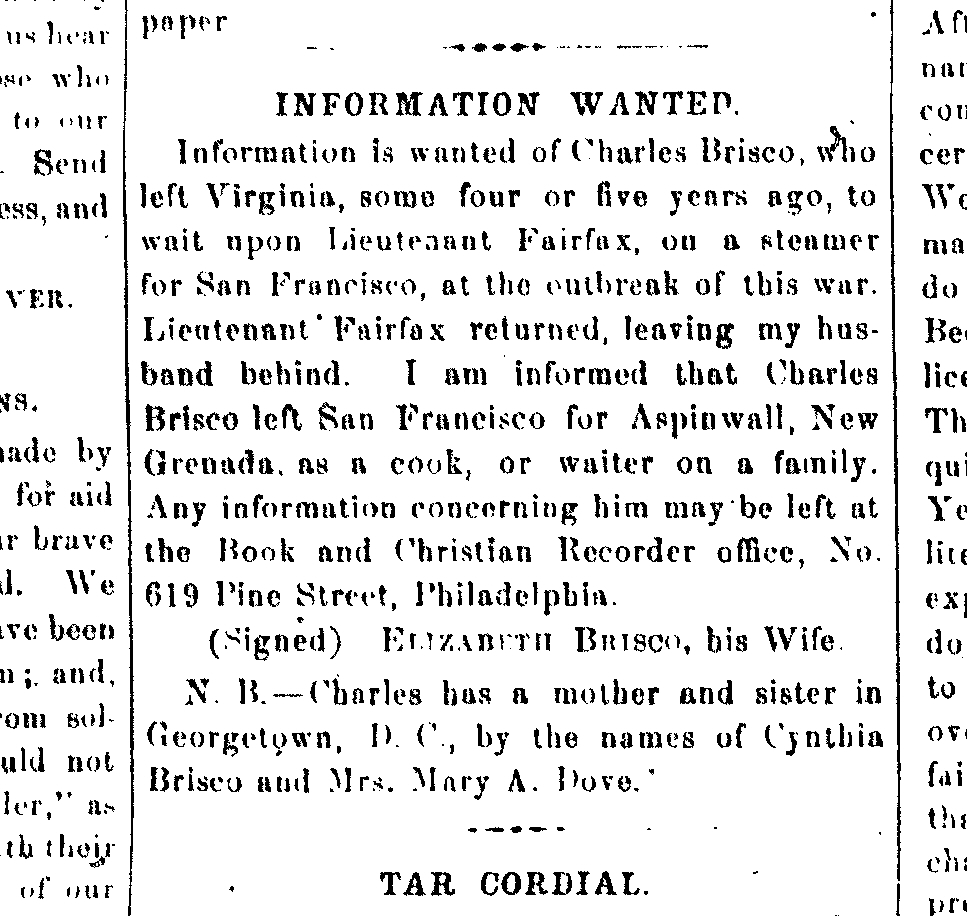
This advertisement shows African American agency and resilience during the Civil War era. Elizabeth Brisco used a Black-owned newspaper to seek information about family members separated by slavery, which demonstrates the active efforts of formerly enslaved people to reunite with loved ones.
The Christian Recorder, founded in 1852, is the official newspaper of the African Methodist Episcopal Church, the first Black denomination in the United States, and the oldest continuously published African American newspaper in the country. Its role as a platform for these notices shows how important Black-owned media was for keeping communities connected during a difficult period.
An Act to Establish a Bureau for the Relief of Freedmen and Refugees, 1865
This law created the Freedmen's Bureau to provide assistance and support to formerly enslaved people and refugees during Reconstruction. It established a federal agency tasked with addressing the immediate needs of millions of African Americans transitioning from slavery to freedom.
Key points from the act:
- Establishment of the Freedmen's Bureau
- Quote: "That there is hereby established in the War Department, to continue during the present war of rebellion, and for one year thereafter, a bureau of refugees, freedmen, and abandoned lands"
- Explanation: This act created a new government agency specifically to address the needs of former slaves and refugees during and after the Civil War.
- Scope of the Bureau's responsibilities
- Quote: "the supervision and management of all abandoned lands, and the control of all subjects relating to refugees and freedmen from rebel states"
- Explanation: The Bureau was given broad authority to manage lands and assist both freedmen and refugees in the aftermath of the war.
- Leadership and structure
- Quote: "The said bureau shall be under the management and control of a commissioner to be appointed by the President, by and with the advice and consent of the Senate"
- Explanation: The act established a clear chain of command, with a Presidential appointee leading the Bureau and assistant commissioners for each insurrectionary state.
- Provision of basic necessities
- Quote: "the Secretary of War may direct such issues of provisions, clothing, and fuel, as he may deem needful for the immediate and temporary shelter and supply of destitute and suffering refugees and freedmen and their wives and children"
- Explanation: The Bureau was empowered to provide food, clothing, and other supplies to people in need, addressing immediate humanitarian concerns.
- Land allocation for refugees and freedmen
- Quote: "to every male citizen, whether refugee or freedman, as aforesaid, there shall be assigned not more than forty acres of such land"
- Explanation: This section outlined the "40 acres" provision, allowing for the temporary use and potential purchase of land by freedmen and refugees.
- Reporting requirements
- Quote: "The commissioner shall, before the commencement of each regular session of congress, make full report of his proceedings with exhibits of the state of his accounts to the President, who shall communicate the same to congress"
- Explanation: The act established accountability measures, requiring regular reports to ensure oversight of the Bureau's activities and expenditures.
Circular No. 11 from the Bureau of Refugees, Freedmen, and Abandoned Lands, 1867
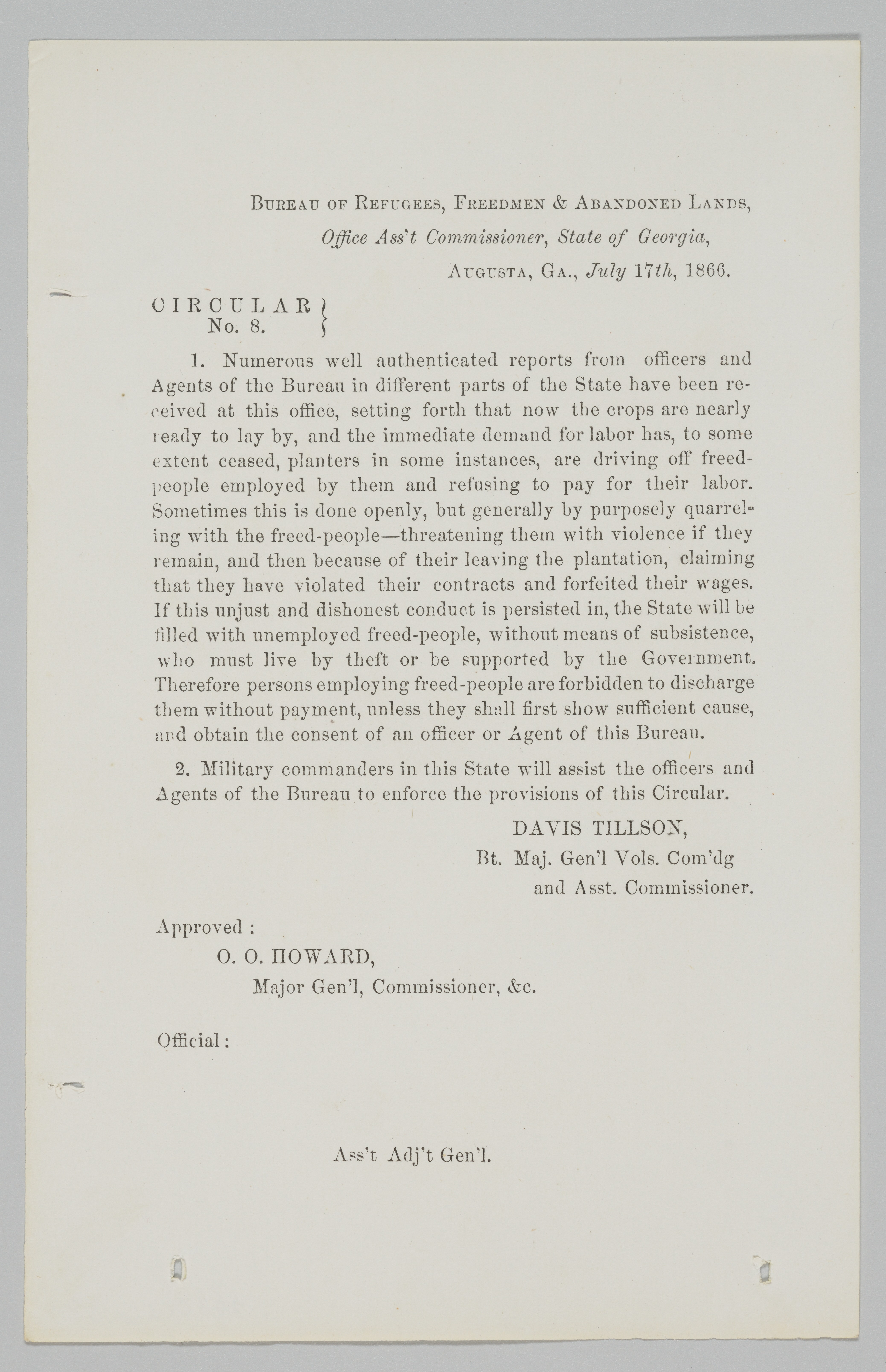
This document comes from the immediate aftermath of the Civil War, as the federal government tried to address the needs of newly emancipated African Americans. The Freedmen's Bureau played a central role in providing assistance and protection to formerly enslaved people during Reconstruction.
Circulars like this one communicated official policies and directives that shaped how the Bureau supported freedpeople in their transition to freedom. The document gives insight into the early efforts to integrate African Americans into American society as full citizens and the practical challenges that came with that work.
Clarissa Reed, ad in the Southwestern Christian Advocate, New Orleans, LA, 1883
Clarissa Reed's advertisement is a powerful example of African Americans using print media to reconnect with family separated during slavery. Notice the date: 1883, almost two decades after abolition. This ad reflects how long the search for loved ones continued and how deeply slavery's separations affected Black families.
The use of African American newspapers for this purpose shows the resourcefulness of formerly enslaved people in rebuilding their lives, and it underscores how Black-owned media supported communication networks in the post-Civil War era.
DEAR EDITOR-I desire to in- quire for my people. Mother was Pearline, stepfather was Sam. Mother had two sets of children. There were five of us, and two died before I left home. The oldest, Sophronia, was sold first; there were Fannie, Morgan, Anderson and myself. Parents belonged to John Ronden. The old man and I was sold to a Mr. Currel, and he died, and mistress married again and carried me to Kentucky. My people were living in St. Charles county, Missouri, when I was sold for cutting off two of my young boss's fingers. It has been about 46 years since I saw or heard from my people. Then I was sold from Kentucky to New Orleans. Last owner was Mrs. Moore. Write to me at Union Chapel M. E. Church, New Orleans, care Rev. S. Priestley.
How to Use This on the AP African American Studies Exam
Using Sources Effectively
When you get a personal ad like Brisco's or Reed's, identify who is speaking, what they want, and what the source reveals about Black life. These ads show agency, the lasting damage of the domestic slave trade, and the role of the Black press. Reed's 1883 ad is useful for showing how long the search for family lasted.
When you get a government document like the Freedmen's Bureau Act or a circular, focus on purpose and authority. Ask what the federal government was trying to do and what that says about Reconstruction.
Comparison and Causation
Practice connecting a personal source to a policy source. For example, the Bureau Act explains why the agency could help reunite families and legalize marriages, while the ads show people using those resources and their own networks. That cause-and-effect link is strong evidence in a written response.
Common Trap
Do not treat the Freedmen's Bureau as a total success or a total failure. It provided real, important help with food, schools, and marriage records, but the "40 acres" land provision largely did not deliver lasting land ownership for freedpeople. Holding both truths makes your analysis stronger.
Common Misconceptions
- Misconception: The Freedmen's Bureau only helped formerly enslaved people.Actually: Its main focus was assisting freedpeople, but the law also covered refugees, and relief could reach destitute people affected by the war. Keep its primary function central while noting the broader language.
- Misconception: "40 acres" means freedpeople got permanent land.Actually: The act mentioned assigning land, but in practice freedpeople rarely kept it. Do not claim the Bureau successfully redistributed land long-term.
- Misconception: Enslaved people had no family life because marriage was not legal.Actually: Marriages were not legally recognized, but enslaved people built strong unions and kinship bonds, including "jumping the broom," and they fought to legalize and protect those families after abolition.
- Misconception: Family reunions are just social events.Actually: For Black families, the reunion tradition grew directly out of the postemancipation search for separated relatives, so it carries historical meaning about resilience and survival.
- Misconception: Choosing a new name was random or unimportant.Actually: Picking a name was a deliberate act of freedom and self-definition, marking a break from identities that enslavers had imposed.
Related AP African American Studies Guides
Practice Questions for 3.2
1 of 10
Which of the following pieces of evidence best supports the claim that the Freedmen's Bureau served as an essential institution for formalizing African American family structures after emancipation?
A.
The Bureau managed confiscated property to provide economic opportunities for freedmen.
B.
The Bureau distributed food and clothing to destitute freedmen and their families.
C.
The Bureau established schools and hired teachers for African American children and adults.
D.
The Bureau legally recognized and recorded marriages previously denied status under slavery.
Vocabulary
The following words are mentioned explicitly in the AP® course framework for this topic.Term | Definition |
|---|---|
abandoned and confiscated property | Land and possessions left behind or seized during the Civil War that the Freedmen's Bureau was responsible for managing. |
abolition | The movement to end slavery and the slave trade, and the legal elimination of slavery as an institution. |
domestic slave trade | The internal trade and sale of enslaved people within the United States, particularly the forced migration of enslaved individuals from the Upper South to the Lower South during the nineteenth century. |
emancipation | The act of freeing enslaved people from bondage and slavery. |
enslavement | The system of reducing people to the status of enslaved persons, tied to racial categories and legal definitions in order to perpetuate oppression. |
family bonds | The emotional and relational connections between family members. |
family reunions | Gatherings of family members, often celebrating shared history, resilience, and cultural traditions. |
formerly enslaved people | Individuals who had been held in slavery and were freed, particularly those transitioning to freedom after the Civil War. |
Freedmen's Bureau | The Bureau of Refugees, Freedmen, and Abandoned Lands, established by Congress in 1865 to assist formerly enslaved people in their transition to citizenship and manage abandoned property from the Civil War. |
jumped the broom | A symbolic ritual performed by enslaved African Americans to solemnize their union when legal marriage was not permitted. |
kinship bonds | Family relationships and connections created through blood, marriage, or social ties. |
legal marriage | A formally recognized and legally binding union between two people. |
legalizing marriages | The process of officially recognizing and validating marriages, particularly those of formerly enslaved people whose unions had not been legally recognized under slavery. |
Frequently Asked Questions
What is AP African American Studies 3.2 about?
Topic 3.2 focuses on how African Americans rebuilt family life after emancipation, especially through searching for separated relatives, legalizing marriages, using the Black press, and interacting with the Freedmen's Bureau.
What was the Freedmen's Bureau?
The Freedmen's Bureau, officially the Bureau of Refugees, Freedmen, and Abandoned Lands, was a federal agency created in 1865 to assist formerly enslaved people and refugees during Reconstruction.
How did formerly enslaved people search for family members after emancipation?
Many searched through word of mouth, travel, newspaper advertisements, church networks, and records connected to the Freedmen's Bureau. These efforts show both the damage slavery caused and the agency of freedpeople.
Why were legal marriages important after slavery?
Enslaved marriages were not legally recognized, so many freedpeople sought legal marriage after abolition to protect family relationships, assert citizenship, and formalize unions that had already existed.
Why do the Elizabeth Brisco and Clarissa Reed ads matter?
The ads show African Americans using newspapers to seek relatives separated by slavery. They are useful sources because they reveal personal agency, family separation, and the long-term effects of the domestic slave trade.
How should I use this topic on the AP African American Studies exam?
Use it to connect personal sources with federal Reconstruction policy. For example, newspaper ads show individual searches for kin, while Freedmen's Bureau documents show the government's role in assisting freedpeople.
See Fiveable more often in Google
Mark Fiveable as a preferred source and Google is more likely to show you our guides in Top Stories, with a "preferred" badge in AI Mode and AI Overviews.