2.4 African Resistance on Slave Ships and the Antislavery Movement

✊🏿AP African American Studies Unit 2 Review
2.4 African Resistance on Slave Ships and the Antislavery Movement
✊🏿 AP African American Studies
2.1
African Explorers in the Americas
2.2
Departure Zones in Africa and the Slave Trade to the United States
2.3
Capture and the Impact of the Slave Trade on West African Societies
2.4
African Resistance on Slave Ships and the Antislavery Movement
2.5
Slave Auctions and the Domestic Slave Trade
2.6
Labor, Culture, and Economy
2.7
Slavery and American Law: Slave Codes and Landmark Cases
2.8
The Social Construction of Race and the Reproduction of Status
2.9
Creating African American Culture
2.10
Black Pride, Identity, and the Question of Naming
2.11
The Stono Rebellion and Fort Mose
2.12
Legacies of the Haitian Revolution
2.13
Resistance and Revolts in the United States
2.14
Black Organizing in the North: Freedom, Women's Rights, and Education
2.15
Maroon Societies and Autonomous Black Communities
2.16
Diasporic Connections: Slavery and Freedom in Brazil
2.17
African Americans in Indigenous Territory
2.18
Debates About Emigration, Colonization, and Belonging in America
2.19
Black Political Thought: Radical Resistance
2.20
Race to the Promised Land: Abolitionism and the Underground Railroad
2.21
Legacies of Resistance in African American Art and Photography
2.22
Gender and Resistance in Slave Narratives
2.23
The Civil War and Black Communities
2.24
Freedom Days: Commemorating the Ongoing Struggle for Freedom
During the Middle Passage, enslaved Africans resisted in many ways: hunger strikes, jumping overboard, and full ship revolts like the 1839 La Amistad takeover led by Sengbe Pieh. That resistance made the slave trade more dangerous and costly, reshaped how slave ships were built, and turned slave ship diagrams into evidence that abolitionists and later Black artists used to expose the horrors of slavery and honor enslaved Africans' resistance.
Why This Matters for the AP African American Studies Exam
This topic builds skills you will use across the exam. You analyze visual sources (slave ship diagrams and contemporary art), read legal and primary texts (the Amistad plea), and trace cause and effect between African resistance and changes in the slave trade. It also connects to argumentation: you can use resistance aboard ships as evidence that enslaved people consistently fought their commodification, not as passive victims.
You can use this material to:
- Practice source analysis on the required images and the Amistad plea.
- Build causation arguments (resistance led to ship redesigns, higher costs, and abolitionist momentum).
- Trace continuity and change in how slave ship imagery has been used over time, from abolitionist propaganda to modern Black art.
Key Takeaways
- Enslaved Africans resisted during the Middle Passage individually and collectively through hunger strikes, jumping overboard, and revolts, often overcoming language differences to organize.
- Resistance made the slave trade more expensive and dangerous and pushed enslavers to redesign ships with barricades, nets, and guns.
- Sengbe Pieh led the 1839 La Amistad revolt; after a two-year case, the Supreme Court granted the Mende captives their freedom, which boosted abolitionist sympathy.
- Slave ship diagrams were built to maximize profit, yet usually showed only about half the people actually packed onto a ship.
- Diagrams rarely showed the guns, nets, and force-feeding tools enslavers used, so they hid the resistance those tools were meant to stop.
- Abolitionists circulated these diagrams as evidence, and later Black artists reused slave ship imagery to process trauma and honor ancestors.
African Resistance during the Middle Passage
Enslaved Africans resisted their commodification and the trauma of being forced from their homes both individually and collectively, even when captives spoke different languages. Two terms help frame this:
- Commodification: treating people as goods to be bought and sold, which stripped Africans of their humanity.
- Deracination: being torn from one's home, culture, and community.
Methods of resistance aboard slave ships included:
- Staging hunger strikes
- Attempting to jump overboard rather than live enslaved
- Overcoming linguistic differences to organize and stage revolts
These acts were extraordinarily dangerous. Even though captives outnumbered the crew, they faced near-certain death by resisting, which makes the scale of this resistance even more striking.
The La Amistad Revolt
In 1839, more than 30 years after the United States abolished the transatlantic slave trade, Sengbe Pieh (also known as Joseph Cinque), a Mende captive from Sierra Leone, led a group of enslaved Africans in one of the most famous ship revolts. They took over the schooner La Amistad.
The case moved through the courts for two years. The Supreme Court ultimately granted the Mende captives their freedom. The trial generated public sympathy for the abolitionist cause by exposing the cruelty of the slave trade and the determination of enslaved people to fight for their freedom.
How Resistance Changed the Slave Trade
African resistance made the slave trade more expensive and more dangerous, which pushed enslavers to redesign slave ships. New features included:
- Barricades to separate captives from the crew
- Nets to stop captives from jumping overboard
- Guns to suppress revolts
Iron instruments were also used to force-feed people who refused to eat. These anti-resistance features were usually left out of official slave ship diagrams, so the diagrams hid the very tools that proved how hard people fought back.
Slave Ship Diagrams
A Systematic Arrangement of Captives
Slave ship diagrams showed a deliberate arrangement of captives designed to transport as many people as possible and maximize profit. They turned human beings into an anonymous, interchangeable group of goods for sale, which is a key part of what commodification looked like in practice.
Two details matter for source analysis:
- The diagrams typically showed only about half the number of enslaved people actually packed onto a given ship.
- They rarely included the guns, nets, and force-feeding tools enslavers relied on, so they understated both the brutality and the resistance.
Unsanitary and Deadly Conditions
The diagrams revealed cramped, unsanitary conditions that increased disease, disability, and death during a voyage that could last up to 90 days. Tight packing left captives almost no room to move, and the lack of sanitation and ventilation spread illness quickly. These conditions made the Middle Passage one of the deadliest parts of the journey into slavery.
How Resistance and Diagrams Inspired Abolitionists and Artists
African resistance on slave ships spurred antislavery activism. In the eighteenth and nineteenth centuries, Black and white antislavery activists circulated slave ship diagrams to raise public awareness of the dehumanizing conditions of the Middle Passage. The images gave abolitionists concrete, hard-to-ignore evidence.
Since abolition, Black visual and performance artists have repurposed slave ship imagery to process historical trauma and honor their ancestors, the more than 12.5 million Africans forced onto over 36,000 known voyages across more than 350 years. The slave ship has become an icon tied to a major turning point in the shared history of people of African descent: the birth of a global African diaspora.
How to Use This on the AP African American Studies Exam
Using Sources Effectively
When you analyze the Brookes diagram or a modern artwork like Willie Cole's Stowage, identify both what the source shows and what it hides. A strong point is that the diagrams understated the number of captives and left out the guns, nets, and force-feeding tools. That gap is exactly why the images were powerful for abolitionists and why artists keep returning to them.
Causation
Be ready to explain a chain: resistance aboard ships raised costs and danger, which led to redesigned ships, which produced the diagrams, which abolitionists then circulated as evidence. Showing that sequence is stronger than just listing facts.
Continuity and Change
Track how slave ship imagery shifted in purpose over time. Abolitionists used diagrams to expose cruelty in the 1700s and 1800s. Later Black artists reused the same iconography to mourn, remember, and reframe the slave ship as a symbol of survival and diaspora.
Common Trap
Do not treat enslaved Africans as passive. The whole point of this topic is active, organized resistance, including across language barriers, under conditions where resistance often meant death.
Required Sources
Stowage of the British Slave Ship Brookes, Early Nineteenth Century
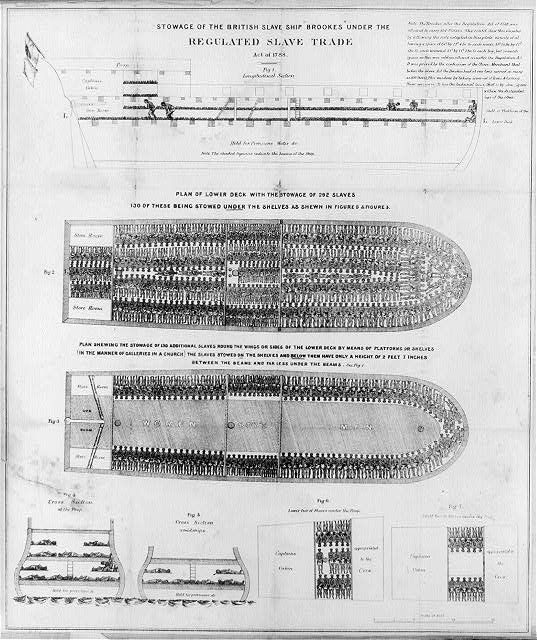
This diagram shows how enslaved Africans were packed into a ship as if they were cargo, arranged to maximize profit during the Middle Passage. Remember that it likely shows only about half the people actually carried and leaves out the guns and nets used to control them. Abolitionists circulated images like this to build antislavery sentiment in Britain and America.
Plea to the Jurisdiction of Cinque and Others, 1839
This legal document from the Amistad case argued that the captives were born free in Africa, were illegally kidnapped, and therefore were not subject to the jurisdiction claimed over them. It shows how courtrooms became a key battleground in the fight against slavery and how legal arguments advanced the abolitionist cause.
"The said Respondents severally, by protestations not confessing or acknowledging any of the matters & things in said several (inserted) libels to be true, as therein alleged, for plea thereto respectively say - That they are severally natives of Africa and were born free, and ever since have been, and still of right are and ought to be free, and not slaves, as in said several libels pretended, or surmised - that they were never domiciled in the Island of Cuba, or the dominion of the Queen of Spain, or subject to the laws thereof; - that on or about the 15th day of April 1839 they and each of them were, in the land of their nativity, unlawfully kidnapped & forcibly and wrongfully carried on board of a certain vessel, near the coast of Africa then & there unlawfully engaged in the slave trade, by certain persons to them unknown, and were thence in said vessel contrary to the will of these respondents, unlawfully transported to the Island of Cuba for the unlawful purpose of being there sold as slaves, and were then illegally landed for the purpose aforesaid..."
Sketches of the Captive Survivors from the Amistad Trial, 1839
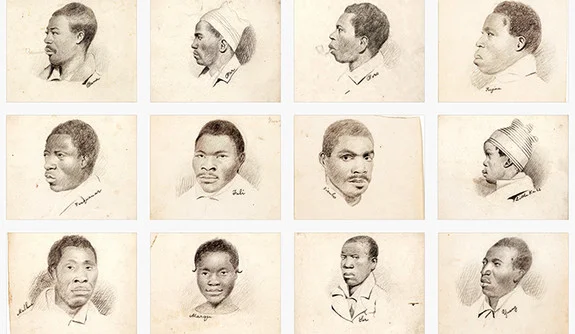
These sketches give a rare visual record of the African captives who resisted enslavement and won their freedom in American courts. By showing individuals rather than an anonymous mass, they push back against the dehumanizing logic of the slave ship diagrams and emphasize the agency of enslaved Africans.
Stowage by Willie Cole, 1997
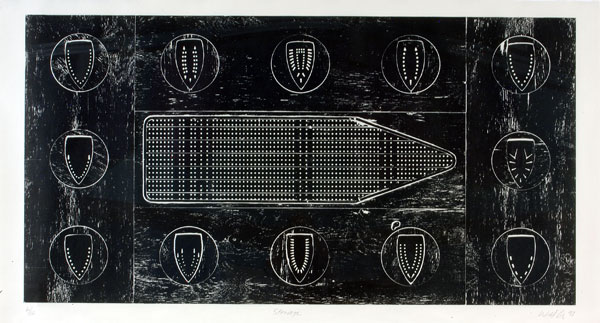
Willie Cole arranges steam irons to echo the layout of a slave ship diagram. The vertical iron faces stand in for the different African communities that would have been aboard, and the horizontal image represents the ship itself. By using an everyday household object, Cole links the Middle Passage to the later domestic labor enslaved people were forced to perform, turning a tool of oppression into an act of remembrance.
Common Misconceptions
- Misconception: Resistance was rare and limited to the Amistad.Actually: Resistance was not rare or only the Amistad. Captives resisted constantly through hunger strikes, attempts to jump overboard, and organized revolts, often across language barriers.
- Misconception: Slave ship diagrams were neutral records.Actually: Slave ship diagrams were not neutral records. They were built to maximize profit, undercounted the people aboard, and left out anti-resistance tools, so they understated the cruelty.
- Misconception: The transatlantic slave trade ended when the United States banned it.Actually: The Amistad revolt happened in 1839, decades after the United States banned the transatlantic slave trade, which shows the trade continued illegally well after the official ban.
- Misconception: Enslaved Africans were passive victims.Actually: Enslaved Africans were not passive victims. Even though resistance often meant near-certain death and captives outnumbered the crew, people still chose to fight back.
- Misconception: Modern art using slave ship imagery is just decoration.Actually: Modern art using slave ship imagery is not just decoration. Artists like Willie Cole reuse the iconography to process trauma and honor the millions forced through the Middle Passage.
Related AP African American Studies Guides
Practice Questions for 2.4
1 of 10
Slave ship diagrams show captives arranged with barely enough room to sit upright during voyages lasting up to 90 days, resulting in widespread disease, malnutrition, and death. Which of the following best explains why enslavers designed ships with these conditions despite high mortality rates?
A.
Greater profit from more captives per voyage outweighed losses from high mortality.
B.
International maritime law required minimum spacing between captives for safety.
C.
European medical knowledge showed confined spaces reduced infectious disease spread.
D.
Tight packing would strengthen captives' bodies and prepare them for labor.
Vocabulary
The following words are mentioned explicitly in the AP® course framework for this topic.Term | Definition |
|---|---|
abolition | The movement to end slavery and the slave trade, and the legal elimination of slavery as an institution. |
abolitionists | Individuals who actively worked to end slavery and support the freedom of enslaved people. |
African resistance | Actions taken by enslaved Africans to oppose their enslavement, including resistance aboard slave ships during the Middle Passage. |
antislavery activism | Organized efforts and movements by Black and white activists to oppose slavery and promote abolition during the eighteenth and nineteenth centuries. |
captives | Enslaved African people forcibly confined and transported on slave ships during the transatlantic slave trade. |
commodification | The process of treating people as goods or commodities to be bought and sold, rather than as human beings with inherent rights. |
cramped conditions | Severely limited and overcrowded spaces on slave ships where enslaved people were confined in extremely close quarters. |
deracination | The violent uprooting or removal of people from their homeland, culture, and community. |
disease | Illness that spread rapidly among enslaved people on slave ships due to unsanitary and overcrowded conditions during the Middle Passage. |
force-feed | A coercive practice used by enslavers to compel enslaved people who refused to eat to consume food against their will. |
historical trauma | The lasting psychological and emotional impact of historical injustices, such as slavery, on communities and their descendants. |
hunger strikes | A form of resistance in which enslaved Africans refused to eat as an act of protest against enslavement. |
iconography of the slave ship | The symbolic imagery and visual representations of slave ships used by artists to represent and process the historical trauma of slavery. |
La Amistad | A slave ship on which enslaved Africans, led by Sengbe Pieh in 1839, staged a famous revolt and took control of the vessel. |
Mende | An ethnic group from Sierra Leone whose members, including Sengbe Pieh, were among the enslaved Africans who revolted aboard La Amistad. |
Middle Passage | The forced voyage of enslaved Africans across the Atlantic Ocean to the Americas, characterized by brutal and dehumanizing conditions. |
resistance | Active opposition or defiance against oppression, injustice, or systems of control. |
Sengbe Pieh | A Mende captive from Sierra Leone who led one of the most famous slave ship revolts aboard La Amistad in 1839. |
slave ship diagrams | Visual representations of slave ships that depicted the layout and conditions of vessels used in the transatlantic slave trade, circulated by abolitionists to expose the dehumanizing conditions of slavery. |
slave ship revolts | Organized uprisings by enslaved Africans aboard ships during the Middle Passage to resist their enslavement and gain freedom. |
systematic arrangement | An organized, methodical placement of enslaved captives on slave ships intended to maximize the number of people transported for profit. |
unsanitary conditions | Filthy and unhygienic environments on slave ships that lacked proper sanitation and contributed to disease and death. |
Frequently Asked Questions
What is AP African American Studies 2.4 about?
AP African American Studies 2.4 focuses on African resistance during the Middle Passage, antislavery activism, slave ship diagrams, the Amistad revolt, and how visual sources shaped arguments against slavery.
How did enslaved Africans resist on slave ships?
Enslaved Africans resisted through hunger strikes, attempts to jump overboard, and organized ship revolts. These actions show that captives actively resisted commodification and forced removal.
Why was the Amistad revolt important?
The 1839 Amistad revolt, led by Sengbe Pieh, became a major legal and abolitionist event. The Supreme Court eventually recognized the Mende captives as free, strengthening antislavery arguments.
What do slave ship diagrams reveal?
Slave ship diagrams reveal the cramped, dehumanizing arrangement of captives during the Middle Passage. They also hide important details, such as resistance and the tools enslavers used to suppress it.
How did abolitionists use slave ship diagrams?
Abolitionists circulated slave ship diagrams as visual evidence of the brutality of the slave trade. The images helped make the conditions of the Middle Passage harder for audiences to ignore.
How is this topic tested on the AP exam?
AP questions may ask you to analyze required visual sources, explain African resistance, connect the Amistad case to antislavery activism, or trace how slave ship imagery changed over time.
See Fiveable more often in Google
Mark Fiveable as a preferred source and Google is more likely to show you our guides in Top Stories, with a "preferred" badge in AI Mode and AI Overviews.