3.10 HBCUs, Black Greek Letter Organizations, and Black Education

✊🏿AP African American Studies Unit 3 Review
3.10 HBCUs, Black Greek Letter Organizations, and Black Education
✊🏿 AP African American Studies
3.1
The Reconstruction Amendments
3.2
Social Life: Reuniting Black Families and the Freedmen's Bureau
3.3
Black Codes, Land, and Labor
3.4
The Defeat of Reconstruction
3.5
Disenfranchisement and Jim Crow Laws
3.6
White Supremacist Violence and the Red Summer
3.7
The Color Line and Double Consciousness in American Society
3.8
Lifting as We Climb: Uplift Ideologies and Black Women's Rights and Leadership
3.9
Black Organizations and Institutions
3.10
HBCUs, Black Greek Letter Organizations, and Black Education
3.11
The New Negro Movement and the Harlem Renaissance
3.12
Photography and Social Change
3.13
Envisioning Africa in Harlem Renaissance Poetry
3.14
Symphony in Black: Black Performance in Music, Theater, and Film
3.15
Black History Education and African American Studies
3.16
The Great Migration
3.17
Afro-Caribbean Migration
3.18
The Universal Negro Improvement Association
Historically Black colleges and universities (HBCUs) were founded mostly after the Civil War because segregation and discrimination shut African Americans out of higher education. These schools trained Black professionals and leaders, built spaces for cultural pride and activism, and gave rise to Black Greek-letter organizations that focused on service and leadership.
Why This Matters for the AP African American Studies Exam
This topic helps you explain causation and impact: why African Americans built their own colleges and how those institutions changed Black educational, professional, and cultural life nationally and internationally. You should be able to compare the liberal arts and vocational-industrial models, connect HBCUs to broader debates about Black advancement, and analyze the required sources as evidence. The visual sources here (the Fisk Jubilee Singers photo, George Washington Carver at Tuskegee, Omega Psi Phi members, and Professor Gail Hansberry) are useful practice for source analysis questions that ask what an image reveals about Black education, scholarship, and community service.
Key Takeaways
- Most HBCUs were founded after the Civil War because segregation and discrimination blocked African Americans from existing colleges.
- The first HBCUs were largely private schools funded by white philanthropists, while Wilberforce University (Ohio, 1856) was the first fully owned and operated by African Americans.
- The Second Morrill Act (1890) created federally funded land-grant HBCUs, leading to 18 new institutions.
- HBCUs used two main models: liberal arts (Fisk) and vocational-industrial (Tuskegee), echoing the Washington and Du Bois debate.
- HBCUs were the main providers of higher education for African Americans until the Black campus movement of the 1960s.
- Black Greek-letter organizations and the Fisk Jubilee Singers grew out of this educational world, spreading leadership, service, and African American spirituals.
Founding of HBCUs
Why African Americans Built Their Own Colleges
Discrimination and segregation kept African Americans out of most existing colleges, so they founded their own. The majority of HBCUs were established after the Civil War to give newly freed African Americans access to higher learning, and they kept that role through the Jim Crow era.
First HBCUs vs Later Institutions
The earliest HBCUs were private colleges and universities established largely by white philanthropists.
- Cheyney University, originally the Institute for Colored Youth (Pennsylvania, 1837), was the first HBCU founded.
- Wilberforce University (Ohio, 1856) was the first university fully owned and operated by African Americans. It was founded by leaders in the African Methodist Episcopal Church.
- Howard University in Washington, D.C., was named after General Oliver O. Howard, the head of the Freedmen's Bureau.
Later HBCUs were created as land-grant colleges with federal funding. The Second Morrill Act (1890) required states to either show that race was not a factor in admission to their existing schools or create separate institutions for Black students. As a result, 18 HBCUs were established.
Florida A&M University and North Carolina A&T State University are examples of land-grant HBCUs. These are illustrative examples, not required AP content.
Educational Models at HBCUs
In the late nineteenth and early twentieth centuries, HBCUs emphasized two educational models:
- Liberal arts education, focused on classical studies, literature, and the humanities, such as at Fisk University.
- Vocational-industrial education, focused on practical skills and trades, such as at Tuskegee Institute.
This split connects to the larger debate between Booker T. Washington, who pushed industrial education, and W.E.B. Du Bois, who promoted a liberal arts education and a civil rights agenda. Many HBCUs blended both approaches to serve a range of student needs.
HBCUs as Primary Educators
HBCUs were the primary providers of postsecondary education to African Americans up until the Black campus movement of the 1960s. That movement pushed for greater Black enrollment and presence at predominantly white institutions. Before then, HBCUs trained much of the country's Black professional class, including teachers, doctors, and lawyers.
Impact of HBCUs
Transforming African American Education
The founding of HBCUs transformed African Americans' access to higher education and professional training. That access allowed many to rise out of poverty and become leaders across all sectors of society, from law and medicine to politics and the arts.
A striking measure of that impact: HBCUs make up only 3 percent of America's colleges and universities, but their graduates include 40 percent of Black members of Congress and 80 percent of Black judges.
Cultural and Academic Significance
HBCUs created spaces for cultural pride, Black scholarship, and activism, and they helped address racial equity gaps in higher education. They preserved and promoted African American culture and history, and many became centers of organizing during later civil rights struggles.
Black Greek-Letter Organizations
Black Greek-letter organizations (BGLOs) emerged across the United States, at HBCUs and at predominantly white institutions. In these organizations, African Americans found spaces to support one another in self-improvement, educational excellence, leadership, and lifelong community service. The 1964 photograph of Omega Psi Phi members collecting canned food shows this service mission in action.
Global Influence of HBCUs
The Fisk Jubilee Singers, a student choir at Fisk University, introduced the religious and musical tradition of African American spirituals to the global stage during their international tours. Their performances raised funds for Fisk and showcased the artistry of HBCU students to audiences in the United States and Europe.
HBCUs also reached beyond the United States in other ways. In the decades after the abolition of slavery in Cuba and Puerto Rico, some Afro-Cuban and Puerto Rican students were drawn to educational opportunities at HBCUs such as Tuskegee Institute.
For a contemporary example of how HBCUs live in popular culture, the sitcom A Different World, a spin-off of The Cosby Show that premiered in 1987, centered on students at a fictional HBCU called Hillman College. Treat this as an application of the concept, not required AP content.
Required Sources
Jubilee Singers of Fisk University, 1875
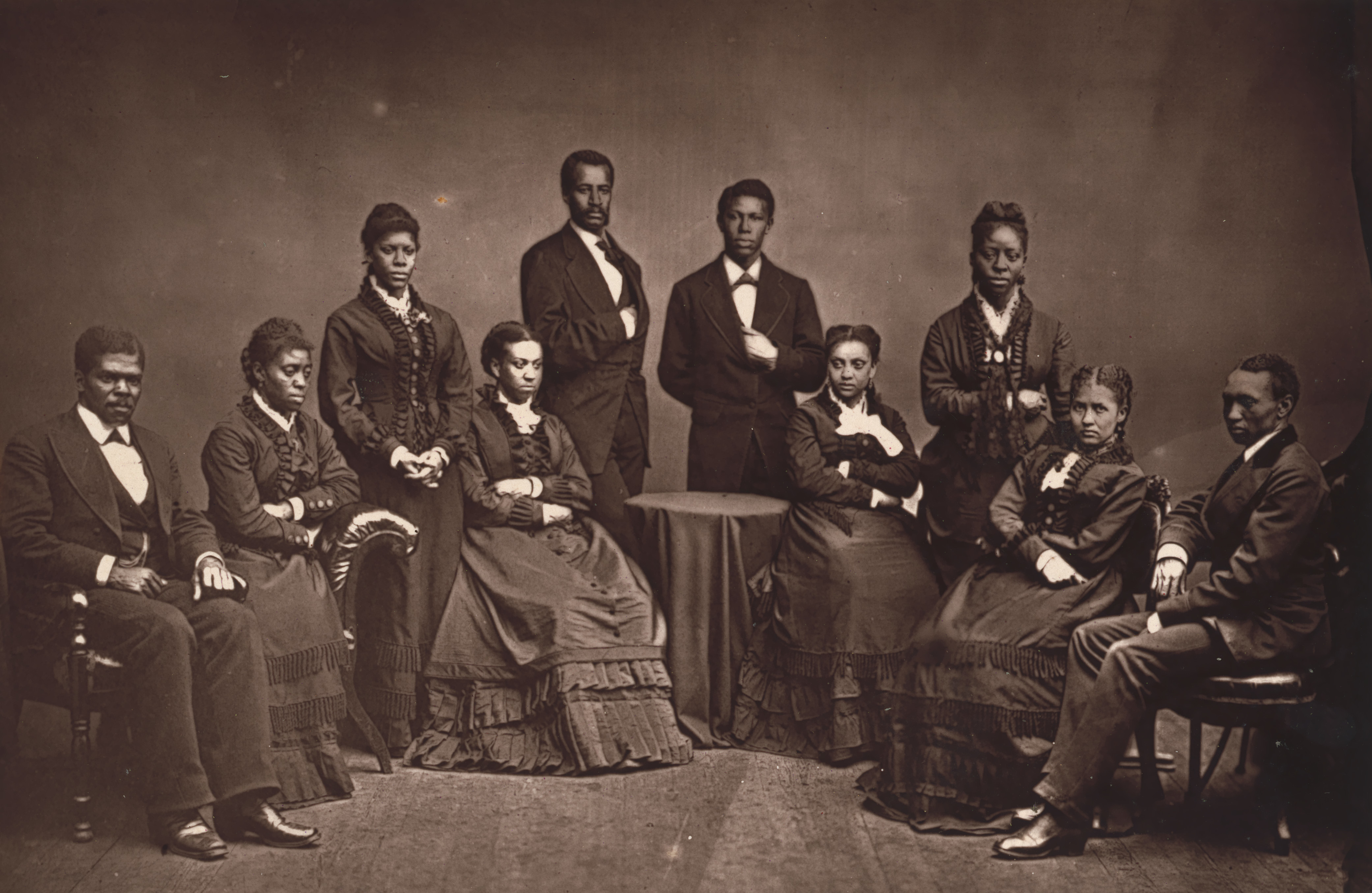
The Fisk Jubilee Singers helped preserve and popularize African American spirituals in the post-Civil War era. Their performances across the United States and Europe brought attention to a musical tradition rooted in slavery and challenged racist stereotypes by showcasing the depth of Black culture. As you analyze this source, notice how a student choir doubled as both a fundraiser for Fisk and a set of cultural ambassadors carrying African American art to a global audience.
Botanist George Washington Carver with Students in his Laboratory at Tuskegee Institute, 1902

George Washington Carver's work at Tuskegee Institute connected scientific research to the lives of Black farmers in the South, including research on crop rotation and new uses for crops like peanuts and sweet potatoes. The image of Carver teaching students fits the vocational-industrial model that Tuskegee was known for and shows the institute as a site of Black scientific achievement and mentorship.
Omega Psi Phi Members with Baskets of Canned Food for Charity, 1964
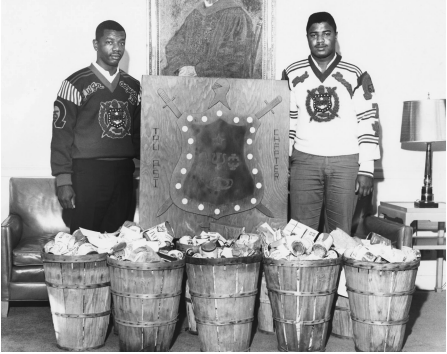
This image captures a Black Greek-letter organization carrying out its service mission during the civil rights era. Collecting food for those in need shows how BGLOs extended beyond campus life to support African American communities through direct action and mutual aid, reflecting the values of leadership and lifelong community service.
Professor Gail Hansberry with Art History Student at North Carolina Central University, 1965

This photograph shows mentorship inside an HBCU during the civil rights era. The exchange between a Black professor and an art history student highlights how HBCUs nurtured Black intellectual and cultural development, giving African American students space to engage with their heritage through fields like art history.
How to Use This on the AP African American Studies Exam
Using Sources Effectively
When a required image appears, identify what it shows and connect it to a larger idea. The Fisk Jubilee Singers photo points to global cultural influence, the Carver image points to the vocational-industrial model and Black scholarship, the Omega Psi Phi image points to BGLO community service, and the Hansberry image points to HBCU mentorship and Black intellectual life.
Comparison
Be ready to compare the liberal arts model (Fisk) with the vocational-industrial model (Tuskegee), and to link that contrast to the Washington and Du Bois debate about how African Americans should advance.
Causation
Explain causes and effects clearly: discrimination and segregation caused African Americans to found HBCUs, and the founding of HBCUs produced effects like expanded access to professional training, spaces for activism, and the rise of BGLOs.
Common Trap
Do not overstate exact statistics or attendance rates that are not part of this topic. Stick to what you can support, such as the point that HBCUs were the primary providers of postsecondary education for African Americans until the 1960s.
Common Misconceptions
- Misconception: Wilberforce was the first HBCU founded.Actually: Cheyney University (1837), not Wilberforce, was the first HBCU founded. Wilberforce (1856) was the first university fully owned and operated by African Americans.
- Misconception: All HBCUs were the same.Actually: HBCUs were not all the same. Some emphasized liberal arts while others emphasized vocational-industrial training, and many combined the two.
- Misconception: BGLOs were limited to HBCUs.Actually: BGLOs were not limited to HBCUs. They emerged at both HBCUs and predominantly white institutions.
- Misconception: The Second Morrill Act simply funded existing HBCUs.Actually: The Second Morrill Act did not simply fund existing HBCUs. It pushed states to either integrate or create separate Black institutions, which led to 18 new HBCUs.
- Misconception: HBCUs disappeared when desegregation began.Actually: HBCUs did not disappear when desegregation began. The Black campus movement of the 1960s expanded Black enrollment at predominantly white institutions, but HBCUs remained important.
Related AP African American Studies Guides
Practice Questions for 3.10
1 of 10
According to an 1895 report by Tuskegee Institute administrators, the institution's vocational curriculum prepared African American students for agricultural and industrial employment because Southern economic conditions offered limited professional opportunities outside these fields. What does this reasoning reveal about how HBCUs justified their educational models?
A.
Educational curricula were designed to match available employment opportunities within segregated Southern labor markets
B.
Vocational training was inherently superior to liberal arts education for all African American students regardless of region
C.
African Americans lacked the intellectual capacity for professional careers and therefore required practical training instead
D.
Southern employers preferred hiring African American workers with vocational credentials over liberal arts degrees
Vocabulary
The following words are mentioned explicitly in the AP® course framework for this topic.Term | Definition |
|---|---|
African American spirituals | Religious and musical traditions developed by African Americans, rooted in African and Christian influences, expressing faith and resilience. |
Black Campus movement | A student-led movement from 1965-1972 in which Black students and allies at colleges nationwide protested for greater opportunities to study Black history and experiences and for increased support for Black students, faculty, and administrators. |
Black Greek-letter organizations (BGLOs) | Fraternities and sororities established by and for African Americans, focused on brotherhood/sisterhood, community service, and social advancement. |
Black scholarship | Academic research, intellectual work, and educational pursuits centered on African American history, culture, and experiences. |
community service | Voluntary work and activities undertaken to benefit and support one's community and address social needs. |
discrimination | The unjust or prejudicial treatment of individuals or groups based on characteristics such as race, color, or religion. |
educational excellence | The pursuit and achievement of high standards in academic achievement and intellectual development. |
Fisk Jubilee Singers | A student choir from Fisk University that performed African American spirituals and toured internationally to promote Black musical and cultural traditions. |
Fisk University | A historically Black university founded in Nashville, Tennessee, known for its academic excellence and cultural contributions to African American education. |
higher education | Post-secondary education provided by colleges and universities, including undergraduate and graduate degree programs. |
historically Black colleges and universities (HBCUs) | Institutions of higher education established primarily to educate African Americans, particularly after the Civil War in response to discrimination and segregation in education. |
land-grant colleges | Educational institutions established through federal land grants, often created to provide practical education in agriculture and mechanical arts. |
leadership | The capacity and practice of guiding, influencing, and directing others toward common goals and social change. |
liberal arts education | A comprehensive educational approach emphasizing broad knowledge across humanities, sciences, and social sciences rather than vocational training. |
postsecondary education | Education beyond high school, including colleges and universities. |
professional training | Specialized education and instruction designed to prepare individuals for specific careers and professional occupations. |
racial equity | The principle of fairness and justice in addressing systemic inequalities and disparities based on race. |
Second Morrill Act | An 1890 federal law requiring states to either demonstrate that race was not a factor in college admission or establish separate institutions for Black students, resulting in the creation of 18 HBCUs. |
segregation | The forced separation of people based on race, enforced through laws and social practices. |
self-improvement | Personal development and enhancement of one's knowledge, skills, and character through deliberate effort and education. |
Tuskegee Institute | An HBCU that emphasized a vocational-industrial educational model in the late nineteenth and early twentieth centuries. |
vocational-industrial model | An educational approach focused on practical training and industrial skills, as exemplified by Tuskegee Institute. |
Wilberforce University | The first university in the United States fully owned and operated by African Americans, founded in Ohio in 1856 by leaders in the African Methodist Episcopal Church. |
Frequently Asked Questions
What does HBCU mean?
HBCU means historically Black college or university. Most HBCUs were founded after the Civil War because segregation and discrimination kept African Americans out of many existing colleges.
Why were HBCUs founded?
HBCUs were founded to expand Black access to higher education and professional training. They created spaces for Black scholarship, cultural pride, leadership, activism, and community development.
What is the difference between Cheyney and Wilberforce?
Cheyney University traces back to 1837 and is the first HBCU founded. Wilberforce University, founded in Ohio in 1856 by African Methodist Episcopal Church leaders, was the first university fully owned and operated by African Americans.
What did the Second Morrill Act do?
The Second Morrill Act of 1890 required states to show that race was not a factor in admissions or create separate land-grant institutions for Black students. This led to 18 HBCUs.
What are Black Greek-letter organizations?
Black Greek-letter organizations, or BGLOs, emerged at HBCUs and predominantly white institutions. They supported self-improvement, educational excellence, leadership, and lifelong community service.
Who was Professor Gail Hansberry?
Professor Gail Hansberry appears in a required 1965 source with an art history student at North Carolina Central University. Use the image to discuss HBCU mentorship, Black scholarship, and cultural education during the civil rights era.
See Fiveable more often in Google
Mark Fiveable as a preferred source and Google is more likely to show you our guides in Top Stories, with a "preferred" badge in AI Mode and AI Overviews.