4.17 The Evolution of African American Music: From Spirituals to Hip-Hop

✊🏿AP African American Studies Unit 4 Review
4.17 The Evolution of African American Music: From Spirituals to Hip-Hop
✊🏿 AP African American Studies
4.1
The Négritude and Negrismo Movements
4.2
Anticolonialism and Black Political Thought
4.3
African Americans and the Second World War: The Double V Campaign and the G.I. Bill
4.4
Discrimination, Segregation, and the Origins of the Civil Rights Movement
4.5
Redlining and Housing Discrimination
4.6
Major Civil Rights Organizations
4.7
Black Women's Leadership and Grassroots Organizing in the Civil Rights Movement
4.8
The Arts, Music, and the Politics of Freedom
4.9
Black Religious Nationalism and the Black Power Movement
4.10
The Black Arts Movement
4.11
The Black Panther Party for Self-Defense
4.12
Black Is Beautiful and Afrocentricity
4.13
The Black Feminist Movement, Womanism, and Intersectionality
4.14
Interlocking Systems of Oppression
4.15
Economic Growth and Black Political Representation
4.16
Demographic and Religious Diversity in Contemporary Black Communities
4.17
The Evolution of African American Music: From Spirituals to Hip-Hop
4.18
Black Life in Theater, TV, and Film
4.19
African Americans and Sports
4.20
Science, Medicine, and Technology in Black Communities
4.21
Black Studies, Black Futures, and Afrofuturism
African American music developed through spirituals, blues, jazz, gospel, R&B, and hip-hop, all built on African-rooted elements like call and response, improvisation, syncopation, storytelling, and the blending of music with dance. These traditions shaped American genres like rock and roll and reached global audiences, while hip-hop grew from young Black and Latino communities in the 1970s Bronx into a worldwide cultural form.
Why This Matters for the AP African American Studies Exam
This topic connects musical history to bigger course themes: cultural production, resistance, identity, and the lasting influence of the Black Freedom and Black Arts movements. On the exam, you can use it to trace continuity and change over time (African roots carried forward into new genres) and causation (how political movements shaped hip-hop). It also gives you strong examples for source analysis, since you may be asked to interpret a song, photograph, or scholarly text and connect it to historical context.
When you write about music here, focus on how it reflects lived experience and how Black artists shaped American and global culture. That kind of argument, backed by specific evidence, is exactly what longer written responses reward.
Key Takeaways
- African-based elements (improvisation, call and response, syncopation, storytelling, and music fused with dance) are the foundation of African American music.
- The African American musical tradition includes spirituals, blues, jazz, gospel, R&B, and hip-hop, and it shaped genres like rock and roll and international styles like Latin jazz.
- Performers like Sister Rosetta Tharpe, Bo Diddley, and Little Richard helped build rock and roll by reworking gospel and blues with new rhythms and electric instruments.
- Hip-hop began in the 1970s Bronx among young Black and Latino people and grew into a global culture with DJing, rapping, breakdancing, and graffiti art.
- Hip-hop drew on the Black Freedom and Black Arts movements, blending Black nationalism, Afrocentric fashion, jazz, and poetry to express African American identity.
- Black music has long carried joy, hope, creativity, and social critique in the face of racism and oppression.
African Roots in African American Music
African American music starts with elements African people carried across the Atlantic and kept alive for generations. These shared techniques run through almost every genre that follows.
- Improvisation: creating and changing melodies, rhythms, or lyrics in the moment.
- Call and response: a leader sings or plays a phrase, and a group answers back. You hear this in spirituals and work songs.
- Syncopation: stressing the offbeats to create a distinctive groove. This shapes genres like ragtime and jazz.
- Storytelling: using lyrics to share personal experience, cultural memory, and social commentary, as in blues and hip-hop.
- Music fused with dance: treating movement as part of the music itself, from ring shouts to breakdancing.
These are not separate tricks. They work together and give African American music its recognizable sound and feel.
The Genres and Their Global Reach
The African American musical tradition is a chain of connected genres. Each one builds on what came before and pushes outward into American and international music.
- Spirituals grew out of the experience of slavery and laid groundwork for later genres like gospel and soul.
- Blues developed in the American South and shaped rock, country, and jazz.
- Jazz emerged in Black communities in New Orleans and became a global art form with many subgenres.
- Gospel carried sacred music traditions that fed into R&B, soul, and rock and roll.
- Rhythm and blues (R&B) blended blues, jazz, and gospel and helped create rock, soul, and pop.
- Hip-hop emerged from Black and Latino communities in the Bronx and became a worldwide cultural force.
This tradition also revolutionized genres beyond itself. Rock and roll grew directly out of Black music, and styles like Latin jazz show its international reach.
Rock and Roll's Black Foundations
Rock and roll did not appear from nowhere. Black performers built it by reworking gospel and blues with new rhythms and electric instruments.
- Sister Rosetta Tharpe brought electric guitar and blues-inspired vocals into gospel performance.
- Bo Diddley used African-derived rhythms, including the beat that carries his name.
- Little Richard combined high-energy piano, a bold stage style, and powerful vocals that influenced many later artists.
Music as a Record of Black Life
Black music reflects joy, hope, and creativity alongside sharp social critique. It documents both struggle and celebration.
- Spirituals and work songs sometimes carried coded messages of resistance and hope.
- Blues lyrics often dealt with love, heartbreak, and the hardships of Black life as a kind of release and commentary.
- Hip-hop artists frequently critique systemic racism, police brutality, and economic inequality while celebrating Black culture and identity.
What Hip-Hop Is and Where It Came From
Hip-hop is a culture, not just a music genre. It was born out of collaboration and creativity among young Black and Latino people in the 1970s, rooted in New York City's Bronx borough, and it grew into a global phenomenon. It is usually described through four elements: DJing, MCing (rapping), breakdancing, and graffiti art.
How Rap Music Started
Music is the most lasting part of hip-hop. Artists like James Brown influenced the DJs who shared music at community events in the 1970s.
- DJs experimented with turntable techniques like mixing and scratching.
- Joseph Saddler (Grandmaster Flash) pushed DJ techniques further with cutting and quick mixing, while MCs like his Furious Five rhymed over the beats, helping create the origins of modern rap.
- DJs learned to extend "the break," the most danceable section of a song, to give dancers more room to perform.
Breakdancing
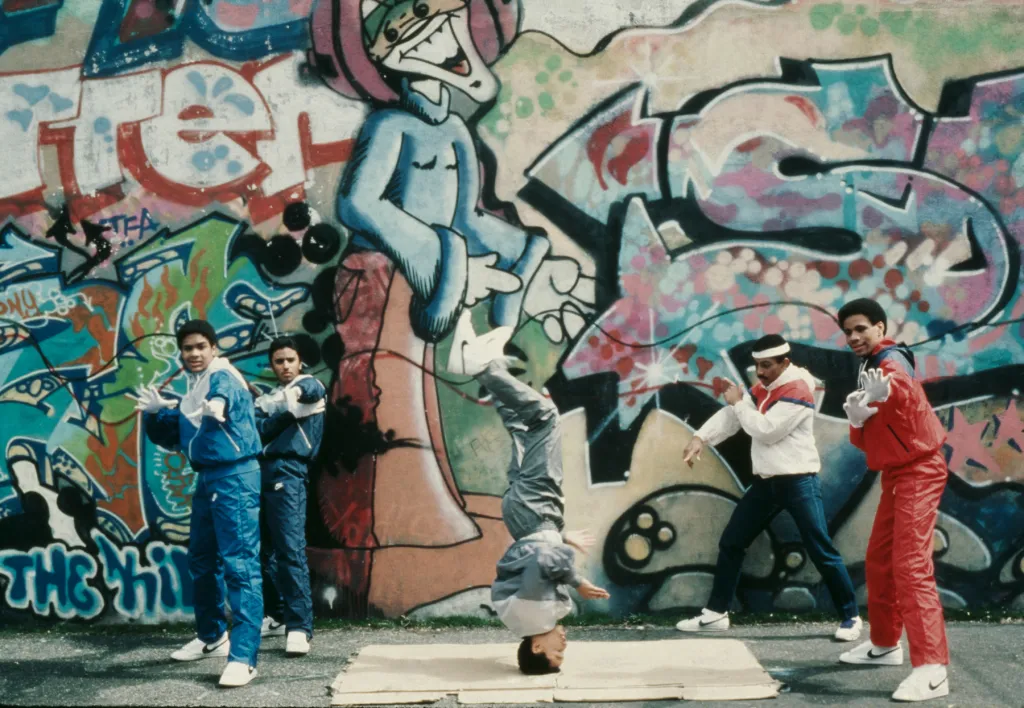
Extending the break gave dancers space to invent moves and routines. "Breakdancing" was performed solo by "b-boys" and "b-girls" and in groups called crews. It became one of hip-hop's defining forms of physical expression.
Graffiti Art
Graffiti art actually predates hip-hop's music and dance, but it became a key part of the culture. "Writers" covered walls, bridges, and subway cars with their work, and this scene helped bring acclaim to artists like Jean-Michel Basquiat.
How 1960s and 1970s Movements Shaped Hip-Hop
Hip-hop emerged right after the Black Freedom movements and the Black Arts movement. It pulled directly from their ideas, style, and sound.
- It blended Black Panthers' and Afrocentric fashion, Black nationalism, jazz, and poetry to express African American identity and experience.
- After the Black Power movement declined, hip-hop kept voicing African Americans' ongoing political struggles and reflected on the past, present, and future of Black America.
- Artists ranging from Queen Latifah to Kendrick Lamar use hip-hop to raise awareness of African Americans' political concerns for global audiences.
Required Sources
Early R&B: "Ruth Brown - Hey Mama, He Treats Your Daughter Mean (Live)" (video, 2:01)
Ruth Brown's performance shows rhythm and blues taking shape as its own genre in the 1950s. Her dynamic vocals and the song's upbeat tempo capture the fusion of gospel, jazz, and blues that defined early R&B and reached both Black and white audiences. Her success with Atlantic Records helped open doors for later Black female vocalists and fed into the rise of rock and roll.
"The Evolution of African American Music" by Portia K. Maultsby, in Africanisms in African American Music, 1980
Maultsby's scholarly work traces how African American musical traditions developed and changed over time, from African origins through slavery, Reconstruction, and beyond. It shows the cultural continuities and innovations that connect genres across generations, and it explains how music served as a way to preserve heritage and express identity. Use it as a model for arguing that Black music is a continuous tradition, not a set of unrelated styles.
"Breakdancers in New York," 1984
This photograph captures breakdancing as a central part of hip-hop and 1980s Black youth culture. It shows how young people turned urban spaces into stages for performance and competition. When you analyze it, connect the image to hip-hop's Bronx origins and to the idea of music fused with dance.
How to Use This on the AP African American Studies Exam
Using Sources Effectively
Expect to interpret a song, image, or text and tie it to context. With a source like the breakdancing photo or a Ruth Brown performance, name the genre, identify the African-rooted elements at work, and explain what the source reveals about Black life or culture in its time period.
Continuity and Change
Be ready to trace how one tradition carries forward. A strong response might show how call and response moves from spirituals to gospel to hip-hop, or how blues feeds into rock and roll. Point to specific genres and artists as evidence.
Causation
Connect movements to music. Explain how the Black Freedom and Black Arts movements, Black nationalism, and Afrocentric fashion shaped hip-hop's content and style. This is the clearest cause-and-effect argument in the topic.
Common Trap
Do not stop at naming a genre. Always link it back to a course theme like resistance, identity, cultural production, or social critique. The argument matters more than the list.
Common Misconceptions
- Misconception: Hip-hop is only African American.Actually: Hip-hop is not only African American. It grew from young Black and Latino communities together in the Bronx, and that shared origin matters.
- Misconception: Hip-hop is only rap.Actually: Hip-hop is more than rap. The culture includes DJing, MCing, breakdancing, and graffiti art, and graffiti actually came before the music and dance.
- Misconception: The African American musical tradition is a set of separate styles.Actually: The African American musical tradition is connected, not a set of separate styles. Spirituals, blues, jazz, gospel, R&B, and hip-hop build on shared African-rooted elements.
- Misconception: Black performers only borrowed from rock and roll.Actually: Black music did not just borrow from rock and roll. Black performers helped create rock and roll by reworking gospel and blues with new rhythms and electric instruments.
- Misconception: Music here is only about entertainment.Actually: Music here is not only about entertainment. It carries joy and creativity along with serious social critique of racism and inequality.
Related AP African American Studies Guides
- 4.9 Black Religious Nationalism and the Black Power Movement
- 4.11 The Black Panther Party for Self-Defense
- 4.5 Redlining and Housing Discrimination
- 4.8 The Arts, Music, and the Politics of Freedom
- 4.12 Black Is Beautiful and Afrocentricity
- 4.4 Discrimination, Segregation, and the Origins of the Civil Rights Movement
Practice Questions for 4.17
1 of 10
Grandmaster Flash's development of cutting and backspinning techniques in the mid-1970s Bronx, demonstrated at community block parties for predominantly young Black and Latino audiences, was historically significant primarily because it
A.
proved that African American DJs could compete commercially with white rock musicians in mainstream radio markets
B.
established DJing as a replacement for live bands at community events, reducing costs for event organizers
C.
transformed DJing from passive music playback into active musical creation, enabling MCs to rap over extended rhythmic foundations
D.
demonstrated that turntable manipulation required formal musical training equivalent to traditional orchestral instruments
Vocabulary
The following words are mentioned explicitly in the AP® course framework for this topic.Term | Definition |
|---|---|
African American musical tradition | A body of musical genres and styles created by African Americans, including spirituals, blues, jazz, gospel, R&B, and hip-hop, that has shaped American and global music. |
African-based musical elements | Musical and performative traditions originating from Africa that form the foundation of African American music, including rhythm, vocal techniques, and performance styles. |
Afrocentric fashion | Clothing and style choices that celebrate and emphasize African and African American cultural identity and heritage. |
b-boys | Male breakdancers who performed independently or in groups (crews) as part of hip-hop culture. |
b-girls | Female breakdancers who performed independently or in groups (crews) as part of hip-hop culture. |
Black Arts movement | A cultural and political movement (1965-1975) in which Black artists, writers, musicians, and dramatists used art as a tool to advance Black liberation and create a distinct Black cultural identity. |
Black Freedom movement | A period of transnational activism from the mid-1940s to the 1970s focused on achieving civil rights and racial equality for Black Americans and people of African descent globally. |
Black nationalism | A political and cultural ideology emphasizing African American self-determination, cultural pride, and independent institutions separate from white-dominated society. |
Black Panthers | A revolutionary African American political organization founded in 1966 that advocated for Black power, self-defense, and social justice. |
Black Power movement | A social and political movement in the 1960s-1970s that emphasized Black self-determination, cultural pride, and economic independence. |
blues | An African American musical genre characterized by expressive vocals, call-and-response patterns, and themes reflecting hardship and emotional experience. |
breakdancing | A form of dance performed to hip-hop music, showcasing choreographed moves and routines by individual dancers or crews. |
call and response | A musical and performative technique where one voice or instrument initiates a phrase and another responds, originating from African musical traditions. |
crews | Groups of breakdancers who performed together as part of hip-hop culture. |
DJs | Disc jockeys who played music and created new sounds at community events, foundational to hip-hop's development. |
gospel | A genre of African American religious music that evolved from spirituals and features powerful vocals, emotional expression, and Christian themes. |
graffiti art | Visual art form where artists created designs on walls, bridges, and subway cars as a vital form of artistic expression in hip-hop culture. |
hip-hop | An African American cultural movement and musical genre featuring rap, DJing, and sampling that emerged in the late 20th century as a form of artistic and social expression. |
hip-hop culture | A culture born out of collaboration and artistic creativity among young Black and Latino community members in the 1970s, originating in New York City's Bronx borough. |
improvisation | The spontaneous creation of music or performance without prior planning, a key element of African American musical traditions. |
jazz | An African American musical genre that emerged in New Orleans, characterized by improvisation, syncopation, and blending of African and European musical elements. |
Latin jazz | A musical genre that blends jazz with Latin American rhythms and instrumentation, influenced by African American jazz traditions. |
mixing | A turntable technique where DJs blend and combine different musical tracks or sounds. |
rap music | A musical genre that originated from improvised vocal rhymes performed over DJ-created beats. |
rhythm and blues (R&B) | An African American musical genre that combines blues, jazz, and gospel influences with a strong rhythmic emphasis and themes of love and social experience. |
rock and roll | An American musical genre that was significantly influenced by African American blues and gospel traditions, popularized through artists who adapted these styles with electric instruments. |
scratching | A turntable technique where DJs manipulate the vinyl record to create distinctive sound effects. |
social critique | The use of music to comment on and challenge social injustices, racism, and oppression experienced by African Americans. |
spirituals | Religious songs created by enslaved African Americans that blended African musical traditions with Christian themes and served as expressions of faith and resistance. |
storytelling | The narrative tradition of conveying experiences, histories, and emotions through music and performance in African American cultural expression. |
syncopation | A rhythmic technique that emphasizes unexpected beats or off-beat accents, a foundational element in African American music. |
the break | An extended instrumental section in a song that provided dancers with opportunities to showcase new moves and routines. |
turntable techniques | Methods used by DJs to manipulate and create music, including mixing and scratching. |
writers | Artists who created graffiti art and emblazoned public spaces with designs to gain acclaim in hip-hop culture. |
Frequently Asked Questions
What is AP African American Studies 4.17 about?
Topic 4.17 traces African American music from African-rooted musical and performative traditions through spirituals, blues, jazz, gospel, R&B, rock and roll, and hip-hop.
What African-based elements shaped African American music?
The CED highlights improvisation, call and response, syncopation, storytelling, and the fusion of music with dance as foundational elements in African American music.
How did African American music influence American and global genres?
African American musical traditions shaped rock and roll, Latin jazz, and many other genres. Artists such as Sister Rosetta Tharpe, Bo Diddley, and Little Richard helped lay the foundation for rock and roll.
Where did hip-hop originate?
Hip-hop emerged in the 1970s Bronx through collaboration among young Black and Latino community members. Its key elements include DJing, MCing or rapping, breakdancing, and graffiti art.
How did political movements shape hip-hop?
Hip-hop emerged after the Black Freedom and Black Arts movements and drew on Black nationalism, Afrocentric fashion, jazz, poetry, and ongoing political concerns in Black communities.
How should I use music examples on the AP African American Studies exam?
Use music as evidence of cultural production, identity, continuity and change, and social critique. Name the genre or source, identify the African-rooted element, and connect it to historical context.
See Fiveable more often in Google
Mark Fiveable as a preferred source and Google is more likely to show you our guides in Top Stories, with a "preferred" badge in AI Mode and AI Overviews.