1.7 Indigenous Cosmologies and Religious Syncretism

✊🏿AP African American Studies Unit 1 Review
1.7 Indigenous Cosmologies and Religious Syncretism
✊🏿 AP African American Studies
1.1
What Is African American Studies?
1.2
The African Continent: A Varied Landscape
1.3
Population Growth and Ethnolinguistic Diversity
1.4
Africa's Ancient Societies
1.5
The Sudanic Empires: Ghana, Mali, and Songhai
1.6
Learning Traditions
1.7
Indigenous Cosmologies and Religious Syncretism
1.8
Culture and Trade in Southern and East Africa
1.9
West Central Africa: The Kingdom of Kongo
1.10
Kinship and Political Leadership
1.11
Global Africans
Religious syncretism is when African societies blended introduced faiths like Islam and Christianity with their own Indigenous spiritual beliefs and cosmologies. Enslaved Africans carried these blended traditions across the Atlantic, where practices like ancestor veneration, divination, healing, and collective singing and dancing survived in African diasporic religions such as Louisiana Voodoo.
Why This Matters for the AP African American Studies Exam
This topic builds a key skill you will use throughout the course: tracing how African cultural and spiritual practices survived and changed across the Atlantic. It connects to continuity and change over time, since you can follow specific practices from West and West Central Africa into communities in the Americas.
It also gives you strong material for source analysis. The required sources here are visual and performance based, so you can practice reading how art and ceremony carry religious meaning and show cultural blending. That kind of analysis supports comparison and argument-building tasks where you connect early African societies to later diasporic culture.
Key Takeaways
- Syncretism means blending introduced faiths (Islam, Christianity) with Indigenous African spiritual beliefs and cosmologies.
- Leaders adopting Islam (Mali, Songhai) or Christianity (Kongo) often led their subjects to merge these faiths with local practices.
- About one-quarter of enslaved Africans who arrived in North America came from Christian societies, and about one-quarter from Muslim societies in Africa.
- Practices traceable to West and West Central Africa, such as ancestor veneration, divination, healing, and collective singing and dancing, survived in diasporic religions like Louisiana Voodoo.
- Enslaved people often performed spiritual ceremonies of these syncretic faiths to strengthen themselves before leading revolts.
- Know the three required sources and what each one shows about syncretism.
How Syncretism Developed in African Societies
Syncretism is the blending of different religious and cultural traditions into something new. In several early West and West Central African societies, rulers adopted outside faiths through trade and political ties. When leaders converted, their subjects often kept their Indigenous spiritual beliefs and folded the new faith into them rather than fully replacing one with the other.
Two clear examples come from earlier topics in this unit:
- Islam spread into West Africa through trans-Saharan trade, and empires like Mali and Songhai adopted it.
- The Kingdom of Kongo adopted Christianity (Roman Catholicism) through its ties with Portugal.
In both cases, people blended the introduced faith with local cosmologies, which are systems of belief about the spiritual world, ancestors, and how the universe is ordered. This blending happened gradually as communities found ways to fit new teachings alongside existing traditions.
How Syncretic Practices Crossed the Atlantic
When Africans were enslaved and forced to the Americas, they carried these syncretic traditions with them. About one-quarter of the enslaved Africans who arrived in North America came from Christian societies in Africa, and about one-quarter came from Muslim societies in Africa. So many people already held religious identities that were themselves blends of introduced and Indigenous beliefs.
In the Americas, enslaved Africans and their descendants kept practicing these faiths, often in secret. Spiritual practices that can be traced back to West and West Central Africa survived in African diasporic religions, including:
- Veneration of the ancestors (honoring and communicating with deceased family members)
- Divination (seeking spiritual knowledge or guidance)
- Healing practices
- Collective singing and dancing
Louisiana Voodoo is the diasporic religion named in this topic as an example of where these practices survived. These syncretic faiths gave people a way to hold onto ancestral connections and find strength. Africans and their descendants often performed spiritual ceremonies of these faiths to strengthen themselves before leading revolts.
Application note: Religions like Vodun in Haiti and Santeria in Cuba are often discussed as examples of African diasporic syncretism. Use them as examples of the concept, not as the specific required content of this topic.
Required Sources
You should be able to explain how each required source shows syncretism or the survival of African spiritual practices.
"Osain del Monte" by Grupo Abbilona (video)
Osain del Monte is an Afro-Cuban performance group whose performances illustrate the syncretism of Afro-Cuban religions. The drumming, call-and-response singing, and traditional instrumentation show how West African spiritual and musical elements were preserved and carried into Caribbean culture.
Yoruba Oshe Shango Ceremonial Wand, Mid-Twentieth Century

The oshe Shango is a ceremonial wand among the Yoruba in Nigeria and a core element of dances honoring the orisha (deity) Shango. Shango is the orisha of thunder, fire, and lightning, and a deified ancestor who was a monarch of the Oyo kingdom. The wand typically includes three features: a handle, two stone axes that stand for Shango's lightning bolts, and a female figure who usually carries the axes on her head.
Oya's Betrayal by Harmonia Rosales, 2020
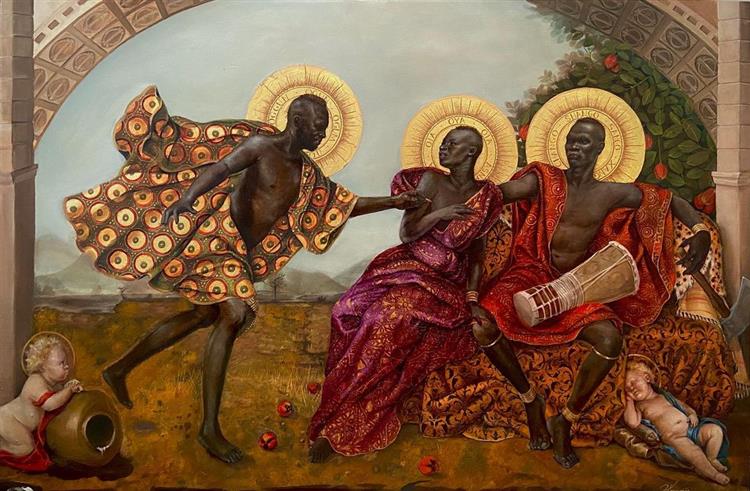
This painting depicts African spiritual practices through visual syncretism that combines Yoruba oral traditions with Renaissance style. It features a conflict among the orishas Oya, Ogun, and Shango. The blend of a European painting style with Yoruba religious content is itself an example of syncretism.
How to Use This on the AP African American Studies Exam
Using Sources Effectively
When you get a visual or performance source, name what you see and connect it to syncretism. For the oshe Shango wand, point to the specific features (handle, two stone axes for lightning, female figure) and tie them to honoring the orisha Shango. For Oya's Betrayal, explain that combining Yoruba content with Renaissance style is visual syncretism.
Continuity and Change
Be ready to trace a practice from Africa to the Americas. A strong move is to name a specific practice (ancestor veneration, divination, healing, or collective singing and dancing) and explain that it survived in African diasporic religions like Louisiana Voodoo.
Evidence and Argument
Use the one-quarter Christian and one-quarter Muslim statistic to support claims about the religious backgrounds of enslaved Africans. Connect spiritual ceremonies to resistance by noting that people performed them to strengthen themselves before leading revolts.
Common Trap
Do not treat syncretism as one faith simply replacing another. The point is blending, where Indigenous beliefs continued alongside and inside the introduced faith.
Common Misconceptions
- Misconception: Syncretism is the same as conversion.Actually: Syncretism is not the same as conversion. People did not just drop their old beliefs; they blended Indigenous cosmologies with Islam or Christianity.
- Misconception: It is only a Christianity story.Actually: It is not only a Christianity story. Both Islam (in places like Mali and Songhai) and Christianity (in Kongo) were blended with local beliefs.
- Misconception: African diasporic religions are made up in the Americas from nothing.Actually: African diasporic religions are not "made up" in the Americas from nothing. They preserve practices that can be traced back to West and West Central Africa.
- Misconception: The one-quarter and one-quarter figures mean half of all enslaved Africans were Christian or Muslim.Actually: The one-quarter and one-quarter figures describe Christian and Muslim backgrounds specifically. They do not mean half of all enslaved Africans, since many came from societies with other Indigenous beliefs.
- Misconception: Spiritual ceremonies were only personal comfort.Actually: Spiritual ceremonies were not only personal comfort. They also served collective purposes, including strengthening people before revolts.
Related AP African American Studies Guides
Practice Questions for 1.7
1 of 10
Candomblé practitioners in Bahia identified orishas with Catholic saints to preserve West African spiritual practices while appearing to conform to colonial Catholic requirements. What does this religious strategy best demonstrate?
A.
African orishas and Catholic saints were identical religious concepts requiring no meaningful adaptation.
B.
African-descended people blended African and Catholic practices to maintain ancestral spiritual traditions.
C.
African-descended Brazilians abandoned African spiritual traditions and became exclusively Catholic.
D.
Catholic colonizers successfully eliminated all African spiritual practices from Brazil through forced conversion.
Vocabulary
The following words are mentioned explicitly in the AP® course framework for this topic.Term | Definition |
|---|---|
African diasporic religions | Religious systems developed by African-descended communities in the Americas that blend African spiritual traditions with Christianity and Islam. |
Christianity | A major world religion adopted by leaders in some African societies such as Kongo, often blended with local spiritual practices. |
collective singing and dancing | Communal spiritual practices involving group participation in music and movement, traced to West and West Central African traditions. |
divination | A spiritual practice of seeking knowledge about the future or hidden matters through supernatural means, part of West and West Central African traditions. |
healing practices | Spiritual and medicinal practices used to treat illness and promote wellness, rooted in West and West Central African traditions. |
Indigenous spiritual beliefs | Traditional religious and cosmological systems of African societies that existed before the introduction of major world religions. |
Islam | A major world religion that was adopted by leaders in some African societies such as Mali and Songhai, often blended with local spiritual practices. |
Kingdom of Kongo | A West Central African state that established political and religious ties with Portugal in the late 15th century and became a major participant in the transatlantic slave trade. |
Louisiana Voodoo | An African diasporic religion practiced in Louisiana that combines West and West Central African spiritual practices with Catholicism and other traditions. |
Mali | A Sudanic empire that flourished from the thirteenth to seventeenth centuries, succeeding Ghana and controlling major trade routes and gold resources. |
orisha | A deity in Yoruba spiritual tradition, often venerated in African diasporic religions and represented through ceremonial objects and practices. |
Shango | A Yoruba orisha associated with thunder, fire, and lightning, and a deified ancestor-monarch of the Oyo kingdom, central to syncretic African diasporic practices. |
Songhai | The last and largest of the Sudanic empires, flourishing in the fifteenth to sixteenth centuries before decline due to the shift from trans-Saharan to Atlantic trade routes. |
syncretic practices | Religious and cultural practices that blend elements from different faith traditions, combining introduced religions with indigenous spiritual beliefs. |
veneration of the ancestors | A spiritual practice involving the honoring and reverence of deceased family members and forebears, traced to West and West Central African traditions. |
Yoruba | An African ethnic group whose spiritual traditions, including veneration of orishas, have been carried forward in African diasporic religions in the Americas. |
Frequently Asked Questions
What is religious syncretism in AP African American Studies?
Religious syncretism is the blending of introduced religions, such as Islam or Christianity, with Indigenous African spiritual beliefs and cosmologies. Topic 1.7 traces how those blended practices developed in Africa and continued in the Americas.
How did Kongo Christianity show religious syncretism?
In Kongo, leaders adopted Christianity through contact with Portugal, but communities blended Christian ideas with local spiritual beliefs. This shows that conversion did not necessarily erase Indigenous cosmologies.
How did Islam in Mali and Songhai connect to syncretism?
Islam spread into West African societies such as Mali and Songhai, often through trade and elite adoption. Many communities blended Islamic practices with local beliefs rather than fully replacing existing spiritual systems.
What African spiritual practices survived in the diaspora?
Practices such as ancestor veneration, divination, healing practices, and collective singing and dancing survived in African diasporic religions. The CED names Louisiana Voodoo as one example.
What required sources connect to AP African American Studies 1.7?
Required sources include Osain del Monte by Grupo Abbilona, a Yoruba Oshe Shango ceremonial wand, and Oya’s Betrayal by Harmonia Rosales. Each source helps show African spiritual practice, Yoruba religious traditions, or visual and religious syncretism.
Why does Topic 1.7 matter for the AP exam?
Topic 1.7 helps you explain continuity and change across the African diaspora. Strong exam answers connect specific practices or sources to the survival and adaptation of African spiritual traditions in the Americas.
See Fiveable more often in Google
Mark Fiveable as a preferred source and Google is more likely to show you our guides in Top Stories, with a "preferred" badge in AI Mode and AI Overviews.