4.5 Carrying Out a Test for a Population Mean or Population Mean Difference

📊AP Statistics Unit 4 Review
4.5 Carrying Out a Test for a Population Mean or Population Mean Difference
📊 AP Statistics
Unit 1 Overview: Exploring One-Variable Data and Collecting Data
1.1
Introducing Statistics: What Can We Learn from Data?
1.2
Variables
1.3
Tabular Representation and Summary Statistics for One Categorical Variable
1.4
Graphical Representations for One Categorical Variable
1.5
Graphical Representations for One Quantitative Variable
1.6
Descriptions for One Quantitative Variable Distributions
1.7
Summary Statistics for One Quantitative Variable
1.8
Graphical Representations of Summary Statistics
1.9
Comparisons of the Distributions for One Quantitative Variable
1.10
The Investigative Question Revisited and Data Collection
1.11
Random Sampling
1.12
Potential Problems with Sampling
1.13
Experimental Design
AP Stats t-Test Summary
Carrying out a one-sample t-test for a population mean means you calculate the test statistic , find the p-value using a t-distribution with degrees of freedom, and then compare that p-value to your significance level to decide whether to reject the null hypothesis. The same process works for matched pairs once you turn the paired data into a single set of differences.
Why This Matters for the AP Statistics Exam
Inference for means shows up across the AP Statistics exam, both in multiple-choice questions and in free-response questions that ask whether data provide convincing evidence of some claim. When you see that phrasing, the question is asking for a full significance test, not just a description of the data.
A complete t-test for a mean asks you to:
- Identify the parameter and state hypotheses in terms of .
- Pick the correct procedure (a one-sample t-test) and check conditions.
- Calculate the test statistic and p-value.
- State a conclusion in context, with a clear link between the p-value and the decision.
This topic focuses on the middle and final steps: getting the test statistic, finding the p-value, and writing a justified conclusion. Showing each step clearly and using correct notation is important for clear exam work.
Key Takeaways
- The test statistic is , where is the standard error of the mean.
- Use a t-distribution with degrees of freedom to find the p-value.
- Your alternative hypothesis decides whether the p-value comes from one tail or two tails.
- The p-value is found by assuming the null hypothesis is true, meaning the true population mean equals .
- Compare the p-value to : if p-value , reject ; if p-value , fail to reject .
- For matched pairs, find the differences first, then run a one-sample t-test on those differences.
Calculating the Test Statistic
The first step in carrying out a significance test for a population mean is calculating the test statistic. For a mean with unknown population standard deviation, that statistic is a t-score.
The t-score measures how far your sample mean is from the hypothesized mean, in units of standard error. You find it by dividing the difference between the sample mean and the hypothesized mean by the standard error of the mean. The standard error is the sample standard deviation divided by the square root of the sample size.
The larger the absolute value of the t-score, the more the sample mean differs from the hypothesized mean relative to the expected variability.
The test statistic formula is:
where is the sample mean, is the hypothesized mean, is the sample standard deviation, and is the sample size. This formula is not printed on the formula sheet, but you can build it from the general test statistic formula and the standard error formula that are provided.
Example
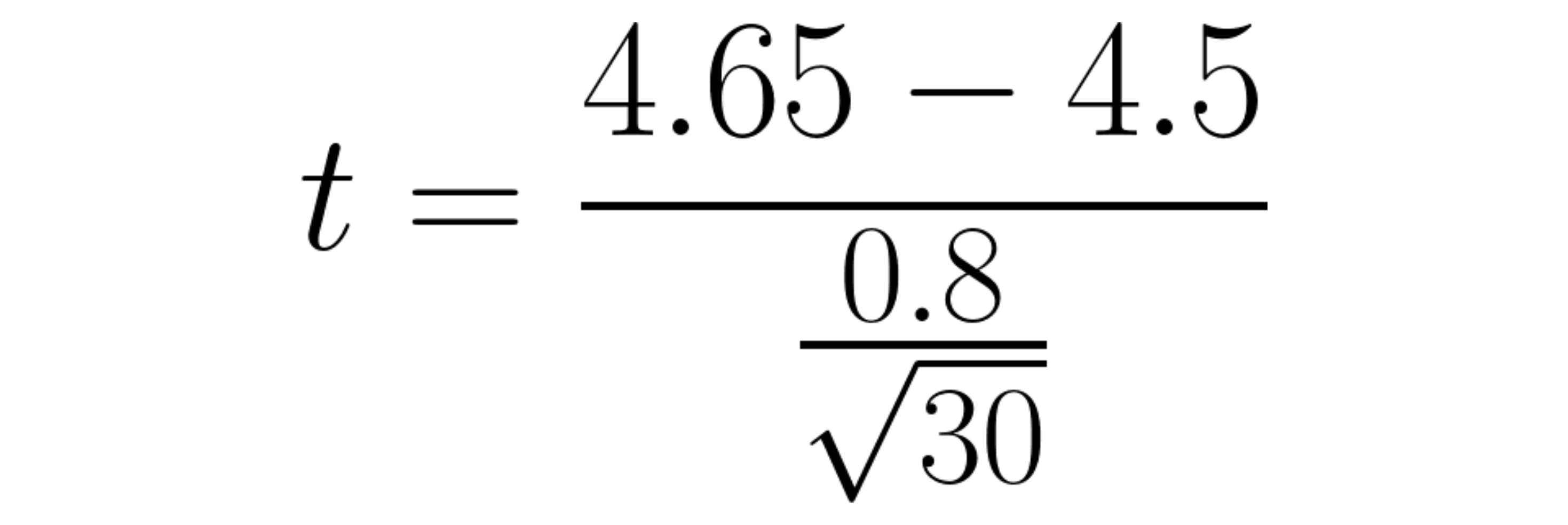
Ricardo has a bag of 30 oranges. The bag says each orange weighs an average of 4.5 oz, so .
Ricardo weighs all the oranges and finds a sample mean of 4.65 oz with a standard deviation of 0.8 oz.
Calculating the P-Value
A hypothesis test for a mean is either one-tailed or two-tailed, and that choice comes from the alternative hypothesis you wrote when setting up the test.
- If the alternative is directional, such as or , you use a one-tailed test and look at only one tail of the curve.
- If the alternative is non-directional, such as , you use a two-tailed test and account for area in both tails.
The p-value is computed by assuming the null hypothesis is true, meaning you assume the true population mean equals the value stated in . It tells you how likely a result this extreme (or more extreme) would be if were actually correct.
To find the p-value from a t-table:
- Find the degrees of freedom, which is always one less than the sample size, so .
- Locate your t-score in the row matching your degrees of freedom to estimate the tail area. If your exact df is not listed, round down to the nearest df on the table.
Example
In Ricardo's orange example, . Looking at the row for 29 degrees of freedom and a t-score near 1.027, the tail probability is approximately 0.15.
- For a one-tailed test, that tail area is your p-value.
- For a two-tailed test, double it to get about 0.30, because the t-distribution is symmetric and the two tail areas are equal.
Using a Calculator for the T-Score and P-Value
Technology such as a graphing calculator can run a one-sample t-test quickly. A common choice in AP Statistics is the TI-84.
To run a one-sample t-test:
- Go to the STAT menu.
- Move to TESTS and select the T-Test option.
- Choose to enter summary statistics (, , , and ) or to use data already stored in a list.
After you select Calculate, the output reports the test statistic and the p-value. Both belong in your written response on the AP exam. For a t-test for a population mean, you should also report the degrees of freedom, even though the calculator output does not list them.
Using the P-Value to Make Conclusions
Once you have the test statistic and p-value, you make a formal decision by comparing the p-value to your significance level (often 0.05).
- If the p-value , the result would be unlikely if were true, so you reject in favor of .
- If the p-value , the result is not statistically significant, so you fail to reject .
Your conclusion needs a numerical comparison and context. These templates help:
- p-value : "Since p-value , we reject . We have convincing evidence at the level that (state in context)."
- p-value : "Since p-value , we fail to reject . We do not have convincing evidence at the level that (state in context)."
A significance test result is the statistical reasoning that supports your answer to the research question about the population you sampled.
How to Use This on the AP Statistics Exam
Free Response
When a free-response question asks whether data provide convincing evidence of a claim, treat it as a full significance test. Work through all four pieces: parameter and hypotheses, procedure and conditions, test statistic and p-value, and a conclusion in context that links the p-value to the decision.
Problem Solving
- Write the formula with numbers plugged in before reporting the t-score, so your work is clear.
- Always state for a one-sample t-test, even when using a calculator.
- Match the tail count to your alternative hypothesis: one tail for or , two tails for .
Matched Pairs
For matched-pairs data, find the difference for each pair first, then run a one-sample t-test on those differences. Define your order of subtraction clearly so your hypotheses and conclusion match.
Common Trap
State your conclusion as "reject " or "fail to reject ." Never say you "accept" the null or alternative hypothesis, since a significance test never proves a hypothesis true.
Common Misconceptions
- Misconception: A big p-value proves the null hypothesis is true.Actually: It does not. A large p-value only means you do not have enough evidence to reject , so you fail to reject it rather than accept it.
- Misconception: You can use a z-test whenever you have a mean.Actually: When the population standard deviation is unknown and you use the sample standard deviation , you use a t-test, not a z-test.
- Misconception: Degrees of freedom are not needed if the calculator gives the p-value.Actually: For a one-sample t-test, you should still report as part of complete work.
- Misconception: The standard error is just the sample standard deviation.Actually: The standard error of the mean is , not by itself.
- Misconception: A two-tailed p-value is the same as a one-tailed p-value.Actually: For a symmetric t-distribution, the two-tailed p-value is twice the one-tail area.
- Misconception: Rejecting proves is true.Actually: It only means the data give convincing evidence for at your chosen significance level, not absolute proof.
Related AP Statistics Guides
- Unit 4 Overview: Inference for Quantitative Data: Means
- 7.2 Constructing a Confidence Interval for a Population Mean
- 7.1 Introducing Statistics: Should I Worry About Error?
- 7.4 Setting Up a Test for a Population Mean
- 7.3 Justifying a Claim About a Population Mean Based on a Confidence Interval
- 7.6 Confidence Intervals for the Difference of Two Means
Vocabulary
The following words are mentioned explicitly in the AP® course framework for this topic.Term | Definition |
|---|---|
degrees of freedom | A parameter of the t-distribution that affects its shape; as degrees of freedom increase, the t-distribution approaches the normal distribution. |
matched pairs | Paired observations where two measurements are taken on the same subject or on subjects that are matched according to specific criteria, used to analyze the mean difference between the paired values. |
null hypothesis | The initial claim or assumption being tested in a hypothesis test, typically stating that there is no effect or no difference. |
p-value | The probability of observing a test statistic as extreme as or more extreme than the one calculated from the sample data, assuming the null hypothesis is true. |
population mean | The average of all values in an entire population, denoted as μ. |
population means | The average values of two distinct populations being compared, denoted as μ₁ and μ₂. |
reject the null hypothesis | The decision made when the p-value is less than or equal to the significance level, indicating sufficient evidence against the null hypothesis. |
sample mean | The average of all values in a sample, denoted as x̄, used as an estimate of the population mean. |
sampling distribution | The probability distribution of a sample statistic (such as a sample proportion) obtained from repeated sampling of a population. |
significance level | The threshold probability (α) used to determine whether to reject the null hypothesis in a significance test. |
significance test | A statistical procedure used to determine whether there is sufficient evidence to reject the null hypothesis based on sample data. |
standard error | The standard deviation of a sampling distribution, which measures the variability of a sample statistic across repeated samples. |
t-distribution | A probability distribution used when the population standard deviation is unknown and the sample standard deviation is used instead, characterized by heavier tails than the normal distribution. |
test statistic | A calculated value used to determine whether to reject the null hypothesis in a hypothesis test, computed from sample data. |
Frequently Asked Questions
What is an AP Stats t-test for a population mean?
A one-sample t-test for a population mean tests a claim about a true mean when the population standard deviation is unknown and the sample standard deviation is used.
What is the t-test statistic formula for a population mean?
The test statistic is t = (sample mean minus hypothesized mean) divided by the standard error, s divided by the square root of n. It measures how far the sample mean is from the null value in standard error units.
How many degrees of freedom does a one-sample t-test use?
A one-sample t-test uses n - 1 degrees of freedom, where n is the sample size. For matched pairs, n is the number of paired differences.
How do you interpret a p-value for a population mean test?
Interpret the p-value by assuming the null hypothesis is true. It is the probability of getting a sample result as extreme as, or more extreme than, the observed result in the direction of the alternative hypothesis.
When do you reject the null hypothesis in a t-test?
Reject the null hypothesis when the p-value is less than or equal to the significance level alpha. If the p-value is greater than alpha, fail to reject the null hypothesis.
What is a common mistake on AP Stats t-test conclusions?
A common mistake is saying you accept the null hypothesis. AP Statistics conclusions should say reject or fail to reject the null, then state the evidence in context.