4.9 Vector-Valued Functions

📈AP Precalculus Unit 4 Review
4.9 Vector-Valued Functions
📈 AP Precalculus
4.1
Parametric Functions
4.2
Parametric Functions Modeling Planar Motion
4.3
Parametric Functions and Rates of Change
4.4
Parametrically Defined Circles and Lines
4.5
Implicitly Defined Functions
4.6
Conic Sections
4.7
Parametrization of Implicitly Defined Functions
4.8
Vectors
4.9
Vector-Valued Functions
4.10
Matrices
4.11
The Inverse and Determinant of a Matrix
4.12
Linear Transformations and Matrices
4.13
Matrices as Functions
4.14
Matrices Modeling Contexts
A vector-valued function turns parametric motion into vectors. The position vector tells you where a particle is, and the velocity vector tells you how fast and which way it is moving.
Why This Matters for the AP Precalculus Exam
This topic lives in Unit 4, which is not assessed on the AP Precalculus exam. The exam tests Units 1, 2, and 3. Schools may still teach this topic because it builds directly into calculus, physics, and computer graphics, where motion gets broken into independent horizontal and vertical parts.
What you build here is still useful thinking. Vector-valued functions connect three earlier ideas: parametric functions, planar motion, and vectors. Getting comfortable with position and velocity vectors now makes calculus topics like motion in the plane feel familiar later. If your class includes Unit 4, expect to use a graphing calculator to plot parametric curves and analyze motion.
Key Takeaways
- A position vector or gives a particle's location at time .
- The magnitude gives the particle's distance from the origin.
- The velocity vector describes how the particle moves at time .
- The sign of tells you right (positive) or left (negative); the sign of tells you up (positive) or down (negative).
- The magnitude of the velocity vector gives the particle's speed.
- Position and velocity are two different vectors. Do not mix up where something is with how it is moving.
Position Vector
The position of a particle moving in a two-dimensional plane can be written as a vector-valued function:
Here and are the coordinates of the particle at time , and and are the unit vectors in the x and y directions. You can also write the same position vector in component form:
This is just the parametric function written as a vector. Same information, new notation.
The magnitude of the position vector at time , written , gives the distance of the particle from the origin (0, 0):
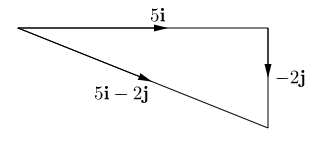
Velocity Vector
The velocity of a particle moving in a plane is given by a separate vector-valued function:
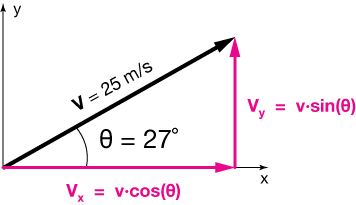
The components and are the horizontal and vertical velocities of the particle.
At any time , the sign of each component tells you direction:
- If , the particle is moving right. If , it is moving left.
- If , the particle is moving up. If , it is moving down.
The magnitude of the velocity vector gives the speed of the particle:
Speed is how fast the particle moves, with no direction attached. You can read it as the distance the particle would cover per unit of time if it kept that velocity.
How to Use This on the AP Precalculus Exam
Unit 4 is not on the AP Precalculus exam, so you will not be scored on vector-valued functions. Use these steps as practice for clear reasoning and for calculus prep if your class covers the unit.
Problem Solving
- Read whether the problem gives you position or velocity. Position uses and ; velocity uses and .
- To find distance from the origin, take the magnitude of the position vector.
- To find speed, take the magnitude of the velocity vector.
- To describe direction of motion, check the signs of and separately. Horizontal and vertical motion are independent.
- Keep your notation consistent. Decide whether you are using form or form and stick with it within a problem.
Common Trap
Plugging a time value into the position function when the question asks about speed or direction. Speed and direction come from the velocity vector , not from the position vector.
Common Misconceptions
- Misconception: Position and velocity are the same vector.Actually: Position and velocity are not the same vector. tells you where the particle is; tells you how it is moving. A particle can be far from the origin but moving slowly, or close to the origin but moving fast.
- Misconception: Velocity is just one number.Actually: Velocity is not just one number. It has horizontal and vertical components. Speed is the single number you get from the magnitude of the velocity vector.
- Misconception: The sign of a velocity component tells size, not direction.Actually: The sign of a velocity component tells direction, not size. A velocity of in the x direction means moving left at speed 5, not moving slowly.
- Misconception: The magnitude of the position vector is distance traveled along the path.Actually: The magnitude of the position vector is distance from the origin, not distance traveled along the path. Those are different ideas.
- Misconception: Velocity uses and , not the derivatives and .Actually: Velocity uses the derivatives and , not and . The position vector tells you location; the velocity vector tells you motion.
Related AP Precalculus Guides
Practice Questions for 4.9
1 of 10
A particle's position vector is given by for . Use graphing technology to approximate the time when the particle's distance from the origin is exactly , then identify the exact value of this time.
A.
B.
C.
D.
Vocabulary
The following words are mentioned explicitly in the AP® course framework for this topic.Term | Definition |
|---|---|
parametric function | A function that expresses the coordinates of a point as functions of a parameter, typically time t, written as f(t) = (x(t), y(t)). |
planar motion | The movement of a particle or object in a two-dimensional plane. |
position vector | A vector that represents the location of a particle relative to the origin, with magnitude equal to the distance from the origin. |
speed | The magnitude of the velocity vector, representing the rate at which a particle is moving regardless of direction. |
vector-valued function | A function that outputs vectors, typically expressed as p(t) = ⟨x(t), y(t)⟩ or p(t) = x(t)i + y(t)j, where each input t produces a vector output. |
velocity vector | A vector-valued function v(t) = ⟨x'(t), y'(t)⟩ that represents the rate of change of position with respect to time, indicating both direction and speed of motion. |
Frequently Asked Questions
What is a vector-valued function in AP Precalculus?
A vector-valued function represents planar motion with vectors. For position, p(t) = gives the particle’s location at time t.
How is a parametric function written as a vector-valued function?
If a parametric function gives x(t) and y(t), write the position vector as p(t) = x(t)i + y(t)j or p(t) = .
What is the velocity vector for planar motion?
The velocity vector is v(t) = . Its components describe horizontal and vertical motion at time t.
How do you find speed from a velocity vector?
Speed is the magnitude of the velocity vector: |v(t)| = sqrt((x′(t))^2 + (y′(t))^2). It tells you how fast the particle is moving without direction.
How do velocity components show direction?
The sign of x′(t) tells whether the particle moves right or left, and the sign of y′(t) tells whether it moves up or down.
Is AP Precalculus Unit 4 tested on the AP exam?
No. The AP Precalculus exam assesses Units 1, 2, and 3. Unit 4 topics like vector-valued functions may still be taught for calculus and STEM preparation.
See Fiveable more often in Google
Mark Fiveable as a preferred source and Google is more likely to show you our guides in Top Stories, with a "preferred" badge in AI Mode and AI Overviews.