3.2 Sine, Cosine, and Tangent

📈AP Precalculus Unit 3 Review
3.2 Sine, Cosine, and Tangent
📈 AP Precalculus
3.1
Periodic Phenomena
3.2
Sine, Cosine, and Tangent
3.3
Sine and Cosine Function Values
3.4
Sine and Cosine Function Graphs
3.5
Sinusoidal Functions
3.6
Sinusoidal Function Transformations
3.7
Sinusoidal Function Context and Data Modeling
3.8
The Tangent Function
3.9
Inverse Trigonometric Functions
3.10
Trigonometric Equations and Inequalities
3.11
The Secant, Cosecant, and Cotangent Functions
3.12
Equivalent Representations of Trigonometric Functions
3.13
Trigonometry and Polar Coordinates
3.14
Polar Function Graphs
3.15
Rates of Change in Polar Functions
What are sine, cosine, and tangent in AP Precalculus?
Sine, cosine, and tangent are defined using an angle in standard position and the point where its terminal ray crosses a circle centered at the origin. On the unit circle, the sine of an angle is the y-coordinate of that point, the cosine is the x-coordinate, and the tangent is the slope of the terminal ray, which equals sin θ over cos θ.
Why This Matters for the AP Precalculus Exam
This topic builds the foundation for everything in Unit 3, which carries a large share of the AP Precalculus exam. Once you can connect an angle to a point on the unit circle, you can find exact trig values, graph sine and cosine, build sinusoidal models, and later move into polar coordinates. Expect to use these definitions on both multiple-choice and free-response questions, where you may need to identify trig values, explain why a value fits a given angle, and read meaning from the position of a point on a circle.
Key Takeaways
- An angle is in standard position when its vertex is at the origin and its initial ray lies along the positive x-axis. The terminal ray is the side that rotates.
- Counterclockwise rotation gives a positive angle; clockwise gives a negative angle. Angles that share a terminal ray are coterminal and differ by a whole number of full revolutions.
- Radian measure is the ratio of arc length to radius. On the unit circle, one radian is the central angle subtended by an arc with length 1.
- On the unit circle, sin θ is the y-coordinate of point P and cos θ is the x-coordinate of point P.
- Tangent is the slope of the terminal ray: tan θ = y/x = sin θ / cos θ, and it is undefined when cos θ = 0.
- For any circle of radius r centered at the origin, sin θ is the vertical displacement over r and cos θ is the horizontal displacement over r.
A Refresher on Standard Position
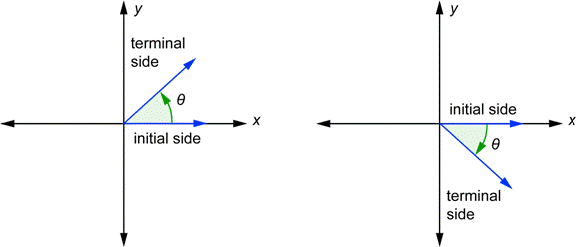
In the coordinate plane, an angle is made of two rays that share an endpoint called the vertex. An angle is in standard position when the vertex sits at the origin and one ray lies along the positive x-axis.
- That fixed ray on the positive x-axis is the initial ray.
- The ray that rotates to form the angle is the terminal ray.
The measure of the angle comes from how far the terminal ray rotates away from the positive x-axis.
- Positive angle measures mean a counterclockwise rotation.
- Negative angle measures mean a clockwise rotation.
For example, a 90 degree angle is formed by rotating the terminal ray counterclockwise a quarter turn from the positive x-axis.
Angles in standard position that share a terminal ray differ by an integer number of revolutions. So a 90 degree angle and a 450 degree angle land on the same terminal ray because they differ by one full turn (360 degrees). These are called coterminal angles.
Radian Measure
The radian measure of an angle in standard position describes the angle using arc length. It is the ratio of the length of the arc subtended by the angle on a circle centered at the origin to the radius of that same circle.
For example, if an angle subtends an arc of length 4 units on a circle with radius 2 units, the radian measure is 2, since that is the ratio of 4 to 2.
A useful feature of radian measure is that it does not depend on the size of the circle. The same angle gives the same radian measure no matter how big the circle is, because the arc and radius scale together.
On a unit circle, which has a radius of 1, the radian measure of an angle equals the length of the subtended arc. The ratio of arc length to radius is just arc length divided by 1, which is the arc length.
Sine on the Unit Circle
Given an angle in standard position and a circle centered at the origin, there is a point P where the terminal ray intersects the circle. The sine of the angle is the ratio of the vertical displacement of P from the x-axis to the distance between the origin and P.
Here is the angle, is the y-coordinate of P, and is the radius.
For a unit circle, the sine of the angle is the y-coordinate of point P, because dividing by a radius of 1 leaves just the y-value.
The sine function is periodic with a period of , and its output stays between -1 and 1.
Cosine on the Unit Circle
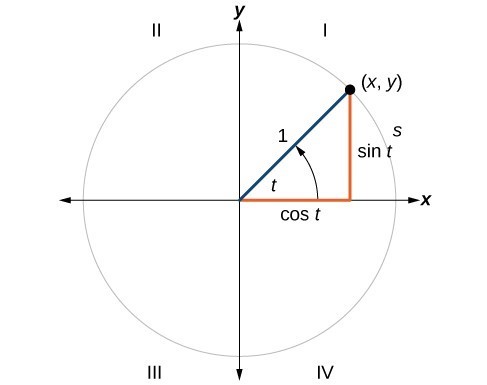
Using the same setup, the cosine of the angle is the ratio of the horizontal displacement of P from the y-axis to the distance between the origin and P.
Here is the x-coordinate of P and is the radius.
For a unit circle, the cosine of the angle is the x-coordinate of point P, since dividing by a radius of 1 leaves just the x-value.
Like sine, the cosine function is periodic with a period of , and its output stays between -1 and 1.
Tangent on the Unit Circle
Given an angle in standard position, the tangent of the angle is the slope of the terminal ray, if that slope exists. Slope is vertical displacement over horizontal displacement, so for the point where the terminal ray meets the unit circle:
You can also write tangent as the ratio of sine to cosine:
Tangent is undefined when , because you cannot divide by zero. That happens at angles like and , where the terminal ray is vertical and has no defined slope. The tangent function is periodic with a period of .
How to Use This on the AP Precalculus Exam
Problem Solving
- Draw the angle in standard position first. Mark the rotation direction and find where the terminal ray crosses the circle.
- On the unit circle, read sin θ straight off the y-coordinate and cos θ off the x-coordinate. No extra formula needed.
- For a circle of radius r that is not 1, use sin θ = y/r and cos θ = x/r.
- For tangent, use the slope of the terminal ray or compute sin θ / cos θ. Check whether cos θ = 0 before dividing.
- Use the quadrant to set the signs. Sine matches the sign of y, cosine matches the sign of x, and tangent is positive when x and y have the same sign.
Common Trap
- When a problem gives a radius other than 1, do not just read coordinates as the trig values. You must divide by r.
- Watch the rotation direction. A negative angle goes clockwise, which can change the quadrant and the signs.
Common Misconceptions
- Misconception: Sine and cosine are just "the coordinates" for every circle.Actually: Sine and cosine are not "just the coordinates" for every circle. The point coordinates equal sin θ and cos θ only on the unit circle. For radius r, you divide by r.
- Misconception: Radians are the same as degrees.Actually: Radians are not the same as degrees. A radian comes from the arc length to radius ratio, so do not treat π as if it equals 180 in a calculation; π radians corresponds to 180 degrees.
- Misconception: Tangent is always defined.Actually: Tangent is not always defined. Whenever cos θ = 0, tangent has no value because the terminal ray is vertical.
- Misconception: Coterminal angles are "different angles" on the circle.Actually: Coterminal angles are not "different angles" on the circle. They share the same terminal ray and the same sine, cosine, and tangent values, even though their measures differ by full revolutions.
- Misconception: A larger circle changes the radian measure of an angle.Actually: A larger circle does not change the radian measure of an angle. Arc length and radius grow together, so the ratio stays the same.
Related AP Precalculus Guides
Practice Questions for 3.2
1 of 10
| θ | x | y |
|---|---|---|
| 2π | 0 | 1 |
| 32π | −21 | 23 |
| 43π | −22 | 22 |
| 65π | −23 | 21 |
| π | −1 | 0 |
The table above gives the coordinates (x,y) of the point where the terminal ray of an angle θ in standard position intersects the unit circle.
Based on the table, which of the following statements about on the interval is true?
A.
is negative and decreasing.
B.
is positive and decreasing.
C.
is positive and increasing.
D.
is negative and increasing.
Vocabulary
The following words are mentioned explicitly in the AP® course framework for this topic.Term | Definition |
|---|---|
cosine function | A trigonometric function that gives the x-coordinate (horizontal displacement from the y-axis) of a point on the unit circle corresponding to a given angle. |
radian measure | The measure of an angle defined as the ratio of the arc length subtended by the angle to the radius of the circle. |
sine function | A trigonometric function that gives the y-coordinate (vertical displacement from the x-axis) of a point on the unit circle corresponding to a given angle. |
standard position | The position of an angle with its vertex at the origin and its initial side along the positive x-axis. |
tangent function | A trigonometric function, denoted f(θ) = tan θ, that gives the slope of the terminal ray of an angle in standard position on the unit circle. |
terminal ray | The ray that forms the final side of an angle in standard position. |
unit circle | A circle with radius 1 centered at the origin, used to define trigonometric functions where a point on the circle has coordinates (cos θ, sin θ). |
Frequently Asked Questions
What are sine, cosine, and tangent in AP Precalculus?
On the unit circle, cosine is the x-coordinate, sine is the y-coordinate, and tangent is the slope of the terminal ray. Tangent also equals sine divided by cosine when cosine is not zero.
What does standard position mean?
An angle is in standard position when its vertex is at the origin and its initial ray lies on the positive x-axis. The other ray is the terminal ray.
What is radian measure?
Radian measure is the ratio of arc length to radius. On the unit circle, the radius is 1, so the radian measure equals the length of the arc cut off by the angle.
How do you find sine and cosine from the unit circle?
Find the point where the terminal ray intersects the unit circle. The y-coordinate is sine, and the x-coordinate is cosine.
Why is tangent the slope of the terminal ray?
Slope is vertical change divided by horizontal change. On the unit circle, that is y divided by x, which is the same as sine divided by cosine.
When is tangent undefined?
Tangent is undefined when cosine is zero because tangent equals sine divided by cosine. This happens when the terminal ray is vertical, such as at pi/2 and 3pi/2.
See Fiveable more often in Google
Mark Fiveable as a preferred source and Google is more likely to show you our guides in Top Stories, with a "preferred" badge in AI Mode and AI Overviews.