4.8 Vectors

📈AP Precalculus Unit 4 Review
4.8 Vectors
📈 AP Precalculus
4.1
Parametric Functions
4.2
Parametric Functions Modeling Planar Motion
4.3
Parametric Functions and Rates of Change
4.4
Parametrically Defined Circles and Lines
4.5
Implicitly Defined Functions
4.6
Conic Sections
4.7
Parametrization of Implicitly Defined Functions
4.8
Vectors
4.9
Vector-Valued Functions
4.10
Matrices
4.11
The Inverse and Determinant of a Matrix
4.12
Linear Transformations and Matrices
4.13
Matrices as Functions
4.14
Matrices Modeling Contexts
What are vectors in AP Precalculus?
A vector is a directed line segment with both magnitude (length) and direction. In AP Precalculus you write vectors in component form like , find their magnitude and direction, and combine them using scalar multiplication, addition, dot products, and unit vectors.
Why This Matters for the AP Precalculus Exam
Vectors are part of Unit 4, which is not assessed on the AP Precalculus exam. The AP Exam covers material from Units 1, 2, and 3. Even so, this topic is worth learning because it builds skills you will use in calculus, physics, and other college courses.
Working with vectors strengthens habits that show up across the course: moving between graphical, numerical, and analytical representations, choosing the right procedure, and communicating your reasoning clearly. Vectors also lead directly into vector-valued functions and matrices later in Unit 4, so getting comfortable here makes the rest of the unit easier.
Key Takeaways
- A vector has both magnitude and direction. The starting point is the tail and the ending point is the head.
- For a vector from to , the component form is where and .
- Magnitude is , found from the components.
- Scalar multiplication scales each component and keeps the vector parallel to the original; vector addition adds matching components.
- The dot product is , and it equals zero exactly when two nonzero vectors are perpendicular.
- A unit vector has magnitude 1 and is found by multiplying a nonzero vector by the reciprocal of its magnitude.
What a Vector Is
A vector is a directed line segment. It carries two pieces of information: how long it is (magnitude) and which way it points (direction). Vectors model quantities like velocity, force, and displacement, where direction matters as much as size.
When you draw a vector as an arrow:
- The tail is where the vector starts.
- The head is where the arrow points and ends.
- The length of the segment is the magnitude.
Representing Vectors in Components
A vector in the xy-plane is described by two components. If a vector goes from to , then:
You write the vector as . The component is the horizontal change and is the vertical change.
The zero vector is the special case when and are the same point, so the magnitude is 0.
Direction and Magnitude
The direction of is parallel to the line from the origin to the point . The magnitude is:
Finding Components with Trigonometry
If a vector is given geometrically by its length and the angle it makes with the x-axis, you can find its components with trigonometry. For a vector of magnitude at angle :
The horizontal component uses cosine and the vertical component uses sine.
Vector Operations
Scalar Multiplication
Multiplying a vector by a constant scales each component:
The result is parallel to the original vector. Its magnitude becomes times the original magnitude. A negative reverses the direction.
Vector Addition
To add two vectors, add their matching components:
Graphically, place the tail of the second vector at the head of the first. The sum runs from the tail of the first vector to the head of the second. This is the tip-to-tail method, and the same sum is the diagonal of the parallelogram formed by the two vectors.
Dot Product
The dot product of two vectors is a single number (a scalar):
For example, with and :
The dot product also equals the product of the two magnitudes and the cosine of the angle between them:
This gives a quick perpendicularity test: if the dot product of two nonzero vectors is 0, the angle between them is 90 degrees, so the vectors are perpendicular. You can also rearrange the formula to find the angle between two vectors:
Unit Vectors
A unit vector has magnitude 1. To build a unit vector pointing the same way as a nonzero vector, multiply the vector by the reciprocal of its magnitude:
For example, if a vector has magnitude 5, multiply it by to shrink it to length 1 while keeping its direction.
Any vector can also be written using the standard unit vectors and :
where points along the x-axis and points along the y-axis.
Triangles Formed by Vector Addition
When you add vectors, the vectors and their sum can form a triangle. The Law of Sines and the Law of Cosines help you find unknown side lengths and angle measures in those triangles.
Law of Sines
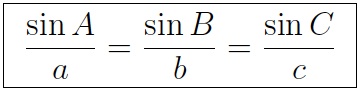
For a triangle with sides , , and opposite angles , , :
Law of Cosines

Use the Law of Cosines when you know two sides and the included angle, or all three sides. Use the Law of Sines when you have an angle paired with its opposite side. Both are useful for analyzing the triangle made by two vectors and their resultant.
How to Use This on the AP Precalculus Exam
Unit 4 is not tested on the AP Precalculus exam, so you will not see vector questions on the official test. The practice below helps you build fluency for class assessments and later courses.
Problem Solving
- Read carefully whether a vector is given by two endpoints or by a magnitude and angle. Use , for endpoints, and , for magnitude and angle.
- Keep components in order. Mixing up and changes both the magnitude and the direction.
- For perpendicularity, compute the dot product first. If it is 0, the vectors are perpendicular, and you do not need to find the actual angle.
- When finding a unit vector, compute the magnitude first, then multiply each component by its reciprocal. Check your answer by confirming the new magnitude is 1.
Common Trap
- A scalar times a vector is still a vector, but a dot product of two vectors is a scalar. Watch what type of object your answer should be.
- Magnitude is always nonnegative because of the square root, even when components are negative.
Common Misconceptions
- Misconception: A vector is just its length.Actually: A vector is not just its length. Two vectors with the same magnitude can point in different directions, which makes them different vectors.
- Misconception: Component order does not matter.Actually: Component order matters. means horizontal change and vertical change . Swapping them gives a different vector.
- Misconception: The dot product is a vector.Actually: The dot product is a number, not a vector. Its sign tells you whether vectors point in generally similar or opposite directions, and a value of 0 means perpendicular.
- Misconception: A zero dot product means a zero vector.Actually: A zero dot product does not mean a zero vector. It means the two vectors are perpendicular, as long as neither one is the zero vector.
- Misconception: Scaling by a negative number does not flip direction.Actually: Scaling by a negative number flips direction. The result stays parallel to the original, but it points the opposite way.
- Misconception: A unit vector means rounding to length 1.Actually: Unit vector does not mean rounding to length 1. You divide by the exact magnitude, so the components are usually not whole numbers.
Related AP Precalculus Guides
Practice Questions for 4.8
1 of 10
A table displays the dot products of an unknown vector with three known vectors. In Row 1, vector and the dot product . In Row 2, vector and the dot product . In Row 3, vector and the dot product . What is the value of in the third row of the table?
A.
The value of in the table is exactly .
B.
The value of in the table is exactly .
C.
The value of in the table is exactly .
D.
The value of in the table is exactly .
Vocabulary
The following words are mentioned explicitly in the AP® course framework for this topic.Term | Definition |
|---|---|
angle measure | The input value in a polar function that represents the direction from the positive x-axis, typically measured in radians or degrees. |
components | The horizontal (a) and vertical (b) values of a vector, where a = x₂ - x₁ and b = y₂ - y₁. |
directed line segment | A line segment with a specified direction from a starting point to an ending point. |
direction | The orientation of a vector, which is parallel to the line segment from the origin to the point with coordinates (a, b). |
dot product | A scalar quantity obtained by multiplying the magnitudes of two vectors and the cosine of the angle between them; equals zero when vectors are perpendicular. |
head | The ending point or tip of a vector. |
Law of Cosines | A relationship used to find side lengths or angle measures in a triangle when given other side lengths and angles. |
Law of Sines | A relationship stating that the ratio of a side length to the sine of its opposite angle is constant for all sides and angles in a triangle. |
magnitude | The length of a vector, calculated as the square root of the sum of the squares of its components. |
parallel vectors | Vectors that have the same or opposite direction, resulting from scalar multiplication of a vector by a constant. |
perpendicular | Two vectors are perpendicular when the angle between them is 90 degrees, indicated by a dot product of zero. |
scalar multiplication | The multiplication of a constant (scalar) by a vector, resulting in a new vector whose components are each multiplied by that constant. |
standard basis vectors | The unit vectors →i = ⟨1, 0⟩ and →j = ⟨0, 1⟩ that point in the positive x and y directions, respectively, in ℝ². |
tail | The starting point or beginning of a vector. |
unit vector | A vector with a magnitude of 1, often used to indicate direction. |
vector | A mathematical object with both magnitude and direction, represented as an ordered pair of components in ℝ². |
vector addition | The process of combining two or more vectors to produce a resultant vector. |
vector sum | The addition of two vectors by adding their corresponding components to produce a new vector. |
zero vector | A vector with components ⟨0, 0⟩ that occurs when the tail and head are at the same point. |
Frequently Asked Questions
What is a vector in AP Precalculus?
A vector is a directed line segment with magnitude and direction. In the plane, it can be written in component form as .
How do you find vector components from two points?
For a vector from P1 = (x1, y1) to P2 = (x2, y2), subtract coordinates: a = x2 - x1 and b = y2 - y1. The vector is .
How do you find the magnitude of a vector?
For a vector , the magnitude is the square root of a squared plus b squared. This comes from the distance formula in the coordinate plane.
What is scalar multiplication of a vector?
Scalar multiplication multiplies each component by the same constant. The new vector stays parallel to the original, and a negative scalar reverses its direction.
What is the dot product used for?
The dot product adds the products of corresponding components. It can also test perpendicularity: two nonzero vectors are perpendicular when their dot product is zero.
How do you find a unit vector?
A unit vector has magnitude 1. For a nonzero vector, divide each component by the vector's magnitude to get a unit vector in the same direction.
See Fiveable more often in Google
Mark Fiveable as a preferred source and Google is more likely to show you our guides in Top Stories, with a "preferred" badge in AI Mode and AI Overviews.