2.11 Logarithmic Functions

📈AP Precalculus Unit 2 Review
2.11 Logarithmic Functions
📈 AP Precalculus
2.1
Change in Arithmetic and Geometric Sequences
2.2
Change in Linear and Exponential Functions
2.3
Exponential Functions
2.4
Exponential Function Manipulation
2.5
Exponential Function Context and Data Modeling
2.6
Competing Function Model Validation
2.7
Composition of Functions
2.8
Inverse Functions
2.9
Logarithmic Expressions
2.10
Inverses of Exponential Functions
2.11
Logarithmic Functions
2.12
Logarithmic Function Manipulation
2.13
Exponential and Logarithmic Equations and Inequalities
2.14
Logarithmic Function Context and Data Modeling
2.15
Semi-log Plots
What are logarithmic functions in AP Precalculus?
A logarithmic function in general form has a domain of all real numbers greater than zero and a range of all real numbers. Because it is the inverse of an exponential function, it is always increasing or always decreasing, always concave up or always concave down, has a vertical asymptote at , and has no extrema (except possibly on a closed interval) and no inflection points.
Why This Matters for the AP Precalculus Exam
This topic builds the function-analysis skills you use all through Unit 2 and beyond. Once you can identify a logarithmic function's domain, range, increasing/decreasing behavior, concavity, asymptote, and end behavior, you can match graphs to equations, describe key features, and reason about transformations. The natural log and common log show up again when you manipulate logarithmic expressions, solve exponential and logarithmic equations, and build models from data.
On the exam, expect to recognize logarithmic functions across graphs, tables, and equations and to describe their features precisely. Some multiple-choice and free-response questions allow a graphing calculator for evaluating logs and analyzing graphs, but you should be able to reason about these characteristics without one. When you show work, write limits and domain restrictions clearly so your reasoning is easy to follow.
Key Takeaways
- The domain of is and the range is all real numbers.
- Logarithmic functions are inverses of exponential functions, so they are always increasing or always decreasing.
- Their graphs are always concave up or always concave down, so they have no inflection points and no extrema except possibly on a closed interval.
- There is a vertical asymptote at , and the end behavior is unbounded.
- For a function , if the input values of are proportional over equal-length output-value intervals, then is logarithmic.
- A logarithmic graph is the reflection of its matching exponential graph over the line .
Key Characteristics of Logarithmic Functions
Now that you have seen how logarithmic functions connect to exponential functions, here are the features you need to identify and describe.
Domain and Range
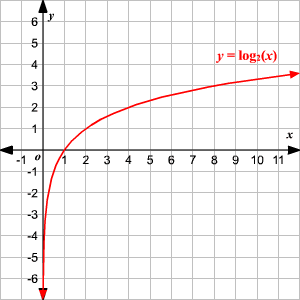
The domain of a logarithmic function in general form, written as , is any real number greater than zero (). This is because the logarithm of a negative number or zero is undefined. The range of a logarithmic function is all real numbers.
Extrema, Concavity, and Inflection Points
Because logarithmic functions are inverses of exponential functions, their properties are closely tied to the properties of exponential functions.
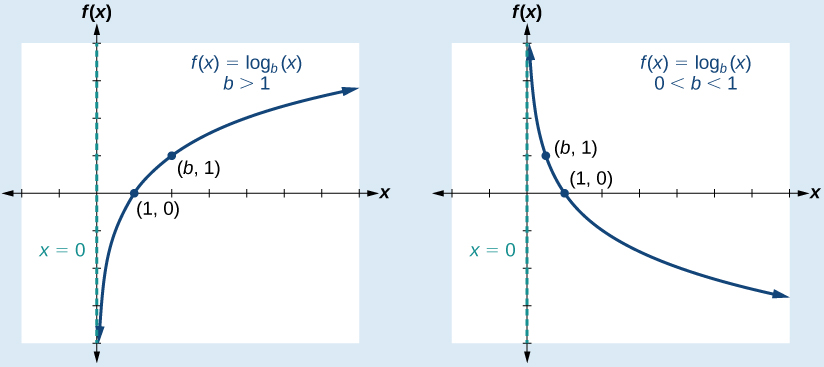
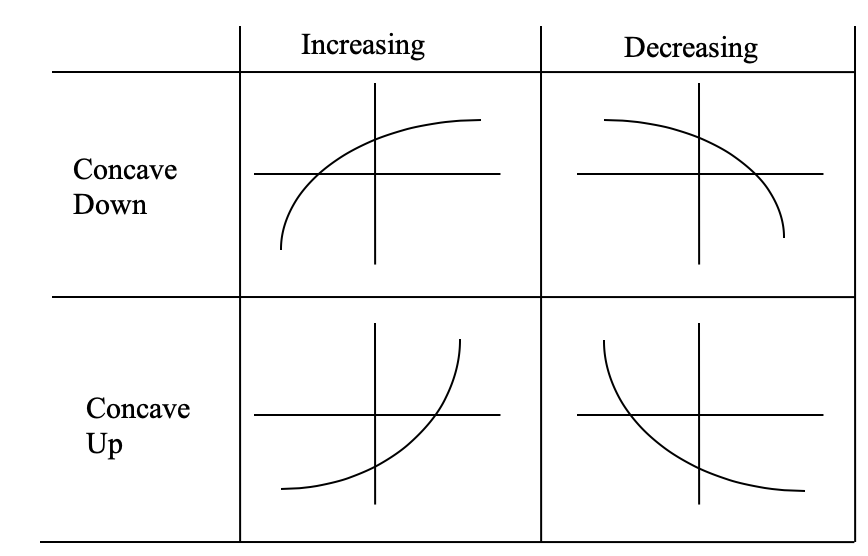
If an exponential function is increasing, its inverse logarithmic function is also increasing, and if an exponential function is decreasing, its inverse is also decreasing. This means the graph of a logarithmic function is always increasing or always decreasing, never both.
The graph of a logarithmic function is also always concave up or always concave down.
Because of this, logarithmic functions do not have extrema except on a closed interval, and their graphs do not have inflection points. There is no change in direction of increase/decrease and no change in concavity.
Additive Transformation Function g(x) = f(x + k)
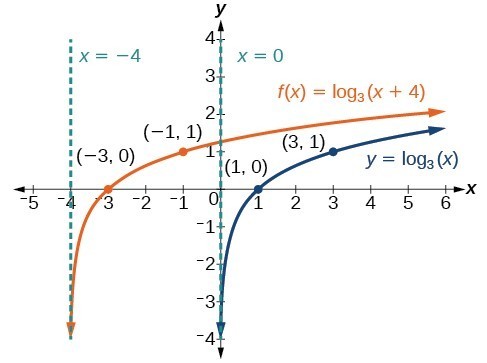
The additive transformation function shifts the graph of horizontally by a fixed amount . For a logarithmic function , this gives .
The additive transformation of a logarithmic function in general form does not keep input values proportional over equal-length output-value intervals. So that shifted function is not itself a logarithmic function in general form.
The useful direction works as a test: if the input values of are proportional over equal-length output-value intervals, then the original function is logarithmic. This proportional spacing of inputs is a defining behavior of logarithmic functions.
Limits and Asymptotes
With their limited domain, logarithmic functions in general form are vertically asymptotic to . As the input approaches zero from the right, the output approaches positive or negative infinity. The logarithm of a very small positive number is a very large negative number, and the logarithm of a very large number is a very large positive number.
The end behavior is unbounded. As grows without bound, the output also grows or falls without bound. In limit notation:
The sign depends on the value of and whether or .

How to Use This on the AP Precalculus Exam
MCQ
- Match a logarithmic graph to its equation by checking the vertical asymptote, the direction (increasing or decreasing), and the concavity.
- Use the domain to rule out answer choices quickly. Any input value of zero or less is not in the domain of a general-form logarithmic function.
- Remember the reflection link: a logarithmic graph and its matching exponential graph are reflections over the line .
Free Response
- State the domain and range explicitly when asked to describe key features.
- Write end behavior with correct limit notation, and make sure the sign matches the values of and .
- When you describe increasing/decreasing or concavity, justify it instead of just naming it, since clear reasoning is important for clear exam work.
Common Trap
- Do not claim a logarithmic function has a maximum or minimum on its full domain. Extrema only appear when the domain is restricted to a closed interval.
- The vertical asymptote of is at . A horizontal shift moves that asymptote to , so check the shift before stating the asymptote.
Common Misconceptions
- Misconception: Logarithmic functions have a horizontal asymptote.Actually: They have a vertical asymptote at , not a horizontal one. Their end behavior as is unbounded, so the output keeps growing or falling.
- Misconception: The domain is all real numbers.Actually: The domain of a general-form logarithmic function is only . The range, not the domain, is all real numbers.
- Misconception: Logs can flatten out and have an inflection point.Actually: A general-form logarithmic graph keeps the same concavity throughout, so there is no inflection point.
- Misconception: A logarithm always increases.Actually: It is always increasing or always decreasing, depending on the sign of and whether or . A reflection across the x-axis (negative ) flips the direction.
- Misconception: Shifting a log left or right makes it stop being a log.Actually: A horizontal shift moves the graph and its asymptote, but it does not change the basic shape. The general-form proportional-spacing property is what the shifted-function test checks for.
Related AP Precalculus Guides
Practice Questions for 2.11
1 of 10
| x | g(x) |
|---|---|
| 5 | 1 |
| 25 | 2 |
| 125 | 3 |
| 625 | 4 |
The table above gives selected values of a function g.
Which of the following describes the relationship between and the exponential function ?
A.
is an additive transformation of , and is a logarithmic function.
B.
is the inverse of , and is a logarithmic function.
C.
is the inverse of , and is a rational function.
D.
is the reciprocal of , and is an exponential function.
Vocabulary
The following words are mentioned explicitly in the AP® course framework for this topic.Term | Definition |
|---|---|
additive transformation | A transformation of a function involving addition or subtraction, resulting in vertical and horizontal translations. |
concave down | A characteristic of a graph where the rate of change is decreasing, creating a curve that opens downward. |
concave up | A characteristic of a graph where the rate of change is increasing, creating a curve that opens upward. |
decreasing function | A function over an interval where output values always decrease as input values increase. |
domain | The set of all possible input values for which a function is defined. |
end behavior | The behavior of a function as the input values approach positive or negative infinity. |
exponential function | A function of the form f(x) = ab^x where a ≠ 0 is the initial value and b > 0, b ≠ 1 is the base. |
extremum | Maximum or minimum points on a function; logarithmic functions do not have extrema except on closed intervals. |
increasing function | A function over an interval where output values always increase as input values increase. |
inverse function | A function that reverses the mapping of another function, such that if f(x) = y, then f⁻¹(y) = x. |
logarithmic function | A function of the form f(x) = a log_b x where b > 0, b ≠ 1, and a ≠ 0, characterized by output values changing additively as input values change multiplicatively. |
point of inflection | A point on the graph of a polynomial where the concavity changes from concave up to concave down or vice versa, occurring where the rate of change changes from increasing to decreasing or decreasing to increasing. |
range | The set of all possible output values that a function can produce. |
vertical asymptote | A vertical line x = a where the graph of a rational function approaches infinity or negative infinity as the input approaches a. |
Frequently Asked Questions
What are logarithmic functions in AP Precalculus?
A logarithmic function is the inverse of an exponential function. In general form, f(x) = a log_b(x) has domain x > 0, range all real numbers, and a vertical asymptote at x = 0.
What is the domain and range of a logarithmic function?
For a logarithmic function in general form, the domain is x > 0 and the range is all real numbers. The input must be positive.
What asymptote does a logarithmic function have?
The general-form logarithmic function has a vertical asymptote at x = 0. If the function is shifted horizontally, the asymptote shifts too.
Are logarithmic functions increasing or decreasing?
A logarithmic function is always increasing or always decreasing, depending on the sign of a and the base b. It does not switch direction across its full domain.
Do logarithmic functions have extrema or inflection points?
In general form, logarithmic functions have no extrema on their full domain and no inflection points because they keep one direction of change and one concavity.
What is a common AP Precalculus mistake with logarithmic functions?
A common mistake is saying the domain is all real numbers. For general-form logs, the input must be positive, so the domain is x > 0.
See Fiveable more often in Google
Mark Fiveable as a preferred source and Google is more likely to show you our guides in Top Stories, with a "preferred" badge in AI Mode and AI Overviews.