2.2 Change in Linear and Exponential Functions

📈AP Precalculus Unit 2 Review
2.2 Change in Linear and Exponential Functions
📈 AP Precalculus
2.1
Change in Arithmetic and Geometric Sequences
2.2
Change in Linear and Exponential Functions
2.3
Exponential Functions
2.4
Exponential Function Manipulation
2.5
Exponential Function Context and Data Modeling
2.6
Competing Function Model Validation
2.7
Composition of Functions
2.8
Inverse Functions
2.9
Logarithmic Expressions
2.10
Inverses of Exponential Functions
2.11
Logarithmic Functions
2.12
Logarithmic Function Manipulation
2.13
Exponential and Logarithmic Equations and Inequalities
2.14
Logarithmic Function Context and Data Modeling
2.15
Semi-log Plots
Linear functions () work like arithmetic sequences: you start with an initial value and repeatedly add a constant rate of change. Exponential functions () work like geometric sequences: you start with an initial value and repeatedly multiply by a constant factor. In AP Precalculus, this comparison helps you decide whether data changes by a constant difference or a constant ratio.
Why This Matters for the AP Precalculus Exam
This topic connects the sequences you studied in 2.1 to the continuous functions that fill the rest of Unit 2 and beyond. Being able to switch between linear and exponential thinking sets you up for exponential modeling, regressions, and comparing competing models later in the unit. On the AP Precalculus exam, you may see this idea on both multiple-choice and free-response questions, where you decide whether data changes at a constant rate (linear) or proportionally (exponential), then build the matching function. Showing clear steps when you set up and solve for a slope or base is important for clear exam work, since answers without supporting work may not support a stronger score on free-response.
Key Takeaways
- A linear function mirrors an arithmetic sequence : same initial value plus repeated addition of a constant.
- An exponential function mirrors a geometric sequence : same initial value times repeated multiplication by a constant.
- Over equal-length input intervals, constant change in output means linear; proportional change in output means exponential.
- Point-based forms let you build either function from a known point: for linear, for exponential.
- Any of these four (arithmetic sequence, linear function, geometric sequence, exponential function) can be pinned down from two distinct values.
- A sequence and its matching function can have different domains: sequences live on whole numbers, while functions are usually defined on all real numbers.
Arithmetic Sequence Lookalikes: Linear Functions
A linear function has the form , where is the y-intercept (the point where the line crosses the y-axis) and is the slope (the constant rate of change). A positive slope means the line rises, a negative slope means it falls, and a slope of 0 means it is horizontal.
Recall that an arithmetic sequence is a list of numbers where the difference between consecutive terms is always the same. It can be written as , where is the initial term and is the common difference. You generate the sequence by adding to the previous term.
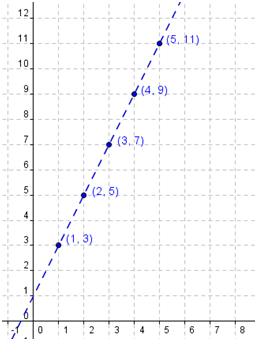
Both linear functions and arithmetic sequences can be described as an initial value plus repeated addition of a constant rate of change. In a linear function, the initial value is the y-intercept and the constant rate of change is the slope . In an arithmetic sequence, the initial value is the first term and the constant rate of change is the common difference .
Because of this shared structure, both can model situations with a constant rate of change.
Point-Based Form for Linear Functions
Just like arithmetic sequences, linear functions can also be built from a known point and a constant rate of change. In an arithmetic sequence, the known value is the kth term and the rate of change is the common difference . In a linear function, the known value is a point and the rate of change is the slope .
The point-slope form of a linear function, , and the explicit formula of an arithmetic sequence, , both let you find a value from one known value plus a constant rate of change.
The formulas look alike, but they describe different things: linear functions are continuous functions, while arithmetic sequences are discrete sequences.
Geometric Sequence Lookalikes: Exponential Functions
An exponential function has the variable in the exponent rather than the base. Its general form is , where is the initial value and is the base (a positive number not equal to 1). Depending on the value of , this models exponential growth or decay.
Recall that a geometric sequence is a list of numbers where the ratio between consecutive terms is always the same. It can be written as , where is the initial term and is the common ratio. You generate the sequence by multiplying the previous term by .
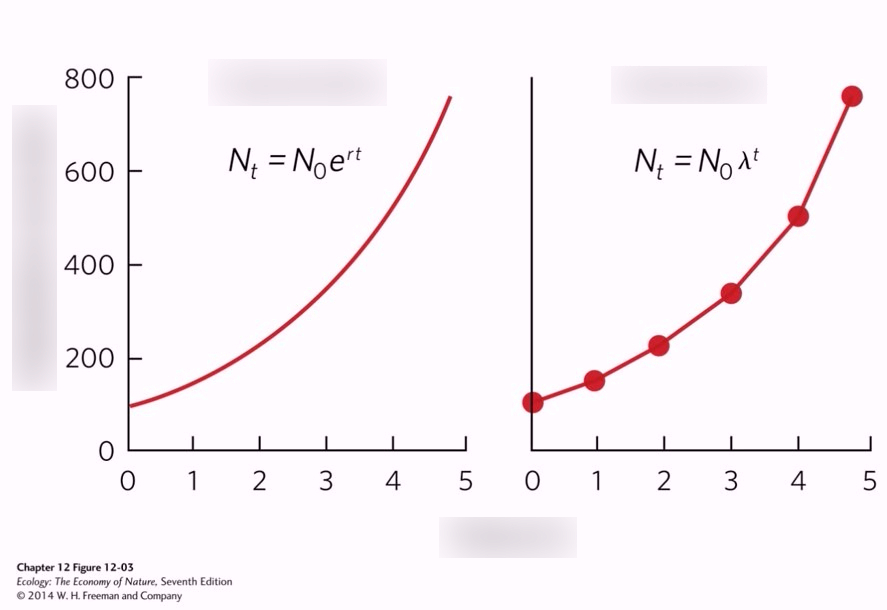
Both exponential functions and geometric sequences can be described as an initial value times repeated multiplication by a constant ratio. In an exponential function, the initial value is and the constant ratio is the base . In a geometric sequence, the initial value is the first term and the constant ratio is the common ratio .
Because of this, both can model situations with exponential growth or decay, such as compound interest, population growth, and radioactive decay.
Point-Based Form for Exponential Functions
Like geometric sequences, exponential functions can also be built from a known value and a constant ratio. In a geometric sequence, the known value is the kth term and the ratio is the common ratio . In an exponential function, the known value is a point and the ratio is .
The point-based form of an exponential function, , and the explicit formula of a geometric sequence, , both let you find a value from one known value plus a constant ratio.
Again, similar-looking formulas describe different things: functions are not the same as sequences.
Caveats of Sequence vs. Function: Domains
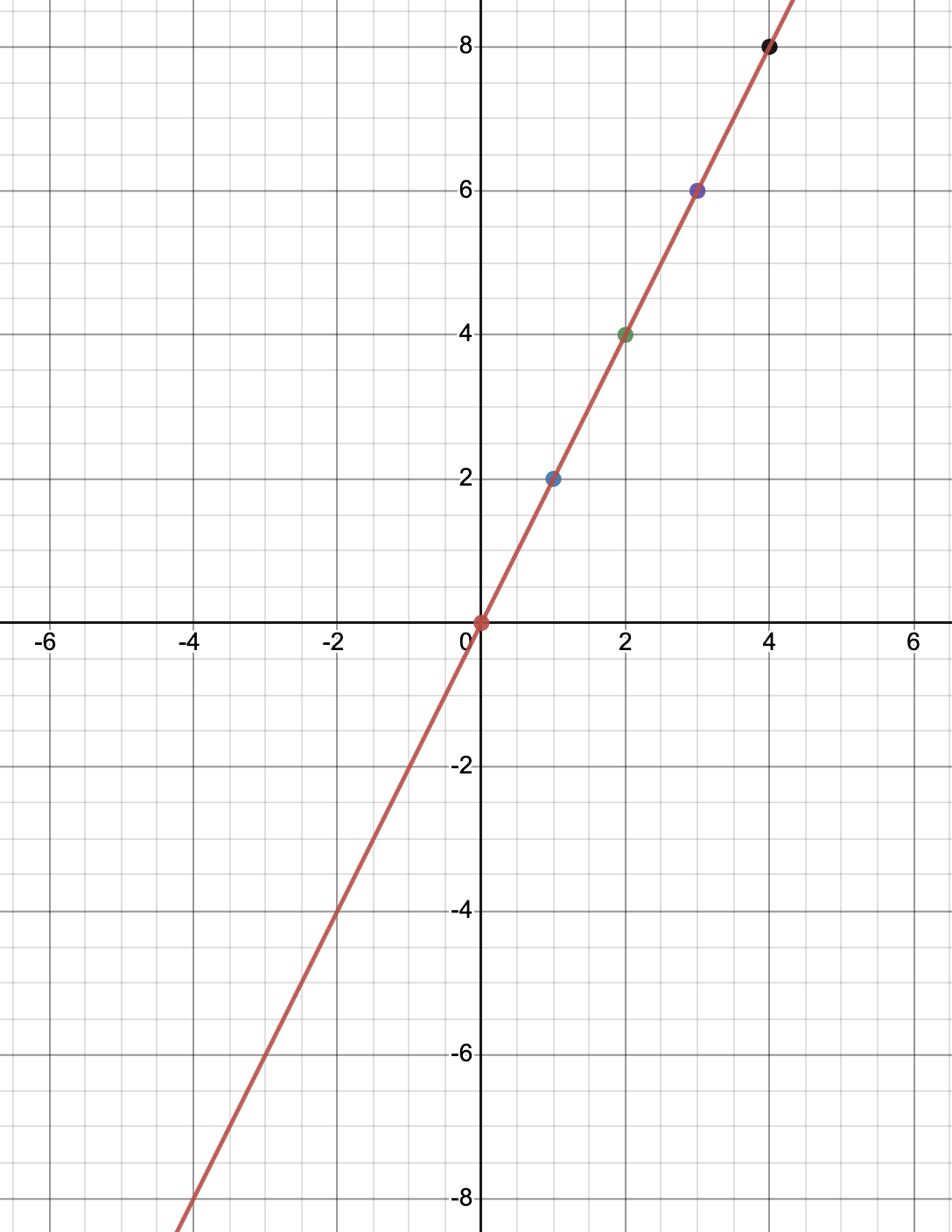
Sequences and their matching functions may have different domains. The domain of a sequence is typically the whole numbers, while the domain of a function can be any set of real numbers. For example, the sequence has a domain of whole numbers, but the corresponding function has a domain of all real numbers.
In the image below, notice how the function (red line) includes values on the negative x-axis, while the sequence (dots) is limited to what comes at or after 0.
The same idea applies to exponential cases. The sequence has a domain of whole numbers, while the corresponding function is defined for all real numbers.
A sequence can also be defined with a recursive formula, which gives the nth term in terms of earlier terms. In that case the sequence's domain may be limited to the whole numbers for which the formula works. A corresponding function can cover a wider domain using an explicit formula that connects the term to the input variable.
Similarities and Differences
1. Over equal-length input-value intervals, look at how the output values change:
- Change at a constant rate: the function is linear. The difference between output values stays the same across equal input steps.
- Change proportionally: the function is exponential. The ratio between output values stays the same across equal input steps.
2. Both forms use an initial value and a constant involved with change.
- In a linear function , the initial value is the y-intercept and the constant is the slope .
- In an exponential function , the initial value is and the constant is the base .
The big difference: linear functions are based on addition, while exponential functions are based on multiplication.
3. Arithmetic sequences, linear functions, geometric sequences, and exponential functions can each be determined by two distinct values.
- Arithmetic sequence: a known term plus the common difference (or two terms).
- Linear function: a point plus the slope (or two points).
- Geometric sequence: a known term plus the common ratio (or two terms).
- Exponential function: a point plus the base (or two points).
How to Use This on the AP Precalculus Exam
MCQ
When you see a table of values, check the change between equal input steps before picking an answer. If the outputs go up by the same amount each step, the data is linear and you want . If the outputs are multiplied by the same factor each step, the data is exponential and you want . Confusing constant difference with constant ratio is the most common trap here.
Problem Solving
To build a function from two points and :
- For a linear function, find the slope , then use point-slope form .
- For an exponential function, find the ratio with , then plug a known point into to solve for .
Write your steps clearly when solving for a slope or base. Answers without supporting work may not support a stronger score on free-response.
Common Trap
Watch the domain. If a problem describes a sequence (whole-number inputs only), do not treat it as a continuous function, and do not connect the points into a smooth curve unless the problem actually gives you a function of the real numbers.
Common Misconceptions
- Misconception: Constant difference is the same as constant ratio.Actually: Constant difference is not the same as constant ratio. Linear functions add the same amount each step; exponential functions multiply by the same factor each step. Check which one a data set actually shows before choosing a model.
- Misconception: A sequence and its matching function are identical.Actually: A sequence and its matching function are not identical. They may share a formula structure, but sequences are defined on whole numbers (discrete points), while functions are usually defined on all real numbers (a smooth curve).
- Misconception: The base in is a slope.Actually: The base in is a multiplier, not a slope. It tells you the factor of change per unit, not a constant amount added.
- Misconception: You need a full table to build these functions.Actually: You do not need a full table to build these functions. Two distinct values are enough to determine a linear function, an exponential function, an arithmetic sequence, or a geometric sequence.
- Misconception: In point-slope and point-based forms, is the initial value at .Actually: In point-slope and point-based forms, is a known point, not the initial value at . Do not assume is the y-intercept unless .
Related AP Precalculus Guides
Practice Questions for 2.2
1 of 10
The graph of the exponential function is shown above.
A geometric sequence is defined such that for all integers . Which of the following defines ?
A.
B.
C.
D.
Vocabulary
The following words are mentioned explicitly in the AP® course framework for this topic.Term | Definition |
|---|---|
arithmetic sequence | A sequence where each term after the first is found by adding a fixed number called the common difference to the previous term. |
common difference | The constant difference between successive terms in an arithmetic sequence, denoted by d. |
common ratio | The constant factor by which each term in a geometric sequence is multiplied to obtain the next term. |
constant rate | A rate of change that remains the same across all intervals; for quadratic functions, the rate at which average rates of change are changing. |
domain | The set of all possible input values for which a function is defined. |
exponential function | A function of the form f(x) = ab^x where a ≠ 0 is the initial value and b > 0, b ≠ 1 is the base. |
geometric sequence | A sequence where each term after the first is found by multiplying the previous term by a fixed number called the common ratio. |
initial value | The starting value of a function, represented by b in linear functions and a in exponential functions. |
linear function | A polynomial function of degree 1 with the form f(x) = mx + b, representing a constant rate of change. |
point-slope form | A way of expressing linear functions as f(x) = y_i + m(x - x_i) based on a known slope and a point on the line. |
proportional change | Output values that change by a constant factor or ratio over equal-length input intervals, characteristic of exponential functions. |
slope | The rate of change of a line, representing how much the output changes for each unit change in the input. |
Frequently Asked Questions
What is AP Precalculus 2.2 about?
AP Precalculus 2.2 is about comparing change in linear and exponential functions. Linear functions change by repeated addition of a constant rate, while exponential functions change by repeated multiplication by a constant factor.
How can I tell whether data is linear or exponential?
Over equal input intervals, linear data changes by a constant difference in output values. Exponential data changes by a constant ratio or percent change in output values. If you add the same amount each step, think linear; if you multiply by the same factor each step, think exponential.
What are point-based forms for linear and exponential functions?
A linear function through a known point can be written as $f(x)=y_i+m(x-x_i)$. An exponential function through a known point can be written as $f(x)=y_i r^{x-x_i}$. These forms are useful when a problem gives one point and a slope or ratio.
What should I watch for on the AP Precalculus exam?
Watch whether the problem describes constant additive change or constant ratioal change. Also check the domain: sequences use integer inputs, while functions usually use real-number inputs. Showing how you found the slope or ratio helps make your reasoning clear.
See Fiveable more often in Google
Mark Fiveable as a preferred source and Google is more likely to show you our guides in Top Stories, with a "preferred" badge in AI Mode and AI Overviews.