4.7 Parametrization of Implicitly Defined Functions

📈AP Precalculus Unit 4 Review
4.7 Parametrization of Implicitly Defined Functions
📈 AP Precalculus
4.1
Parametric Functions
4.2
Parametric Functions Modeling Planar Motion
4.3
Parametric Functions and Rates of Change
4.4
Parametrically Defined Circles and Lines
4.5
Implicitly Defined Functions
4.6
Conic Sections
4.7
Parametrization of Implicitly Defined Functions
4.8
Vectors
4.9
Vector-Valued Functions
4.10
Matrices
4.11
The Inverse and Determinant of a Matrix
4.12
Linear Transformations and Matrices
4.13
Matrices as Functions
4.14
Matrices Modeling Contexts
Parametrizing an implicitly defined function means rewriting a curve like as a pair of equations and that both depend on a parameter . A correct parametrization, when you substitute and back into the original equation, satisfies that equation for every in the domain.
Why This Matters for the AP Precalculus Exam
Unit 4 topics, including this one, are not assessed on the AP Precalculus Exam. The exam covers material from Units 1, 2, and 3. Whether you study Unit 4 depends on your school's course plan.
That said, parametrizing implicitly defined functions is still worth learning. It pulls together skills from earlier in Unit 4 (parametric functions, implicitly defined functions, and conic sections) and builds reasoning you will use in calculus, physics, and computer graphics. If your class covers this topic, you may use a graphing calculator to graph parametric curves, so practice setting viewing windows and parameter restrictions.
Key Takeaways
- A parametrization writes a curve as , where both coordinates depend on a parameter .
- A parametrization is correct only if substituting and into the original equation makes it true for every in the domain.
- For , the simplest parametrization is . If is invertible, its inverse can be written as .
- A parabola is parametrized by solving for one variable: solve for to get , or solve for to get .
- An ellipse centered at is parametrized by and for .
- A hyperbola uses secant and tangent: which one goes with versus depends on whether it opens left-right or up-down.
Representing Curves in the Plane Parametrically
A parametrization expresses a curve as a set of equations and that both depend on a parameter . When you substitute these into the equation that defines the curve implicitly, they should satisfy the equation for every value of in the domain.
For example, the equation describes the unit circle centered at the origin. A parametrization of this circle is with domain . Substituting into the implicit equation gives , which is always true.
The key point is that a parametrization gives a specific way to write the curve, in terms of a set of equations, that satisfies the implicit equation for every value of the parameter in the domain.
Functions and Their Inverses
If is a function of and is the graph of , then the curve can be parametrized as , where and . You can picture this as moving along the x-axis: at each input , you plot the point on the graph of .
When is invertible, it has an inverse function . The inverse can be parametrized as for an appropriate interval of . Notice that the roles of the two coordinates are swapped.
One detail to watch: the domain of for the inverse parametrization comes from the range of the original function.
Representing Conic Sections Parametrically
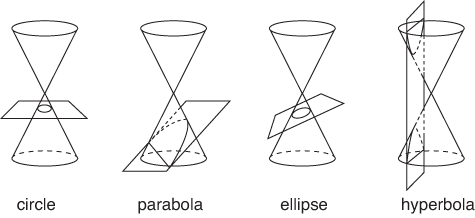
In Topic 4.6, you saw conic sections, the shapes created by intersecting a plane and a cone, such as circles, ellipses, parabolas, and hyperbolas. Each type has its own standard equation and properties. Here is how to parametrize each one.
Parabolas
A parabola, like any equation involving two variables, can be written in parametric form. The approach is to solve for one variable and let the parameter stand in for the other.
If the equation can be solved for , parametrize it as , where is expressed in terms of and is just .
If the equation can be solved for , parametrize it as , where is expressed in terms of and is just .
Either way, the parabola is represented as a set of points that satisfy the original equation for different values of in the domain.
Ellipses
An ellipse centered at can be parametrized by:
where is the horizontal radius and is the vertical radius. The domain is , which traces a complete counterclockwise revolution. These trigonometric equations let you express the position of a point on the ellipse at any angle .
Hyperbolas
A hyperbola can also be parametrized using trigonometric functions, but the setup depends on the direction it opens.
For a hyperbola centered at that opens left and right, use:
for .
For a hyperbola centered at that opens up and down, use:
for .
Remember that and that , so these parametrizations are undefined wherever .
How to Use This on the AP Precalculus Exam
Unit 4 is not tested on the AP Precalculus Exam, so treat the steps below as practice for class assessments and as preparation for calculus.
Problem Solving
- To parametrize , set and . To parametrize an invertible function's inverse, swap to .
- For a conic, first identify the center and the values of and from the standard equation, then plug into the right trig template.
- Match the hyperbola template to its orientation. Left-right opening pairs with and with ; up-down opening pairs with and with .
How to Check Your Work
- Substitute and back into the original equation. A correct parametrization makes the equation true for every in the domain.
- For the ellipse, the identity confirms the parametrization. For the hyperbola, does the same job.
- Confirm the parameter interval covers the full curve and does not include values where the functions are undefined.
Technology
- When graphing a parametric curve, set an appropriate viewing window and a parameter range for . Without the right interval, you may see only part of the curve or an unexpected direction of travel.
Common Misconceptions
- Misconception: A parametrization is unique.Actually: A parametrization is not unique. The same curve can be written with different equations and can even be traced in different directions, so your answer may look different from a classmate's and still be correct.
- Misconception: Just having two equations that depend on guarantees they trace the right curve.Actually: Substituting back into the original equation is what proves a parametrization works. Just having two equations that depend on does not guarantee they trace the right curve.
- Misconception: For an inverse function, the parameter domain comes from the domain of the original function.Actually: For an inverse function, the parameter domain comes from the range of the original function, not its domain. Reusing the original domain can produce the wrong piece of the curve.
- Misconception: The trig pairing is the same whether the hyperbola opens left-right or up-down.Actually: The hyperbola templates are easy to mix up. The trig pairing depends on whether the hyperbola opens left-right or up-down, so check the orientation before you write or .
- Misconception: A hyperbola parametrization has no gaps in .Actually: Secant and tangent are undefined where , so a hyperbola parametrization has gaps in . Treating the interval as fully continuous will give you incorrect points.
Related AP Precalculus Guides
Practice Questions for 4.7
1 of 10
A particle moves along an ellipse such that its position at time is recorded in a table. At , the particle is at . At , it is at . At , it is at . Which parametrization and justification best match this data?
A.
and , because the initial point is and the vertical displacement at is exactly .
B.
and , because the initial point is and the horizontal displacement at is exactly .
C.
and , because the center is and the horizontal displacement at is exactly .
D.
and , because the center is and the vertical displacement at is exactly .
Vocabulary
The following words are mentioned explicitly in the AP® course framework for this topic.Term | Definition |
|---|---|
conic sections | Curves formed by the intersection of a plane with a cone, including parabolas, ellipses, circles, and hyperbolas. |
domain | The set of all possible input values for which a function is defined. |
ellipse | A conic section formed when a plane intersects a cone at an angle, or the set of points where the sum of distances to two foci is constant. |
hyperbola | A conic section formed when a plane intersects both nappes of a cone, or the set of points where the difference of distances to two foci is constant. |
implicitly defined function | A function defined by an equation relating x and y, rather than explicitly solving for y in terms of x. |
inverse function | A function that reverses the mapping of another function, such that if f(x) = y, then f⁻¹(y) = x. |
invertible function | A function that has an inverse function; a one-to-one function where each output corresponds to exactly one input. |
parabola | A conic section formed when a plane intersects a cone parallel to its side, or the set of points equidistant from a focus and directrix. |
parameter | An independent variable (often denoted t) used to express the coordinates of points on a curve in parametric form. |
parametric equations | A pair of equations that express x and y coordinates as functions of a parameter, typically written as x(t) and y(t). |
parametrization | A representation of a curve using a pair of functions (x(t), y(t)) where both x and y are expressed in terms of a parameter t. |
trigonometric parametrization | A method of representing curves using trigonometric functions (such as sine, cosine, secant, and tangent) as the parametric equations. |
Frequently Asked Questions
What does parametrization mean in AP Precalculus?
Parametrization means representing a curve with two coordinate functions, x(t) and y(t), both written in terms of a parameter t. A correct parametrization satisfies the original equation for every allowed value of t.
How do you check a parametrization?
Substitute x(t) and y(t) into the original equation. If the equation is true for every value of t in the domain, the parametrization works for that curve.
When do you use (t, f(t)) versus (f(t), t)?
Use (t, f(t)) when the curve is solved for y as y = f(x). Use (f(t), t) when the curve is solved for x as x = f(y), or when parametrizing the inverse of an invertible function on an appropriate interval.
How do you parametrize an ellipse?
An ellipse centered at (h, k) can be parametrized as x(t) = h + a cos t and y(t) = k + b sin t for 0 <= t <= 2pi, where a and b are the horizontal and vertical radii.
How do you parametrize a hyperbola?
For a left-right hyperbola centered at (h, k), use x(t) = h + a sec t and y(t) = k + b tan t. For an up-down hyperbola, use x(t) = h + a tan t and y(t) = k + b sec t.
Is parametrization the same as implicit differentiation?
No. Parametrization rewrites a curve using x(t) and y(t). Implicit differentiation finds a derivative from an equation involving x and y. The two topics can involve implicit curves, but they answer different questions.
See Fiveable more often in Google
Mark Fiveable as a preferred source and Google is more likely to show you our guides in Top Stories, with a "preferred" badge in AI Mode and AI Overviews.